Click here to open 'USArmyGermany' frameset
| MAPS | MILCOM | Related Links |

Wonderful aerial view of the Reichel Building, sometime after it was released back to the German owners.
(The original photo was posted on the Rheinberg Military Community FB page by Markus Brüggemann)
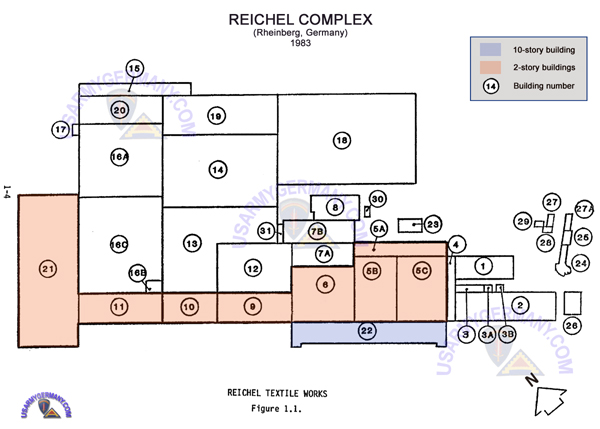
Installation map for Reichel Kaserne, 1983
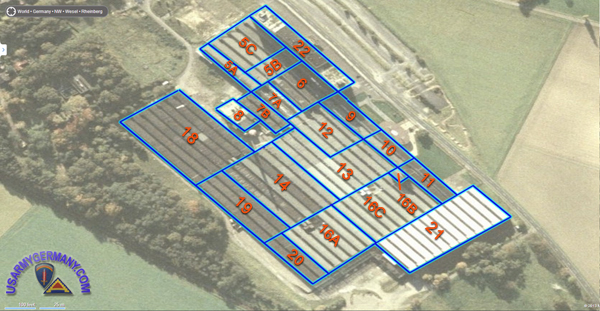
Building numbers superimposed over a BING aerial image (pre-2001) of the Reichel Complex
| Looking for installation maps, photos and information on US Army kasernes in and around Rheinberg. If you have any, please contact the webmaster. |
|
 Reichel Factory (1970s), soon to be Hqs for 54th Area Support Group (German postcard) |

|
||||
 1. Ceremony in gym 1. Ceremony in gym |
 2. Ceremony in gym 2. Ceremony in gym |
 |
|

 1. Bldg 5C? 1. Bldg 5C? |
 2. Bldg 21? 2. Bldg 21? |
 3. Bldg 18 3. Bldg 18 |
 4. Old parking sign 4. Old parking sign |

Bldg 8, the central boiler plant for the Reichel Complex.
 5. Bldg 8 5. Bldg 8 |
 6. Bldg 8 6. Bldg 8 |
 7. Bldg 8 7. Bldg 8 |
 8. Bldg 8 8. Bldg 8 |

Inside one of the warehouses at Reichel Complex

An office within one of the warehouse buildings
 9. Inside warehouse |
 10. Another shot of a warehouse |
 11. Side of office |
 12. Not sure what this is |
 13. Not sure |
 14. Hot water pumps? |
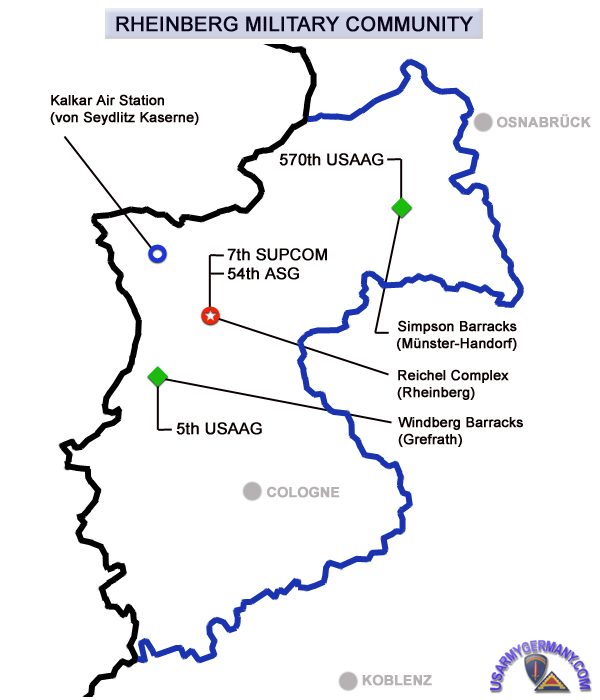
Rheinberg MILCOM area of responibility, early 1980s (Walter Elkins)
(If you have an official Army map that shows the boundaries of the Rheinberg Military Community or an installation
map
of the Reichel Complex from any
time between the early 1980s to the early 1990s, please contact the webmaster.)
 Rheinberg Military Community crest
  |
In a prepared statement presented to the Subcommittee on Military Construction Appropriations during hearings held to consider proposed military construction projects for 1985, the Department of the Army provided their assessment of the need for the purchase of the former Reichel textile factory in Rheinberg, Germany. The statement can be viewed by clicking on the thumbnail to the left. |
|---|
| The report includes some interesting information on Reichel Building and the early days of occupation by US Army units. What follows are some of the details. |
General Description: The 54th Area Support Group has only recently begun leasing major portions of the Reichel Complex in Rheinberg, FRG. This facility is the former headquarters of the Reichel Corporation, a carpet manufacturer, which recently went into the equivalent of bankruptcy. The complex exists of:  Ten-story office tower constructed of precast concrete, approximately 40 percent glazed and having an area of 312,000 square feet. Approximately one million square feet of warehouse/manufacturing space. The majority of this space is constructed of concrete with a barrel vault sawtooth roof having a large north facing skylight. One section is of all metal construction. Central Boiler Plant Building. Ten-story office tower constructed of precast concrete, approximately 40 percent glazed and having an area of 312,000 square feet. Approximately one million square feet of warehouse/manufacturing space. The majority of this space is constructed of concrete with a barrel vault sawtooth roof having a large north facing skylight. One section is of all metal construction. Central Boiler Plant Building.The facility, as of February 1983, is still managed by Reichel (or former Reichel) employees. A portion of the manufacturing area is still in operation under the control of a second carpet maker. The remainder of the manufacturing/warehouse space and part of the office building are unoccupied. This complex was selected to be surveyed because of the possibility that the U. S. Army acquire the property and develop the entire facility. Location: The 54th ASG is located on the southwest edge of the town of Rheinberg, West Germany. Rheinberg is located in far west central Germany near the City of Wesel. Facilities: This facility was built in several stages, there are, therefore, several different types of construction. With the exception of a few minor out buildings, this is one interconnected building. The overall plan, with the present "Building Numbers" is shown in the figure above. There are three (3) major construction categories:  Building 22 is a 10-story office tower with penthouse boardroom. It is constructed of precast concrete and approximately 40 percent glazed. The short dimension is only 65 feet so that with careful layout, cross ventilation can be maintained and no air conditioning is required (or installed). The building is heated with hot water radiators. The southwest facing glass is equipped with external shutters which, when closed, are operable similar to venetian blinds. Buildings 7, 8, and 12 through 20 are single story concrete with a barrel vault sawtooth roof, each bay of which has a large north facing skylight. These are manufacturing/storage spaces. The skylights are double-glazed and provide enough ambient lighting for general use without artificial illumination. Even in the presently active manufacturing space, artificial lighting was only installed on the machinery as task lighting. Buildings 5, 6, 9, 10, 11, and 21 are similar to the other manufacturing spaces except are two-story high. The ground floor of these spaces, having glazing only in the exterior walls, lacks the natural lighting of the other factory spaces. These were used for storage or are vacant. Building 22 is a 10-story office tower with penthouse boardroom. It is constructed of precast concrete and approximately 40 percent glazed. The short dimension is only 65 feet so that with careful layout, cross ventilation can be maintained and no air conditioning is required (or installed). The building is heated with hot water radiators. The southwest facing glass is equipped with external shutters which, when closed, are operable similar to venetian blinds. Buildings 7, 8, and 12 through 20 are single story concrete with a barrel vault sawtooth roof, each bay of which has a large north facing skylight. These are manufacturing/storage spaces. The skylights are double-glazed and provide enough ambient lighting for general use without artificial illumination. Even in the presently active manufacturing space, artificial lighting was only installed on the machinery as task lighting. Buildings 5, 6, 9, 10, 11, and 21 are similar to the other manufacturing spaces except are two-story high. The ground floor of these spaces, having glazing only in the exterior walls, lacks the natural lighting of the other factory spaces. These were used for storage or are vacant.Occupancy: At the time of the survey in February 1983, the 54th ASG occupied the equivalent of four full floors of the office tower (Building 22) all as administrative space; a portion of Building 1 was being remodeled for administrative space and a small portion of the warehouse was being utilized for recreation (volleyball). The remainder of the facility is either still carpet manufacturing/storage or is vacant. The 54th ASG was in the process of planning utilization of the entire facility. Generally, it is proposed that Buildings 22, 1, 2, and 3 continue as administrative, and the warehouse/manufacturing space be converted to a mix-use facility including:  Commissary - PX Maintenance Warehouse Recreation Other Community Facilities Commissary - PX Maintenance Warehouse Recreation Other Community FacilitiesWebmaster note: The report also includes a list of the buildings with their primary function (in 1983) (1):
(If you have any updates or corrections on how the various buildings at the Reichel Complex were utilized during 1982-1992, please contact the webmaster. Of special interest is information on where the various units, activities and community facilities were located. As always, PHOTOS and maps are especially appreciated!!) |
| 1985 |
| (Source: The Traveler (Rheinberg Military Comunity newspaper), March 1, 1985) |
The Rheinberg Military Community (RMC) encompasses approximately 19,577 square miles (over one-fifth of the total land mass of West Germany), to include 8,000 soldiers and airmen at 51 remote sites. |
| (Source: Department of the Army Historical Summary, Fiscal Year 1987) |
| In the late 1970s, analysis of the evolving threat to Europe's Central Region concluded that NORTHAG would be defending against the most probable main attack of the Warsaw Pact. As a result, the United States agreed to reinforce this area outside the traditional U.S. area of operations. Concurrently, we made a national commitment to develop the capability to reinforce NATO with ten divisions within ten days. The Reichel Logistics Facility is ideally located and suited to provide a cost-effective logistical support coordination center necessary to accomplish reinforcement objectives in the NORTHAG region. Congress has appropriated funds to transport and pre-position war materiel in the NORTHAG area and has authorized purchase of the Reichel facility. However, approval for obligation of funds has been withheld until completion of a study to determine the feasibility of closing or consolidating selected overseas facilities. Failure to purchase this facility precludes its full use and impedes the total process of development of the war plan. The Reichel facility also serves as a community support base for approximately 5,000 military personnel and family members in and around the Rheinberg community area. Present community facilities are woefully inadequate and Army personnel are experiencing substantial hardships. This project remains USAREUR's highest priority for military construction funding. |
| 1987 |
| (Source: Support Sentinel (21st SUPCOPM newspaper), May 6 1987) |
| Rheinberg 'creature feature' riding high in the northwest By Sgt. Mary Spatafore and MSgt Walter Sokalski The early '60's sci-fi film, "The Blob," had a red creature oozing through a small American town, devouring everything in its path. The creature couldn't be stopped. It's happening again in the German state of Nordrhein-Westphalia. But this time it's quality of life support oozing its way to soldiers, airmen, civilians and their family members stationed at remote sites throughout this northwest corner of the Federal Republic of Germany. Prior to 1981, American military and State Department personnel living and working in what is now known as the Rheinberg Military Community were required to travel up to four hours one way for basic personnel, financial and quality of life support. For these "pioneers," the basic services were available only in such places as Bremerhaven and Giessen, Germany, or across the Dutch border at Camp New Amsterdam or Schinnen. May 27, 1981, is the benchmark for support in the Rheinberg community. That's when a small group of 21st Support Command soldiers moved into the Reichel carpet factory to establish headquarters for the 54th Area Support Group. "We came to set up a new unit in a new place where no basic support that every soldier is used to was available," said retired SFC John Hayes, one of the first two Americans stationed at the Reichel Building. According to Hayes, the first two years were the hardest. The first priority of the recreated 54th ASG was to establish a beachhead for the quality of life and basic operations support that was scheduled to invade the community before the end of the decade. |
|

The majority of Rheinberg military community members reside outside the city itself. To better serve its soldiers, the community was divided into a headquarters base ops with three subcommunities. Each subsommunity has branch offices with a limited range of community support facilities and programs. The hubs of these minisupport facilities are Moenchengladbach, Muenster and Geilenkirchen. "This is a definite benefit for the soldier or airman since the facilities and activities provided in each subcommunity alleviate the need for constantly traveling to Rheinberg for services," Cagley said. "As a result, a remote site soldier spends less time away from the unit and receives better quality of life services closer to home." Headquarters, 54th ASG, does double duty, acting as both the wartime planner for base operations support in the Northern Army Group, or NORTHAG, arena and the community staff for peacetime quality of life and base ops support. Rheinberg's financial support network reaches into almost every corner of Westen Europe. the 11th Army Finance Support Unit provides a full range of services to Army and Air Force units in seven European nations. The Rheinberg community commander also commands 7th Support Command, the major logistics partner for NORTHAG. The range of support provided to community members literally grows every month, but as Cagley said: "There is still much to be done." Yes, something is "oozing" out to the remote site soldier, but this time no one wants to stop it even if they could. |
We came across your Website and wanted to let you know that we used to work for the 54th Area Support Group. My husband Charles W. Nickell was in the military and was the communications NCO for SPO along with CPT Watkins, 54th Area Support Group and I was the secretary for the Director of Resource Management Mr. Woodcock. We are still in contact with some of the people we used to work with (Brewington, Quillen, Woodcock, Downing). We wanted to know if you would like for us to email you some pictures of Rheinberg to place on the website (Photos 1 & 2, plus Reichel Bldg photo). |
