If you do NOT see the Table of Contents frame to the left of this page, then
Click here to open 'USArmyGermany' frameset |
1st
Infantry Division
Big Red One
Looking for more information from military/civilian
personnel assigned to or associated with the U.S. Army
in Germany from 1945 to 1989. If you have any
stories or thoughts on the subject, please email me (webmaster).
|
|
|
|
|
| |
| Division
History |
|
| 1945
- 1955 |
|
|
 |
|
| |
| Reorganization
of Tactical Forces in Post-war Germany |
| |
The historical
study "Reorganization
of Tactical Forces, VE-Day to 1 January 1949"
is part of the excellent OCCUPATION FORCES IN EUROPE SERIES. This
study was prepared with a view toward highlighting the peculiar conditions
affecting the organization of US Army, Europe from the end of the
war in Eruope to the end of 1948. A great deal of emphasis was placed
on two organizations in particular: the US Constabulary and the 1st
Infantry Division - together, they comprised the bulk of tactical
troops in US Army, Europe, after 1946.
The following excerpts provide some detail of the organizational changes
of the 1st Infantry Division as it performed its occupational missions
during this period. |
| |
|
Chapter I - The First Two Years
This chapter covers the
early concepts for employing the forces required to occupy Germany
after the end of World War II and the impact of
the ensuing manpower problems
- caused by redeployment and the ever-diminishing troop ceiling
(Occupational Troop Basis) - on these concepts. We pick up the discussion
in mid-1946, at a time where the tactical units consisted of the
Third Army (Heidelberg) with three infantry divisions (1st, 3rd
and 9th) and several separate regiments (3rd, 14th, 29th and 508th
Abn).
NOTE: The 3rd Infantry Division was in the process of being
redeployed back to the United States. Another separate infantry
regiment - the 5th - was located in Austria but came under the control
of US Forces in Austria.
|
| |
11.
Nontactical Role of Tactical Troops
a. The idea of a tactical reserve was finally abandoned. At the time
of the creation of the U.S. Constabulary, plans had called for a tactical
reserve of three divisions. Later plans reduced the reserve to one
division. But on 19 September 1946 a letter from European Theater
Headquarters to major commands, outlining the reductions necessary
to meet the 1 July 1947 0TB of 117,000, provided for a reduction of
the reserve to a single regiment less a battalion. Tactical units
were to have primarily static duties in the Occupation and were to
subordinate their tactical capabilities to their administrative and
custodial duties. No service forces were to be retained for the purpose
of supporting the remaining tactical elements in a combat role. The
first phase of reducing to the 117,000 OTB was to include discontinuance
of the four separate regiments remaining in the Theater and of some
elements of the 9th U.S. Infantry Division; reduction of Third Army
Headquarters to a static rather than a combat role; and redeployment
in the Theater of the 1st U.S. Infantry Division to replace the separate
infantry regiments. In the final phase, the entire Third Army Headquarters
would be phased out.
b. On 24 September 1946 the 1st Infantry Division, then concentrated
in the area Bamberg-Regensburg-Landshut with the mission of training
as a tactical and strategic reserve for the European Theater, was
given the new mission of serving as a static force in the Occupation.
In a conference on the OTB at USFET (US Forces, European Theater)
Headquarters on 24 September 1946, a representative of the G-3 Division
said:
"We recognize and the War Department recognizes that we have no tactical
capabilities and that we will not have any tactical capabilities;
and the training of battalions, regiments, etc., for tactical work
is over and that the only training we can do will be individual training,
very small group training, and most of that will be on-the-job."
c. Toward the end of 1946 the War Department requested a new survey
of the combat efficiency of major units in the European Theater. With
combat efficiency of 100 percent regarded as ability to take the field
on a combat mission, Headquarters, European Theater, estimated the
combat efficiency of U.S. Constabulary -- the only unit available
for tactical missions in the Theater - as 65 percent. The 1st Infantry
Division, deployed in small detachments throughout the Occupation
Zone, was estimated to have a combat efficiency of only 20 percent.
d. By 1 July 1947, U.S. Constabulary provided a tactical force believed
capable of dealing with internal security in the Occupied areas and
charged with the primary mission of maintaining order in those areas.
But there was no strategic or tactical reserve other than that maintained
within the organization of U.S. Constabulary, and troops of the 1st
Infantry Division were so widely dispersed on static assignments that
"operational capability of the Division as a tactical fighting unit
was greatly reduced." |
| |
|
Chapter
II - The Search for Tactical Manpower
12. Revival of the Tactical Reserve
Concept
a. During the latter part of 1946 and the early months of 1947,
a plan was formulated for the reorganization of the European Theater
by re-establishing military districts and making the military communities
(military posts) the basis for reorganization of the entire Occupation
Forces. This plan aimed to conserve manpower and to avoid the necessity
for further reorganization if the strength of the Occupation Forces
were to be still further reduced. Under this plan, the 1st U.S.
Infantry Division and the U.S. Constabulary would each be responsible
for administration of a military district. The main purpose was
to reduce administrative overhead by placing all units under the
military posts in whose geographical boundaries they were stationed.
b. The first effect of the reorganization, however, was to further
weaken the combat elements of the Occupation Forces. Remaining combat
elements became the first victims of the search for manpower with
which to strengthen 1st Division and Constabulary headquarters and
to man the station complements of the military posts. The light
tank elements of the Constabulary were the first to go. Reduction
in strength in other elements of the Constabulary occurred soon
after, as it did in numerous service, administration, and intelligence
units.
c. However, the immediate impact of the reorganization did not reflect
its long-range implications which, if no further drastic reductions
in troop strength occurred, meant a manpower saving. Such a manpower
saving would at an early date permit at least a partial reassembling
of the 1st U.S. Infantry Division. At the same time, it was expected
that a gradual reduction in the police-type duties of the Constabulary
would take place as the German police force, customs service, railroad
police, and other services became operational. Thus the Constabulary,
too, would be available as a reserve.
d. On 8 August 1946, Lt. Gen. Clarence R. Huebner, wartime commander
of the 1st U.S. Infantry Division, was appointed Deputy Chief of
Staff, USFET, and, on 31 August 1946, Chief of Staff, USFET. But
the date which may be taken as the real start toward reconstituting
the United States Army in Europe as an effective tactical force
was 15 March 1947, when Headquarters, U.S. Ground and Service Forces,
Europe, was established at Frankfurt, Germany, with Lt. Gen. Clarence
R. Huebner as Commanding General. Headquarters, U.S. Ground and
Service Forces, Europe, was redesignated, effective 15 November
1947, Headquarters U.S. Army, Europe, (USAREUR).
13. Situation of 1st Infantry Division on 1 January
1947
a. At the beginning of 1947 the 1st Infantry Division was distributed
(6) as follows:
|
| |
|
UNIT
DESIGNATION
|
DUTY
STATION |
AREA
OF RESPONSIBILITY |
| 1st
Bn, 26th Inf Reg |
Ludwigsburg |
Wuerttemberg-Baden |
| 2nd
Bn, 26th Inf Reg |
Munich |
Part of
Bavaria |
| 3rd
Bn, 26th Inf Reg |
Nürnberg |
War Crimes
Trail |
| Div
Arty, 5th & 33rd FA Bns |
Fulda |
Greater
Hesse |
| 32nd
FA Bn |
Bamberg |
Part of
Bavaria |
| 7th
FA Bn |
Landshut |
Part of
Bavaria |
|
|
|
|
The
dispersion of the 1st Infantry Division was actually much greater
than is shown in this tabulation since some of the battalions were
further subdivided. The 2d Bn, 26th Infantry Regiment, for example,
was distributed in three companies and six detachments in nine towns,
in addition to its headquarters city, Munich. In the early part of
1947, with its troops so widely deployed that training and control
by the divisional commander was impossible, headquarters administrative
responsibilities further reduced the potential effectiveness of the
unit as a field headquarters in time of emergency.
b. General Huebner's appointment as Commanding General, U.S. Army,
Europe, indicated a return to the concept of a tactical reserve, to
be realized as rapidly as manpower could be uncovered. This was also
shown in preparations to open the Grafenwöhr Training Area, formerly
an extensive training area of the German Army, as the training center
of the 1st U.S. Infantry Division. Headquarters, 26th Infantry Regiment,
was directed to move to Grafenwöhr, with the mission of preparing
the area for use by 1 May 1947. It was planned to use the center for
the training of company-size units, which would be given a 4-week
basic training course. Training began in May, and continued in five
training cycles until the middle of November. Each battalion, except
those of the 16th Infantry Regiment, was required to release a company
or battery periodically for training.
c. When the 26th Infantry Regiment was assigned to establish a training
center at Grafenwöhr, General Huebner wrote a letter to the various
post commanders and the commanding officers at the Bremen Port of
Embarkation and the Berlin Military District announcing his intention
of reassembling at the earliest possible moment the scattered elements
of the 1st U.S. Infantry Division. In effect, this letter served notice
that the 1st Division would soon be unavailable for static duties
in the Occupation and that military posts where 1st Division units
were presently assigned would have to find other manpower to carry
out those duties, or reorganize in such a way as to free them. The
4-week release required immediately for training purposes was simply
a first stem in this direction.
d. As a result of these letters and the growing belief that it was
essential to re-establish a reserve force in Europe, the various posts
and agencies of the European Command conducted a critical self-scrutiny
beginning is the spring of 1947, with the express purpose of tightening
organization, eliminating jobs wherever possible, making better use
of available German labor as well as of U.S. and Allied or neutral
civilians, and closing out at the quickest possible rate the secondary
missions growing out of the war.
14. Re-emergence of the Reserve
a. By the summer of 1947 the establishment of a combat reserve as
an element of the Occupation Forces had been accepted as EUCOM Policy
and, after a period of eight months without a reserve, dating from
the reduction in strength imposed in the fall of 1946, the European
Command was again establishing a combat reserve designed to cope with
special emergencies. This reserve was kept within the prescribed troop
ceiling, with no request to the War Department for an increase in
strength, and was made possible only by a reduction in the number
of troops available for the day-to-day tasks of the Occupation. The
first stage in development of the reserve was the freeing of combat
elements from their static duties for periods of field training and
maneuvers.
b. The new reserve consisted of three principal elements. The first
element, a general reserve, consisted of the 26th Regimental Combat
Team and the 18th Infantry Regiment less one battalion. The second
element, the Constabulary reserve, consisted of one regiment, supported
by certain additional combat elements, especially the 7th Field Artillery
Battalion, trained to operate in the field in close conjunction with
the Constabulary reserve regiment. The third element was a mobile
field headquarters maintained and trained as part of the headquarters
of the 1st U.S. Infantry Division.
15. Concentration of the 26th Regimental Combat
Team
a. In the summer of 1947 the Commanding General of the 1st U.S. Infantry
Division was directed to prepare detailed plans for the concentration
of the 26th Regimental Combat Team, which was to be established as
a reserve for support of the U.S. Constabulary in the event of internal
disorders in Germany. Early plans provided for the inclusion of one
infantry regiment, one light artillery battalion, one medium artillery
battalion, one medium tank company, one engineer company, one medical
company, and detachments of signal, ordnance, and quartermaster troops.
Toward the end of July it was announced that the 26th Regimental Combat
Team would be established in the Grafenwöhr Training Area, beginning
on 1 August, and with concentration complete by 25 September. After
training there, the 26th RCT would be stationed permanently in the
Bamberg-Erlangen-Grafenwöhr area. A directive published on 24
July 1947 revealed that the 26th RCT would consist principally of
the three battalions of the 26th Infantry Regiment, the 5th Field
Artillery Battalion, the 33d Field Artillery Battalion, and one company
each from the lst Engineer Battalion and the lst Medical Battalion.
Other elements were to be added by the Commanding General of the lst
Infantry Division. The addition in August of one medium tank company
would mark a reversal of the earlier policy which had eliminated tank
elements from the Occupation Forces. At this time too, it was proposed
to the War Department that light tank elements organized on a provisional
basis be re-established in U.S. Constabulary. The medium tank company
added to the 26th RCT was the 12th Medium Tank Company. In September
another medium tank company, the 11th, was organized on a provisional
basis and made part of the 26th RCT.
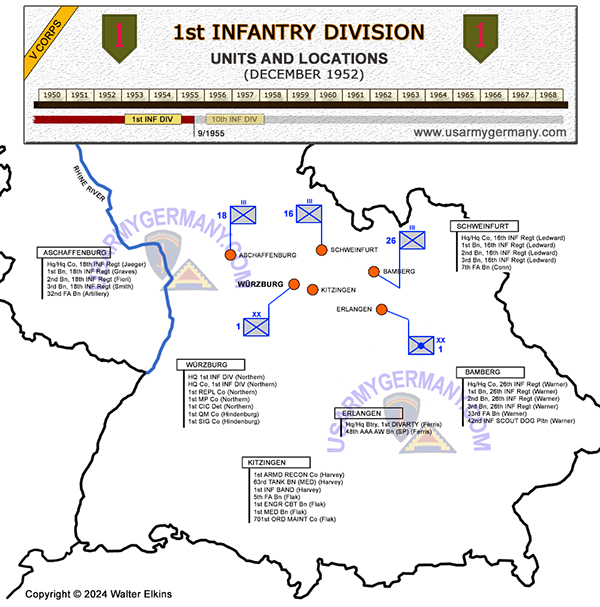
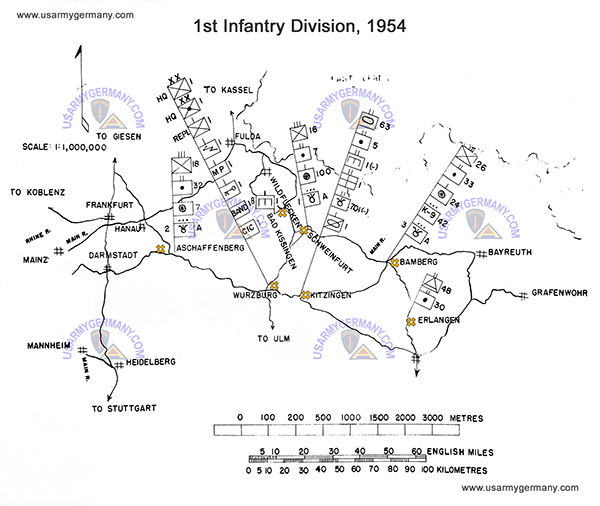
b. By November the 26th RCT, then located at Bamberg and Erlangen,
was composed of the following units: |
|
UNIT
DESIGNATION
|
|
26th Infantry Regiment less cannon company and anti-tank company |
| 5th
Field Artillery Battalion (155mm, Howitzer, Truck-driven) |
| 33rd
Field Artillery Battalion (105mm, Howitzer, Truck-driven) |
| 11th
and 12th Medium Tank Companies (Grafenwöhr) |
| Company
C, 1st Engineer Battalion |
| Company
C, 1st Medical Battalion |
| Detachment,
1st Quartermaster Company |
| 1st
Platoon, 1st Signal Company |
| Detachment,
701st Ordnance Company |
| Detachment,
1st Military Police Company |
|
|
It was referred
to in November as the European Command reserve, and its concentration
on a permanent basis, rather than for a training and maneuver period
only, was significant. Its training program was prescribed and supervised
by the Commanding General of the 1st Infantry Division. If committed
to action in event of an emergency occurring in U.S. occupied territory,
it was to be released to the Commanding General, U.S. Constabulary,
or the Commanding General, U.S. Forces, Austria. It was required to
be ready to move one-third of its force on four hours notice and the
remainder within twelve hours.
16. Effect of 26th RCT Concentration upon Other
Elements of the 1st Infantry Division
a. When the 26th RCT was concentrated in the Grafenwöhr Training
Area in August and September 1947, it was necessary to replace the
units comprising it by other units of the 1st Infantry Division for
performance of the static duties of the Occupation. The first effect
of the concentration was to spread even more thinly certain of the
other elements of the 1st U.S. Infantry Division. The 26th Infantry
Regiment and the 5th and 33d Field Artillery Battalions were relieved
from their static duties largely by the 1st Battalion of the 18th
Infantry Regiment which was withdrawn from duty in the Bremen Enclave
and stationed in Stuttgart, Nuernberg, Dachau, and Darmstadt. Henceforth,
no combat unit was stationed in the Bremen Enclave, but arrangements
were made with the British Occupation Forces for reinforcement of
U.S. service troops there in event of emergency, and movement of a
force of the U.S. Constabulary across the British Zone to the Enclave.
b. That the wider dispersal of 1st U.S. Infantry Division units was
only a temporary expedient was demonstrated toward the end of 1947,
when plans to form a second regimental combat team from elements of
the 1st Infantry Division were formulated. This action meant that
military posts where such units were stationed would have to rely
even more heavily than before on other available manpower and curtail
to the utmost their Occupational duties, limiting such activities
to essential tasks. On 1 March 1948 the 18th Infantry Regiment, less
its 1st Battalion, was released from assignment to EUCOM Headquarters
and returned to operational control of the Commanding General, 1st
Infantry Division. Almost immediately, training to prepare the 18th
Infantry for combat operations was begun.
c. By the spring of 1948, when plans for summer training were formulated,
the goal toward which Theater planners were working with regard to
tactical forces was fairly clear. Their plans called for the concentration
of the 1st Infantry Division, less the 16th Infantry Regiment (serving
in Berlin and Austria) in the Grafenwöhr Training Area, where
unit training, including training at the regimental combat team level,
and the use of automatic weapons, was to be stressed. Summer training
was to point to a divisional exercise in which the 1st Infantry Division
would be joined by the 2d Constabulary Regiment and the 91st and 94th
Field Artillery Battalions. The object of the training was to prepare
the 1st Infantry Division to operate as a strategic reserve.
(The remainder of Chapter II and all of Chapter III deals with changes
within the US Constabulary.) |
| |
Chapter
IV - Reorganization of the 1st U.S. Infantry Division in 1948
29. Difficulties Involved in Reorganization
a. Simultaneously with the reorganization of the U.S. Constabulary,
plans were made to reorganize the 1st Infantry Division under the
new T/0&E prepared by the Department of the Army. Such a reorganization
followed logically upon the reassembly of the Division and the return
to the Commanding General of the Division of operational control of
its elements from the various posts at which they had been stationed.
Although reorganization was delayed by the fact that certain of the
Tables of Organization and Equipment involved had not yet been approved
and published, it was indicated that the new organization would require
approximately five thousand spaces more than the old-type infantry
division. On the other hand, the increase in personnel within the
division would make it more nearly self-supporting in line with the
aims of current Command policy governing tactical troops.
b. On 17 September, EUCOM was directed by the Department of the Army
to proceed with the reorganization of the 1st
Infantry Division, which would have an authorized strength of 952
officers, 48 warrant officers, and 17,751 enlisted men, aggregating
18,751. The reorganization was to be effected by 10 October. Actually,
as in the case of the Constabulary, provisional reorganization was
already under way.
c. It was impossible for EUCOM Headquarters to consider the reorganization
of the 1st Infantry Division apart from the reorganization of U.S.
Constabulary and the composition of the OTB, for the major problem
in connection with the reorganization was that of finding within the
authorized Theater troop basis 3,297 spaces to implement the reorganization.
The actual difference between the old-type division and the new-type
division was 5,662 spaces, and in July U.S. Constabulary was informed
that, in effecting its reorganization, it would have to provide 3,500
of the required spaces. However, the addition of other units resulted
in approximately 2,365 spaces being made available. After discussions
with the various staff divisions, OPOT decided that other spaces required
would be drawn from various services, military posts, and units in
the Theater; and in this way, through small requisitions on many agencies,
a total of 3,222 spaces were yielded leaving OPOT Division with a
reserve of approximately 190, mostly officers.
30. Changes in the New Division T/0&E
To make 1st Infantry Division conform to the new T/0&E, the Department
of the Army directed that the following actions be taken: Headquarters
Special Troops to be redesignated as 1st Replacement Company and inactivated;
in the 1st Medical Battalion, Headquarters and Headquarters Detachment
to be redesignated as Headquarters and Headquarters Company and Company
A redesignated as an Ambulance Company; Company B to be disbanded;
Company C to be relieved of assignment to Company B and redesignated
Medical Detachment, Division Headquarters, 1st U.S. Infantry Division;
Company D redesignated as the Clearing Company. The 701st Ordnance
Light Maintenance Company was to be redesignated the 701st Ordnance
Maintenance Company (drawing additional equipment for maintenance
of tanks). One mechanized Cavalry Reconnaissance Troop was to be transferred
intact from U.S. Constabulary and redesignated the 1st Reconnaissance
Company. An additional company, Company D, was to be activated for
the 1st Engineer Combat Battalion. In each of the Division's regiments
- the 16th, 18th and 26th - the medical detachments were to be redesignated
Medical Companies. An antitank company and a cannon company were to
be activated and redesignated as Tank Company and Heavy Mortar Company,
respectively, for each Regiment. A tank battalion, the 745th, was
to be activated and redesignated the 63d Heavy Tank Battalion; and
the 639th Antiaircraft Artillery Automatic Weapons Battalion was to
be activated and redesignated the 48th Antiaircraft Artillery Automatic
Weapons Battalion. All of these units which were to be newly activated
or reorganized were to be assigned as organic elements of the 1st
Infantry Division.
31. Provisional Reorganization
a. Although the official reorganization was not to be effective until
10 October 1948, by 22 July the provisional reorganization directed
by EUCOM Headquarters, with Department of the Army approval, had been
completed. Most of the reorganization was carried out, despite serious
shortages in trained officers, prior to 1 July, and on that date,
the following units, including organic elements and those for support
of the 1st Infantry Division, were present with the Division in the
Grafenwöhr Training Area: |
|
UNIT
DESIGNATION
|
|
16th Infantry Regiment (minus 3rd Battalion) |
| 18th
Infantry Regiment |
| 26th
Infantry Regiment |
| Headquarters
and Headquarters Battery, 1st US Infantry Division Artillery |
| 5th
Field Artillery Battalion |
| 7th
Field Artillery Battalion |
| 32nd
Field Artillery Battalion |
| 33rd
Field Artillery Battalion |
| Headquarters
and Headquarters Company, 1st US Infantry Division |
| 1st
US Infantry Division Band |
| 1st
Signal Company |
| 1st
Quartermaster Company |
| 701st
Ordnance Company |
| 1st
Medical Battalion |
| 1st
Engineer (Combat) Battalion |
| 7825th
Station Complement Unit (Mobile) |
| 11th
Tank Company (Heavy) |
| 12th
Tank Company (Heavy) |
| 531st
Ordnance Tank Maintenance Company |
| 511th
Quartermaster Service Company |
| 556th
Ordnance MAM Company |
| 58th
TC Truck Company |
| 63rd
TC Truck Company |
| 425th
Army Band |
| 7866th
Headquarters and Headquarters and Service Company, Heavy Tank
Battalion |
| 7711th
Air Liaison Detachment |
| 7793rd
Augmentation Detachment |
| 1st
Military Police Company |
| |
|
| Units assigned
to the 1st US Infantry Division but not present in the Grafenwöhr
Training Area were: |
|
UNIT
DESIGNATION
|
DUTY
STATION |
|
| 57th
Field Hospital |
Würzburg |
|
| 3rd
Battalion, 16th Inf Reg |
Berlin |
|
| 8591st
Labor Service Platoon |
Darmstadt |
|
| 24th
TC Truck Company |
Nürnberg |
|
| 59th
TC Truck Company |
Nürnberg |
|
| 544th
TC Truck Company |
Nürnberg |
|
| 590th
TC Truck Company |
Nürnberg |
|
| 7931st
Ordnance Evacuation Company |
Kitzingen |
|
|
|
|
|
|
b. By 22 July
the provisional reorganization was completed pending the assignment
of personnel and the issue of equipment to fill the T/O&E. Tank
companies for the 18th and 26th Regiments had been formed previously
as the 11th and 12th Tank Companies, respectively, and on 7 July,
the 16th Infantry Regimental Tank Company and the 1st U.S. Infantry
Division Heavy Tank Battalion were organized. The 1st U.S. Infantry
Division Antiaircraft Artillery Automatic Weapons Battalion (Self-Propelled)
was formed on 17 July and on 1 August, the 1st Reconnaissance Company
was organized.
c. To meet the over-all personnel demands required by the reorganization,
arrangements for the transfer of spaces from U.S. Constabulary and
from other Theater units were directed by OPOT Division, EUCOM Headquarters.
It was more difficult to find in the Theater enough available officers
with sufficient field training to handle their assignments. However,
between 1 July and 10 October, a thorough search was made of other
units and agencies in the Theater, and wherever feasible, ground
officers with experience were transferred from static assignments
to the new elements of the Division. By the middle of August a flow
of officers from the United States had completely alleviated this
problem. By 10 October, when the formal reorganization became effective,
the actual reorganization had already been implemented by the organization
of the new organic units to be added and by the addition of necessary
personnel and equipment.
32. Training of the 1st U.S. Infantry Division
during 1948
a. During the first six months of 1948, the training of the Division
was along the lines generally in use in the Theater. It consisted
largely of individual training with small arms and training in the
use of crews served weapons, as directed by the OPOT Division, EUCOM
Headquarters plus small unit training in tactical problems. Previously,
emphasis had been placed entirely upon on-the-job training for occupational
tasks. The widespread adoption of tactical training, even if provided
for a short number of hours each week (as was the case with most
troops in the Theater unattached to a tactical organization and
even with many attached to tactical units but assigned to Occupational
missions) represented a significant change in Occupation policy.
b. By the spring of 1948, the provisional reorganization of both
the 1st Infantry Division and the U.S. Constabulary was visualized
and under way, and during the rest of 1948 exercises were projected
in which both these organizations were to participate as units of
U.S. Army, Europe.
c. Throughout the latter half of 1948, the 1st Infantry Division
pursued its own training courses in addition to the combined exercises.
The divisional exercises were designed to test and perfect various
operational procedures. On 5 August the Division was alerted early
in the morning and moved out of the Grafenwöhr area to assembly
areas south of Nürnberg, spending the night there and returning
to Grafenwöhr the following day. During the month of August,
all infantry battalions of the Division engaged in river assault
training under the direction of the 1st Engineer (Combat) Battalion.
On 23 August the Division began a series of exercises called PRIME
and GREEN. Exercise PRIME, held in August, was designed to test
the mobility of the Division and its reaction to alerts. Various
other exercises involving only the 1st Infantry Division were planned
and carried out during the remainder of the year, some of them involving
co-ordination between artillery and infantry, and between fighter
bomber groups and ground forces.
|
 |
|
| |
| 16th Infantry Regiment - 7 July 1948 |
| |
| (Source: ) |
|
|
| |
| (Source: Email from Rod van Ausdall, I&R Platoon, 16th Inf Regt, 1947-51) |
I deployed my I & R Platoon along the Czech border - 1949 or so. We worked with the Constabulary units - I believe they were at Weiden where we also billeted - long hours and many "accidental' forays into Czechoslovakia.
The I & R Pltn was part of the 16th Inf Regt (Grafenwoehr and Nuernberg). We (the 16th) had two battalions "in the zone" and our third battalion was in Berlin. The 18th and 26th Regtiments were the other two but they never pulled the border duty as far as I know.
My platoon was placed on DS to help out the Constab on the Czech border. I was in 16th from 1947 to 1951 (they were pulled out of Austria and redesignated the 7892 Infantry Regiment until we were up to combat readiness and then redesignated the 16th coincident with the 16th Regt being disbanded in Austria. I was in Regimental Hq (as were of course all I and R platoons). Most of us (old timers!) deployed to Korea in 1951.
The duty on Czech border was very wearing due to the I guess 16 hours a day with no breaks. We used our jeeps as (1) radio, (2) machine gun jeep w/ .50 cal and (3) get away vehicles and (4) one M8 armored car we "borrowed from the Constab for each patrol - total of four vehicles for each patrol. My platoon only pulled that duty one year as we (then) had the V Corps mission - Fulda Gap and all that stuff.
Remember when the Germans called the Constab the "Kartoffel Käfers" (potato bugs) due to the way the jeeps were painted. |
 |
|
| |
| 26th
Infantry Regiment - 1948 History |
| |
| (Source: Twenty-Sixth
Infantry Organization Day 1948 Program, 21 February 1948. Compile
by the 26th Inf PIO.) |
 |
|
A
large percentage of the men now in the regiment were not
with us when the 1947 year was born. For those who are
unacquainted with the years events we dedicate this brief
testament of a page of history.
The beginning of the year found the Service and Headquarters
Companies, Regimental Headquarters and the First Battalion
settling down in new duties in the Ludwigsburg area. In
December they had left War Crimes Guard in Nurnberg's
Palace of Justice and as the new year dawned all hands
were busily at work putting the new "house" into shape.
The 3rd Battalion was set up at Zirndorf near Nurnberg,
and still maintained their commitments in that area. Famous
Dachau and Munich were the new responsibilities of the
2nd Battalion. This was the disposition of the 26th Infantry
Regiment.
Each Battalion was seperated from the others by hundreds
of kilometers and some companies were separated from their
Battalions. For a soldier this was indeed an unhappy situation.
No one had an inkling of the future and rumors flew that
the 26th was through, that they would never be brought
together again and even that we would become Constabulary.
|
|
|
| In February,
in Ludwigsburg, the personnel of Service and Headquarters Company
and Regimental Headquarters learned that they would staff a new Headquarters
to be set up. It was to be known as 1st Military District and would
be commanded by General William R. Schmidt, with Colonel S. T. Williams,
26th CO, as assistant District C. O. Suddenly, in the short space
of three weeks, word came that there would be only two districts,
instead of four and Ludwigsburg would close down. The stream of rank,
reversed itself and building was soon echoing only to the footsteps
of the Spacers again. |
| |
 |
|
But
this did not last for long. We were on the move again.
Word had arrived that the 26th Headquarters was opening
up a training center at Grafenwohr to be used in training
all 1st Division troops and other selected units. A small
band of men from Ludwigsburg arrived at the place which
was to become their home for the next 6 months. It was
a dreary sight that greeted these pioneers. Most of the
huge reservation (similar to Fort Bragg) was just a heap
of rubble. There were some buildings on the far end of
camp that were still intact and it was into these that
we moved.
Much work lay ahead. The 26th Headquarters had to be set
up first. Then special engineer units were called in and
work commenced on the Training Area site. A level area
was selected and "dozers" went to work. Roads were cut
and tent frames sprang up. Soon canvas covered these frames
and company streets became orderly rows.
Meanwhile back at 26th Headquarters schedules and assignments
were being drawn up for the first cycle of trainees which
were due May 5th. A 4 week training period with 2 weeks
between cycles was the allotted time. The first group
of prospective trainees included Infantry units other
than the 26th and some Field Artillery batteries. They
fell to with a will and soon the kinks were being ironed
out in the program. The training area received the monicker
of "Tent City" and became the place we would like most
to be away from. Actually all men agreed that the training
was most beneficial and a change from the regular occupational
duties. New cycles rolled in every six weeks throughout
the summer. |
|
|
| |
| A new training
area the Vilseck Training Area, came into being under the 26th Headquarters.
Many were the visitors from Frankfurt's EUCOM Headquarters. Grafehwohr
was prospering. We settled down into the routine, and did not mind
it too much. Units in the 1st Division were shaping up. We were gaining
polish. Before summer's end most companies had gone through this famous
camp, had learned to hate and respect it. |
| |
 |
|
In midsummer Col. S. T. Williams left for Washington to
assume new duties. Col. Maurice C. Bigelow took the reins
to carry on the regiment. A new job was added to the 26th.
They were given the job running a Drill Sergeants School,
to train for a two week period selected sergeants from
the Zone. This school prospered.
A specially selected group of men from the Regiment were
called in to form an Honor Guard. This highly trained
group was to give performances in specialty drill and
silent maneuvers with a machinelike precision. The original
large group was whittled down to a 4 squad machine as
members were unable to continue to meet the standards.
Their first official performance was to lead the Labor
Day parade; a feat for which they were given much acclaim.
|
|
|
| |
| In September,
a startling piece of news arrived. The battalions were coming back
to Grafenwohr to form a Regimental Combat Team. Medics, Engineers
and Field Artillery units were brought in to add to the Infantry.
Training started again, and the outfit began to knit. Came Labor Day
and a host of Generals to see one of the greatest of post-war shows
of power. Generals Bradley, Clay, Huebner, Milburn and others watched
the RCT and 6th Constabulary Regiment parade in mass formation 9,000
strong. Training was resumed. Rumors flew again. We were to move again,
this time, to Bamberg and Erlangen. The advance detail left in late
September to prepare the barracks for occupation. The move started
about the first of October and was complete on the 8th. We were settled
once more in our new home. Bamberg, a practically untouched-by-war
thriving city was an ideal home for the 26th Infantry. The Panzer-Kaserne
and nearby La Garde Kaserne in Bamberg, were large and in excellent
condition. After settling down, training resumed at an accelerated
pace. Steps were taken to build an "espirit" of which the men would
be proud. |
| |
 |
|
| A
soldier of the week was selected. Battalion retreat parades
were held three nights a week and a Regimental review
on Fridays. The best appearing and performing companies
were announced as parade winners. Competition between
units soared. As replacements joined the Regiment they
were first interviewed by Col. Bigelow, greeted and then
placed on duty with the Drill Sergeants school. This was
to give the men training in the 26th principles. A plaque
was awarded-each week to the unit having the best dayroom.
Stress was placed on the Athletic and T I and E program.
Winter training in winter clothing commenced. Night problems
became regular features. Life settled down to a regular
routine. Lt. General Helset, CG of the Norwegian Ground
Forces, reviewed the 26th Infantry. Recruiting boomed.
|
|
|
The opening days
of the year 1948 saw the return of former regimental commander, Col.
Samuel T. Williams. General Clay inspected and reviewed the 26th Infantry
regiment and remarked: "You are the only men prepared to fight at
a minutes notice." In rapid succession, Generals Van Fleet, Milburn
and a bevy of Dutch dignitaries inspected the regiment.
Col. Williams expanded the sports program. Plans were laid for the
summer athletic program. Men of the regiment generously donated over
20,000 dollars to a March of Dimes Drive. An I and E off-duty school
was inagurated and met with a high degree of success.
The regiment is sitting on top of the world. A unit with pride and
poise, ready to face the future. Ready to take their own niche in
the Hall of Fame. |
 |
|
| |
| Division Artillery |
| |
| (Source: Email from Tommy Knox, 7th FA Bn, 1948-52) |
 |
|
I was stationed in the 7th F.A. Battalion in Schwabach, Germany from 1948 to 1952.
We had a country band and played all over Germany. In fact, we were the cause of AFN opening a radio station at Nuernberg. They had a country program called the Hillbilly Gasthaus. We auditioned to play that program live every day from 3 to 3:30 pm in Frankfurt, Germany. We would have had to transfer into Special Services. Our COL wouldn't release us to do that, so they opened a station in Nuernebrg and we played the program there.
Enclosed is a letter for song request from the U.S.S. Midway (6th US Fleet aircraft carrier) . As you can see they were in Turkey when they picked us up.
As you probably know, AFN covered all of Europe and more. We got a lot of requests from the German people. They loved country music in Germany. They had a French lady opera singer one time at the Nuernberg Opera House. Of all people, they asked our country band to play intermission for her. That was probably the biggest we ever played for. The Nuernberg Opera House had three balconies. It could hold a lot of people.
Another time we got an official looking letter in German. None of us could read German so we got one of the German Service Club hostesses to read it for us. She said it was from the biggest recording studio in Germany asking us to record a record. We went to our colonel, the same one who had turned us down for Special Services. We were giving the 7th FA a lot of publicity that he did not want to lose. So he turned us down again. He said we would be making too much money.
I would love to hear from some of the old band members or anyone else wants to email me.
|
|
|
|
 |
|
| |
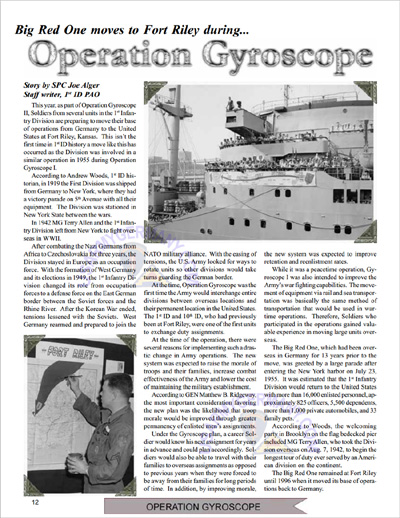
| GYROSCOPE |
|
| |
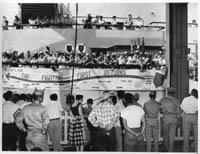
1st
Inf Div returns to US, 1955
|
|
|
|
| |
 |
|
| |
|
Related Links:
Society of
the First Infantry Division - A wonderful site hosted by
the official organization of veteran's who have served in the 1st
Infantry Division (The Big Red One) of the U.S. Army.
26th Infantry
Regiment Association - A great site dedicated to the "Blue
Spaders" vets
|
| |
|
|
| |
|