| If you do
NOT see the Table of Contents frame to the left of this page, then
Click here to open 'USArmyGermany' frameset |
||||
|
6900th
Civilian Support Center |
||||
|
|
||||
|
||||
|
|
||||
| CSC History | ||||
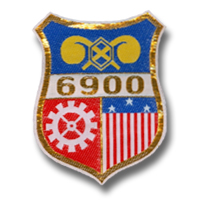 6900th CSC (Maint & Smoke Generation) Patch 6900th CSC (Maint & Smoke Generation) Patch |
||||
| (Source: COMPASS, The CEGE Newspaper, courtesy Siegbert Mann) | ||||
| 6900th Civilian
Support Center History By Doris Green It was the former Polish displaced persons and Prisoners of War who comprised the unit at its conception after World War II. They remained a majority until they gradually retired or died over the years and German workers were hired in their places. The first commander of 6900th LS SG BN (known as the "Polish Smoke Battalion") after it officially become a Battalion-level unit in 1956 was LTC (Labor Service) Jozef Behm who retired in 1969. He was followed by LTC (LS) Wladyslaw Menke, who served until 1981 when LTC (LS) Zygmunt Lewandowski became Superintendent, followed by LTC (ZBIl) Stanislaw Moronczyk. Then from 1984 to 1889, LTC (ZB 11) Stanislaw Borkowski held the top position when he was succeeded by the last Superintendent, Bogoljub Kovacevic. LTC (ZB 11) Bogoljub Kovacevic (a native of Yugoslavia) was the first non-Polish Superintendent and the last 6900th CSC Superintendent. The battalion was originally established in 1946 as 6952nd LS Center with the 4087th, 4094th, 4189th and 4207th Guard units. Since September 1952 the 6952nd was in a transforming phase and additionally tasked with Smoke missions. On September 1, 1956 the 6952nd LS Center was renamed to the 6900th LS SG BN. On February 1, 1971 the 6900th LS SG BN was renamed to 6900th Labor Service Maintenance/Supply Support & Smoke Generation Battalion (6900th LS M /S & SG BN) which was later again renamed to the 6900th Civilian Support Center Maintenance/Supply, Direct Support & Smoke Generation (6900th CSC M/S, D/S & SG). The Battalion participated on all REFORGER (REturn FORces to GERmany) maneuvers and many other exercises. It supported e.g. the 1st ID, 8th ID, 3rd AD, 2nd ACR etc. Part of the 6900th CSC M/S, D/S & SG was the 8530th Civilian Support Group (CSG), 8531st CSG, 8532nd CSG, 8533rd CSG. All of these units were stationed at the Gendarmerie Barracks, Mannheim - Schoenau except the 8532nd which was stationed at Turley Barracks, Mannheim. The 6900th CSC was part of V Corps before being assigned to Combat Equipment Group, Europe (CEGE) Combat Equipment Battalion East in 1970. CEGE is a subcommand of the 21st Theater Army Support Command (TASCOM). This reassignment took place because of the phase-out of the US Army Chemical Corps, which moved back to the US. This left only the 6900th CSC to provide smoke generator support as the primary mission with POMCUS (Prepositioned Overseas Material Configured in Unit Sets) support as secondary. These roles were reversed in August 1, 1970 and remained so until 1987 when a Manpower survey team recommended that CEGE utilize only 44 of the 250 Civilian Support personnel assigned at POMCUS. At this time the Mannheim POMCUS site was responsible for 1 Division (1st Inf Div) and their equipment (est. 1200 wheeled and tracked vehicles). During the 1964-87 time frame, approximately 250 employees were assigned to the POMCUS operations. Further, the survey team recommended only 88 positions each in the units (CSG) for wartime contingency. At this time the primary mission once again reverted to providing smoke generator support although personnel continued to perform some jobs required by CEGE. Prior to 1987, approximately 130 employees worked at the WK4R30 supply activity at Spinelli Barracks (Mannheim - Kaefertal) and another 120 employees at 1st Combat Equipment Company (Maintenance & Support) (1st CEC M/S) track and wheel shops, quality control, preservation section and S-4 storage. In 1988 the 6900th CSC additionally took over the Artillery Simulation as fire marker (sic) at 7th Army Training Command (7 ATC). In 1990 only about 60-80 employees perform the CEGE mission and 20 of these work at 1st CEC. This reduction came about as the result of the reduction in force (RIF) and hiring freeze. Average loss of personnel has been about 25 per month in 1990. All weapons (Rifle M16A1 and Pistol M1911A1) were turned in August 1, 1990 followed by some equipment turn-in (M816, M35A2, M151A2, M3A4, Tents etc.). The mess facility was closed October 1, 1990. Also, beginning Oct. 1, the remaining three units were been phased out with everything being done for the placement of remaining personnel. The 7 ATC has asked that one company be retained to provide smoke generator support and Artillery simulation for training exercises. Consequently, the 8530th CSG has been designated to move to Hohenfels. The 6900th CSC M/S, D/S SG, 8530th CSG, 8531st CSG, 8532nd CSG and 8533rd CSG were deactivated on December 31, 1990. After the Flags where retired, all Flags were sent to the Polish museum in London, United Kingdom for display. On January 1, 1991 the 8530th CSG (SMK) was reactivated at 7 ATC Combat Maneuver Training Center (CMTC) Hohenfels for smoke generator support and Artillery simulation. The 8530th Civilian Support Group (SMOKE) is now receiving new personnel and equipment (M998 HMMWV and new state of the art smoke generator equipment). |
||||
| 1966 | ||||
| (Source: STARS & STRIPES, June 5, 1966) | ||||
| The 6900th LS Smoke Generator Bn is the only smoke-making unit in USAREUR. Its mission is to conceal from the enemy any friendly tactical element fighting in open terrain. The battalion was formed ten years ago but is still commanded by the same LS lieutenant colonel (Jozef Behm). When the 15th Chem Gp was deactivated under the COSTAR concept, the 6900th was reassigned to the 11th Engr Gp. Each of the battalion's four companies has 48 generators that make different shades of smoke by burning vaporized fuel. |
||||
| 1969 | ||||
| (Source: STARS & STRIPES, April 2, 1969) | ||||
| Lt Col Jozef Behm, commander of the 6900th LS Smoke Generator Battalion at Gendarmerie Kaserne, Mannheim-Schönau, retired the end of March 1969 after commanding the Bn for almost 13 years. Major Widyslaw Menke has assumed command of the battalion. (Webmaster note: The Smoke Generator battalion had five subordinate companies and was probably still a subordinate unit of the 11th Engineer Group at this time.) At the beginning of WWII, Lt Col Brehm served as a battalion commander in the Polish Army but was captured by the Germans during their invasion of Poland in 1939. He was then held as a POW at a camp in Murnau. After WWII he joind the US Army's labor service organization as commander of various Labor Service units. In July 1956, Behm assumed command of the newly activated 6900th Labor Service Smoke Generator Battalion. |
||||
| 1970 | ||||
| (Source: STARS & STRIPES, September 8, 1970) | ||||
| The 6900th LS Smoke Generator Battalion has officially become part of the USAREUR Augmentation Readiness Group (UARG). Commander of the 6900th is Wladyslaw Menke. The merger is designed to coincide with REFORGER II. The 6900th will provide additional personnel to each UARG battalion involved in the excercise - these will consist of mechanics, supply personnel and drivers. |
||||
| 1975 | ||||
| (Source: STARS & STRIPES, May 23, 1975) | ||||
| The 6900th LS Battalion is headquartered at Gendarmerie Kaserne, Mannheim and is subordinate to the Combat Equipment Group Europe. The battalion consists of four subordinate labor service companies. 85 percent of the battalion's personnel are East Europeans who work in various positions at CEGE. CEGE's primary mission is to stores and maintain of equipment that has been preprositioned in Europe for REFORGER forces and other units. The command stores and maintains equipment for more than three and a half divisions - nearly 140,000 major items. |
||||
| 1988 | ||||
| (Source: YouTube website) | ||||
 A former member of the 8531st CSG takes us to Hohenfels Training Area and the smoke generators of the 8531st - A former member of the 8531st CSG takes us to Hohenfels Training Area and the smoke generators of the 8531st -  (5:00 min) (5:00 min) |
||||
 |
||||
| (Source: 21st TAACOM Support Sentinel, Nov 1990) | ||||
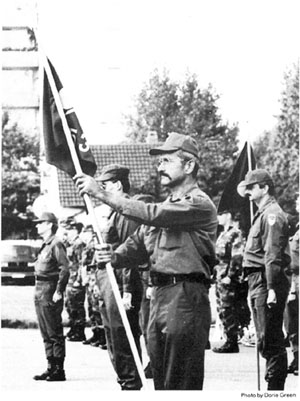
| 6900th CSC retires its colors By Dorie Green CEGE PAO The 6900th Civilian Support Center in Mannheim retired its colors. The 6900th is being phased out as part of the overall reduction of civilian support units in Europe. The phaseout will be mainly through attrition, according to Bogoljub Kovacevic, superintendent. The process is expected to take about a year and must be accomplished by the end of fiscal year 1991. Presently Kovacevic is working with the Mannheim Civilian Personnel Office and the Civilian Support Agency in Heidelberg to place employees in other positions within the 60-kilometer range of Mannheim. |
||||
|
||||
| Actually, the phaseout began some months ago when official work was received, starting with the reduction of personnel. The remaining three units will be phased out with everything being done for the placement of remaining personnel. During the 1964-87 time frame, approximately 250 employees were assigned to the POMCUS operations. Kovacevic spoke reverently about the former Polish employees who made up the 6900th which was known as the "Polish Smoke Battalion" for many years. It was the Polish displaced persons who comprised the unit at its conception after World War II. They remained a majority until they gradually retired or died over the years and German workers were hired in their places. Kovacevic is the first non-Polish superintendent. He said the Polish workers were dedicated and loyal and could always be counted on when asked for support. As an example, he mentioned Col. Lloyd (Jim) Brown, a former CEGE commander from 1971-73 who visited the 6900th. Brown stated that "the most reliable work force was the 6900th." Kovacevic explained that the Polish workers lived at the kaserne and were "really loyal to the 6900th." Brown visited CEGE headquarters in August and reiterated what he told the 6900th superintendent on a prior visit. In fact, these sentiments were echoed by other commanders through the years. The first commander of 6900th after it officially become a battalion-level unit in 1956 was Jozef Behm who retired in 1969. He was followed by Wladyslaw Menke, who served until 1981 when Zygmunt Lewandowski became superintendent, followed by Stanislaw Moronczyk. Then from 1984 to 1989, Stanislaw Borkowski held the top position when he was succeeded by the current superintendent, Bojoljub Kovacevic. During the Recognition Day ceremony, the 6900th and individual employees were recognized for their service. |
||||
|
||||
|
|
||||
| Related Links: |
||||