If you do NOT see the Table of Contents frame to the left of this page, then
Click here to open 'USArmyGermany' frameset |
4th
Infantry Division
Ivy Division
(Page 1 - Division History / Headquarters & Division Troops)
Looking for more information from military/civilian
personnel assigned to or associated with the U.S. Army
in Germany from 1945 to 1989. If you have any
stories or thoughts on the subject, please contact me . .
|
|
|
|
|
|
| Division
History |
| |
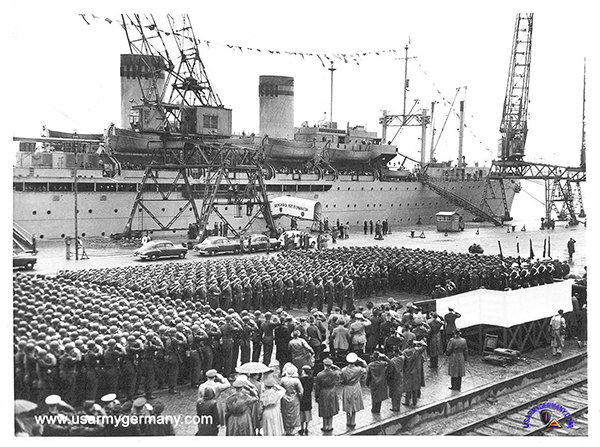
Advance party of 4th Inf Div arrives at Columbus Quay, Bremerhaven (Webmaster collection)
|
| |
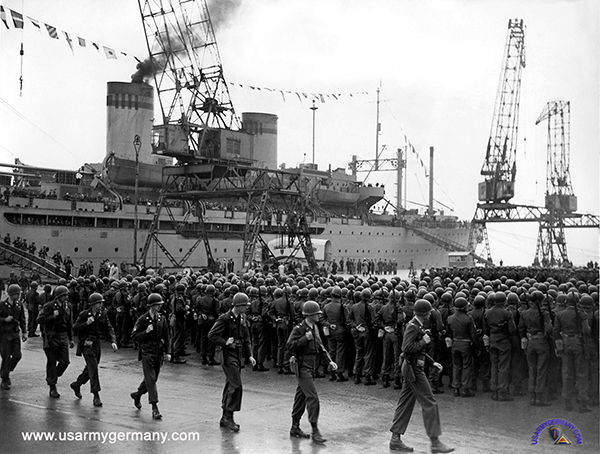
Advance party of 4th Inf Div arrives at Columbus Quay, Bremerhaven (Webmaster collection)
|
| |
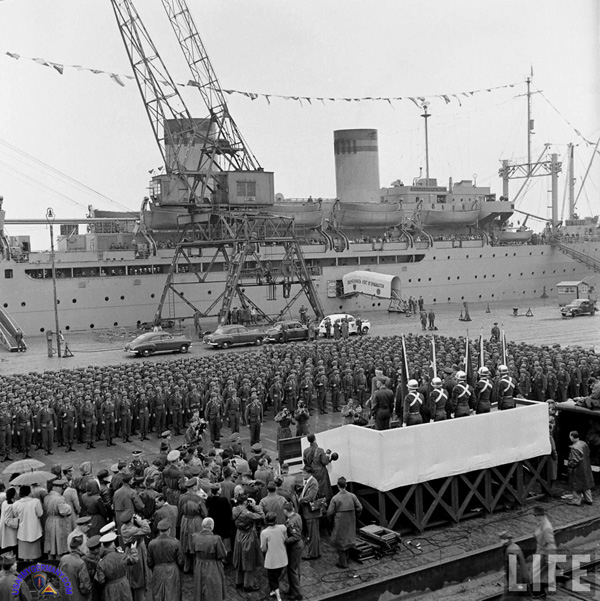
Advance party of 4th Inf Div greeted by dignitaries at Columbus Quay, Bremerhaven (TIME, Inc.)
|
| |
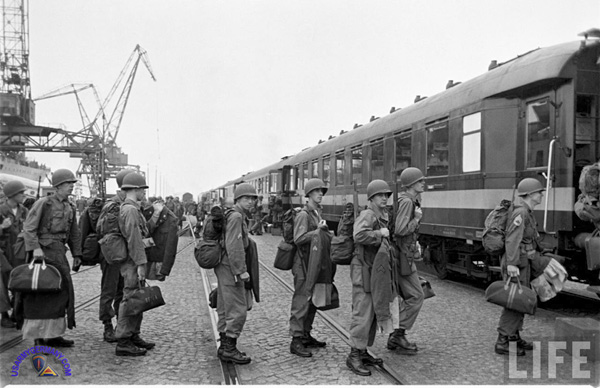
4th Inf Div soldiers board one of three Transportation Corps trains at Columbus Quay
that
will transport them to the
staging area near Mannheim (TIME, Inc.)
|
| |
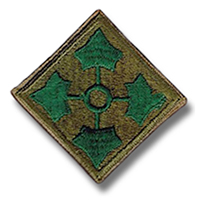
 HQ 4th Infantry Division DUI HQ 4th Infantry Division DUI |
| |
| 1951 |
| (Source: LIFE Magazine, June 11 1951; STARS & STRIPES, May 28 & 29, and June 10, 1951) |
On a dark and rainy day (May 28, 1951), the advance party of the 4th Infantry Division arrived at Bremerhaven onboard the troopship General Alexander Patch. The advance party consisted of about 1,200 men -- mostly headquarters troops, service units and artillerymen.
Meeting the arriving 4th Inf Div troops at the Columbus Quay was a delegation of US Army and French Army officers and the POE's 427th Army Band. Among the officers were French Army General Alphonse-Pierre Juin (who has been designated to head the Allied Army Forces, Central Europe); Lt Gen Manton S. Eddy (7th Army CG) and Maj Gen Harlan N. Hartness (4th Inf Div CG). |
|
| |
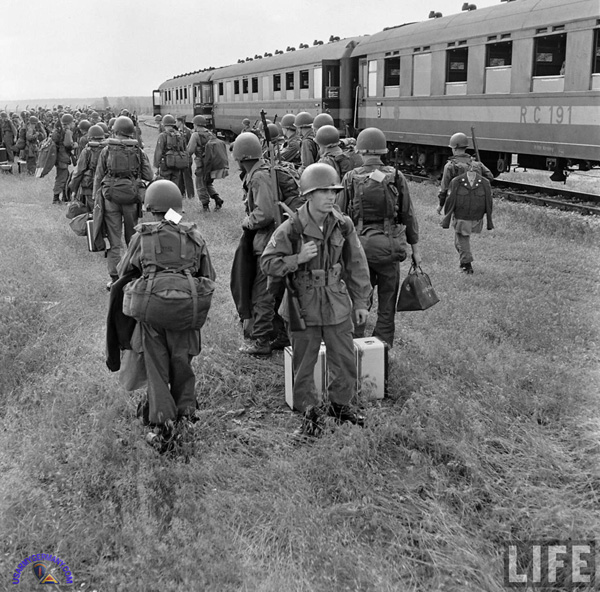
4th Inf Div soldiers move toward their assigned company areas after detraining at the
staging area in Sandhofen (Mannheim) (TIME, Inc.)
|
| |
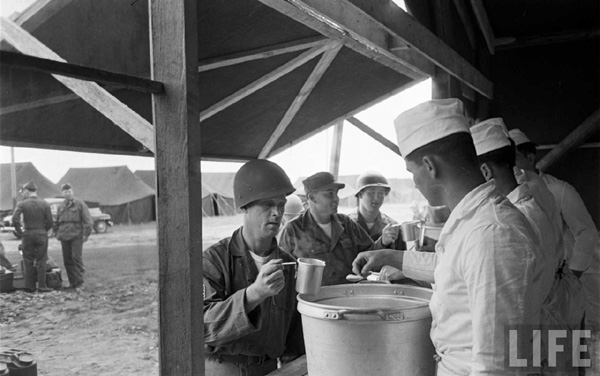
At Camp Y-79, the tent-area plan provided for a kitchen for each unit of battalion size (TIME, Inc.)
|
| |
As the troop trains coming from Bremerhaven arrived at Camp Y-79, the 4th Inf Div soldiers detrained and headed for their respective company areas. Under the direction of camp commander Col. Maxwell Emerson (former 7th Army deputy quartermaster), the staging area - a tent city - had been erected in preparation for the arrival of Augmentation troops by EUCOM and Heidelberg Military Post personnel.
Kitchens and unit PX's were located in battalion areas. A large camp recreation hall contained a larger PX, movie theater, APO, American Express and Deutsche Post office, an American Red Cross office and a writing room. Also set up were a camp dispensary (operated by the 130th Station Hospital), unit recreation areas, mobile bath units and a bus service that was available for personnel with passes from the camp gate to the nearest streetcar line.
Processing of division vehicles and equipment was already underway as the first troops arrived with the 88th Heavy Maintenance Ordnance Company and the 7931st Ordnance Evacuation Company, under the direction of the camp ordnance officer, unloading incoming freight trains and delivering the equipment to unit dumps.
Company-level officers were given tents in their unit areas; field-grade officers were billeted in a nearby kaserne (Coleman Barracks). |
|
| |
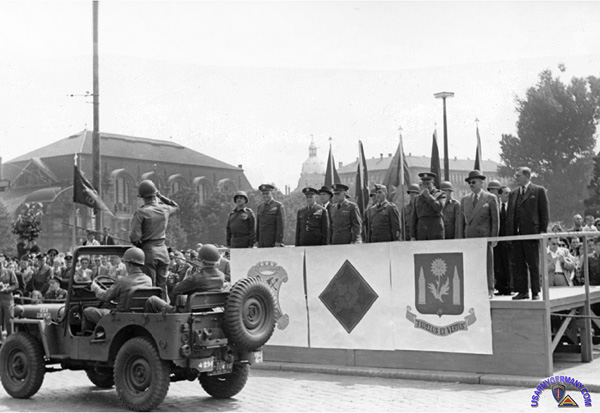
4th Inf Div parade in Mannheim (Prof. Christian Führer)
|
| |
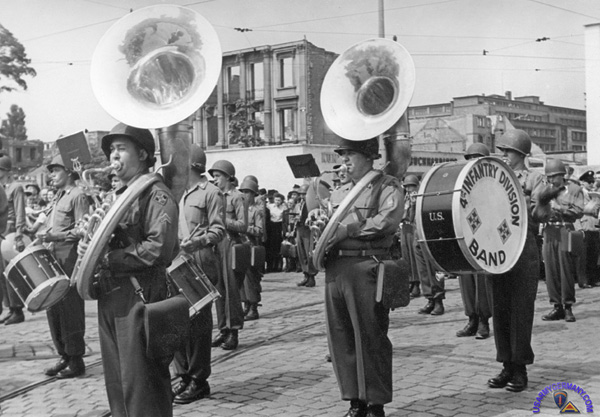
4th Division band in Mannheim (Prof. Christian Führer)
|
| |
| On June 9, with 4th division troops still being assembled at Camp Y-79, 3,700 troops of the 4th Inf Div participated in a German-American friendship parade in Mannheim. In a 40 minute march through downtown Mannheim, the soldiers passed in a nine-man front the reviewing stand before Lt Gen Manton S. Eddy, Lt Gen Clarence R. Huebner, Maj Gen Harlan N. Hartness as well as city officials and HICOG digitaries. Also included in the parade was the 4th Division band playing martial music. |
|
|
|
| 1952 |
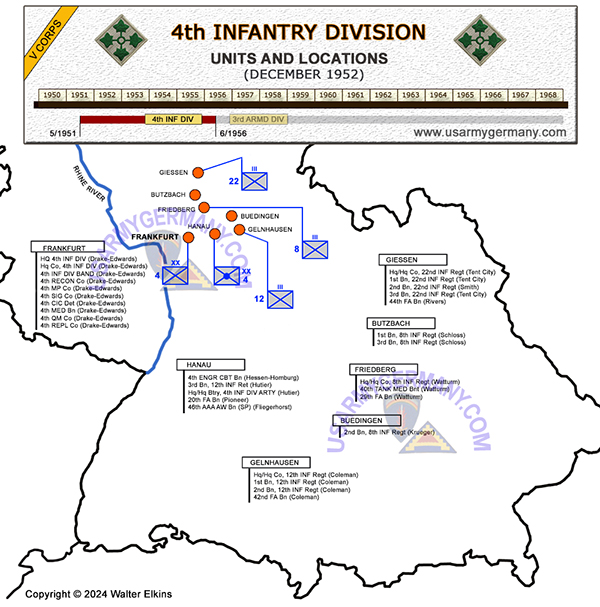 Location of 4th Infantry Division units and stations, 1952 (Walter Elkins)
Click on the graphic to view a higher res version of the map
If you have additional information/corrections, contact the webmaster - see email link at top of page |
| |
|
|
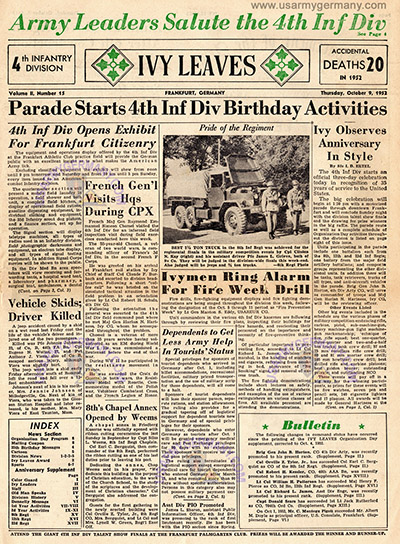
35th Anniversary issue of IVY LEAVES (Oct 9, 1952)
(Click on image to view the entire insert - now converted to PDF) |
|
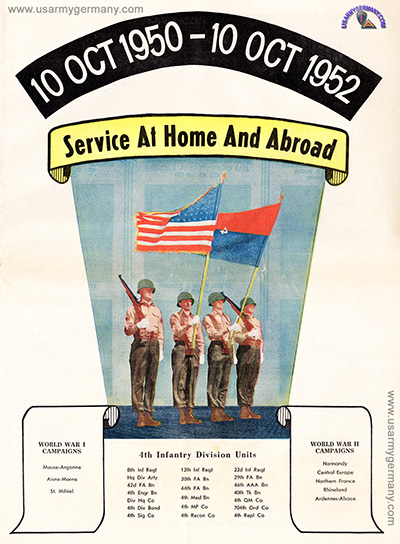
Special Insert, 35th Anniversary issue of IVY LEAVES (Oct 9, 1952)
(Click on image to view the entire insert - now converted to PDF) |
| |
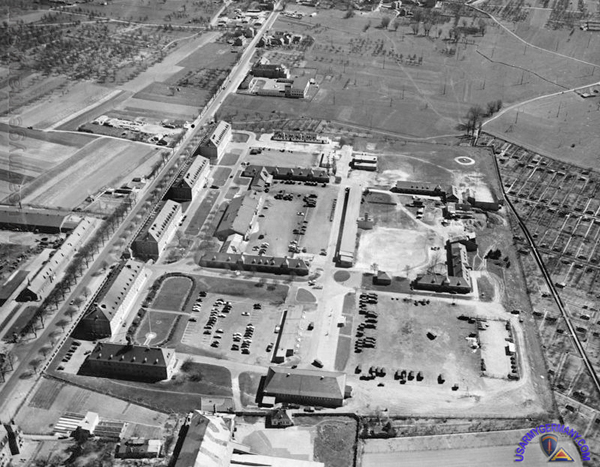
Aerial photo of Drake Kaserne - HQ 4th Inf Div, early 1956 |
| |
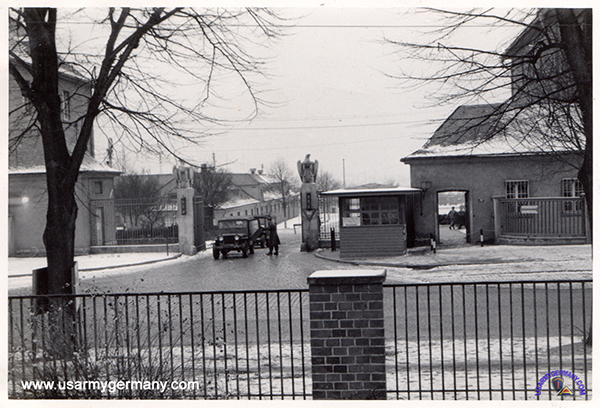
Main gate, Drake Kaserne - HQ 4th Inf Div, early 1950s (Webmaster's collection)
|
|
| |
| ORGANIZATION |
| (Source: STATION LIST, December 1952) |
| UNIT |
CITY |
COMMENTS |
| Hq/Hq Co, 4th Inf Div |
Frankfurt |
|
| 4th QM Co |
Frankfurt |
|
| 704th Ord Co |
Frankfurt |
later reorganized as 704th Ord Bn |
| 4th Div Band |
Frankfurt |
|
| 4th MP Co |
Frankfurt |
|
| 4th Repl Co |
Frankfurt |
|
| 4th Sig Co |
Frankfurt |
|
|
|
|
| 8th Inf Regt |
Friedberg |
|
 1st & 3rd Bn 1st & 3rd Bn |
Butzbach |
|
| 2nd Bn |
Büdingen |
|
| 12th Inf Regt |
Gelnhausen |
|
| 3rd Bn |
Hanau |
|
| 22nd Inf Regt |
Kirch-Göns |
|
|
|
|
| Hq/Hq Btry, 4th Div Arty |
Baumholder |
later moved to Hanau |
| 20th FA Bn (155mm How, Towed) |
Hanau |
|
| 29th FA Bn (105mm How, Towed) |
Friedberg |
|
| 42nd FA Bn (105mm How, Towed) |
Gelnhausen |
|
| 44th FA Bn (105mm How, Towed) |
Kirch-Göns |
|
| 46th AAA AW Bn (SP) |
Hanau |
|
|
|
|
| 40th Tank Bn (90mm) |
Friedberg |
|
| 4th Recon Co |
Frankfurt |
|
| 4th Engr Bn (Cbt) |
Hanau |
|
| 4th Med Bn |
Frankfurt |
|
|
|
| |
| 1953 |
| (Source: "4th
Infantry Division, 1917-1953." Special Section of IVY LEAVES,
the 4th Infantry Div newspaper, October 8, 1953) |
Training Program During Past 12 Months Keeps Ivy Units Busy at Home, in Field
By Sgt Ken Walker
In and out of the field, to and from the classroom, out to the range and back, in the air and on the ground, training took a major slice out of the daily routine of 4th Division men during the past year.
In individual weapons firing, in squad and platoon tactics, in company and battery and battalion alerts and CPXs, in regimental and division maneuvers and problems, the Ivyman of the past 12 months was trained and retrained and trained again, until even the individual began to believe he was combat ready. His leaders knew it.
Basic style training In drill and PT and manual of arms was not forgotten. Over and above such fundamentals rose a structure of preparedness built on teamwork -- teamwork between individuals and between the larger units.
The best example of such teamwork about a year ago was "Exercise Rosebush," the mammoth French and American maneuvers which gave a workout to some 75,000 troops including the 4th Inf Div and ended in September with praise for all concerned.
"Rosebush" kept the 4th Inf Div in the field for 72 hours, in a simulated defense of a powerful "Aggressor" push from the East toward the Rhine River. Ivymen, among the defenders, were instrumental in halting the armored thrusts toward Giessen at the conclusion of the exercise, slowing the "Aggressor" to a far greater extent than was their mission.
Especially praised was the average Ivyman's awareness of the importance of security and teamwork. Camouflage also got a pat on the back.
During "Rosebush" one small Ivy unit pulled an unusual escape, after having been surrounded by "Aggressors" during the night. The unit dispatched a messenger to the enemy CP with a request for clearance for the unit to move forward. No enemy personnel checked identification, and the request was granted. The "Aggressor" even furnished an MP escort to speed the friendly troops on their way. |
|
|
|
Helped
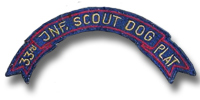
by Dog Platoon
Hq Co, 8th Inf Regt, was accompanied during the problem
by a squad from the 33d Inf Scout Dog Platoon, consisting
of six German police dogs and their masters. The dogs
ferreted out numerous small enemy positions that might
otherwise have gone undiscovered. |
|
|
The 22nd and 8th Inf Regts saw most of the action during "Rosebush," while the 12th was held in reserve and had to be content with light skirmishes. Together with the 14th Armd Cav Regt and other allied units, the 4th Inf Div at the close of the problem had thrown up a defensive wall before the city of Giessen that the "Aggressor" could not crack.
In the middle of September, the majority of Ivymen were still remembering "Rosebush." A few had other things more important to think about concerning their personal training. Two non-coms, one from the 8th and one from the 22d Inf Regt, departed for the States, temporarily, to attend the Army Helicopter Transport Pilot School at Ft. Sill, Okla. They were promoted to warrant officer junior grade at the end of the 17 week course. Other division men of company and battery TI&E sections were arriving and departing the Command Conference Leaders Course at Dachau, Germany, part of the USAREUR TI&E School.
The turn of October found Ivymen throughout the division engaged in individual training, with a purpose. They hoped to capture the division crown in fields such as marksmanship, care of vehicles, rifle squad technique of fire, tank crew drill, heavy weapons drill, best guidon bearer, outstanding private and outstanding NCO. With a little teamwork, they hoped to be among the best drilled carbine or rifle platoon. All these events were to be part of the October 10 Organization Day festivities.
In the midst of the preparations, the division hit the field, again, this time in a short CPX. While in the field, the division was visited by French Maj Gen Raymond Chomel, who toured the positions and was given a briefing on the tactical situation. This CPX was called "Exercise Equinox."
The middle of October found the 12th Inf Regt forsaking the ground for the air at the climax of air transportatbility classes. Instructors headed by 1st Lt Albert Smith went from one battalion to another, giving 16 hour classes, interspersed with practical work. At the of the instruction, Air Force C-82s took the troops aloft, complete with parachutes and Mae Wests, the use of which they had also been well taught.
About the same time, the P&A Plat of Hq Co, 1st Bn, 12th Inf Regt was training itself in bridge building for a good cause. The platoon threw a wooden span across the Kensig River near Gelnhausen in order that the town's citizens might have a short cut to a three-day horse show and festival.
Radio School Trained Man
Later in October, a shot in the arm was given radio communications in the division as 25 EM, trained in low and intermediate radio operation, graduated from the division radio school run by 4th Sig Co, and returned to their units.
Training in motor vehicle maintenance paid off in Hq Btry, 4th Div Arty, the last week in October, when they attained a record of 90 consecutive days without a motor vehicle deadlined. Three trained mechanics maintained the battery's 48 vehicles during the period. At the same time, a training program conducted by officers from Div Hq began for members of Frankfurt Military Post's Officer Reserve Corps. They reviewed organization, equipment and capabilities of an Infantry division.
November's first days saw the 3d Bn, 12th Regt, running through their squad in defense and squad in attack tactics under the eyes of Ivy CG Maj Gen Harlan N. Hartness at Wildflecken. The 3d Bn stayed six days in the area, using live ammo in the problems.
Throughout the division, training talks on motor vehicle safety deadlined vehicles for four-hour winter driving classes. Training aids and posters conveyed the major points in the program to all division drivers.
Bulldozers and land clearance training in the 4th Engr Bn gave a shot in the arm to the Ivy German-American relations program in mid-November, as the engineers cleared the site for a new Youth Center in Hanau. The previous center was destroyed during the past war.
Many Attended Schools
In the 8th Inf Regt, the number of men attending Army training schools simultaneously in mid-November was 146. USAREUR and Seventh Army schools were teaching Ivymen everything from cooking to defensive chemical warfare. The 22d Regt, in additlon, scheduled five schools of its own: voice radio, driving, typing, military tactics and basic education.
The 12th and 8th Regts had November visits to their training sites in the field and in the kasernes by a committee from Army Field Forces, bent on discovering any problems hlndering training. No criticisms were recorded.
November 24, men of the 4th Med Bn and other medical units in the division attended a refresher course in the making out of medical records and reports at Frankfurt's Div Hq.
As December began men of the 8th Regt began winter-long small bore firing training, preparing for three regimental matches to be held the following spring. End in view for the 8th's S3 section, and Col Orville Z. Taylor, Regt'l CO, was improvement of squad technique of fire. The regiment began a new cycle of clerical training at the same time, in the Friedberg Education Center, with duty-hours (illegible) and unit administration courses scheduled for four fours daily for a seven week period.
A series of training classes to indoctrinate Ivymen in methods of keeping warm and preventing frostbite, chills and frozen feet while participating in winter outdoor training was begun in December under the direction of the G3 section. The four-phase instruction included: cold injury, clothing and equipment, heat, shelter, water and food, and first aid and hygiene.
At the turn of the year, each Infantry battalion and Engineer company in the division underwent a week's training in surviving winter conditions. The troops were taught how to move, shoot and best exist during severe winter conditions. Included was training in skiing and snow-shoeing.
In mid-January the 29th FA Bn and the 8th Inf Regt began an exchange training series, designated to familiarize the Infantrymen with the Artillery and vice versa. The course took six days, and was repeated until all battery and company grade officers, as well as sergeants acting in those capacities, had taken the training.
Mammoth River Crossing
A mammoth five-day river crossing, "Exercise Boatride," began February 2, and reached its climax on the fourth day as all three regiments assaulted the Main River in a pre-daybreak attack. It was the largest assault river crossing for the division since its reactivation in October 1950.
The problem not only developed technical procedures involved in getting from one side of the river to the other without bridges but provided the practical training necessary for repeat performances, if needed.
After moving into a staging area the first day, the 4th Division units spent the next day getting the "Friendly" bank cleared of scattered "Aggressor" units. The third morning all units sent out patrols to co-ordinate the crossing.
On the morning of the fourth day, assault troops stormed across the river before dawn routing the Armored "Aggressor" forces from the beachhead on the far side. The assault climaxed two full days of round-the-clock probing of the enemy lines in snow and bitter cold. The first waves went over in plywood boats and on rubber rafts, while succeeding waves used landing craft, DUKWs or rubber rafts propelled by motor launches. Engineers immediately began working to complete two pontoon bridges, screened from observation by smoke generators. The first Ivy armor moved across the river just before noon on M2 rafts constructed from Treadway bridge sections. Supporting elements crossed the same evening and the final morning, while the Infantry expanded the bridgehead. Counter-attacks on the fifth morning were repulsed. |
|
| |
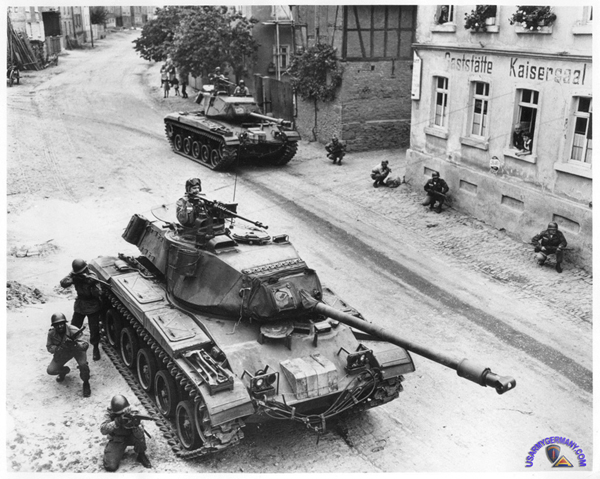
4th Infantry Division troops near Ockstadt during a field problem in 1954 |
| |
Other February Training
In mid-February, such things as rifle squad in the attack, platoon in the attack and both in defense, began to take the individual Ivyman's attention. At the same time, the 22d Inf Regt received its new 4.2 mm mortars and began training their heavy mortar company in earnest and a new heavy weapons school was opened for men of the same unit. The school offered a ten-week course in indirect fire, particularly in the use of the 75 and 57 mm recoilless rifles and the .30 cal machine gun.
On Feb. 10, a division-wide training program in preventive maintenance began at the request of Lt Gen Charles L. Bolte, Seventh Army CG. The two-day course was organized by the G4 section under Lt Col Vic Bodner.
As March drew near, all CW operators, switchboard operators and radio chiefs in the 8th Inf Regt attended one of two courses at a recent regimental communications school in Friedberg. Under the direction of Capt Robert Emrich, regimental commo officer, the school aimed at providing training in all spheres of communications. Tape recordings were made of the students in action, and a refresher course given in switchboard operation to insure familiarization with a new-type switchboard just installed by the regiment.
At the same time, the 1st Bn of the 22d Inf Regt began field training anew, this time stressing the use of tanks in the attack, coupled with company-level problems and platoon in attack and defense situations, culminating in an assault with live ammunition.
In mid-March, 1,800 troops of the 12th Inf Regt took to the skies in a climax to air transportability training at Rhine-Main Air Base. Two of the aircraft brushed wing-tips on the take-off but no damage was done to either.
The 22d Regt's 2d BN climaxed a 14-day field training exercise as March ended with a night attack problem lasting 12 hours. The training included firing of individual weapons at known distances. Individual weapons firing was augmented by qualification tests for 3.5-inch rocket launcher and the .30 cal and .50 cal machine guns. A physical training test finished the two-week activities.
One of the most highly praised training fixtures in the division at the time was the 12th Inf Regt's bayonet course, monitored by Gapt Emmet B. Lyle. The course is all uphill, 3,000 yards long, and incudes demolition charges for realism and barbed wire for increased difficulty. Sgt Argustus Kennedy summed ' up the EM's feelings when he said, "You can go through first half of the course using your physical strength, but it's guts and determination that gets you the rest of the way." The course was designed by Capt Karl Losey, regt'l training officer, and built by M Sgt Ismael Escobedo and his Mine and Anti-Tank Pltn.
Late in April, the biggest chapter in the 1952-1953 training story began to unfold as the entire division converged in sections and separate units on one of the U.S. Army's largest field training areas in Germany. From that time until mid-June, garrison life was reluctantly forgotten under the rigors of life in realistic field training.
Realism in the 8th Inf Regt's 3d Bn area exploded with a mortar shell in the Co K area, left over from World War II. For the first ten days of training, the 12th Inf Regt's S3 section had every platoon in the 1st Bn training specifically in day and night patrolling. "Aggressors" were used in the combat-type situations, which lasted anywhere from 30 minutes to two hours. Meanwhile, the 20th, 29th, 42d and 44th FA Bns and the 46th AAA Bn were taking classes and field instruction in Shell Reporting, and Crater Analysis, under direction of Maj Paul Gawkowski of 4th Div Arty Hq. In the 22d Inf Regt, problems ranged in size from squad and platoon to company and battalion.
Early in May, flame warfare techniques, including use of flame thrower and napalm, were taught to the division in field positions by a Div Hq Chem Section team headed by Maj Samuel T. Bonds, Div Chem Officer. Target training in the 4.2 mm mortar was tried and perfected by the 22d Regt. Hv Mtr Co, with 12 mortars able to deliver two rounds apiece, or 24 rounds, on the target simultaneously. Meanwhile, Tk Co of the 8th Regt was conducting (illegible) for both new and veteran drivers.
As May hurried on, Double-Time-On-Target tests were conducted by the 22d and the results added much to the effectiveness of the unit.
In the 12th Regt, a close combat course and transition range firing were witnessed by Lt Gen William Hoge, Seventh Army CG, touring 4th Inf Div installations accompanied by Maj (then Brig) Gen Joseph H. Harper. The generals saw company and battery size units of all three Ivy regiments, the 40th Tk Bn and 4th Div Arty go through their paces in the division-wide training exercises.
All Infantry units in the division also went through hand grenade training, bayonet drill, rifle grenade exercises, bazooka firing, camouflage training and endless foxhole and gun emplacement digging.
Tactical air command programs also hit all units of the division, with low-flying Piper Cubs simulating aircraft attacks and support for ground units.
As the training drew to a close, the picture came into focus for the troops. Larger units participated in larger-scale war games, such as battalions holed up in the ruins of an abandoned German town, awaiting an attack by "Aggressors" in force. Many lessons were learned as the men began to see where they fitted into their units in actual combat-style action.
A display of explosive demolition was given by the 4th Engr Bn, which unexpectedly touched off a small forest fire in the area. The demonstrators showed their own safety precautions as they quickly brought the blaze under control with a bucket brigade using helmets full of sand.
Training Period Ends
June's first two weeks brought the training to a close with major large scale problems, mostly on battalion level. Live ammo was the usual thing as the battalions smashed through full-strength problems in both attack and defense.
Climaxing the more than seven weeks of uninterrupted field training, Battalion and Regimental Hqs went into the field and participated with the rest of the division's foot soldiers in twelve and one-half mile forced marches. The marches usually started at 8 am and lasted four hours. Medical, Service and similar companies were in no way exempted from the training.
The 20th FA Bn turned up at the end of the program with top honors in battalion testing among the Division's FA Bns, after having fired every type of mission, including high angle, and with fire observed and adjusted from aircraft.
When the division returned to garrison later in June, training went on, but not at the 24-hour-a-day pace of the field.
During the year the separate companies -- 4th Recon, 4th QM, 4th MP, Div Hq and the Band -- and the 704th Ord Bn aided the entire division to a successful year in training as well as training themselves as they effectively accomplished their supporting roles. |
|
|
|
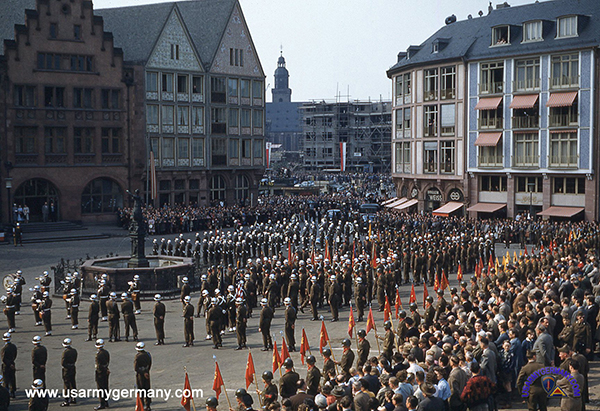
4th Infantry Division bids farewell to Frankfurt, Germany, May 1956 (Webmaster's collection)
(Click on the image to see a higher resolution copy) |
| |
| May 1956 |
| (Source: STARS & STRIPES, May 6, 1956) |
As the culmination of a week-long celebration of German-American Friendship, the 4th Infantry Division held a colorful farewell review parade in downtown Frankfurt on May 6, 1956.
2,000 troops of the division passed a special reviewing stand set up in front of the famous Römer, the city's town hall and one of its most important landmarks, where in the past German emperors of the Holy Roman Empire were crowned.
The 4th Inf Div Band and the drum and bugle corps from the 8th, 12th and 22nd Infantry Regiments opened the ceremonies. Also represented were the 4th Division Artillery and 4th Division Special Troops.
Among the digitaries present at the review were the commanding general of the 4th Inf Div, Maj Gen Rinaldo Van Brunt; Frankfurt Mayor Walter Leiske; the US Ambassador to Germany, James B. Conant; the commanding general of 7th Army, Lt Gen Bruce C. Clarke; the West German representative to CENTAG, Lt Gen Hans Speidel; and Maj Gen Helmuth Laegeler, West German Army commander.
The 4th Inf Div is being replaced by the 3rd Armored Division as part of Operation GYROSCOPE. The first major increments of the 4th Divison are scheduled to return to the U.S. later this month. |
 |
|
|
| Fourth
Division in Germany, 1951 - 1956 |
| |
 |
 |
Some of the images and information from the "Command Report to the Troops, 4th Infantry Division, 1951" and "4th Infantry Division, European Command, 1951-52" will be posted as soon as possible |
 |
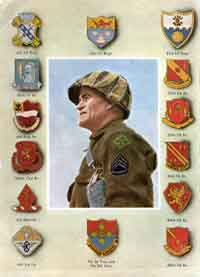 |
click on thumbnail to view larger image of the unit crests
Some of the images and information from the Famous Fourth in Germany, 1951- 1956 will be posted as soon as possible |
|
|
|
|
| 4th Infantry Division Troops |
| |
704th Ordnance Maintenance Battalion
40th Tank Bn
4th Engineer (Cbt) Bn
4th Medical Bn
. . . .
|
|
|
| 704th Ordnance Battalion |
| |
| 1953 |
| (Source: STARS & STRIPES, May 21, 1953) |
The 704th Ord Maint Co, Edwards Bks, Frankfurt, was reorganized and redesignated as the 704th Ordnance Battalion on April 9, 1953. First CO of the battalion is Maj Maurice V. Sargent.
The new battalion consists of a headquarters detachment and two lettered companies, A & B Company.
Company A -- commanded by Capt Donald Sears, is divided into three maintenance platoons. Each platoon is located near the regiment that it supports. The platoons are further broken down into small teams that provide instructor-inspector service, field repair, and assist as instructors in service schools pertaining to their specialties.
Company B -- commanded by Capt Phillip J. Robertson, is located near division headquarters (Frankfurt) and is divided into three platoons:
 Armament Pltn Armament Pltn
Wheel & Track Pltn
Service & Supply Pltn
The company maintains a repair shop that can handle anything from giant tractor trucks to making adjustments on delicate observation instruments. Shop officer is CWO Nonnie F. Dickenson. His shop has handled more than 6,000 job orders in the past six months. Mobile repair units assist the shop by traveling in vans that are equipped with lathes, drills, electric testing equipment and other modern tools.
An Ordnance Supply Point supervised by 1st Lt Thomas Davenport serves as the focal point for the Division's repair and replacement system. The supply unit handles over 80 tons of supplies weekly (up from 30 tons just five months ago). |
|
|
|
|
| |
| |
| |
| |
| |
|







.jpg)