Seventh
Army Logistics
7th Army
Looking for more information from military/civilian
personnel assigned to or associated with the U.S. Army
in Germany from 1945 to 1989. If you have any
stories or thoughts on the subject, please email me (webmaster).
|
|
|
|
|
| |
| History |
|
| |
|
 |
|
| |
| 7th Army Depots |
|
| 7th Army Engineer Depot |
| |
| (Source: STARS & STRIPES, April 14, 1954) |
The 7th Army Engineer Depot is located at Kaiserslautern and is responsible for supplying all (7th) Army units in the US Zone of Occupation in Germany with enineering supplies and equipment.
An average of 26 rail cars a week arrive at the depot with supplies that are classified, packaged and stored in four warehouses at the depot. A fifth warehouse is used to store 200,000 gallons of paint.
The 7th Army Engr Depot covers an area of 48,000 square yards. Six 20-ton cranes and a fleet of forklifts do the heavy work. The manpower of more than 200 officers and enlisted men is supplied by the 355th Engr Depot Company. |
|
|
| 7th Army Ordnance Depot |
|
|
|
|
| 7th Army Signal Depot |
| |
| |
 |
|
| |
| Project MASS (Modern Army Supply System) July 1956 - June 1958 |
|
| Chemical Corps |
| |
|
|
| Engineer Corps |
| (See articles on 521st Engr Gp's role in Project MASS.) |
|
|
| Medical Corps |
| |
|
|
| Ordnance Corps |
| (See articles on 19th Ord Bn's role in Project MASS.) |
|
|
| Quartermaster Corps |
| (See articles on Quartermaster units under the 2nd QM Group participating in Project MASS.) |
|
|
| Signal Corps |
(See articles on 160th Signal Gp's role in Project MASS.)
(See articles on 97th Signal Bn's role in Project MASS.) |
|
|
| Transportation Corps |
| (See articles on 181st Trans Bn's role in Project MASS.) |
 |
|
| |
| 7th Army Stock Control Center |
|
| (Source: STARS & STRIPES, August 3, 1956) |
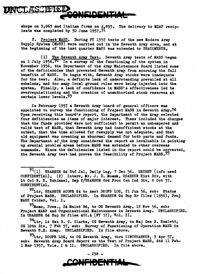
The test of US Army's Modern Army Supply System project was officially kicked off on July 2, 1956. Ordnance and Chemical were the first two technical services to initiate their tests.
Officer in charge of the project at HQ 7th Army (Vaihingen) is Maj Harold E. Maier, Chief of the Supply Section, G-4, HQ 7th Army.
The project calls for implementing a revised stockage plan where only fast-moving repair parts are stored in depots within the theater, while non-stocked (less frequently requested) items are requisitioned directly from depots in the States. The formerly slow pace of the supply system used by US Army forces overseas is being streamlined through the extensive use of electrical transmissions (see the article on the MASS Platoon of the 97th Sig Bn).
Prior to the implementation of Project MASS, 7th Army depots stocked about 400,000 items. With the housecleaning (elimination of less freqently requested items from the depots) allowed by Project MASS that number is being reduced to about 50,000 items. In addition, rapid transportation of the repair parts requisitioned from stateside depots is designed to get the parts to the using unit within 20 days.
7th Army Stock Control Center, Vaihingen -- Chief of the center is Maj Frank B. Huntley; |
|
|
| (Source: STARS & STRIPES, May 29, 1958) |
Planning for the Army's new logistics system was begun in 1952; Project MASS went into field test operation in July 1956 at 7th Army in Germany. That field test ends officially on June 30, 1958 when it goes into full operation (probably under a new name).
The heart of the new logistics system is its transceiver communications system, linked with the IBM 650 computer system (or in Wikipedia). This system eliminates hand-written paperwork for supply items that are shipped from the US to the 7th Army. The transceiver is an electronic machine operated at the DSU (Direct Support Unit) level - the machine codes the item required and transmits the request to the 7th Army SCC. The SCC refers the request to one of six BASEC depots. If the item is on hand, it will be shipped by the depot to the requesting DSU. If not, SCC passes the request via transceover to the Overseas Supply Agency in the US. Here it is passed on via tranceiver to one of the Army depots in the US.
If the item is shipped from the US depot by plane, it will arrive at Rhein-Main AB and then trucked or airlifted to the DSU. (Some items (e.g. special weapons items) are sent (US to Europe) on priority "blue-streak" requisitions within hours after receipt of the request.)
If the item is shipped by sea, it will arrive at Bremerhaven and from there expressed to a ComZ depot. From there it will be forwarded to the DSU.
The "brains" of the new logistics system is an IBM 650 located at the 7th Army SCC. This system processes data on magnetic tapes instead of using the older method of punched cards. OIC of the computer is 1st Lt Harry S. White. The 7th Army SCC is expecting a replacement for the IBM 650 in the future - the MOBIDIC, a mobile data processing system. (See additional information on MOBIDIC on the COMZEUR Page.)
Project MASS project officer is MAJ Harold E. P. Maier. CO of the 7th Army Stock Control Center in Zweibrücken is .... Chief of the Data Processing Division, 7th Army Stock Control Center, is Lt Col Albert R. Hoffman. |
|
| (See articles on 7th Inventory Control Center.) |
|
| MOBIDIC (Mobile Digital Computer) |
| |
| (Source: STARS & STRIPES, April 10, 1963) |
The first large-scale mobile computer system (called MOBIDIC) is recently been integrated into the 7th Army supply system and is now automatically processing supply data at the 7th Army Stock Control Center at Zweibruecken. (The tranition to the MOBIDIC system included a series of equipment acceptance and shake down tests that involved representatives from the contractor, Sylvania Electronics Products, Inc. and personnel of the 7th Army SCC. 7th Army SCC also wrote computers programs that run on the computer.)
7th Army SCC began operations in July 1958. At the time, the assigned mission of 7th Army SCC was to serve as the initial source for repair parts supply for 7th Army combat units and to provide timely supply status information to the staff and commander. (All of this was part of the Project MASS.)
The MOBIDIC system is mobile and air transportable. It is contained in four standard 30-foot Army trailer vans. The vans contain
 the high speed computer system;
 an off-line control system (performs routine functions concurrent with and independent of the central computer);
 tape transports;
 maintenance and support equipment .
|
|
| MASS Platoon, 97th Sig Bn |
|
| (Source: STARS & STRIPES, August 3, 1956) |
MASS Platoon of the 97th Signal Battalion operates the Transceiver Division of the 7th Army Stock Control Center at Vaihingen, Germany. This is the nerve center of Project MASS. The operators of the platoon work in a long building with many transceivers and other business machines that operate around the clock.
The SCC maintains a complete list (in a punched-card file) of all repair parts on hand in the 7th Army. The incoming requisitions from DSU's (direct support units of the technical services participating in Project MASS) are checked against the file electrically to determine if the part is available in 7th Army or if it must be ordered from the US.
The first step in processing the requisition received (as a signal transmitted via transceiver from the requesting unit) at the SCC is to reproduce the punched card on one of the transceivers that connect the Center with the DSU. Each transceiver can reproduce an average of ten cards a minute.
Once the punched card has been produced, it is added to a "deck" of punched cards with other requisitions received that day and sent by the Transceiver Division to the Machine Accounting Division also at the SCC. The actual check to determine of the part is on hand or must be ordered is done here. The "deck" is first sorted into number sequence on a business machine and then recorded (printed) on paper by a tabulator-printer for the day's permanent transaction record. Finally, the card carrying the order is matched with cards showing stock "on hand" in the 7th Army and stock "due in" from the US.
If the part is determined to be available, a "picking tag" card is made from the original requisition card and sent by transceiver to the appropriate depot ordering the part to be sent to the DSU.
If the part needs to be ordered from the US, a requisition is sent by radio-transceiver
to the Overseas Supply Agency in Brooklyn, NY.
Besides the normal day-to-day processing of parts requisitions, the SCC also checks a file of parts on hand in 7th Army depots. If an item drops below 75 percent of stockage level, the necessary replenishment is also ordered by transceiver to the US.
|
 |
|
|
|
Related
Links
|
| |