| If you do
NOT see the Table of Contents frame to the left of this page, then
Click here to open 'USArmyGermany' frameset |
||||
565th Engineer Batatlion |
||||
|
|
||||
|
||||
|
|
||||
| Battalion History | ||||
 565th Engineer Battalion DUI 565th Engineer Battalion DUI |
||||
| 1960 - present | ||||
| (Source: 130th Engineer Brigade website) | ||||
| The 565th
Engineer Battalion was reactivated on Jun 24, 1960, in
Karlsruhe, Germany, as part of the 7th Engineer Brigade supporting
the training of NATO defense forces. The battalion units consisted
of the 502nd Engineer Company (Float Bridge), the 809th Engineer Company
(Panel Bridge) and the 8594th Civilian Labor Group (Float Bridge).
In July 1975, the 535th Engineer Company (Light Equipment) was assigned
to the battalion with its permanent station in Grafenwoehr, Germany.
On Jun 30, 1976, the battalion was altered by deactivation of the
809th Engineer Company and the transfer of the 535th Engineer Company
to the 563rd Engineer Battalion. The assignment of the 93rd Engineer Company (Mobile Assault Bridge) to the 565th Engineer Battalion changed the mission support to the VII Corps to focus only on bridging. On Feb 21, 1977, the 502nd Engineer Company received the Ribbon Bridge, and was redesignated as the 502nd Engineer Company (Assault Float Bridge) effective Dec 16, 1978. These two redesignations made the battalion the first pure engineer battalion (Assault Float Bridge) in the United States Army. On Jun 17, 1985, the 563rd Engineer Battalion was inactivated and the 38th Engineer Company (Medium Girder Bridge) and the 503rd Engineer Company (Combat Support Equipment) were assigned to the 565th Engineer Battalion. This made the 565th the largest battalion in the 7th Engineer Brigade. On May 15, 1986, the 565th Engineer Battalion was deactivated and Task Force 565 was formed. On Aug 16, 1986, by authority of a VII Corps general order, the 565th Engineer Battalion (Provisional) was formed. On Dec 1, 1987 the 38th Engineer Company (MGB) and the 503rd Engineer Company (CSE) were transferred to the 237th Engineer Battalion, thus leaving the 565th a pure engineer assault float bridge battalion again. In Jan 1988, the 93rd Engineer Company received the ribbon bridge and was redesignated as the 93rd Engineer Company (Assault Float Bridge). On Oct 16, 1990, the 565th Engineer Battalion (Provisional) was activated and became the 565th Engineer Battalion supporting 7th Engineer Brigade and VII Corps. With the deactivation of the 7th Engineer Brigade on Jun 22, 1991, the 565th Engineer Battalion was assigned to the 130th Engineer Brigade and V Corps. On Jul 1, 1991, the 38th Engineer Company again joined the 565th Engineer Battalion (Assault Float Bridge), making it the 565th Engineer Battalion (Corps) (Bridge). On Sep 30, 1991, the 8594 Civilian Support Group was deactivated after 31 years of service. In May 1992, the 516th Engineer Company (Medium Girder Bridge) joined the battalion with a proud history. The 565th Battalion Headquarters and Headquarters Detachment was inactivated on 15 December 1993. V Corps reactivated the 565th Engineer Battalion on April 14, 1998 with the current organization consisting of the 502nd Engineer Company (Assault Float Bridge), the 38th Engineer Company (Assault Float Bridge) 1), the 320th Engineer Company (Topographic) and the Headquarters and Headquarters Detachment, 565th Engineer Battalion. All units are stationed in Hanau, Germany. 1) (Source: Email from Carrington Stoffels) I have a correction to the 565th En Bn page. The 38th Engr Co was a medium girder bridge company. I was the commander in 01-03 when we inactivated in Iraq 15 Sep 03. |
||||
|
|
||||
| 1973 | ||||
| (Source: Email from Edie Prost) | ||||
| My name is William (Bill) A. Prost. I was assigned to the 565th Engineer Battalion from mid 1973 to November 1975. I started out as the 502nd Engineer Company (Float Bridge) - M4T6 Float Bridge - Maintenance Officer until I got promoted to Captain in August 1974. Then I was assigned to Battalion S-4 as the Battalion Maintenance Officer and Neureut Kasern "Consolidated Dining Facility Officer.” There were two other Units under the 565th Engineer Battalion - 8594 CLG (Civilian Labor Group) having their "Class 60" Float Bridge and the 809th Engineer Company (Bailey Bridge) (Dry Span/Gap). In mid-1975 I was Designated the Battalion S-4. During my tour with the 565th Engineer Battalion, we Bridged the Rhine, Maine, Nechar, Mosel, and Danube Rivers. We also supported at least three REFORGER Exercises. Each year we provided Bridge train for the Combat Engineer Battalions within the 7th Engineer Brigade. Plus, we participated in NATO Float Bridge training events/competition. In 1975, we even built a completely “Dry Span” using Bailey, M4T6 and Class 60 Bridge components to cross the Danube River. (Not sure that had ever been done before or since). During my tour at Neureut Kasern there were a total of 7 Company size units (with Mess Sergeants) on the installation - the 72nd Signal Bn, the 565th Engr Bn (two Companies) and POMCUS (REFORGER Equipment “Stock Pile” Storage) Unit - the 8594 Engineer Company (CLG) was situated adjacent to the installation since they were not Active Duty US Army personnel. Neureut Kasern was about a mile from Smiley Barracks and the Military Family Housing Area (and the PX, Commissary, Gas Station, etc.) I have a lot more INFO and STORIES about my time in the 565th Engineer Battalion if you would like to know it/them. |
||||
| 1979 | ||||
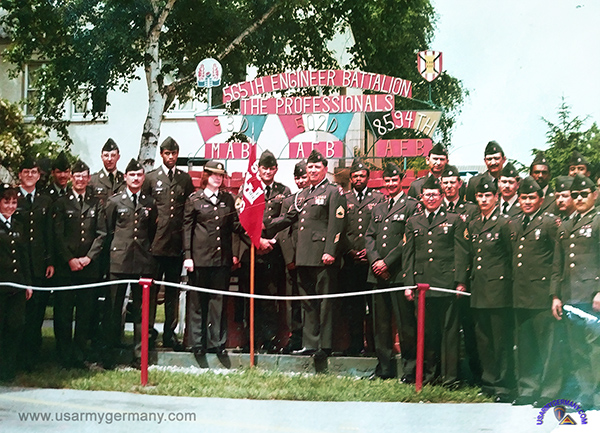 HHC, 565th Engr Bn group photo, 1981 (Ricky Pendergraff) |
||||
| (Source: Email from Ricky Pendergraff) | ||||
| I was assigned to HHC as admin specialist (71L) from early 1979 to late 1981. The most beautiful country I ever seen. Best duty of my 7 years. A few months before I arrived Karlsruhe had to be bridged because of a flood. Loved Armed Forces Day and bridging the Rhine River for foot traffic. LTC Dennis Culp was the Commander when I was there. The Company photo is from 1981. Some of the people in it: Capt Ruth Thomas, SFC Bill Clark, SSG Johnny Silva (my boss), SP5 Ricky Pendergraff (me), SP4 Phillip Bassett, SP4 Steven Whittaker (great friend), SP4 Onus Clark (roomie and great friend), PFC Greg Carlson. |
||||
| 1984 | ||||
| (Source: TOWN CRIER, October 5, 1984) | ||||
| 565th Eng. Bn. bridges the way for REFORGER, By Athena Petry | ||||
| More than halfway across Germany, tucked in and around small towns and villages with storybook characteristics, the 565th Engineer Battalion traveled to do their part for REFORGER `84. The annual Return of Forces to Germany exercise relocated the Neureut Kaserne soldiers to an area north of Augsburg where they assumed the task of bridging the Danube River so practicing troops from stateside units could exercise their maneuvering and fighting skills. During the first week, they donned the bands of the "orange forces" and then, the following week, the bands of the "blue forces" to signify the opposing forces they were sent to the field to support. According to CSM Kenneth Wojczynski, battalion sergeant major, the banks of the Danube are familiar to the men and women of the 565th Eng. Bn. Also, REFORGER is not the only opportunity the engineers have to go out and hone their skills to perfection. They have bridged many German rivers. The 565th Eng. Bit. is one of only two battalions in the Army taht is completely "float." It is made up of three companies, the 93rd Mobile Assault Bridge Company, the 502nd Ribbon Bridge Company and the 8594th Civilian Support Group Ribbon Bridge Company. The 565th Eng. Bn. is an element of the 7th Engineer Brigade. They also provide direct bridging support to the 7th Engineer Corps as well. 1st Lt. Luis Torres, executive officer for the 502nd Eng. Co., said the training areas the battalion uses are well planned. He explained that the areas they usually use for training are very realistic since they could be the same rivers they would be bridging in an actual conflict. Although the supervisors for the various units agreed that the training was fairly realistic, 1st Sgt. Buddy Bazzell, 93rd Eng. Co. added, "We'd like to have more crossing traffic once we get our bridges built." Approximately 85 percent of the entire battalion was in the field during the 2½ weeks the soldiers were away. They took with them 472 pieces of equipment to include several different types of wheeled vehicles, bridge parts and tractors. According to MSgt. Doug Masterson, HHD 565th, the 565th companies have more equipment per company than most battalions have total. During this recent exercise, the weather played a key role in the training. Although they bridged the Danube several times, they did not bridge it as much as they had originally planned due to the rising waters of the Danube river brought on by several days and nights of rain. In an actual conflict, they would have bridged it anyway, but for the exercise Torres said safety was a factor they would not ignore. The second weekend of the 2½-week field problem brought a lull in the action and, although the maneuvering was halted, the training for the 565th engineers was not. That weekend was devoted to individual soldier training of common tasks. When the soldiers were not training, they were busy with maintenance and catching up on much-needed sleep. Damaged equipment was either repaired on the spot or transported to designated maintenance areas for repair. There were incidents of maneuver damage to some equipment, but Bazzell said it was less than in previous years. He contributed this to "tighter control, more supervision and all the usual rules of the ball game." The training areas were also put through a maintenance cycle as roads and fields were repaired from damage caused by the heavy equipment and rain. The units located in lowlying areas, such as the 93rd Eng. Co., were plagued by mud that would bog down some of the heaviest vehicles. During these maintenance "breaks," it was business as usual said SFC Earl Sego, maintenance NCO for the 502nd Eng. Co. He said the equipment would be repaired with the expectation that "everything would be driven home." Good training, realistic location and better than adequate support meant an overall successful REFORGER for the troops of the 565th Eng. Bn. Enough to inspire Bazzell to state, "They say 7th Brigade leads the way. Hell, we are the way!" |
||||
| (Source: TOWN CRIER, October 5, 1984) | ||||
| Civilian sees field training in new light, By Liz Moore | ||||
| As a volunteer photographer/interpreter for the Town Crier, I was able to witness the 565th Engineer Battalion in action for REFORGER. In the past, I've always heard soldiers, upon their return from the field, make comments such as "it was so muddy," "1 hardly got any sleep" or "we didn't get to take a shower for days " All these comments, I thought, were grossly exaggerated. They were not kidding! That is exactly how it is and I lived for a weekend through it. While out tromping through the mud, I had the pleasure of meeting the 8594th Engineer Company, the German Civilian Support Group assigned to the 565th Eng Bn. Although they are civilians, they are tasked to do everything the Army does. In the beginning the Army had German employees only as security guards and mechanics. They were doing such a great job that in 1950, a German technical unit was formed. They were trained at an engineer school in Murnau, Bavaria, which is comparable to the Army's engineer training program. Currently, Karlsruhe's 8594th Eng. Co. and a German Civilian Support Group in Schwetzingen are the only bridge units in USAREUR. The commander of the 8594th, Maj. Hans Tollkuehn, was an interpreter for the 565th Eng. Bn. for 13 years before taking command of this company two years ago. Of his 159 civilians, 132 were in the field with him. According to the major, "We're ready for any mission, but it can't be completed without a day's worth of repairing" That was exactly how long it took his unit to repair minor problems on their vehicles. Forty-eight vehicles are assigned to his company and none are deadlined. This mis because his men don't rotate like regular soldiers, but stay for as long as they are employed by the company. Therefore, all of the men are very familiar with their equipment. Some of his key personnel have been with the engineer company since its beginning 34 years ago. Language never seems to be a problem between the German and American units. There is the basic terminology for all the equipment and everyone knows it. All the men seem to like their job and, as Tollkuehn said, with a smile, "we are proud to work with the U.S. Army and enjoy the atmosphere and the job that goes along with it. He wasn't the only person with a smile on his face when it came to talking about the Americans. Many residents, in the small towns surrounding the soldiers' camps, were overjoyed at having the Americans in town. One restaurant employee said, "The Americans are always a treat to have around. I never have to worry about them not paying or creating a disturbance. They are very decent people." I found this to be a common feeling among the German townspeople. They also didn't seem to mind sweeping their streets everyday after all the muddy vehicles went through the towns. In fact, many residents said they wish the Americans would come back more often. I was totally impressed by all that went on around me. After seeing the Americans at work in the field I felt very proud to be associated with them. I hope that all the family members and friends in Karlsruhe share this feeling of pride in what our troops are doing, when they are away from home on a training mission. (Editor's note: Liz Moore is the program director for sports, Morale Supprt Activities.) |
||||
| 1985 | ||||
|
||||
If you have more
information on the history or organization of the 565th Engr Bn, please
contact me . . |
||||
 |
||||
|
|
||||