| If you do
NOT see the Table of Contents frame to the left of this page, then
Click here to open 'USArmyGermany' frameset |
|||||||||||||
|
Supreme Headquarters, Allied Powers Europe |
|||||||||||||
|
|
|||||||||||||
|
|||||||||||||
|
|
|||||||||||||
| History | |||||||||||||
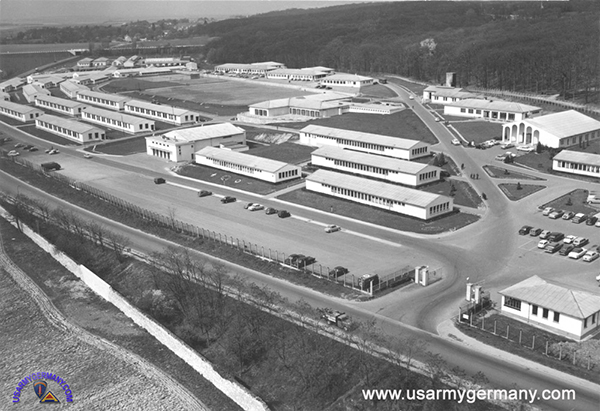
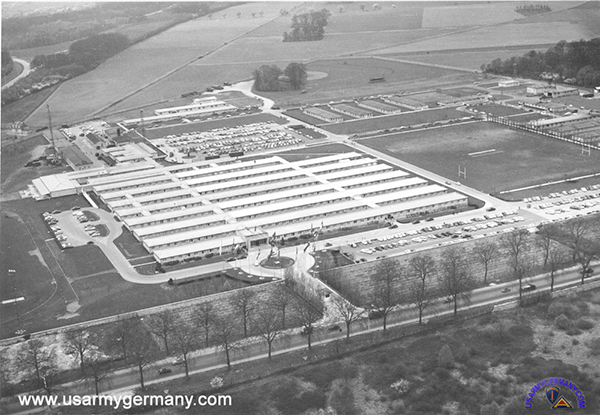 Supreme Headquarters, Allied Powers Europe, Rocquencourt, France (John McCulloch) |
|||||||||||||
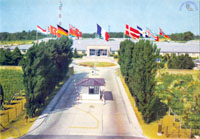
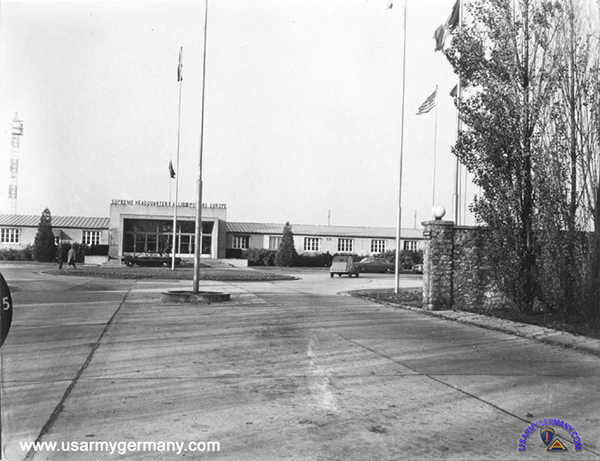 Main gate, Headquarters SHAPE (John McCulloch) |
|||||||||||||
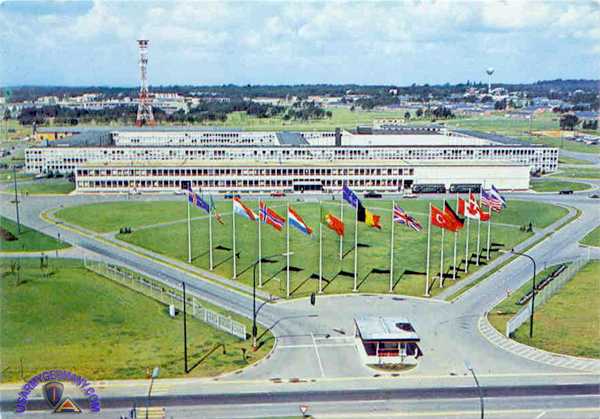 Supreme Headquarters, Allied Powers Europe, Casteau, Belgium (probably late 1960s) |
|||||||||||||
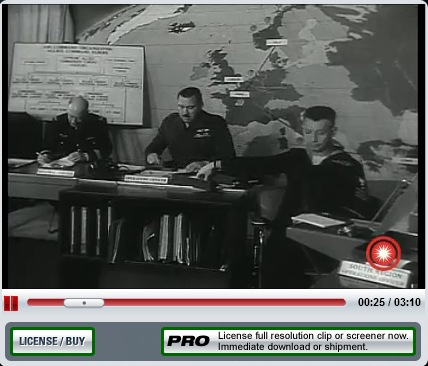 SHAPE Operations Center and the Forward Scatter System (CriticalPast website) |
|||||||||||||
| 1950 - present | |||||||||||||
| (Source: www.shape.nato.int, 1998) | |||||||||||||
| SHAPE History The Origins of SHAPE Fourteen months after the allies signed the North Atlantic Treaty the Korean war erupted in June 1950, increasing fears of a Soviet attack on Western Europe. The US government was concerned about its European allies' willingness or ability to defend themselves should such an attack occur, because most European countries were in the throes of a painful post-war economic and social reconstruction. Furthermore, in the summer of 1950, the alliance possessed only an extremely limited organisation. No NATO military commanders had been appointed, NATO military HQs or commands established and all the allies' military forces remained under national control. The US took the lead galvanising the alliance. In autumn 1950, the US Secretary of State proposed to the NATO allies establishing a large integrated military force, consisting of units contributed by individual nations, including West Germany, controlled by a centralized military organisation which would administer and train those forces under a single NATO commander. This was a radical proposal and after some hesitation, NATO Foreign Ministers approved Mr Acheson's proposal, with the exception of German participation. They agreed to appoint a Supreme Commander supported by an international staff. He would be delegated limited authority to ensure that national units assigned to his command were organised and trained into an effective force. In mid-December 1950, the allies unanimously asked President Truman, who agreed to nominate GEN Eisenhower as the first Supreme Commander Allied Powers Europe. Eisenhower was chosen because of his immense prestige and experience as the Supreme Commander of Allied Forces in Europe during the Second World War. His wartime experience of the politico-military difficulties involved in welding and maintaining a cohesive multinational military command structure (SHAEF) and force was to stand him in good stead while establishing SHAPE and guiding it through its first year of existence. Furthermore, Eisenhower, as were to a lesser extent his successors, was the embodiment of American power, political commitment and military presence in Europe. Eisenhower appointed a wartime comrade, GEN Gruenther, as his Chief of Staff, who assembled a small group of US officers in Paris to establish a temporary HQ and establish his new HQ and command. This group of primarily US officers was called the SHAPE Study Group and established itself in the Hotel Astoria in Paris, not far from the Etoile. The hotel was chosen because it was used by a US communications detachment and the site guaranteed the excellent communications required. However, the hotel's location in the centre of Paris caused numerous security problems and it soon became too small for the SHAPE Study Group, let alone the SHAPE staff when they began arriving. One result was that bathrooms were used as strong rooms to store classified information. Several countries were considered for the site of SHAPE's permanent HQ. However, countries in northern and southern Europe were considered too isolated from the rest of the command, Britain was not part of continental Europe - a psychological disadvantage for an HQ responsible for the defence of Europe - and West Germany was not a NATO member and considered too close for comfort to Soviet controlled territory. Therefore, Eisenhower's staff recommended locating SHAPE in France because it was more central than other contenders. |
|||||||||||||
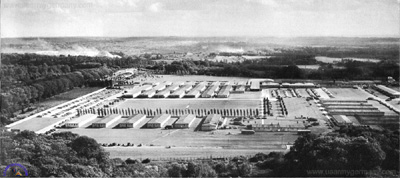 Rocquencourt, France, mid-1960s (  ) ) |
|||||||||||||
| Ike's staff selected a site at Rocquencourt in the Versailles suburb of Paris. They did so not so much for the city's renown, but primarily because of the excellent communications it offered. Furthermore, the Versailles area used the same automatic switch communications equipment as the SHAPE Study Group, facilitating the implantation of the new HQ and its vital communications requirements. The site had the additional advantage of being part of the French President's pheasant shoot. In February 1951, the French Minister of Defence approved the site at Rocquencourt as the location for SHAPE's permanent HQ. Buildings were quickly constructed and the new HQ was handed over to SHAPE on 23 July 1951, at a cost of 733 million French Francs. | |||||||||||||
| Meanwhile, on 2 April 1951, narrowly avoiding April Fool's day, GEN. Eisenhower established SHAPE. It comprised 183 officers from 9 nations of the 12 NATO allies, Portugal and Luxembourg sent staff to SHAPE later, Iceland has no armed forces. The predominant nation was the US with 100 officers. The remaining 83 officers comprised 27 French, 26 British, 10 Italians, 7 Belgians, 5 Dutch, 3 Danes, 3 Norwegians and 2 Canadians. The army was the predominant service with 126 posts. Airforce officers occupied 34 posts and naval officers 23. Of the senior posts, the two most influential were SACEUR and the Chief of Staff, both American. Field Marshal Montgomery from Britain was the Deputy SACEUR and British and French officers were Deputy Chiefs of Staff. Of 7 Assistant Chiefs of Staff, 3 were British, 2 French, 1 Italian and 1 American. In 1952, Greece and Turkey, followed by West Germany in 1955, joined NATO and all three nations sent officers to SHAPE, bringing the number of nations represented at SHAPE in the mid-1950's to 12. One of Eisenhower's major lasting influences on SHAPE was his exhortation that SHAPE staff's loyalty was not to their nation, but NATO and SHAPE. As he explained to Belgian leaders early in 1951 he considered himself "one twelfth Belgian" (at that time NATO comprised 12 nations). Eisenhower emphasised that his staff represented all service and member nations "Here we know ourselves as a single entity in carrying out the objectives of NATO and in building up a strong defence for the purpose of preserving the peace. Actually, for the purpose of operation, we shall set aside our individual nationalities." Eisenhower's Chief of Staff, GEN Gruenther, acknowledged the difficulties involved ensuring that staff served the allied, rather than their national cause, "we consider that an officer who comes to the staff doesn't become so overnight, it can be done in time however..." |
|||||||||||||
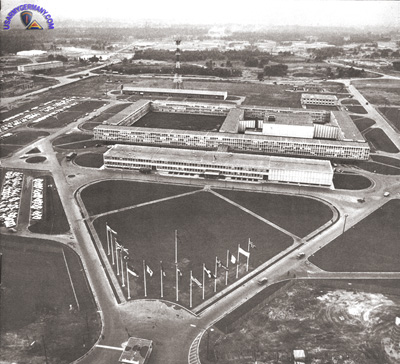 Casteau, Belgium, 1967 |
|||||||||||||
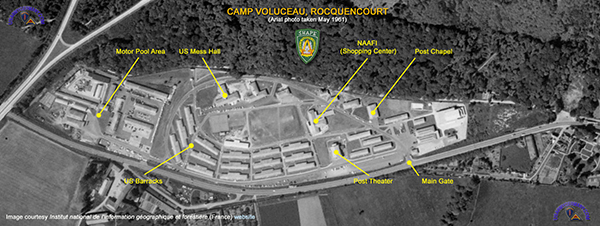
| The Relocation of SHAPE from France to Belgium On 21 February 1966, President de Gaulle publicly stated he intended to radically alter France's participation in the Atlantic alliance. Shortly after, on 10 March 1966, the French government indicated France would withdraw from NATO's integrated military command structure. NATO and other allied military headquarters and installations therefore had to leave French territory by 1 April 1967. The majority of French military personnel departed the various NATO military headquarters by 1 July 1966. However, some French servicemen in communications and support functions remained until 1 October 1966. On 7 September 1966, the SHAPE Relocation Team was established in Brussels to ensure close coordination with the Belgian authorities involved in relocating SHAPE in their country. In mid-September, the Belgian government agreed to build by 1 April 1967, adequate buildings to accommodate SHAPE's immediate occupancy and operational needs, and complete other construction by 1 September 1967. The Belgian government chose the Casteau site for SHAPE because:   it comprised 200 hectares of "terrain militaire", land owned by the state, thereby eliminating the lengthy and expensive process of purchasing land; it could be served by the Belgian air base nearby at Chievres; and it would have rapid access to NATO HQ (which would move from Paris to Brussels) once work was completed on a new autoroute between Mons and Brussels (planned to begin in late 1967). it comprised 200 hectares of "terrain militaire", land owned by the state, thereby eliminating the lengthy and expensive process of purchasing land; it could be served by the Belgian air base nearby at Chievres; and it would have rapid access to NATO HQ (which would move from Paris to Brussels) once work was completed on a new autoroute between Mons and Brussels (planned to begin in late 1967). Last but not least, the Borinage region urgently needed "inward investment" to compensate for the decline and closure of its once famous coal mines and other traditional industries. Construction work began at Casteau on 14 October 1966, by a Belgian consortium of Association Momentanee, SOGEMAP-Group, ALPHA-ELECTROBEL-GIBBS and HILL. The first building to be completed was the Communications Centre on 15 December 1966. When President de Gaulle announced France was withdrawing from SHAPE, the HQ comprised: 1,025 personnel (431 officers, 436 other ranks, 158 civilians); 1,412 support staff., and 344 local wage rate staff of whom 277 were French. The latter comprised gardeners, electricians, drivers, plumbers and painters. SHAPE's relocation from Rocquencourt (on the western outskirts of Paris) to Casteau was conducted in three main phases: the move of a reconnaissance team to Belgium; the deployment of the main staff body to Casteau (staggered throughout March 1967); and the final closure of SHAPE's facilities in France by the "Termination Group". The staff's main objective was to ensure a timely transfer of satisfactory command and control facilities from the old to new HQ. SHAPE staff removed from Rocquencourt all movable items (office stationery and equipment), economically movable communications facilities, and non-NATO funded property belonging to the allies (except France), including national and international stores. SHAPE vehicles, augmented by commercial contractors, were used to transport the equipment and stores. Classified information was kept in safes and transported by military vehicles under military escort and Gendarmerie convoy. The first equipment transfer occurred on 22 November 1966, when military vehicles moved supplies from SHAPE-France to Brussels for use by the SHAPE Relocation Office. On 29 December 1966, the first communications equipment was transferred from France to Casteau. Official SHAPE vehicles took the following route from Paris to Mons: Autoroute du Nord, N-29 to French/Belgian border crossing at Quievrechain (at which point Belgian Gendarmes took over the responsibility for escorting convoys of classified material), N-22 to Mons and then N-7 to Casteau. A daily shuttle bus service between SHAPE-France and SHAPE-Belgium began on 31 March 1967. The relocation required about 884 vehicle journeys between Rocquencourt and Casteau - SHAPE military vehicles made approximately 340 and commercial vehicles, 354 journeys. Approximately 22,411 metric tons (or 788 standard modem containers) of supplies, equipment and household goods were moved. On 30 March 1967, the flags were lowered at SHAPE-France, and the next day a flag raising ceremony took place at SHAPE-Belgium. When SHAPE opened in Belgium, all Phase I buildings were complete or ready for occupancy, and all basic utilities operating. At the end of 1967, the cost of construction at SHAPE-Casteau was approximately 1,649 million Belgian Francs (shared amongst the members of the integrated military command structure). The French authorities agreed that SHAPE families could stay in France until the end of the 1966-67 academic year to permit children to complete their studies. By 1 April 1967, 1,935 staff members had left Rocquencourt and approximately 4,000 dependants remained. By 1 July 1967, 415 SHAPE staff - to oversee closing down facilities and negotiate with the French authorities - and approximately 2,000 dependants remained in the Paris area. Camp Voluceau (the SHAPE Support Group) closed on 8 September 1967, and the last household goods were transferred on 14 December 1967. |
|||||||||||||
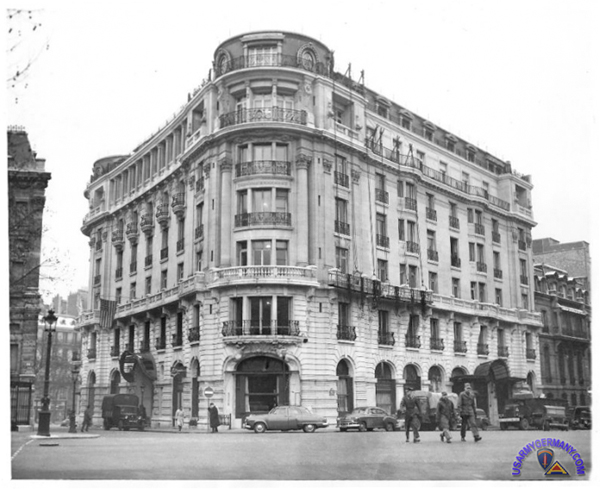 Hotel Astoria, initial site of HQ SHAPE, Paris (early 1950s) |
|||||||||||||
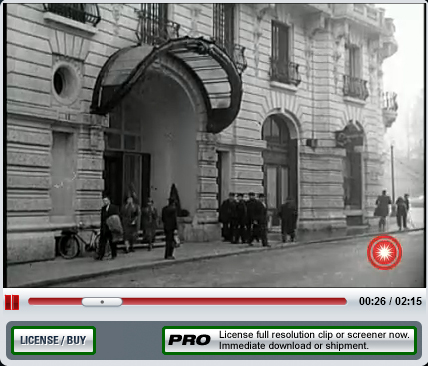 Hotel Astoria, initial site of HQ SHAPE, Paris (CriticalPast website) |
|||||||||||||
| 1951 | |||||||||||||
| On April 2, 1951 General Eisenhower signed the activation order for Allied Command Europe and its headquarters at SHAPE. Supreme Headquarters, Atlantic Powers in Europe (SHAPE) was initially set up in the Hotel Astoria on the Champs Elysées, Paris, France. The site was to be temporary while construction of a permanent facility began in the Parisian suburb of Rocquencourt. Gen Dwight D. Eisenhower, the first commander of SHAPE, arrived in Paris in January 1951 to set up the SHAPE headquarters at the hotel. Headquarters, Allied Forces Central Europe (AFCENT) was activated in Fontainebleau, France in 1953. On the same day ACE’s subordinate headquarters in Northern and Central Europe were activated, with the Southern Region following in June. |
|||||||||||||
| 1961 | |||||||||||||
| (Source: Email from John A. McCulloch) | |||||||||||||
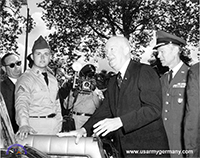
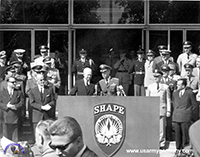
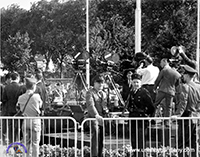
| At HQ SHAPE, 1961-63. I was assigned to the Photo Lab, Bldg 42, during that time. On August 8th, 1962 former President Eisenhower came to SHAPE. Finally, after the speeches and press photographs that August, Ike headed fast, -=alone=- towards his car. I was near the rear bumper and opened the door, then tried to step back - but slammed into the Secret Service bozo and couldn't move! By then all had caught up and one of the other SHAPE photogs took the shot. Thankfully, several saw me try to step away and why I was there - got called to General Norstad's office and lightly 'chewed'! I could only ask if I should have let him open his own door as NO ONE made any move to do so. Damned if you do, damned if you don't! My main purpose that day was to set up the audio to the SHAPE 35mm film cameras, the two Wall cameras in the center of the press photo, with large white tape on the magazine canisters. After that, I also carried a Speed Graphic to 'get any shots I could.' Somewhere I have both President Kennedy and Queen Elizabeth visiting SHAPE. Have to find them, they're 30x40 mounted, so I'd have to photograph the photographs! Most of the time, as there was NO work for me in my specialty [audio recordist] I worked as a photographer, in the lab, photo supply room or night security photographer. In the latter [a period of about 14 months], I'd come in just before 5 PM, finish the prints in the washer, [develop and print any shots I'd taken that day while out on pass], clean the lab and go to sleep. The Gendarmes would call and wake me if there was a need for photographs [accidents, crime, etc.]. Return from any such call out, develop the negatives, label, print 3 sets, write a report and have it all on the Captain's desk when he arrived at 9 AM. Also put fresh chemicals into the trays and set the coffee going. As it was a 16 hour shift, there were two of us on 'night duty'. We 'worked' Thursday and Friday nights, off the weekend unless we drew the 'Weekend Duty' as all would do in rotation, then work Monday, Tuesday and Wednesday night. Then OFF on full pass until the following Thursday. Had to call in at 5 PM in case the other guy didn't show [never happened] - so essentially a week on, a week off. Not too bad duty for a 21-22 year old PFC! |
|||||||||||||
|
|||||||||||||
| (Source: Author's private collection) | |||||||||||||
|
|||||||||||||
 |
|||||||||||||
| MISCELLANEOUS SHAPE UNIT CRESTS | |||||||||||||
|
|||||||||||||
|
|||||||||||||
| (Source: Author's private collection) | |||||||||||||
|
|||||||||||||
| (Source: Online biography of BRIGADIER GENERAL WILLIAM E. GERNERT, Air Force website) | |||||||||||||
| SHAPE Operations Center (SHOC) After graduating from the Armed Forces Staff College in August 1955, Brigadier General William E. (Bill) Gernert (1970) was assigned to the Supreme Headquarters Allied Powers Europe with duty in London for one year and then in Paris where he established the SHAPE Operations Center and served as chief during the center's first two years. |
|||||||||||||
 |
|||||||||||||
|
|
|||||||||||||
| NATO/SHAPE Support Group | |||||||||||||
| (Source: 80th Area Support Group web site) | |||||||||||||
|
80th
ASG History
The NATO/SHAPE Support Group [U.S.] was activated on 1 April 1967 in Brussels and moved to Caserne Daumerie later that year. (On December 31, 1967, Chièvres Air Base was reassigned to SHAPE and the Americans established the NATO/SHAPE Support Group (U.S.) there.) The organization is now called the 80th Area Support Group [NATO/SHAPE Support Group]. The commander is both U.S. Military Community Activity, Belgium Commander and the U.S. Community Representative. In meeting the special demands of this international environment, the 80th ASG maintains a subordinate 254th Base Support Battalion in Schinnen, The Netherlands, and an Area Support Team [NATO Support Activity] in Brussels, Belgium. The 80th ASG also supports communities in the areas of Luxembourg, France, the United Kingdom and northern Germany. |
|||||||||||||
|
|||||||||||||
|
|
|||||||||||||
| 7th Signal Service Battalion | |||||||||||||
| 1953 | |||||||||||||
| (Source: STARS & STRIPES, June 24, 1953) | |||||||||||||
7th Signal Battalion |
|||||||||||||
|
|||||||||||||
| Related
Link |
|||||||||||||
 .
.