| If you do
NOT see the Table of Contents frame to the left of this page, then
Click here to open 'USArmyGermany' frameset |
|||
|
30th
Medical Group |
|||
|
|
|||
|
|||
|
|
|||
| 30th Medical Group History | |||
| 1955 - Present | |||
| (Source: 30th Medical Group History) | |||
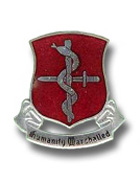 30th Medical Group DI
Post-WWII After V-E Day the 30th Medical Group was assigned responsibility for supervising the hospitalization of repatriated allied military personnel, prisoners of war, and displaced persons in an area of approximately 350 square miles (Webmaster Note: in the 9th Army zone), embracing the cities of Wittenberg, Salzwedel, Hannover, Braunschweig and Magdeburg, Germany. After accomplishing this mission the Group was moved to Koppel, Germany, near the college town of Marburg to prepare for redeployment to the Pacific Theater. The Group departed Germany on 27 June 1945 for Camp Philadelphia near Rheims, France, for processing of personnel and equipment. It departed that station on 8 August 1945 enroute to the Calais Staging Area near Marseilles, France. While at the staging area the war in the Pacific ended, and the Group received orders reassigning it to CONUS. The unit departed Marseilles on 20 August 1945 aboard the USAT Boronqueen, arrived in New York on 30 August and proceeded to Camp Kilmer, NJ. Germany 1955 and beyond On 21 February 1955, the Group - at zero strength - was transferred to US Army, Europe as replacement for Headquarters, 95th Medical Group. The 30th was assigned to Seventh Army with station at Landstuhl Army Medical Center, Landstuhl, Germany in accordance with GO #10, Headquarters, Eighth Army (Forward) (it had been stationed in Korea) and GO #231, Headquarters, USAREUR, 1954. On that same date, the Group acquired by attachment two Evacuation Hospitals, three Surgical Hospitals (Mobile, Army), a Medical Battalion (Separate), five Medical Companies (Separate), two Medical Companies (Hcptr)(Amb), seven Medical Detachments (OA-KI cells), and three Labor Service units (German), all in a training status plus one Evacuation Hospital (operational) attached for training only. The 30th Med Group performed its normal mission at this station and was in support of Army troops in the rear of VII Corps. On April 1, 1955, Headquarters, 30th Medical Group moved from Landstuhl to its present location in Ludwigsburg, Germany. Attached units consisted of one Medical Battalion, two Surgical Hospitals, one Evacuation Hospital, a Preventive Medicine Company, a Medical Company (Air Ambulance), and eight Medical Detachments (OA). Members of the 30th Medical Group accompanied the task force to Lebabon from 26 July - 14 October 1958. Elements of the 30th Medical Group have performed distinguished service while providing relief to flood stricken areas in Somali, 26 November 1961 - 7 January 1962; Tanganyika, 26 April - 19 June 1962; and Morocco, 8 - 13 January 1963. Group personnel also participated in missions to the earthquake disaster areas of Iran, 5 September - 5 October 1962 and Yugoslavia, 27 July - 15 August 1963. In June 1965, the Headquarters, 30th Medical Group and its attached units were released from assignment to Seventh Army and reassigned to Headquarters, 7th Field Army Support Command. Effective 1 September 1965, the Group was further attcahed to Headquarters, 7th Medical Brigade and in 1974, the 30th Medical Group was assigned to 2nd Support Command (Corps) and given the mission of providing medical care to VII Corps. On 21 June 1976, the 30th was reassigned to the US Army Medical Command, Europe, the predecessor of 7th Medical Command. HHD was further reassigned to VII Corps on 21 October 1978 and then 3rd Corps Support Command on 17 October 1991 (after VII Corps had been inactivated). The 30th Medical Group was reorganized as the 30th Medical Brigade per Order #175-5, dated 25 October 1991, effective 16 March 1992. The unit still serves in Germany as an element of V Corps. |
|||
If you have more
information on the history or organization of the 30th Medical Gp,
please contact me . . |
|||
 |
|||
|
|
|||
| (Source: The Champion, August 30, 1989) | |||
| 30th Med history
told The 30th Medical Group dates from October 1, 1933 when it was constituted in the Regular Army as the 30th Medical Regiment (Armored). It was called into active service at Camp Berkley, Texas, on July 25,1942 and was redesignated as the 30th Medical Group on September 1, 1943. The unit was transferred to Liverpool, England in 1944 and left from there for Omaha Beach, where it provided support to the staging area at Valogne. On December 4, 1944 the Group reassigned to the Ninth Army in support of actions in the Rhine and Ruhr Valleys and in the drive to the Elbe River. After the war the 30th Medical Group supervised the hospitalization of repatriated allied military personnel, prisoners of war and displaced persons. Upon completing this mission, the unit returned to CONUS where it served in a training status at Camp Swift, Texas, Camp Polk, Louisiana and Fort Benning, Georgia. It was deactivated at Fort Benning in 1949. In 1953 the Group was reactivated in Korea where it coordinated the operation of all medical units in 8th Army area, as well as providing primary medical and dental care and evacuation for UN troops. The unit was awarded the Meritorious Unit Commendation for this action. In 1955 the Group was transferred to USAREUR, assigned to 7th Army and stationed at Landstuhl Army Medical Center. In addition to its training mission it supported Army troops in the rear of VII Corps. In 1955 the Group moved to Coffey Barracks, where on September 1, 1965 it was attached to Headquarters, 7th Medical Brigade. In August 1973, the Brigade Headquarters was deactivated and the Group became directly subordinate to Headquarters USA Medical Command. October 26, 1979, 30th Medical Group was transferred to 2d Corps Support Command, VII Corps and now consists of HQ and HQ Detachment, two Combat Support Hospitals and two Medical Companies. The mission of the Group is to furnish health services support to all VII Corps units and other U.S. or allied forces in the sector as directed. |
|||
|
|
|||
| (Source: Jon Bacon, 10th Trans Gp (Hwy Trk), Hq/Hq Det, 4th Trans Bn; 590th Trans Co; 47th Med Det (HA); 4th Surg Hosp(MA); Co C 547th Engr Bn (Bridge Builders) | |||
| After a serving at Flak Kaserne in Ludwigsburg in the 10th Trans
Grp, 4th Trans Bn HQ Det and 590th Trans Co, I transfered to the 47th Med
Det (Helicopter Ambulance), Illesheim Installation for a short time in late
1960. Then I transfered to the 4th Surgical Hospital (Mobile Army) in the
same building as Headquarters, 30th Medical Group at Krabbenloch Kaserne in
Ludwigsburg, Germany.
In 1960 I was tranfered to Luwigsburg. We flew over Regensburg (what a
view!) and "Whiskey Outbound"
(http://www.ansbach.army.mil/locallandmark.htm) on the way to Ludwigsburg. At the 47th Med Det, I remember a seat of the pants pilot / CO but I am not sure of his name. I worked for 1st Lt Dan Acosta and SFC William G. Tulloch. I was supposed to be a clerk even though I was not trained for it. I remember Pelar Garza (Pilar), Sp/5 Bob Shine, Sp/4 Albert Cassady, Sp/4 Taylor, Pvt. William E. McKee, Pvt John P. Lucore and Cree. I think McKee and Lucore were promoted when I was there. Some of the men and a chopper or two were TDY or lived off site and worked away from the Hanger so I did not get to know them. I remember seeing the painted over 8th Infantry Division insignia on one of the Choppers. Someone said that one of ours was leaking and the 8th Inf CO's was "taken" as a replacement. The old lady who took care of our barracks always came in the morning saying "aufstehen" until Lucore would say "Get out so we CAN aufstehen". She always smelled of BO so someone gave her a new bar of soap. She still smelled bad after that. Someone said she sold the soap. In the 30th Medical Group, I worked for Master Sergeant Maskel of 30th Med Group training as an Audio Video operator. I was licensed at the AAFES school in Munich and received my Methods of Instruction training at 30th Group. We provided training to medical and non-medical officers in Med units. Otherwise I worked in 4th SHMA Pharmacy Lab and X Ray. Sometimes I worked for the German-American Affairs Activity. 128th Evac was in the next building. Then I transfered to Co C, 547th Combat Engineer Bn (Bridge Builders) at Kelley Barracks in Darmstadt. We trained on various bridges and field maneuvers and we spent part of the winter in Mannheim building a tent city for the Berlin Crisis troop movement. In Combat Engineers, the CO found that I was good at electronics so I worked in Radio Maintenance. That I could do. In Sep 1962 I rotated back to the States 6 months late because of the Berlin and Cuban crisis. In 1963 I enlisted again and attended Signal school at Ft Monmouth and continued service in Hawaii 'til 1966. I served for 3 years mostly in Europe and then 8 months reserve and then another 3 years active mostly in Hawaii. After the Army I worked for Department of Defense High Priority Army Communications in the West Pacific and Air Force Communications in Western Alaska. I have been in Industrial and Aerospace Electronics since then. I currently work with Flight Management Systems. Jon Bacon |
|||
|
|||
|
|
|||
| 56th Medical Battalion | |||
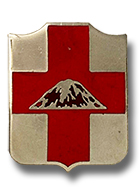 56th Medical Battalion DUI 56th Medical Battalion DUI |
|||
| 95th Medical Group | |||
| 1952 | |||
| (Source: STARS & STRIES, June 15, 1952) | |||
| The 56th Medical Battalion (Sep) at Schwäbisch Hall recently celebrated its 11th anniversary since being activated and its first anniversary of its reorganization. Lt Col Willard E Thompson is the current battlion commanding officer. The battalion is comprised of the following units:   Hq & Hq Detachment, Schwäbisch Hall 184th Medical Collection Company (Sep), Schwäbisch Hall 546th Medical Clearing Company (Sep), Schwäbisch Hall 556th Medical Ambulance Company (Sep), Schwäbisch Hall 926th Medical Ambulance Company (Sep), Schwäbisch Hall Hq & Hq Detachment, Schwäbisch Hall 184th Medical Collection Company (Sep), Schwäbisch Hall 546th Medical Clearing Company (Sep), Schwäbisch Hall 556th Medical Ambulance Company (Sep), Schwäbisch Hall 926th Medical Ambulance Company (Sep), Schwäbisch Hall |
|||
| (Source: Email from Gerald T. Pierce) | |||
| I was a member of the 56th Medical Battalion, the 546th Medical Co. (Clr)(Sep) from August, 1952 until February, 1955. I first arrived in Germany in August, 1952, and was sent to the 546th Medical Co which was located in Hessental, just outside Schwabisch Hall. In October of that same year the entire battalion was transferred to Crailsheim, which was a brand new base, just opening. My first 2-3 months in Crailsheim was not too pleasant. Since we were the only outfit on the base, we had guard duty about once a week until an engineering outfit moved on base. I remained in Crailsheim working in the supply room, until 1955; my last assignment was Supply Sergeant. While in Crailsheim, I married my wife and we have now been married for 54 years (2008). We have returned to Germany many times, my wife still has a sister who lives in Crailsheim. |
|||
| 30th Medical Group | |||
| 1966 | |||
| (Source: Email from Bill Thomas, 595th Med Co (CLR), 1966-68) | |||
| I wrote you some time ago about components of the 30th Med. Group not included in these writings. I was a part of the 595th Medical Co. (Clearing) which was part of the 56th Med. Battalion which was part of the 30th Med Group. Other companies in the battallion were, as I recall, the 546th Medical Co. CLR, and three ambulance companies, and a HQ CO. I was assigned from 1966-68 at Wharton Barracks in Heilbronn, Germany and then relocated to McKee Barracks in Crailsheim, Germany. Everyone was relocated back to the states in early 1968 as part of something called Operation Reforger. As I recall, this was the relocation of about 100K troops back to the US. I'm vacationing in southern Germany this summer and will visit Heilbronn and Crailsheim. I have not been able to get much current info about the status of those posts. I have been able to contact the son of the people my wife and I lived with off-base. We are to meet him and his brother and sister while we are there. I shared some names of a few people I remembered in my earlier writing. One exercise I remember took a special unit from my company to Moron and Zaragosa, Spain in support of a joint airborne exercise. ADDITIONAL INFORMATON Thanks for returning my email so quickly. There appears to be a sizeable void in information about elements of the 30th from 1965-'75. I might have some information about some of the units' locations and duties from 1966-'68. Group HQ was in Ludwigsburg in 1968. I remember because I had to take a complaint to the IG and was interviewed there. I'm not certain the 595th Med CO Clr was part of the 56th Medical Bn. It might have been the 51st. Either way, we were made up of two clearing companies (field hospitals) and three ambulance companies. I think I remember the 417th was one of them. Wharton Barracks in Heilbronn was my initial post. With the change from 7th Army to the 7th Medical Brigade, the entire battallion was assigned to Crailsheim in early/mid 1967. All elements of my battallion were sent back to the states in '68 as part of something called "Operation Reforger", part of 100,000 troops being sent back to bases in the US. My company was assigned to Ft. Devens. I don't know where the other elements were assigned. I was given an early release to go to college in August of 1968. I was part of a unit activated to go to Israel during the 6 Day War of 1967. We got as far as the tarmac of an air base, waiting for a C-130 to take us to Israel for medical support.. We were being issued as many clips of live ammunition as we wanted when word was sent down the war was over. Beyond that, it was limited to a 30 day TDY to Spain for medical support of a joint Spanish/US airborne exercise, and monthly drills in the woods to set up our equipment, and 90 day TDY assignments at hospitals and dispensaries. I was TDY to the 5th General Hospital in Bad Cannstatt, just outside Stuttgart. Another TDY was with the base dispensary in Heilbronn. I remember taking and picking up TDY personnel at Dachau. Most of the time I drove a deuce and a half and then a jeep for the XO. A lot of my time was spent in the motor pool as my MOS as an x-ray tech was pretty useless when I discovered the machines intended for field hospitals proved to be faulty and were dropped from our inventory but the personnel slots somehow were not. My wife and I lived off-base because of my lack of rank and time in service. We still managed to buy a car and see some of the world while we were there. Sadly, I did not get contact info from some of the guys I once knew. I found a cook from the 546th some years ago. His wife was there and my wife and I ran around with them some. Another was a basic medic assigned to my company who was kin to an aunt (by marriage). The wife and I liked him and took him with us when we went to some special places. He became an arson investigator for the Alexandria, La. fire department. My wife and I are scheduled to go to Germany on July 7th for two weeks. I have not been able to confirm ANY active units at McKee Barracks or Wharton Barracks. I have hopes of actually going onto the bases just to see what all has changed. What with the security the way it is now, that may not be possible. We are renting a car and driving ourselves from Munich to Stuttgart, to Heilbronn, to Rothenberg, to Salzburg, to Munich over the two weeks. I have a very few pictures of some of the guys in my unit I can share if you are interested. It looks like you have a lot of work involved in this effort. I'd be pleased to provide any help I can though it was 40 years ago. TRIP REPORT My wife and I returned from Germany this past Saturday. We toured all of the towns we remembered from the late 1960's. You are correct about Wharton Barracks in Heilbronn, it is closed. The Polizei I spoke with said the base had been closed since 1990 and the city had bought the property. Most of the acreage was in apartments but about half was in an existing and a new construction of Polizei facilities.
Crailsheim was essentially the same story with one item of special interest to me. The family we lived with produced 2 architects, just like their father. One of them helped design and oversee the renovations of the dependent housing into apartments while the barracks areas and maintenance shed areas were leveled and new single occupant houses had been built. It seems a large contingent of "foreigners" had moved there and many of them were concentrated on the former base. A new school was also on the former base to take care of the newcomers.
A brand new McDonald's sits across the street from the former gate to McKee Barracks. We stopped there just to get a Coke with some ice!!!!!
I did take time to stop at Kelly Barracks in Stuttgart and we saw a sign for Robinson Barracks. Guards at Kelly indicated the 5th General Hospital in Bad Cannstatt was also closed about 1990 and it too had been converted to apartments.
We toured the castle in Heidelberg and saw one uniformed soldier outside the army hospital there. Much has changed but it needed to.
I hope this info helps confirm or fill in a few holes for you. Reading your site and email from you prepared me for most of the changes |
|||
| (Source: Email from TD Francis) | |||
I ran across your site as my attention was drawn to the heading “30th Med Group”, a unit in my chain of command.
There may have been one or two other units, but I could not recall. |
|||
| (Source: Email from Richard Failing) | |||
| Hi, just looked up my old Army unit. I was assigned to USAREUR May of 1966 and was discharged in Dec 1967. Was drafted Dec 15, 1965. Trained as a combat medic in Ft Sam Houston in San Antonio, Tx. My entire medic training company was sent to Germany during the Vietnam troop buildup. My duty in the 56th started in Heilbronn where Lt Chingalini assigned me to HQ detachment as a clerk typist. I was also assigned an M151 Jeep and did mail runs to Heidelberg and other cities - had a blast driving my M151 on German roads! We moved our unit to McKee Barracks (as you state) in Crailsheim, Germany probably 6 months after I arrived in Germany. So I spent approx 12 months in Crailsheim - it was good duty. Crailsheim was in a great location as far as seeing Bavaria in Germany. Went to a couple of nearby medieval towns walled and moated with bridges to enter. One town was Rothenburg, another smaller was Dinkelsbuehl.....both a lot of very relaxing places to go..... Short tour but full of good experiences, so glad I had a military experience! |
|||
|
|||
| 47th Medical Detachment (Helicopter Ambulance) | |||
| 1954 - 1961 | |||
| Section moved to the Air Ambulance Page | |||
|
|||
|
|
|||
| 128th Evacuation Hospital | |||
| 1955 - 19.. | |||
| The 128th
Evacuation Hospital was reactivated on Jan 17, 1955. It
was moved from Landstuhl to Ludwigsburg, Germany on Aug 1, 1955. On Sept 29, 1972 the 128th Evac Hosp was redesignated as the 128th Combat Support Hospital. Recently, the unit relocated to Nellingen Barracks. The 128th has supported VII Corps from 1955 until the present. The unit's mission: to provide hospitalization and area medical services in support of VII Corps and other forces, as required. |
|||
| 1980 | |||
| (Source: Email from David Walker) | |||
| I served with the Hospital from August 1980 to August 1983 as Personnel Staff Noncommissioned Officer (PSNCO). I was attached to the Group Headquarters for the first 9 or 10 months then went to the hospital where I also served as the Patient Administration Officer during field training exercises. 128th CSH: Chief Nurse was Major V. Burke, RN and Commander was LTC Gilliam, MSC The 30th Group was assigned to the 2d Corps Support Command, Nellingen Barracks, just outside of Stuttgart. 2d Corps Support Command was assigned to VII Corps. The 30th was assigned to Coffee Barracks, Ludwigsburg. I served 24 years in the Army retiring 1 September 1995 and was in Germany for 18 years and 9 months. Thanks. ADDITIONAL COMMENTS |
|||
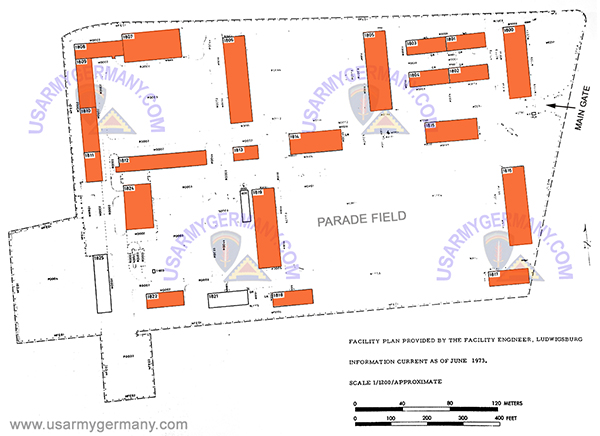 Annotated plan of Coffey Barracks, mid-1970s (Webmaster collection) (Click on map to view a higher resolution of the map with a building use schedule) |
|||
| This is as I remember Coffey Barracks: Between 1800 and 1816 was the gate. There was a small addition or building end the end of 1800 for the gate guards. The Ludwigsburg Military Community's offices were located in Ludendorff Kaserne. They would make mail/distribution runs and drop off movies at the gate. The movies were shown in the back of the snack bar's storage area on a sheet that was put up. We had old church pews to sit on. You would had to bring your own eats and drinks, and the movies were free. Looking at the map, if you came up past the post by the club, gate and then keep driving past the post, the street would "T" I believe. There was a street just past the 128th that went to the right and followed the fence. We would run around the post for our physical fitness training and tests. Coffee Barracks had cobble stone streets. Back to the "T", if you turned left and went about a 1/4 mile, on the left was a small Commissary. The check out lines always seemed to run the length of the store. Most of the shopping would be done where to main PX and commissary were located, at Robinson Barracks(RB). RB was on a hill and in or next to the high school was the office and broadcast facilities for AFN Radio. We had an arrangement with the EOD unit (Bldg 1819) to pick up the new Battle Dress Uniform (BDUs) when their soldiers went back to the States. We bought 1 pair each so we were the 2d unit on base to have the new BDUs. I had my barracks room in Bldg 1816 (207th MI) for a short period, then moved into a room on the first floor of 30th Med/651st. The 207th moved into Coffee end of 1980 or early in 1981. The fenced-in area behind Bldg 1822 in the out cove was used as a storage area for privately owned vehicles (POV) that were registered as nonoperational or abandoned. (Any soldier on leave or back in the States on Temporary Duty (TDY), would leave their car close to the barracks. There would always be soldiers looking for "free" parts.) Many memories, hope this helps. Tx Dave |
|||
|
|||
|
|
|||
| 274th Medical Detachment (Helicopter Ambulance) | |||
| 1954 - 19.. | |||
| Section moved to the Air Ambulance Page | |||
|
|
|||
|
|
|||
Related Links: |
|||
 Headquarters and Headquarters Detachment