Click here to open 'USArmyGermany' frameset
The Stars And Stripes - European Edition
US Army, Europe
Looking for more information from military/civilian personnel assigned to or associated with the U.S. Army in Germany from 1945 to 1989. If you have any stories or thoughts on the subject, please email me (webmaster).
| S&S History (1945-Present) Related Links |
 |
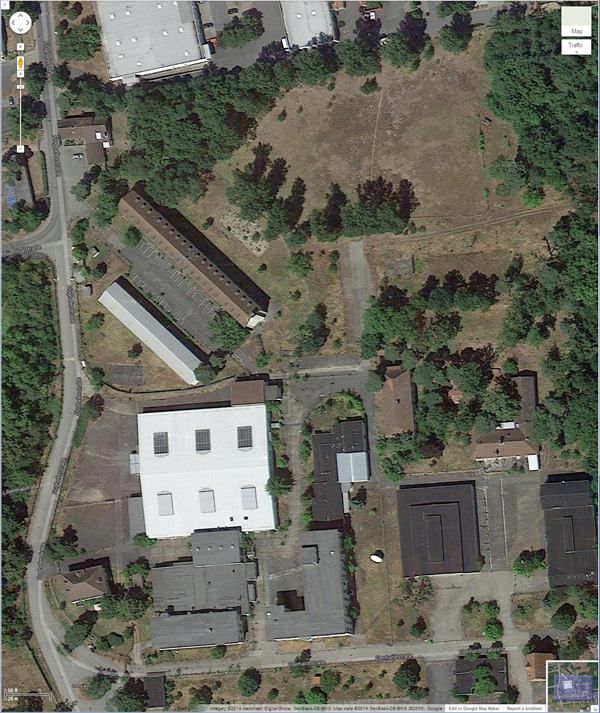
STARS & STRIPES Compound (GOOGLE Maps)
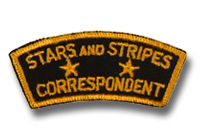 STARS & STRIPES Correspondent Patch
 |
|
The paper developed through this line of succession under circumstances which would be irregular in the operation of any newspaper. The job of setting up a plant in a newly-conquered territory presented problems which could seldom be solved according to the book. You could call it policy or no-policy but that's what the editors had in mind. |
Altdorf Edition, Born at War's End, Outlived Sisters By Dick Jones and Sterling Lord |
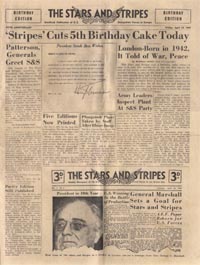
| '47 Paper Was Born In Back of GI Truck Today's European Stars and Stripes first took shape last Dec. 5 in the back of an Army "semi" along the shell-torn Bavarian roads between Altdorf and Pfungstadt. While a skeleton crew stayed behind to put out Altdorf's last edition, another moved up to Pfungstadt and edited the first copy of the current edition. The edition printed today marks the 133rd since the move to Pfungstadt -- the paper's original home in Germany -- 25 miles south of Frankfurt. The shift was completed without missing a single edition, and in spite of the hardships under which it came to life, the Pfungstadt "baby" immediately began to sprout. Working in a newly-equipped plant The Stars and Stripes staff now produces a 12-page paper in five daily editions as well as a 24-page weekly magazine, Weekend, and distributed wherever U.S. troops are located in Europe. The bulldog editions were started Jan. 4, an event unique in the history of The Stars and Stripes. They are the Berlin-Bremen, Western Europe, Austria-Bavaria and Italian editions, the latter going to forces in the Trieste area. The fifth edition is tabbed the Rhine-Main Final and circulates in Frankfurt and vicinity. It is distinguished by a blue ear, the only color used in the daily editions. Two editorial desks were set up when the bulldogs started, one to handle the early editions and one for the Rhine-Main Final. To maintain this extra service, the editorial staff was expanded. The result has been to provide readers at distant points with up-to-date and more local news than was possible with only one dition. About two months after the transfer to Pfungstadt, Weekend was printed by the rotogravure process. The change from black and white to color started with the Feb. 2 issue of Weekend when actual printing of the magazine began on Frankfurter Rundschau presses in Frankfurt. A month later, on March 9, Weekend was jumped from 16 to 24 pages, and a new feature, Sad Sack, civilian cartoon counterpart of the famed wartime character, was added. The majority of The Stars and Stripes employees live and carry on their work in Pfungstadt. Here are the editorial, production, business and circulation offices, staffed almost entirely by civilians, including a number of Allied personnel. As of today, the fifth anniversary of The Stars and Stripes, editorial staff includes the following: Lt Col William G. Proctor, editor-in-chief; Maj Richard E. Knorr, executive manager; Ken Zumwalt, managing editor, and John W. Livingood, assistant managing editor. Weekend staff members: Dick Jones, editor; Sterling Lord, assistant editor; Grace Schmidt; Michael J. Valenti; Don H. Phares; Dorothy Gies and Betty Luros. Sports Department: Bill Boni, sports editor; Larry Olenick, assistant sports editor; Jack Ellis; Ray J. Musleh and Harry E. Brussell. B Bag: S/Sgt Leo M. Patterson, editor; T/Sgt Lonnie E. Towe; S/Sgt John H. Conner and Mrs Anne S. Kirkwood. News room: John Sharnik, day news editor; Joseph Rabinovich; Eugene Levin; Jonathan V. Levin; Victor B. Sanford; Norbert Ehrenfreund and Gustav R. Wieman, copy clerk. Harold McConnell, night bews editor; Nathan J. Margolin; Vincent J. Halloran; Oliver G. Howard; Henry W. Trescott; Bert W. Eustis; Shirley and Howard L. Katzander; Barnett D. Laschever and Flora Fifield. Art department: Ray Irwin, director; John H. Tremasure; Vincent Sandoval and Jimmy M. Dixon. Photo department: John Butler; Michael Vaccaro and Robert Merritt. |
| Hq. Set Up In Frankfurt's Park Hotel Three officers, one enlisted man, and five women secretaries comprise The Stars and Stripes headquarters with offices in Frankfurt's Park Hotel. Now the location of Frankfurt Press Center and Club, the hotel was one of the Hesse city's better hosteleries in pre-war days. Working under the direct supervision of Lt. Col. William G. Proctor, editor-in-chief, the headquarters staff is set up in adjacent rooms with excellent telegraph and telephone communications. Maj. Richard E. Knorr, of Union, N.J., whose business problems date back to the Paris edition in July 1945, is executive manager. Completing the headquarters staff is Capt. Bernard J. McGuigan, of Boston, Mass. McGuigan joined Proctor's staff in December, 1946, after duty with the Troop Information Branch of the Information and Education Service. His present capacity is assistant to the editor-in-chief. The secretaries include Linea E. Larson, of Southport, Conn., Mrs Hope Slocum Connelly, of Brooklyn, N.Y.; Marjorie Scott Elliott, of London; Ella "Molly" Fisher, of London, and Rhea E. Sanders of Charleston, S.C. |
| They Carry the News to EUCOM By LT COL William M. Summers Lieutenant Colonel William M. Summers, Inf., is Editor in Chief of the European edition of the "The Stars and Stripes." He was wartime commander of the 413th Infantry Regiment, 104th (Timberwolf) Division. THE European edition of The Stars and Stripes - excoriated by many, but loved and read by millions throughout the European Theater during the war years - is no longer the robust combat newspaper remembered by those who served in the theater during the period 1942-46. Like millions of other combat veterans, it too had to undergo a period of readjustment. Today a familiar landmark in the occupation program, it has settled down peacefully to the routine duty of keeping United States forces in Europe informed on local, United States, and world events. Since The Stars and Stripes is essentially a soldier's newspaper, its mainstay is soldier and unit news. The occupation soldier, unlike his wartime predecessor, is not especially concerned with returning to the zone of interior. His interest, primarily, is in his local surroundings and in world events. He wants stories about his outfit and other units; he wants to know who was picked Soldier of the Week, and how his team and other teams are faring in EUCOM league sports. But he also wants news of the United States and the world, presented quickly and impartially. Two new kinds of Stars and Stripes audiences have developed since the war, and both must be served - civilian employees of Military Government, and more than 33,000 dependents of military personnel. Back in 1945, if a women's fashion story got into The Stars and Stripes it was presented tongue-in-cheek, from a thoroughly masculine viewpoint. Now, however, not only are fashion stories run straight, but weekly cooking and social columns are popular. The mission of The Stars and Stripes is to provide as complete, accurate and unbiased coverage of general and local news as facilities and equipment permit, together with the wide range of features, illustrations, and background material that is found in the best domestic newspapers. The Stars and Stripes follows a news policy similar to that of leading daily newspapers in the United States. The contents are written and presented without bias. Editorializing does not appear in its news stories, feature articles, headlines, or picture captions. Strictly non-partisan, it pre ants both sides of controversial subjects. There is no crusading and no sensationalizing of stories. The World War II European edition of The Stars and Stripes commenced publication as a weekly in a printing house garret opposite London's Covent Garden on 18 April 1942. From this beginning sprang the far-flung news empire that published more then 20 different editions -- extending geographically from Northern Ireland to Casablanca, and from Tunis to Altdorf, in Bavaria. In March 1945, when six European editions were being published, The Stars and Stripes reached its circulation peak, estimated in excess of 1,500,000 copies daily. The reduction of the occupation forces resulted in a series of consolidations which ended with the establishment of the present single edition, published at Pfungstadt, a small German country town some 20 miles south of Frankfurt. From this center, all United States Occupied Germany, Austria, and Trieste are served. |
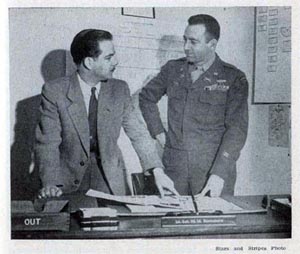 The Managing Editor (left) with the Editor in Chief. |
|
| Besides editing the 12- to 16-page paper seven days a week -- each edition the equivalent in copy content, without advertising, of a 32-page tabloid-size Stateside paper -- the staff carefully checks and double checks the printed copy, a procedure which is not usual in newspaper practice. This is because every line of type is set by German printers who, with few exceptions, neither speak nor read English. Since. German linotypists duplicate any copy matter word-for-word and comma-for-comma, the staff must meticulously insert editorial changes in printed block letters, underlining all capitals, and inserting all punctuation marks. Even the figure 7 must be crossed, European style. Despite these precautions, there is many a slip between the news desk and the make-up stone. The editorial staff, therefore, also checks the page proofs, line for line, before the final go-ahead signal is given to roll the mats, cast the plates, and start the presses. The production department, comprising seven American and Allied employees and 99 indigenous (German) employees, uses a bodge-podge of equipment accumulated during combat days, including ten German linotypes, one American linotype, two |
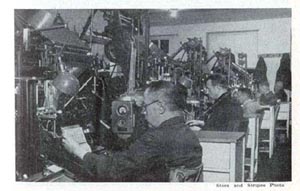 German linotype operators set Stars and Stripes copy. |
|
| In 1947 The Stars and Stripes assumed, as additional duty, the function of procuring, distributing, and retailing all American magazines, newspapers, books, and periodicals sold in the United States Zone. The income from this source enables The Stars and Stripes to remain financially independent, even though it lacks life-sustaining advertising revenue and necessarily carries a heavy overbead. In 1947, also, it launched a new feature magazine entitled Weekend, selling at 10 cents a copy. This publication now has the largest sale of any weekly within the United States Zone. The 24-page Weekend magazine is edited by a 12-man staff, operating entirely separate from the daily. Three linotypes are used in its composition. Proofs are turned out on two American Miehle vertical presses and forwarded to a German rotogravure firm for printing. Like any Stateside counterpart, Weekend carries feature articles, fiction, and picture stories of general interest, with coverage generally related to the occupation or to neighboring countries. Copy is furnished by its staff, by special contributors, and by correspondents in the field. Although the continuous drama of war days is lacking in the occupation today, there is still enough day-to-day action to keep field correspondents jumping -- and dangerous action, at that. Corporal Carrol Sprague, a photographer, was killed when a search plane from which he was photographing an earlier C-47 crash hit a peak in the French Alps. A Stars and Stripes correspondent in Vienna recently came face-to-face with a dozen Russian bayonets while covering the shooting of an American soldier by a Russian guard in that city. In Trieste last year, the same correspondent, Ernie Reed, hurriedly gave refuge to an Associated Press photographer who was being attacked by a mob. Both escaped without injury. One of the paper's news editors, Nathan J. Margolin, spent a month in the battle zones of Greece to give readers a close-up account of the war against the guerillas. While on a story assignment in Northern Spain last fall, Weekend's chief photographer and a Weekend staff writer were wounded when they fled a bandit ambush. The governor of the province apologized, and gave them a Roquefort cheese to assuage their feelings. Joe Flemming, The Stars and Stripes staff man in Berlin, has twice gone on Russian-sponsored tours of the Soviet occupation zone of Germany and has come back to describe life behind the "iron curtain." The Editor in Chief exercises direct control over all Stars and Stripes operations. An Executive Manager, Maurice R. Kirkwood, formerly on the staff and faculty of the Quartermaster School, assists him in coordinating the business details of The Stars and Stripes, Weekend, and commercial periodical and book distribution. |
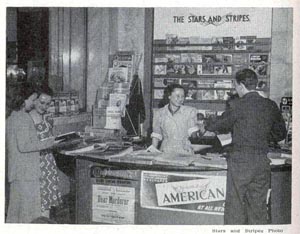 A typical Stars and Stripes newstand somewhere in EUCOM. |
|
| Most of the United States magazines retailed by The Stars and Stripes arrive at Bremerhaven, the occupation zone's chief port, and thence are shipped by fast freight to Pfungstadt, where they are prepared for delivery, along with periodicals published in Europe. The 3,000,000 pieces of literature distributed by The Stars and Stripes each month represent a monthly sales volume in excess of $250,000. Because The Stars and Stripes, a non-appropriated fund agency of the United States Army, is financially on its own, a major part of the earnings goes for payment of expenses. These expenses include the salaries of all employees except the military personnel who are, on assigned duty with The Stars and Stripes. Excess profits revert to the EUCOM Central Welfare Fund. Currently, The Stars and Stripes personnel comprises 3 officers, 58 enlisted men, 107 United States civilians, 32 Allied civilian employees, and 1437 indigenous workers. A new phase of Stars and Stripes postwar operations is the editorial advisory service provided to the 20 post newspapers in the United States Zone. A journalism school is conducted in Pfungstadt for the soldier-editors of post newspapers. In groups of six to ten, these bush-league journalist, come to Pfungstadt on temporary duly to learn all phases of newspaper work. At a special desk, frequently alongside regular Stars and Stripes staffers, the students get valuable practice in editing. Six years after its initial publication in World War II, although facilities and services have had to be adapted to meet the needs of occupation personnel, the Stars and Stripes' objective remains constant -- to help the American soldier become the best informed of any Army. Foremost in its plans for the future is the establishment of modern bookstores throughout the U. S. occupation zones. The first of these is expected to open this summer. |
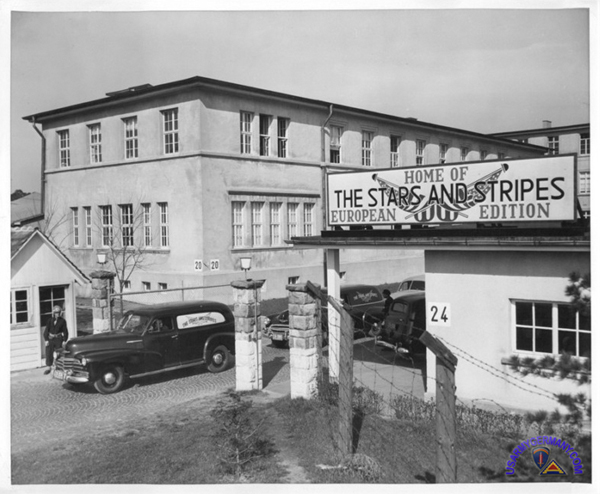
Main Gate, Stars & Stripes Compound, Griesheim, 1952
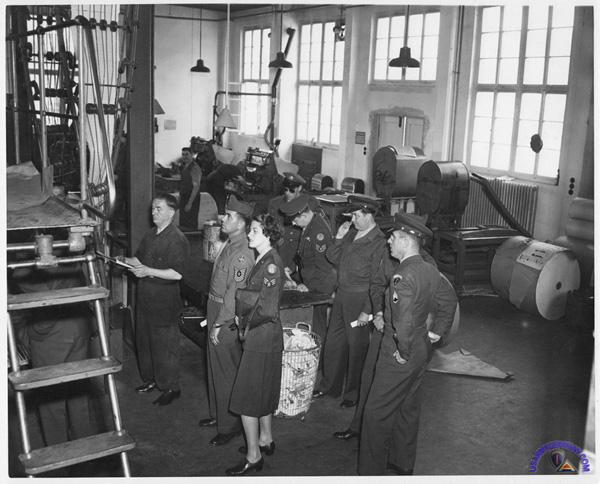
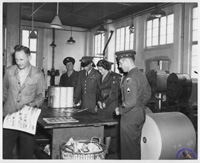
USAFE PIO personnel admire the four-color press during a trour of the Griesheim facility
The STARS & STRIPES is headquartered at Griesheim, near Darmstadt. The Stars and Stripes Compound, as the newspaper plant is known, is located adjacent to the Griesheim Army Airfield, the site of a former Luftwaffe airfield. |
 |
 |
|---|
| The European edition of The Stars and Stripes which rolls off the presses every day at Darmstadt, Germany, was born in battle in the musty offices of a London printing plant. The date was April 18, 1942, and the paper, which also was printed during World War I and discontinued at the finish, again was "drafted" to give American servicemen overseas all the news from home -- sports, comics and items of national and international interest. As the American Army in Europe grew and forged across "Festung Europa", the paper grew with it. By the time the war ground to a halt, The Stars and Stripes was printed in 25 different areas, sometimes in a truck containing a small press and often under fire. Its reporters flew with the Army Air Force on bombing missions, followed the infantry into battle, made a landing with the Rangers and jumped with the paratroopers on D-Day to give its readers on-the-spot coverage. Today The Stars and Stripes has a circulation of about 145,000 and is read by US military and civilian personnel from Norway to Saudi Arabia, an area embracing 19 countries. The paper is printed in a modern plant at Darmstadt, Germany. The printing plant, editorial and central administrative offices are in buildings which before and during World War II were occupied by a German Luftwaffe training school. Adjoining The Stars and Stripes facilities is an airstrip now used by light planes and helicopters of the US Army. Apart from its own reporters and news bureaus, the paper utilizes the news gathering facilities of the Assoiated Press, United Press International and other Stateside and European news agencies. Today's Stars and Stripes contains approximately 25,000 to 30,000 words, the equivalent of a 74-page Stateside tabloid newspaper. Stripes is a 24-page daily tabloid newspaper, carries no advertising, and is printed in four editions. To keep its readers as fully informed as possible, The Stars and Stripes operates more than 400 newsstands within the 19 countries it serves by truck, rail and air. The newsstands carry more than 1,000 US periodicals, pocket books and hardcover books. The present edition of the paper employes 2,000 non-American personnel, 168 American and Allied civilians and has about 20 military personnel assigned. The newspaper is under the supervision of Colonel Ridgway P. Smith, Jr., Editor-in-Chief. |
|
||||
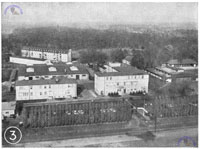 1. Aerial view of STARS & STRIPES Compound, around 1960 |
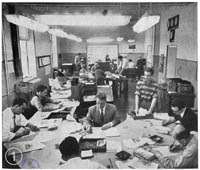 2. Newsroom, around 1960 |
I can't shed too much light on the deactivation as that was all handled at the higher levels, between our officers at HHB VCA and the big wigs at V Corps HQ in the I.G. Farben in Frankfurt (I just thought they figured out how useless our HQ was). All I know is that when I heard it was actually coming down, I was scared shitless thinking I would be routed to one of our line batteries in Babenhausen or Giessen where a PIO guy like me with no journalistic duties to do would be walking the wire or manning a guard shack every night.
As luck would have it I was typing ration cards one day later and the DAC wife of the head of production for Stars & Stripes plunked down at my desk to get her ration card. She looked at me dead on and unbelievably said, "You wouldn't happen to know any enlisted men with a newspaper background? My husband is looking for someone to transfer to Stripes to work page production on Stripes and they unit newspapers that they job print." I said, "Mrs. Blackwell, you sat at the right desk!" She told me all I would need is a letter from my former Production Manager back in the States but it had to be in her husband's hands in a hurry, so as soon as she was out the door I excused myself and RAN - not walked - down to the PX to use the phone and called my former Production manager and literally begged him to send me a letter of reference.
I still don't to this day know how he did it (or how much it cost his newspaper, as this was way before FedEx) but they got the letter with one day to spare (or I would have been out of the running). It took a while and I forgot about it and was on some chickenshit detail under a truck in the motor pool cleaning God-knows what when I feel someone kicking my foot hard, so I come flying out ready for a fight and some over-starched courier smiles and says, "I'm looking for THE luckiest son-of-a-bitch in the Army. I have your reassignment orders to Stars and Stripes in my hand."
And with that simple paper I spent the last fifteen months in heaven: wearing civvies, growing my hair and mustache to ridiculous hippie lengths, attending no formations or doing anything military at all, living in the BEQ just down the road, and working with real stateside-recruited civilian journalists and professional military journalists in our own snug little insulated cocoon at the Stripes compound (we were actually under command of USEUCOM in Stuttgart so technically our headquarters outranked USAREUR so we answered to no one in Europe except our own commanding general, and the Pentagon). We had our own bank branch to cash checks, post office branch to buy stamps and mail stuff and a tennis court AND I got to become a full member of the PRESS CLUB, an officers and civilians club, as an E-4 due to the fact that there was no other military mess hall nearby so they had to let us enlisted men in.
The best part of it all was to sit down next to officers I used to work with - and for - at the old pre-deactivation HHB VCA (who stayed in the area) and have them recognize me and wonder how the HELL I was able to be in an officers club with long hair and civvies as they all knew I had a long time to go until I got out.
I did go home as soon as my hitch was up - no matter how great it was there - as I knew down deep that as easy as I ended up there I could also end up back in the regular spit-shine Army somewhere if I re-upped. I actually cried when I got my regulation haircut and dusted off my uniform for the ride up to Rhein Main and freedom bird back home. Absolutely true story.
I'll look through my stuff from Germany and get back to you. I may have some interesting stuff, like when a drunken motley crew of us Stripers went to Stuttgart to be in the Neckar River raft race against Army engineers (who subsequently kicked our butts - no big surprise there) on July 4, 1976 (U.S. Bicentennial).

A look at "The Stars and Stripes" By Marianne Fulton Posted on the The Digital Journalist website.