Genesis of the United States Constabulary
April 1945 - April 1946
This section
is still under construction
| Frontier Command | |
| District Constabulary | |
| "Mechanized Constabulary Scheduled for Occupation," Stars and Stripes, Nov 14, 1945 | |
| Cavalry units designated as District Constabulary | |
| US Zone map with DC unit locations | |
| Redeployment and Demobilization |
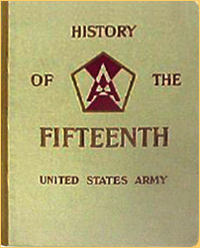 History of the Fifteenth
US Army, 15 August 1944 to 11 July 1945
History of the Fifteenth
US Army, 15 August 1944 to 11 July 1945
FRONTIER COMMAND
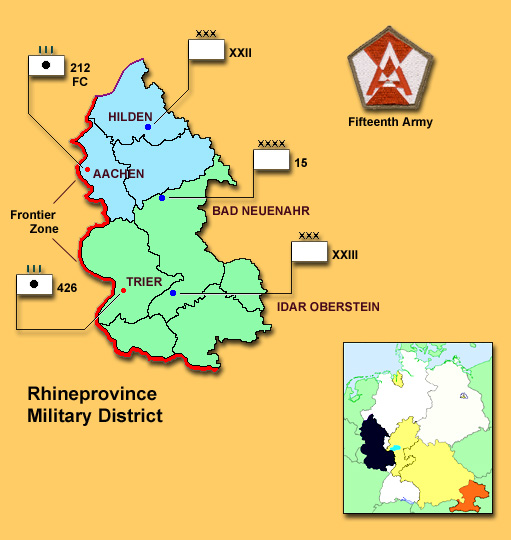
The use of special military organizations to control and maintain security within occupied zones in Germany dates back to the last weeks of World War II in Europe. On 23 April 1945, as the First, Third, Seventh and Ninth Armies continued their drive towards Berlin, Czechoslovakia and Austria, the Fifteenth Army was assigned the mission of "occupying, organizing and governing" the German territories of Rheinprovinz, Saarland, Pfalz, and that portion of Hessen west of the Rhine River. As of this day, the plan for the occupation of German territory after the German surrender (known as the ECLIPSE Plan) was considered to be in effect for the Fifteenth Army sector. To accomplish its mission, Fifteenth Army divided its sector (see map) into two Corps Areas: a northern area under the control of XXII Corps at Hilden (as of April 25) and a southern area under the control of XXIII Corps with its command post located at Idar Oberstein.
Among the many missions assigned to the Fifteenth Army as an occupation force was the control of personnel moving across the western border of Germany. In a study undertaken by the Fifteenth Army in November 1944 to determine a basis for the troops and organization required for the occupation of the Rhineland, the recommendation had been made to establish a Frontier Command with the responsibility of border control by means of fixed posts, road blocks and motor patrols. On 15 April 1945, Fifteenth Army directed the establishment of the Frontier Command.
A Prohibited Frontier Zone that extended from one to five kilometers east of the border was established along the entire German border within the Fifteenth Army Area. Both XXII and XXIII Corps established Frontier Commands to control and maintain the security of their sectors of the Frontier Zone. In the XXII Corps area, the 212th Field Artillery Group was given responsibility for operating the Frontier Command. With its Command Post located in the city of Aachen, the Group supported by CIC teams manned several frontier control stations at designated crossing points along the Dutch and Belgian borders. (It appears that the 426th Field Artillery Group, located in Trier, performed similar duties in the XXIII Corps area.)
The border control mission was discontinued when Fifteenth
Army was relieved of occupation responsibilities by British and
French forces. The XXII Corps area was turned over to I British Corps
on 15 June 1945. The relief of U.S. units in the XXIII Corps area by the
French was completed by 10 July 1945.
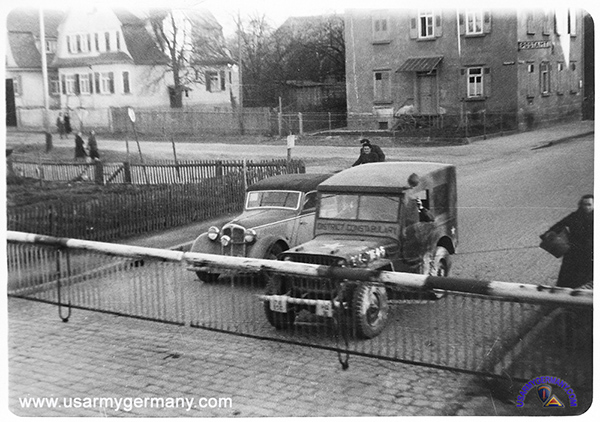


The Enclave DC is headquartered in Grohn with detachments at Bremerhaven and Brake.
The DC's mission is to patrol backroads and isolated areas of the Bremen Enclave, constantly on the watch for trouble or signs of uprisings among the population of the Enclave. To do this the unit makes daily contacts with the Bürgermeisters of the small towns along the patrol route, getting reports from them on the status of civilians within the town and outlying areas not reached by other policing units like the MPs.
The unit also works closely with the CIC, making frequent raids on German suspects to recover government property, secret documents, forbidden books, and firearms.
The Enlcave DC was organized in November 1945 by Capt Robert Crawford.
The unit is organized as Cannon Company, 29th Infantry Regiment with Hqs and 3 platoons. (Before the 29th Inf Regt, the current occupational unit in the Enclave, the DC unit was attached to the 311th Inf Regt.)
Currently, the DC unit is commanded by 1st Lt Signey E Thompson who assumed command when Capt Crawford left on TDY to the US in May (1946).
Present strength: 143 men and 6 officers.
The unit operates 56 vehicles, including 16 armored cars, 26 jeeps, 6 one-and-a-half ton maintenance trucks and 1 half-track.
The majority of the unit officers were trained at the European Theater Intelligence School (Oberammergau).
The enlisted men received 5 weeks of training in basic DC subjects: driving vehicles, communications and radio work, all weapons, riot duty, patrol technique, military intelligence, and map reading.
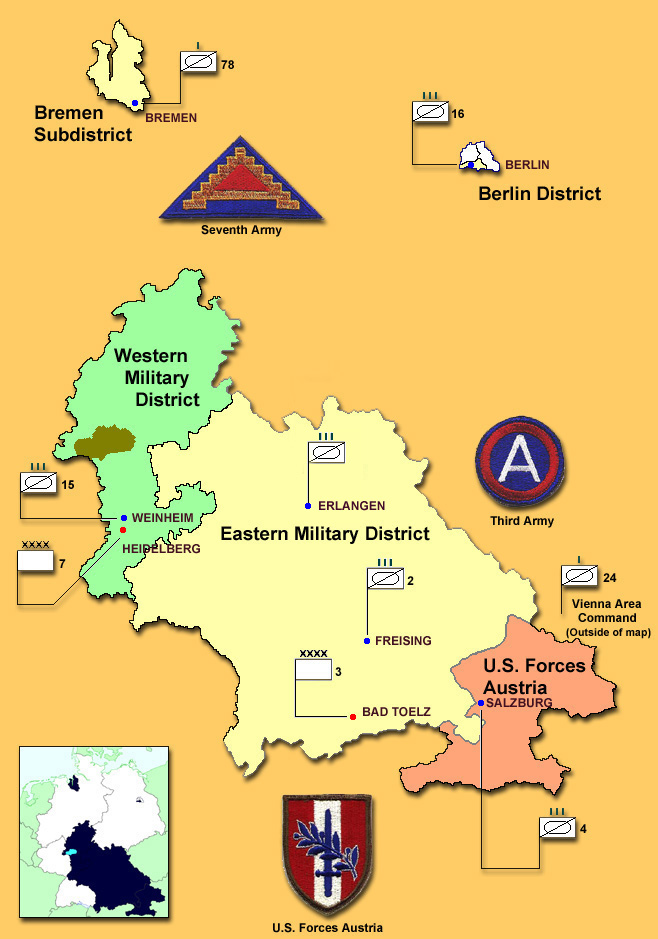
| EASTERN MD | ||||
| 6th Cav Gp (DC) | Erlangen | |||
| 6th Cav Sq (Mech) | ||||
| 28th Cav Sq (Mech) | ||||
| 2nd Cav Gp (DC) | Freising | |||
 Schwaben? Schwaben? |
2nd Cav Sq (Mech) | |||
| Oberbayern? |
42nd Cav Sq (Mech) | Freising? | ||
| WESTERN MD | ||||
| 15th Cav Gp (DC) | Weinheim | |||
| Wuerttemberg |
15th Cav Sq (Mech) | Erbach | ||
| Hesse |
17th Cav Sq (Mech) | Fliegerhorst, Rothwesten | ||
| BREMEN ENCLAVE | ||||
| Cannon Co (DC) | 311th Inf Regt (later replaced by 29th Inf Regt) | Bremen Bks, Bremen see email | ||
| BERLIN DISTRICT | ||||
| 16th Cav Gp (DC) | Patton Bks, Berlin | |||
The final version of the Theater Plan for the Zone Constabulary was to shift to the police type method of occupation by a Zone Constabulary, supported by a three division mobile reserve prior to July 1, 1946. The command structure of the Theater was to be simplified by the retention of only one Army headquarters to which the mobile reserve of three divisions, supporting troops, and the Zone Constabulary would be assigned. Static ground and service force units would be grouped under separate headquarters located in Bremen, Vienna, Berlin and Frankfurt which would report directly to the Theater Headquarters.
| Location | PCS/Inact | |||||
| 1st Inf Div | Regensburg | (remained in Germany until 1955) | ||||
| 9th Inf Div | Augsburg | inact Germany in December 1946 |
||||
| 508th PIR (Sep) | Frankfurt | redeployed to US November 1946 | ||||
| 3rd Inf Regt (Sep) | Berlin | inact in Berlin in November 1946 | ||||
| 5th Inf Regt | Austria | inact Austria Nov 15, 1946 | ||||
| 29th Inf Regt (Sep) | Bremen | inact Germany Oct 31, 1946 | ||||
| 3d Inf Div | Bad Wildungen | arr NY Sep 4, 1946 | ||||
| 14th Inf Regt | Stuttgart | inact Germany Sep 1, 1946 |
BIBLIOGRAPHY:
The Establishment and Operations of the United States Constabulary, 3 October 1945 - 30 June 1947. MAJ James M. Snyder, G-3 Section, HQ US Constabulary, 1947.
History of the Fifteenth United States Army, 21 August 1944 to 11 July 1945.
Reorganization of Tactical Forces, VE-Day to 1 January 1949. Occupation Forces in Europe Series. Francis S. Chase, Historical Division, EUCOM, 1950.