If you do
NOT see the Table of Contents frame to the left of this page, then
Click here to open 'USArmyGermany'
frameset |
Base Section, USAREUR Com Z
Communications Zone
Looking for more information from military/civilian
personnel assigned to or associated with the U.S. Army
in Germany from 1945 to 1989. If you have any
stories or thoughts on the subject, please contact me . .
|
|
|
|
|
|
| BASEC |
| |
| 1951 |
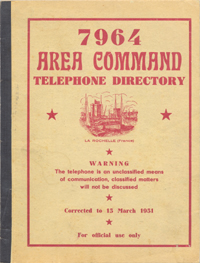 Telephone Directory, March 1951
 |
|
The 7964 Area Command telephone directory for March 1951 contains
--
an Alphabetical Section with names of military personnel who have been assigned official phones (also includes the phone number at their quarters); and
--
a Classified Section with phone numbers of military activities and units in the La Rochelle, Bordeaux, Captieux and Rochefort areas.
|
|
|
|
| |
|
| |
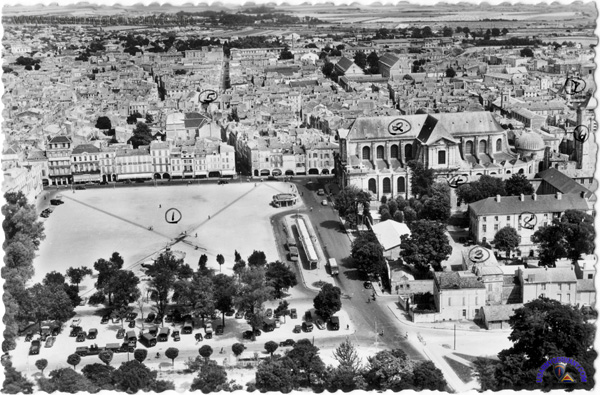
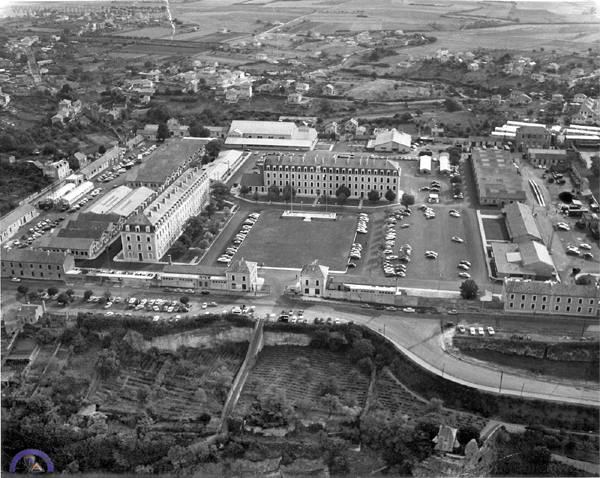
Aerial view of Auffredy Caserne and the Place de Verdun, 1950s (French Postcard)
(Can anyone provide additional details - especially on the military vehicles parked on the Place de Verdun?) |
| |
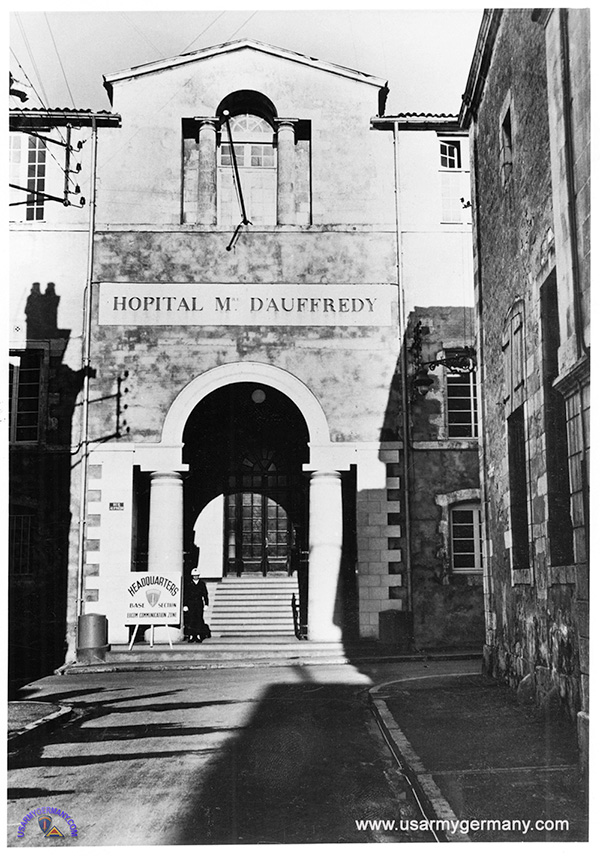
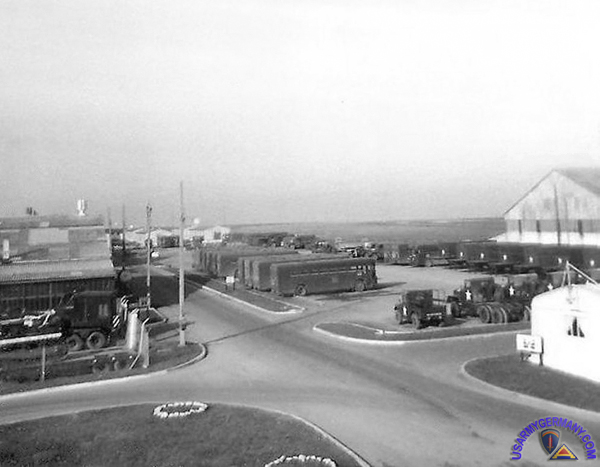
Entrance to Base Section headquarters, Auffredy Caserne, La Rochelle, early 1950s |
| |
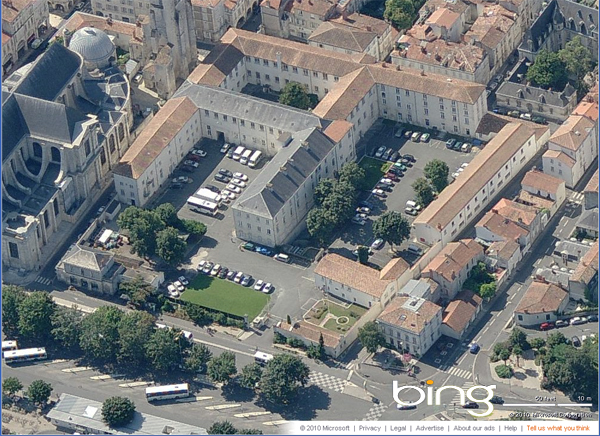
Bird's Eye view of Auffredy Caserne, La Rochelle (Bing)  |
| |
| 1952 |
| (Source: STARS & STRIPES, May18, 1952) |
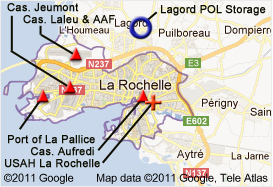 |
|
CG of the Base Section, EUCOM Communications Zone, is Brig Gen Charles C. Blanchard (see also the article on BASEC written by the Gen in 1952).
BASEC is the western end of the Com Z Supply Line where cargo destined for US troops in Europe is transferred from ships to trains or trucks for movement to Army depots and installations in France and Germany.
When HQ BASEC was first established, living conditions were rough - the buildings assigned as headquarters and barracks for the command were in a poor state of repair. Most of the troops were billeted in tents. To make matters worse, many of the the initial sites occupied by units of BASEC were under a layer of mud due to a very wet season.. |
|
|
One of the primary missions of the command is the operation of US ports between Cherbourg (Normandy) and the Spanish border.
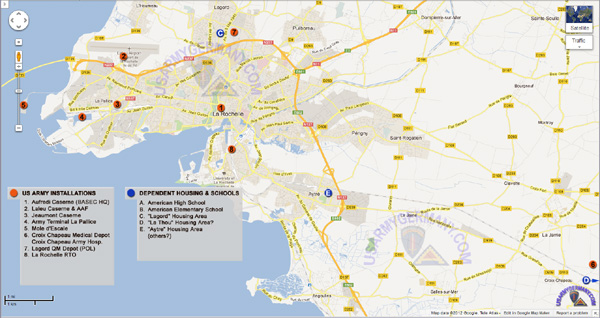
HQ BASEC is located in a former military hospital on Place de Verdun, in the center of downtown La Rochelle. The installation is known as Aufredi (or Auffredy) Caserne ( ). Since office space is short, most of the headquarters troops are located at Laleu, about 2½ miles west of the Hqs bldg. The major dock installations where US ships come in are located at La Pallice, also several miles to the west. ). Since office space is short, most of the headquarters troops are located at Laleu, about 2½ miles west of the Hqs bldg. The major dock installations where US ships come in are located at La Pallice, also several miles to the west.
Today, there are 18 major BASEC installations. (Some of the installations are in operation; a few are close to the point of completion; others are still in the site selection phase.)
One of the installations is Camp Crespy in Bordeaux, France, home of the 7803rd Augmentation Det (formerly known as Bordeaux Det). This installation is occupied by both US as well as French units. The Americans occupy seven buildings within the installation (a number of others live in tents). amp Crespy has a PX and a STRAS & STRIPES newsstand but no snack bar. Det Hqs is located in the Hotel Bon Repos (Rue d'Orman), occupying two floors.
The Det comes under HQ BASEC and controls the installations around Bordeaux and to the south of the city. |
|
|
| |
| (Source: Army, Navy and Air Force Journal, 24 May 1952) |
Base Section, LOC Across France
By Brig. Gen. Charles C. Blanchard, USA |
Following World War II, a Line of Communication (LOC) was established from the port of Bremerhaven to a number of depots and other service installations located in the US Occupied Zone of Germany, east of the Rhine. This LOC was convenient and economical from the point of view of the US Forces, and took full advantage of the facilities of a great industrial country and an abundant force of skilled labor. However, with the new and expanding defense role of American forces in Europe and because of the vulnerability of this LOC, located on the traditional invasion route towards Western Europe, it was recognized as early as November, 1948, that an alternate and supplementary LOC should be developed. Discussions between the United States and French governments resulted in the establishment of a LOC in France.
Brig. Gen. Mason J. Young, USA, was assigned command of the project and established his headquarters at Orleans. An Advance Section was assigned a zone of responsibility in northeastern France, with headquarters at Verdun. Base Section, the other subordinate command, was assigned a zone in southwest France, with headquarters at the seaport of La Rochelle.
Col. John W. Mott, who initially commanded Base Section, moved into the area on 7 November, 1950. At the same time, a number of units were assigned to take over sites of proposed depots, and other facilities to be immediately occupied under the agreement.
At first most of the troops were quartered in tents. The initial sites were occupied during an unusually wet season, and mud, an old military enemy, became a major problem.
Within a week of Colonel Mott's arrival, the task of preparing a port area was begun. A few days later, the first shipments of supplies arrived at Blaye and Le Marquis, in the Grand Estuary. These supplies were moved to a large, burned-over area in the vicinity of Captieux. Amid a continual heavy rainfall, emergency roads were built and supplies stored on pads set up alongside the roads.
Since the initial operations at Captieux, there has been a steady development of the installations comprising Base Section. Many of the installations are in localities famous in history and familiar to the veterans of World War I. The ports of St. Nazaire, Nantes, La Pallice and Bassens were all important ports in the supply line of 1918. An Engineer Depot is being established near Chinon, the site of the meeting between Joan of Arc and the Dauphin. This place also was a World War I Chemical Warfare Training Center. An Ordnance Depot is located at Angouleme, an Ordnance Training Center of World War I. Perigueux, now a Quartermaster Depot, was formerly a hospital center. A POL dump at St. Sulpice is on the site of a former US Depot. At Rochfort, installations erected by Napoleon, which served as depots, and POW enclosures in World War I, are now Ordnance, Transportation Corps and Engineer installations.
The mission of the US Forces in France is unusual in that operations are performed in a friendly nation under the conditions of peace. An agency known as the French-American Fiscal Liaison Office (FAFLO) was set up to work out all matters pertaining to procurement, financing and accounting for the new projects as it would be affected by labor relations, contracting jobs, or leasing of property in France. Maximum use is being made of French labor and no hiring of local personnel can be done directly by Americans. French labor is contracted for through government labor offices and workers are paid on the basis of the prevailing French wage scale. Similarly, French government agents act as intermediaries between the American Army and French contractors who are hired to perform actual building work. French firms selling material to the US Army must deal only through FAFLO, and are paid through this agency.
A problem being faced by the US Forces is the prevailing currency inflation throughout France. Original cost estimates for projects have been exceeded repeatedly, and it is becoming increasingly difficult to plan budgets in advance. On account of this inflation and the time lag required for a French businessman to collect a contracted job through FAFLO, work schedules fall behind and projects are held up for lack of capital. This inflation has also worked against American personnel in spite of the fact that officers and first three graders with dependents are getting a station allowance. Higher living expenses for food and quarters more than absorb established station allowances.
Port operations in southwest France present certain difficulties. Berths, which were adequate for ships during World War I, do not have sufficient draft for modern American freighters requiring, in many instances, that the ships be lightened. Port facilities and labor are inadequate for the additional loads imposed by US operations. These factors result in competition between the interests of the US Forces and commercial companies. In spite of many difficulties, transit sheds and other facilities are being acquired, and a sound port organization is being completed, and suitable operation procedures are being developed.
The construction program in Base Section has presented many difficult problems. The sites provided the US Forces have required, in all cases, major rehabilitation or new construction. The acquisition of a new site usually follows extended negotiations. The completion of plans and the awarding of contracts that are satisfactory to both the US and French authorities requires much time. The shortages of building materials in France contribute to many delays as well as the fact that skilled labor is already operating under full employment conditions. These problems have been solved partially by the erection of prefabricated housing units and warehouses. In a short time, most of the troops will be out of tents and other support facilities will be provided.
In spite of the many unusual problems being encountered, Base Section is steadily developing. A few installations are reaching the point of completion, while other installations have not reached the stage of site selection. However, all US Personnel assigned to this command realize the importance of their task, and are working with the knowledge that the completion of the project is an urgent matter. |
|
|
| |
| 1953 |
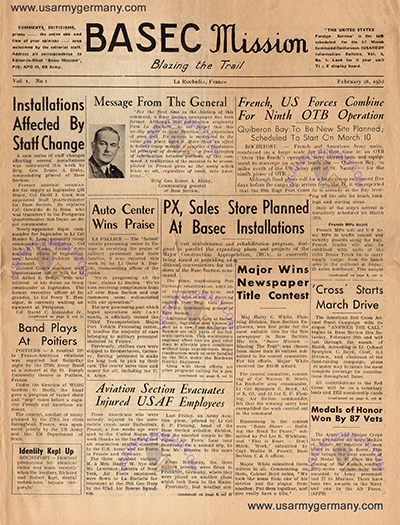
First issue of the BASEC command newspaper, Feb 1953 |
|
| |
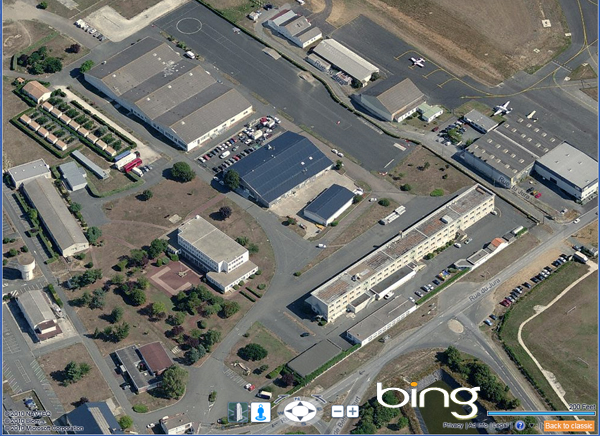
Bird's Eye view of former Laleu Caserne and Airfield, La Rochelle (Bing) |
|
|
1954 |
(Source: STARS & STRIPES, July 18, 1954) |
Changes in the three geographical districts of Base Section have been announced by Basec Hq.
Poitiers District is now the Northern District and includes Cherbourg.
La Rochelle District, extended to include the Brittany peninsula, is now the Western District.
Bordeaux District, now the Southern Dist, extends to the Spanish border.
Commanding the new districts as deputy commanders, Basec, are
Col David R, Zinnamon, chief
Western Dist;
Col Ralph W.
Hansen, chief, Southern Dist; and
Col Ralph O. Gilbertson, chief, Northern Dist.
|
|
| |
| (Source: Army, Navy and Air Force Journal, 2 October 1954) |
European Communications
By Maj. Gen. O.P. Newman, USA
Commanding General, Base Section, USAREUR |
The Berlin Blockade, coupled with the anticipated build-up of US forces in Europe as part of the NATO Defense program, led to a careful examination in early 1950 of the problem of establishing an alternate Line of Communication (LOC). Since World War II all supplies and troops had been funnelled in through Bremerhaven, an enclave in the British Zone of Germany, located on the North Sea and less than an hour away from the Elbe River. A survey team was appointed and determined that France, with her extensive coast lines and numerous first-class ports for the debarkation of troops and the handling of vital supplies, was the logical place for the new LOC. In addition, her excellent rail and road networks connected these ports directly to the Rhine River and our combat forces In Gerrnany.
Our requirements were determined and agreements made with the French government to permit the establishment of the Communications Zone (ComZ), which included all of France. The Base Section of the Communications Zone, more commonly referred to as BASEC, was established on 7 November 1950, with headquarters in La Rochelle, a seacoast town located about 300 miles southwest of Paris, and 100 miles north of Bordeaux. BASEC covers an operating geographical area of approximately 400 miles north and south, by 150 miles east and west. It has grown in the past four years from three small detachments to its present three geographical districts, which include thirteen separate depots, one medical center, three seaports and five installations. Its total area of responsibility is more than twice the size of the entire Allied Occupation Zones of Germany combined, with installations dispersed over an area of 60,000 square miles.
In the initial phases, speed in establishing a working LOC was of prime importance. Troop housing had to take second place to the receiving and storage of supplies. Most of the facilities turned over to us required rehabilitation or in many cases complete rebuilding. Troops and supplies were sent over prior to the renovation, rehabilitation or construction of barracks, mess halls, warehouses and other command support facilities.
Lived In Tents
Two years after the establishment of the LOC, many of the troops were still living in winterized tents. However, construction has been progressing continuously during these four year, and today all of the troops in BASEC are housed in barracks, either permanent or temporary. PX's, Service Clubs and theatres are now located in all of the major installations.
One of our greatest problems, next to construction, has been drainage. The first two years of BASEC's history might well be called the "Battle with Mud." Two armies, the French and the German (during the German occupation) had failed to solve the drainage problem at what is now Captieux Ordnance Depot, the largest ordnance depot in Europe. Because of the peculiar impermeability of the sub-soil, water cannot soak into the ground but must be drained. During the rainy season this installation was literally a sea of mud. Today our Army Engineers have successfully drained this area, and recently the Chief Ordnance Officer, U.S. Army, Europe, declared Captieux to be one of the best ordnance depots in Europe.
Base Section, as a logistical command, has been and still is, in the process of developing its facilities to perform the mission of receiving, storing and shipping supplies destined for combat forces in the forward areas in the event of hostilities. Forces in the field are dependent on effective logistical support. No major operation could be successfully launched or carried through without an adequate and dependable flow of essential supplies.
Four Tasks
Combat Zone supply instruction developed the four main supply tasks of a field army, requirements, requisitioning and local procurement, storage and distribution. BASEC has the same four tasks, differing only in magnitude. The great increase in the scope of the supply operation here is due to two factors. The first is volume. BASEC must not only be prepared to meet the demands of one or more field armies and of army units within the Communications Zone, but it must also meet the supply demands of other services, allies, and/or civilians as directed by higher authority. BASEC must be prepared to meet supply demands of field armies and other users within days.
Today, our storage facilities, while not yet completed, are adequate to insure the accomplishment of this important part of our mission. However, no matter how many items of quartermaster, signal, engineer or ordnance supplies we have on hand, to get these supplies over the French roads and through French villages we must have the full support and cooperation of the French people.
"In the eyes of foreign people, you are a mirror reflecting everything the United States looks like and stands for. By your appearance and actions, so is your country judged. In these times it is vital that we have friends and allies. You can strengthen our security by conducting yourselves at all times in a manner that will win respect of those with whom we live and work, and thus actually demonstrate that our type of democracy offers the most to all men."
Placards bearing the above message occupy a prominent place in our Officers' and Enlisted Men's Clubs, dayrooms and bulletin boards. We are in France today under unusual circumstances. We are not here as co-belligerents, engaged in active hostilities. Neither are we an army of occupation. We are in France in peacetime, at the invitation of the French and with the freely given consent of their government and people. Hence, we are literally pioneering in a new field of international relations and international cooperation.
As the welcome guests of France, our mission here, next to the actual performance of vital military duties, is cultivating and cementing cordial relations with the people of this country.
Reds Busy
When American troops first arrived in France, the Communist minority was very active. Hand-drawn slogans appeared on walls, and were painted on American cars -- "U.S. GO HOME." It was not safe to leave an American car in the street overnight in some localities. Tires were slashed, windows broken, and aerials snapped off. A vigorous campaign to improve Franco-American relations became one of our primary missions. Troops were given orientation lectures, drivers received a special course of instruction, dependents were furnished mimeographed pamphlets acquainting them with the peculiarities of French laws and customs, and both on-duty and off-duty French classes were started.
Staff officers were encouraged to work with their counterparts in the local French governments. For instance, the Provost Marshal and the "Commissaire de Police" work very closely together. The U. S. Army Engineer and the "Genie," the Fire Marshal and "Chef des Pompiers" and of course the Commanding Officer and the "Prefet" all work together to solve our mutual problems.
In May 1952, the 279th Army Band was activated. It has given public concerts throughout Base Section, and in no case has anything but appreciation been shown. Some communities hesitated at first to grant permission for these concerts, fearing hostile demonstrations, but now the band is in great demand. A quintet of Negro soldiers, "The Spiritualaires," became so popular that they were transferred full-time to Special Services, and spent most of their time on the road giving public appearances.
These activities have paid off better than we could have anticipated. Communist incidents have almost died out in cities in the vicinities of our troop installations. Two Communist newspapers have gone out of business due to lack of subscribers. It is very seldom now that an American car is damaged, and the only remaining "U.S. GO HOME" signs are fading out.
French Employees
Over 4600 French employees have been hired by the Army to perform the various jobs necessary in receiving, storing and maintaining records of supplies at the depots. A number have been hired as drivers of trucks, sedans and busses, thus releasing soldiers for other duties. These French employees are known as LWRs because they are hired at the local wage rate, which is considerably lower than the money earned by the American soldier. This benefits not only the American taxpayer as it amounts to a considerable savings in wages, but it is also of great help to the French economy, since many of these Army employees would otherwise be unemployed.
A major mission assigned to BASEC is the Off-shore Discharge Exercise, ODEX. This training exercise provides valuable experience in learning and applying methods for the discharging of troops and cargo from ships anchored at sea. All of these exercises are performed without the use of piers, docks, or other harbor facilities, under simulated wartime conditions. Transportation Corps' latest experimental vehicle, the BARC, was tested at three of our ODEX operations, to determine its capabilities in actual operation. Other technical services have profited by these exercises, since the Medical Corps, Signal Corps, Military Police, Quartermaster, Engineer and Ordnance Corps all join efforts during the ODEX. Observers include high ranking officers from the NATO nations as well as Department of the Army.
BASEC is presently a nucleus from which expansion to a full scale operation could quickly be made in the event of hostilities. |
|
 |
|
|
| Poitiers Garrison (BASEC) |
| |
|
| |
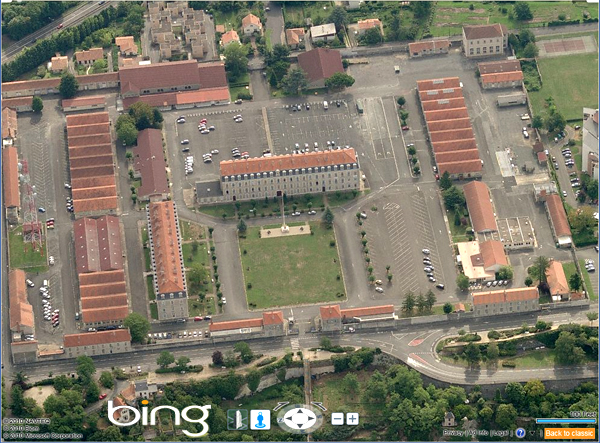
Bird's Eye view of former Aboville Caserne, Poitiers (Bing) |
| |
|
|
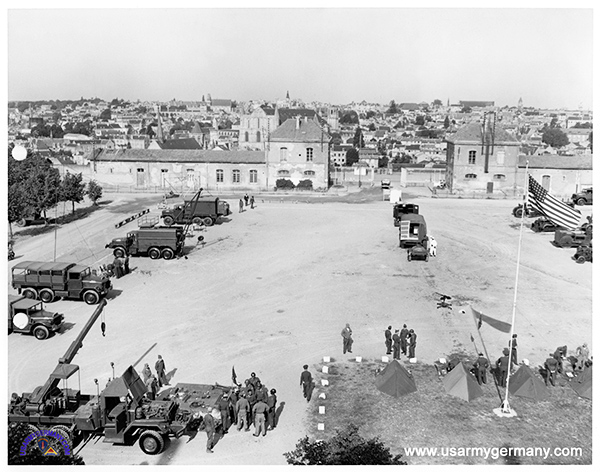
Equipment display set up for Open House, Armed Forces Day 1954 (Webmaster's collection) |
|
| 1956 |
| (Source: STARS & STRIPES, April 28, 1956) |
| When Base Section begins moving its headquarters here from La Rochelle in July nearly all the offices and facilities will be ready for occupancy.
The housekeeping units at Aboville Caserne and Poitiers have been preparing for the shift for years. The interior of the buildings in the caserne, which formerly housed French troops, was entirely rebuilt to provide office space and EM billeting. New buildings have been springing up at a steady rate.
The PX, snack bar and gymnasium are already serving the Poitiers Installation. New equipment in the communications center makes it about the best in Basec.
By June 1, 200 guaranteed rental units, three BOQs-—one each for WACS, Department of the Army civilians and officers—will be ready along with the commissary.
The 500-man mess will be opened June 15 and the officers mess, July 1.
The officers club will swing open its doors July 1 and the new NCO and EM clubs, in October. A hospital is being built and permanent quarters for the dependents' school will be ready in time for the next school year.
The theater is being remodeled to accommodate a CinemaScope screen and projectors.
The advance guard will start moving into Aboville Caserne June 18 and the main group July 9. Officials said they hope to complete the movement by July 18. About 40 per cent of the French personnel will go along.
The transfer is not a recent idea. The original conception of Basec as a supply line for USAREUR was that the command headquarters would be centrally located and away from the port area.
Poitiers, directly in line with the supply route, was tabbed as Basec headquarters as early as November 1950 when the first of its units arrived in La Rochelle. As Basec grew so did its housing and office space problems. Poitiers is expected to be the answer to most of the problems.
|
|
| |
| (Source: STARS & STRIPES, July 29, 1956) |
HQ Base Section (BASEC) of the Communications Zone moved its headquarters from La Rochelle to Poitiers, France, in July 1956.
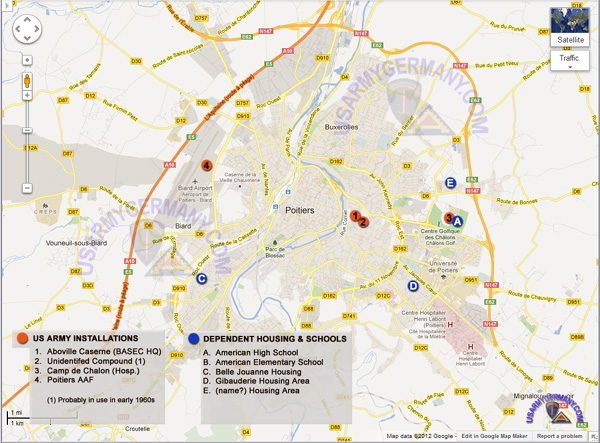
The switch to Aboville Caserne in Poitiers () took three weeks and involved transporting several hundred military personnel and dependents, as well as their household goods and the headquarters office furniture, equipment and supplies (over 60,000 cubic feet of goods).
The advantage of moving the headquarters to Poitiers is the centralization of all BASEC support facilities in one location. At La Rochelle, BASEC headquarters was split between three different parts of the city.
Rental units for dependents are located at Belle Juoane and La Gibaudier (almost finished). There are separate BOQs for WACs, DACs and officers. New facilities (currently under construction) are an officers mess; NCO Club; EM Club; chapel; dependents school; gold course.
Brig Gen James K. Woolnough is the BASEC CG. |
|
|
| |
| (Source: Christmas Card, undated, submitted by Bryan Hackett) |
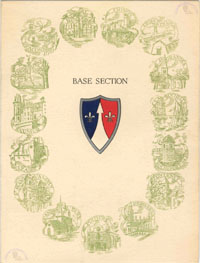 BASEC Christmas Card
 |
|
The following BASEC ports, camps & depots are listed on the cover of the Christmas card:
 Bordeaux Bordeaux
Braconne
Bussac
Chinon
Croix Chapeau
Fontenet
Ingrandes
La Rochelle
Perigueux
Poitiers
Rochefort sur Mer
St Andre de L'Eure
St Jean D'Angely
St Nazaire
Saumur
|
|
|
|
|
|
| Air Section, Base Section |
| |
|
| |
(Source: STARS & STRIPES, Jan 4, 1956) |
Air Section, BASEC, Com Z is located at Laleu Army Airfield () near La Rochelle, France.
The Air Section, formed in 1950, has a strength of 19 military personnel (three are pilots) and comprises two De Haviland L-20's (fixed-wing), two Cessna L-19's (fixed-wing), and two Bell H-13 helicopters. The unit supports the commander of BASEC and his staff throughout western France.
Laleu Airfield has a grass landing strip. (In the first years of operations, there were no hangars available for the American military aircraft. The planes were stored in the motor pool.)
Besides the airfield at Laleu, only the installations (within the BASEC AOR) at Captieux, Bussac, Fontenet and La Roche Sur Yon have suitable landing areas. Civilian facilities have to be used for flights to US installations at Braconne, Saumur, Ingrandes, Poitiers, Perigeux, St. Nazaire, and Chinon. The Merignac Air Base (USAFE) is used for flights to Bordeaux. |
|
|
|
|
| 1st Logistical Command |
| |
 1st Logistical Command Patch 1st Logistical Command Patch |
| |
1961 |
(Source: STARS & STRIPES, Nov 15, 1961) |
The 1st Logistical Command will take over responsibility for all logistical installations in western France on Dec 15, 1961. Headquarters for the 1st Log Comd is being set up at Poitiers, France. All units assigned to the 1st Log Comd will wear the command's shoulder patch, a red, white and blue bull's-eye and arrow.
The command was formerly stationed at Ft. Bragg, N.C. and assigned to the Strategic Army Corps (STRAC). |
|
|
|
(Sources: various sources) |
The 1st Log Comd deployed to France in late 1961 (during the Berlin build up) where it operated under the Communications Zone, United States Army-Europe.
Placed on alert on Sept. 5, 1961, troops of the command left Hampton Roads, Va., on the USNS GORDON for Cherbourg, France. The GORDON landed at Cherbourg on Oct. 19, 1961, and the soldiers of the command continued by rail to Poitiers, site of the command's new headquarters.
The command's mission was to organize a Base Logistical Command which would supervise depot and port operations in western and southwestern France under the command of the Comunications Zone.
Depots that came under the control of the 1st Log Command were Braconne, Chinon, Saumur and Ingrandes General Depots; Chize and Captieux Ammunition Depots; and the Croix Chapeau Medical Depot.
Also, the 1st Log Comd assumed control of Port Area Command, with headquarters at La Rochelle and a complex of docks and terminals along the French west coast.
The command returned to the United States Aug. 11, 1962, after nearly a year of service in Europe. It was assigned to III Corps, Fort Hood, Texas. |
|
|
|
|
| 5th Logistical Command |
| |
The 5th Logistical Command orginated as the Base Section, Communications Zone, established at La Rochelle, France, on July 15, 1951, by authority of General Order 1, EUCOM COMZ, July 15, 1951.
Base Section, COMZ, was redesignated the 5th Logistical Command on June 15, 1958.
The 5th Logistical Command was discontinued on March 1, 1960. |
|
|
|
|
| 20th Engineer Brigade |
| |
1954 |
| (Source: STARS & STRIPES, Aug 25, 1954) |
The 20th Engineer Bde at Croix Chapeau celebrates its fourth year of reactivation on Aug 28, 1954. (The 20th Engineer Brigade was last deactivated at Bremen in December 1946 where it was serving on occupation duty in Germany.)
After serving the first two years as a training brigade at Fort Leonard Wood, Mo., the 20th was deployed to France in November, 1952. The 20th was initially stationed at Camp Bussac where it assumed responsibility for directing engineer construction projects in the Base Section of Com Z.
In February 1953, the brigade moved to its current home at Croix Chapeau. The brigade has a dual mission of operating the medical center facility at Croix Chapeau and directing the overall engineer construction program in BASEC. The command's engineering tasks include water supply purification for all BASEC installations; road construction; airfield construction and maintenance; erection of warehouses, billets, hardstands, ammo pads, and operational buildings; rehabilitation of camp sites and buildings; and operation of rock quarries. |
|
|
| |
| (Source: Wikipedia) |
The 20th Engr Bde was comprised of two battalions and six separate companies. The brigade redeployed to the States in August 1954.
Webmaster note: The engineer battalions attached to the 20th Engr Bde at this time were probably the 83rd Engineer Construction Bn out of Camp Bussac (Landes de Bussac) and the 93rd Engineer Construction Bn at Chinon. (The couterpart to the 20th Engr Bde in the Advance Section was the 313th Engineer Construction Group at Verdun. ) |
|
|
|
|
| 279th Army Band (BASEC) |
| |
1952 |
| (Source: STARS & STRIPES, June 1 1952) |
Communications Zone headquarters has announced that each of Com Z's three major subordinate commands - Orleans Area Command, Advance Section and Base Section - will have an Army band attached to it.
The 76th Army Band will be formed out of the 314th Army Band formerly in Frankfurt and attached to the Orleans Area Command. The 314th was led by CWO Richard H. Zoller and consisted of 22 men.
The 118th Army Band will be formed from the 31st Army Band formerly at Wuerzburg and be assigned to ADSEC.
The 279th Army Band has been ordered by Com Z Hq to be activated for BASEC; bandsmen will be furnished through regular requisitioning channels. |
|
|
| |
| (Source: STARS & STRIPES, June 1 1952) |
The 279th Army Band gave its first concert at Aufredi Caserne in front of more than 500 persons.
The band, directed by WOJG Gordon O. Booth, is the first Army band to be assigned to Com Z Base Section. |
|
|
| |
1955 |
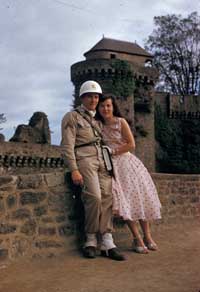
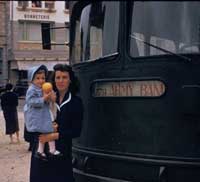
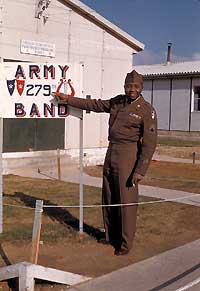
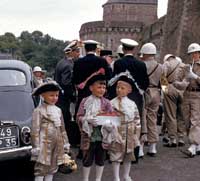
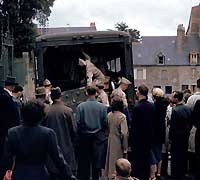
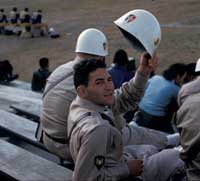
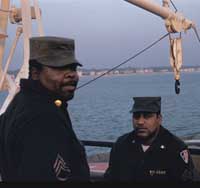
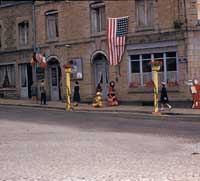
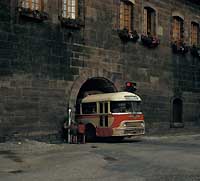
Photos were provided by Robert S. Lunday; his father, Robert G. Lunday, served with the 279th Army Band in La Rochelle from 1955-58. |
279th Army Band
La Rochelle, France |
|
|
|
|
1. (KB)
|
2. (KB)
|
3. (KB)
|
4. (KB) |
5. (KB) |
6. (KB) |
7. (KB) |
8. (KB) |
9. (KB) |
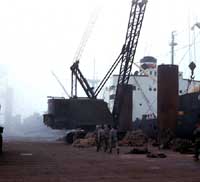
10. Port of Le Rochelle? |
|
|
|
|
|
|
| Army HB Diving Team |
| |
(Source: STARS & STRIPES, April 30, 1963) |
The Army HB Diving Team is located at Rochefort, France. Strength: 7 (includes five divers). The team reports to the commanding officer of Rochefort Sub-Post.
The Army diving team is the only one stationed in Europe.
Their responsibilities include making underwater repairs on Port Area Comd's fleet of landing craft, tugs, repair ships and barges; recovering equipment lost overboard; making underwater inspections of seacoast areas in advance of NODEX ship-to-shore landing exercises. The divers also perform regular inspections and make repairs on the underwater pipeline off Donges through which tankers anchored offshore pump their liquid cargoes directly into Com Z's European petroleum pipeline network.
The divers wear deep-water diving gear or scuba equipment for work in shallow waters.
Fully rigged for deep water diving, a diver wears a 54-pound helmet and breastplate (a.k.a. "hat"), an 18-pound rubberized canvas diving suite (a.k.a. "dress"), a 96-pound lead-weighted belt and 21-pound metal-soled boots (a.k.a. "shoes"). (Total weight: 189 pounds) (When not in use, the helmets are stored on a rack with high-wattage light bulbs burning inside them to cook out all moisture. |
|
|
|
| |
| Related Links: |
 |
|
US Army Assignments Bruce Richards - Bruce was assigned to the 77th Transportation Company (37th Trans Gp) out of La Rochelle, France, and has a photo page on La Rochelle on his website. |
|
 |
|
Caserne Aboville Yahoo Group  - Caserne Aboville in Poitiers, France served as the headquarters for BASEC (COMZ Base Section) from 1961 to 1967, when the US military was asked to leave France. This very active Yahoo Group is open to military and civilian personnel and their dependents who served at Poitiers and surrounding area during that period. - Caserne Aboville in Poitiers, France served as the headquarters for BASEC (COMZ Base Section) from 1961 to 1967, when the US military was asked to leave France. This very active Yahoo Group is open to military and civilian personnel and their dependents who served at Poitiers and surrounding area during that period. |
|
| |
|
|
|
| |
|
|
|
|
| |
| |
|