If you do NOT see the Table of Contents frame to the left of this page, then
Click here to open 'USArmyGermany' frameset

1st Personnel Command
US Army, Europe

Looking for more information from military/civilian personnel assigned to or associated with the U.S. Army in Germany from 1945 to 1989. If you have any stories or thoughts on the subject, please contact me.


History

Replacement System


7720th EUCOM Repl Depot

21st Repl Bn

USAPGE

Personnel Svcs Units

USASSAE

Related Links


History
1978 - Present
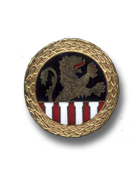
1st Personnel Command DUI
(Source: Headquarters, 1st PERSCOM, 1989)
THE HISTORY OF 1ST PERSONNEL COMMAND

The 1st Personnel Command (PERSCOM) as we know it today grew out of the experience of war. The United States Army was not adequately prepared for the Second World War. It was no surprise then that the Army's initial personnel and administrative systems in the European Theater were sorely deficient. By the time World War II ended, we had acquired a wealth of knowledge and experience. The personnel systems were supporting over 8 million U. S. soldiers in the Theater - hard to imagine when compared with the Theater strength today of 217,717.

The lessons learned then and since are being used today to shape an organization that can begin on the run.

There were many obstacles in supplying a war zone with personnel replacements for a force of 8 million. A rapid succession of military organizational structures devoted to personnel and administrative operations were created, eliminated, modified, or resurrected in different forms to meet mission changes and evolving requirements.

At the beginning of World War II there was no centralized Theater-wide replacement system. Experiments with the replacement system conducted in the United States in 1942 resulted in the activation of the first replacement depots and battalions that same year. 1st PERSCOM's own 21st Replacement Battalion was activated at that time. It is credited with participation in the battle campaigns of Naples, Rome, Southern France, and the Rhineland of Germany.

In October 1943, the Commander of the Services of Supply was directed to establish and operate a replacement system for the field forces. In November of that year, the Field Force Replacement System was established. Its headquarters was at Ben Hall Farms, Cheltenham, England.

On 10 June 1944, the Ground Force Replacement Command (European Theater) was established. This command operated directly under the Deputy Theater Commander and was charged with responsibility of replacements for all ground units. That command was a fore-runner of the replacement operations of the 1st Personnel Command. The geneological roots of 1st Personnel Command units came from a number of organizations.

Postal units have been in Europe for as long as the U.S. Army has been in Europe. Many of them received campaign credit for all of the major battles from Normandy to the Rhineland, and their decorations include Crosses of Gallantry and Presidential Unit Citations. The current parent organization, United States Army Postal Group, Europe (USAPGE), was organized in 1969 and is currently located at Rheinau Kaserne.

The United States Army Confinement Facility, Mannheim (USACF-M) was constructed and first occupied in early 1963. USACF-M serves as the main confinement facility in the European Command. The operational control of the USACF-M was transferred from the 21st Support Command to the 1st Personnel Command on 1 October 1985.

In 1974 the U.S. Army Military Personnel Center, Europe (MILPERCENEUR) was activated in order to integrate all Theater Army personnel management and administration elements into one organization. Included in MILPERCENEUR's charter was responsibility for management of various soldier-support services to include personnel information systems, postal operations, and recreation services.

Several years later MILPERCENEUR was deactivated, and in its place, on 20 October 1978, the 1st Personnel Command came into being. Its first commander was Brigadier General Robert M. Joyce. Its second commander, Brigadier General William G. O'Leksy, took command in April 1979. The third commander was Brigadier General Charles F. Briggs, who took command on 3 August 1983. He in turn passed the command to Brigadier General William H. Gourley, on 13 August 1984. On 23 October 1987, Major General Gourley passed the Colors to the current commander, Brigadier General Ronald E. Brooks.

1st PERSCOM is an organization that performs most of the functions in peace that it would be expected to perform at a time of war. There is one notable exception, during mobilization, several Army Reserve and National Guard units are assigned to 1st PERSCOM, the largest of which is the 800th Military Police Brigade (responsible for enemy prisoners of war). Under the CAPSTONE Program, this reserve component unit (USAR) based in Hempstead, New York, along with our other CAPSTONE units, have successfully participated in major war exercises here in Europe, proving beyond any doubt their readiness to assume their wartime mission at a moments notice.

1st Personnel Command is currently involved in the most broadly based participation in war exercises in its history. 1st PERSCOM's mission is real and critical to the Theater mission -- whether in war or peace.
If you have more information on the history or organization of the 1st PERSCOM, please contact me.

 
(Source: Command Briefing, Headquarters, 1st PERSCOM, 1989)
The 1st Personnel Command (1st PERSCOM) was activated on 20 October 1978. It is a combat services support command dedicated to providing the full range of personnel and administrative support to the USAREUR soldier, in war and in peace.

1st PERSCOM acts as the agent of the Commander in Chief, USAREUR (CINCUSAREUR) for personnel services operations throughout the Theater Army in Europe. Organized to manage replacement operations as well as personnel and administrative services in a rapidly expanding environment, 1st Personnel Command provides the needed rapid reaction and close control during mobilization or actual hostilities. It provides the CINCUSAREUR the maximum degree of flexibility and responsiveness for personnel management and personnel administrative matters to accomplish USAREUR and Seventh Army's mission.

The services performed by 1st PERSCOM touch the lives of every commander, soldier, and their families in USAREUR. These examples highlight some of the important services that 1st PERSCOM provides:

a. Develops, coordinates, and executes Theater Army's war planning for personnel and administrative operations.

b. Manages administrative support operations, providing direct support to the Theater Army Headquarters, and general support to the Theater Army.

c. Provides financial and administrative management and technical support of the recreation services and sports programs.

d. Manages replacement operations, quantitative and qualitative distribution, and use of the enlisted force.

e. Operates the officer personnel management and distribution system.

f. Executes policies and established procedures at the Theater Army level for personnel services support in personnel management, personnel actions, personnel records keeping, and strength accounting.

g. Directs postal operations for the Theater Army, exercising operational control over mail movement into, from and within the Theater to insure timely service to soldiers, their families, the civilian workforce, and retirees.

h. Operates a Theater Army Headquarters ADP Services Center.

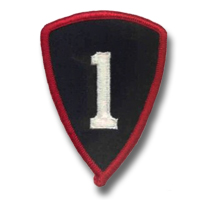
On 7 November 1978, 1st PERSCOM was authorized its own distinctive shoulder patch (a white arabic one on a field of blue, with a red border). This patch symbolizes 1st PERSCOM's place as the only Theater Army Personnel Command on the active rolls of the United States Army deployed overseas to perform personnel and administrative operations.

On 14 August 1981, the proposed design for 1st PERSCOM's own Distinctive Unit Insignia was approved. The round crest consists of 4 white pillars at the base and at the top a gold lion, all encircled by a gold wreath.

The lion adapted from the City of Schwetzingen's Coat of Arms refers to the unit's first home in the European Theater. The 4 pillars represent the 4. main areas of the 1st PERSCOM mission --- personnel, administrative management, morale support, and postal. The round crest framed by a gold wreath signifies the totality and denotes the quality of service provided to the commanders and soldiers of the Theater Army.

On 18 September 1981, 1st PERSCOM had its own unit motto approved. The Motto, "Soldiers 1st", signifies that 1st PERSCOM soldiers are "soldiers first" and that the "Soldier" is "1st" in the 1st Personnel Command.

 
Replacement System, 1945-1963
 
(Source: The Replacement and Augmentation Systems in Europe (1945-1963), HQ USAREUR, 1964)
Units and Facilities of the Replacement System

a. The Early Years.
On 31 January 1946, the Ground Forces Reinforcement Command, the organization that had been responsible for moving replacements to the forward areas in World War II, was discontinued. During the following months the reinforcement depots that had originally handled incoming troops and their assignment were primarily engaged in redeploying personnel. However, as redeployment neared its end, the ports of Antwerp and Le Havre ceased operations in March and in July (1946), respectively. The closing of these installations left the expanded Bremen Port Command -- renamed the Bremerhaven Port of Embarkation (BPE) in March 1947 -- as the sole staging area for U.S. personnel traveling to and from the U.S.-occupied zone of Germany. Meanwhile, in May 1946 the replacement depots -- former reinforcement depots -- were realigned. The 3d Replacement Depot at Marburg was given control of the staging area at Bremerhaven for outgoing personnel, the 17th at Bamberg (Webmaster Note: also location of Headquarters US Constabulary at the time) was assigned the task of handling incoming personnel, and the 2d at Namur was inactivated.

In the succeeding months the decreasing number of replacements permitted a reduction in the processing facilities. At the end of August the functions of reception, classification, and assignment were centralized at Marburg, and the Bamberg processing area was reduced by one-half and used as a transshipment stop only.

In early 1947 consideration was given to the possible transfer of the 3d Replacement Depot to Bremerhaven, so that all the initial processing, classification, and assignment of outgoing and incoming personnel would take place in one location. By March, however, EUCOM headquarters decided to retain the two installations. In May the 3d Replacement Depot was redesignated the 7720 EUCOM Replacement Depot without change in location or functions.

b. Realignment to Support the First Augmentation.
During December 1951 the 307th Replacement Depot, two replacement battalions, and several replacement companies arrived from the United States. The 307th took the place of the 7720 EUCOM Replacement Depot which was discontinued; one of the two replacement battalions was stationed at Rochefort, France and one of the companies at Frankfurt; and the remaining replacement units, including the 307th, were stationed at Zweibruecken. The Bremerhaven Port of Embarkation and Rhein-Main Airfield continued as the entry ports to Europe.

c. The USAREUR Assignment Team.
Early in May 1953, USAREUR established a liaison detachment at the Overseas Replacement Station, Camp Kilmer, New Jersey, to expedite the flow of military personnel to Europe. The detachment, consisting of one officer and two enlisted men, was an element of USAREUR headquarters whose primary function was to expedite the movement of critically needed specialists to Europe by issuing high priority transportation orders. In addition, it facilitated the return of personnel from Europe by correcting "administrative discrepancies."

In the same year the detachment was renamed the USAREUR Assignment Team (Provisional) and during 1954 was moved with the Overseas Replacement Station from Camp Kilmer to Fort Dix, New Jersey, without immediate change in functions.

d. Other Changes.
Another organizational change occurred in January 1955, when the 4th Replacement Group replaced the 307th Depot which was returned to the United States. The 21st Replacement Battalion, activated at the same time, was transferred to Frankfurt in May to take care of the increasing flow of replacements landing at Rhein-Main Airbase, a task that had previously been handled by the 261st Replacement Company. However, little more than a year later the introduction of the mechanized enlisted replacement system permitted the reduction of the 4th Group to a headquarters element, which was subsequently transferred to USAREUR headquarters, where it performed replacement distribution duties under the USAREUR Adjutant General Division.

To satisfy the requirements of the new mechanized system, the assignment team at Fort Dix was replaced by the 527th Replacement Company, which had been transferred from Zweibrueeken on 20 April 1956 to perform the enlarged assignment mission under control of USAREUR headquarters. Subsequently, its functions were assumed by a new USAREUR Assignment Team, composed of 5 officers and 26 enlisted men, which continued to operate satisfactorily during the following years.

e. 1962 - 1963 Status.
By the end of 1962 the replacement system included the ith AG Replacement Group at USAREUR headquarters, the USAREUR Assignment Team at Fort Dix, and three replacement battalions -- the 21st at Frankfurt under USAREUR; the 1st at Zweibruecken under Seventh Army; and the 5th, which had replaced the inactivated 3d Battalion in January 1958, at Orleans, France, under USACOMZEUR control. During this period replacements for USAREUR units arrived through the Bremerhaven Port of Embarkation and Rhein-Main Airbase in Frankfurt, or in the case of USACOMZEUR air transported fillers, through Orly Airfield near Paris. USASETAF replacements used the Port of Leghorn or commercial airfields in Italy.

However, in early July 1963, because of a reduction in the FY 1963 troop basis, the 525th and 526th Replacement Companies were iinactivated and twp other units reorganized. First, the 1st AG Replacement Battalion was reduced to cadre strength (1 officer and 18 enlisted men). It had been transferred to Vaihingen on 15 May, where it was attached to SeventhArmy headquarters and placed under the operational control of the Adjutant General. The personnel could thus maintain their technical proficiency in processing replacements so that they could constitute the nucleus for a full-strength battalion in wartime or in support of contingency operations. The 4th AG Replacement Group at Heidelberg was reorganized by reducing its strength approximately 25 percent with no change in its mission.

 
7720 EUCOM Replacement Depot
1950
(Source: Bill Hodges, 7720th EUCOM Replacement Depot)

The 7720th EUCOM Replacement Depot moved from Marburg, as I recall, in about November 1950, to the Burg Kaserne at Sonthofen and almost immediately began processing (Classification and Assignment) the thousands of troops who began coming into the Theatre after the Korean War broke out (Marburg just did not have the accommodations for these many troops).

We had a cadre of only about 250 personnel. In January or February, to the best of my recollections, the 307th Replacement Battalion (a Reserve group arrived after activation from the New York area, under the command of Col.Oliver J.Troster. Their roster consisted of another couple of hundred personnel. Thereafter, the 7720th ceased to exist and we became the 307th Replacement Battalion.

While we were stationed up on the Burg, we provided full Personnel services to the replacement troops, including QMC (issuance of uniforms and equipment), Railway Transportation, all communications including TO&E data, C & A, counselling when, and if, necessary, T.I. and E., Chaplain services, etc.

There was a Trucking Company stationed at the Beck Kaserne downtown which transported the troops from their Bahnhof arrival up to the Burg, then down again after their 4 or 5 days of briefing. One time a trainload of troops was delivered from Bremerhaven to Sandhofen, up near Mannheim, by accident. There were no train cars available to transport the troops from there to Sonthofen so the Trucking Company and some volunteers convoyed all the way up the then drove them back to the Burg.

We had many German civilians working at the Burg doing Mess Hall duties, Barracks maintenance, Fire Protection, QM Supply, etc.

Sometime in early 1952, the Depot became the HQ for Public Law 50 (I think) Alien Enlistees. These troops (all from behind the Iron Curtain) were housed in a secure section of one of out Barracks. They were schooled in English, took the AGCT Tests, had background checks, when possible, run on them, and oriented in the ways of the US Army before being shipped off to the States for assignment.

I, personally, was rotated in August of 1952. Shortly thereafter the Depot was split in two. From what we heard, half were transferred to Zweibruecken, the other half to Bremen. I don't have any information after that, but I think I do remember that the 307th was de-activated.

For your info, my wife (she, being German) and I go back to Sonthofen just about every year (actually, we stay at Kierwang - just across the valley). But both of us have a great love for the Oberallgaeu. The Burg is in the process of being vacated now by the Bundeswehr and noone seems to know what will happen to it in the future. I must say, in conclusion, that had the Army promised me 20 more years of duty at Sonthofen, I'd have made a career of the military.
Bill Hodges


(Source: Follow up email from Bill Hodges, Feb 2004)
It's great to see the Sonthofen web site is still maintained. Sonthofen still maintains its small town atmosphere even though there are some supermarkets, etc. We were back again in 2003 and, as usual, thoroughly enjoyed our stay.

Heimhuber's Photo Shop is still there and it has many very beautiful photos of Sonthofen and its environs for sale. The owner, unfortunately, passed on several years ago.

A matter of some interest to me arose this past year: a book, entitled, "On the Natural History of Destruction", by an Allgaeuer from Wertach (near Sonthofen), W.G.Sebald, who was only one year old when the war ended, came to Sonthofen in 1952 and saw the "ruins" of two aerial bombings that occurred on February 22 and April 29, 1945. I was dismayed by the (what I thought to be) serious misstatements of fact. We were told, in 1950, that only one bomb was jettisoned onto the town and hit the Brewery which, in any part of Germany, was a major catastrophe.

Herr Sebald was killed in an automobile accident recently and can't be questioned about what he saw in Sonthofen, but can any of the Constabulary people confirm or deny his statements. I'd love to hear about it. I contacted the USAAF Archives at Maxwell Field in Montgomery, Alabama, but they have no record of such a "raid" on either of those dates, but they said it may have been an RAF happening.
Bill Hodges

 
(Source: Allen Hall, Sonthofen, 1951)
I was there in 1951. At that time it was a replacement depot and, as I recall, formerly a school. I have a recollection of Sonthofen being a small, rural athough I have hear if it was it is no longer. Are there any photos of the old part of town? In contrast to other parts of Germany at the time I don't recall any war damage in the Sonthofen area. From the photo in the site I can't remember if that was the old "Repple Depple" or not. I remember that there was a dormitory or dining hall or something there called Allen Hall

 
(Source: Bill Lee, 307th/7720th EUCOM Replacement Depot)
I have read comments about The Burg (Sonthofen) on your website and doubt that I could add much to what has already been said.

I went through basic training at Fort Jackson, SC, went to leadership school but (fortunately) did not graduate (and probably would have gone to Korea) and was shipped to Camp Kilmer, NJ for overseas processing. This was probably in the summer of 1951. I went over on the troop ship General William O. Darby, sick every minute of the about two week voyage to Bremerhaven, Germany. We were there piled on a train (we slept where ever we could) and headed for Sonthofen, unknown to me, of course.

I had just earned a degree from the University of South Carolina (1950) and was luckily assigned to the 307th (later 7720) EUCOM Replacement Depot there. I think this was a reserve unit. I was stationed there until August of 1952 when I was sent back to the States for separation.

While I initially was not too happy about being in the Army (I was drafted); still it was one of the best, most rewarding, enhancing experience of my life then (and now).

At the Ordensburg Kaserne, I was a personnel administrative specialist whose job was to review and update troop files for EUCOM assignments. It was duty most soldiers would envy. First, we slept in the state of the art barracks, had great meals, no KP (civilians did all the housekeeping), although we had a rifle assigned, I never fired one nor did I sleep in a tent during the time I was there. The steam heat and hot showers were accepted/expected luxuries. We had entertainment almost every night in the Service Club, usually local German musicians. We were aware we were in the Army with inspections but these were never as rigid as I had known previously.

Perhaps the best part of the assignment was during the winter months when the snows came to Bavaria. We had no troops to process and life was easy as it was, in fact, most of the time. I lived in Rivers Hall, the second floor of the barracks with a balcony that overlooked the breathtaking beauty of the mountains, any season of the year. It was the longest "vacation" I have ever experienced.

I was promoted to the rank of corporal, made many friends although none that I have kept in contact with since service days. I remember, as an example of how spoiled we were, that in the dining hall for breakfast, the milk (real milk) had cream on the top of the bottle and we would pour it off onto our cereal for breakfast.

One of the "verboten" experiences I remember was the selling of cigarettes on the 'black market' in Sonthofen. Those who did not smoke brought their rationed cartons from the PX, then would simply place them in a handbag, take them downdown to Sonthofen (only a few hundred yards from the Burg) and sell them, usually to merchants there. No one ever questioned this practice. This allowed for the purchase of such German products as Zeiss binoculars, Leica cameras, Rosenthal China, Dresden figurines and Omega watches.

My friends and I used to go down to Sonthofen and dine at the local train station that had a restaurant on the second floor. It was my first taste of a local delicacy, Wiener Schnitzel, something I had never eaten in South Carolina. The potatoes served there were what they called "home fries" but we persuaded the cook to serve what we knew as French fries, something they did not ordinarily list on their menu.

I must add this about the Germans I met. I was there not long after WWII was over but I NEVER had any bad experiences with the German population. I always felt perfectly safe in Sonthofen and I did not hear of any of my friends being intimidated. Maybe this was the exception in the small village like Sonthofen.
 
Being from the South, snow was somewhat rare for me to experience. But it was there at the kaserne aplenty; its beauty was incomparable. Too, it meant that the troops were not coming in for processing so we had a holiday of sorts when this happened.

Perhaps because it was a reserve unit, the officers were a little more relaxed; we were not on a first name basis of course, but they were less than the spit and polish types.

I remember the "short arm" inspections in the early morning hours.
Other than the vacation like setting, the next best part of my tour was the opportunity to travel, mostly alone, on trains that were unfamiliar to me, the language was indeed foreign and no way really to anticipate where my next night would be spent. I visited in Germany of course, Austria, Belguim, Holland, France, Italy, Monaco, Switzerland and England. Without Uncle Sam footing most of the bill, I doubt that these would have been experiences I could recall. SpeakIng of trains, being in the US Armed Forces, I was allowed to ride first class. One "local" train I recall was more like a trolley. It ran from Sonthofen or nearby to Garmisch where I spent several weekend passes, again living in the first class hotels for a modest fee. Life was indeed good even if my address was a German one.

Some names of friends I recall (we were known mostly by only last names or by rank) were Stein, Hayward, Story, Koontz, Jackson, Owens, Powell, Johnson, Lubkowski ... There were others of course but memory fades after 50+ years.

A friend (Hayward) bought a Mercedes convertible (5 passenger) and one weekend we drove to Geneva, Switzerland. I am sure we were just plain lucky since no one had any foreign driving experience. I remember one of the songs played at a bar there was FAR AWAY PLACES and it surely was.

One post stated that if he could have been promised a permanent Sonthofen assignment, he might have gone for long term enlistment. I would not go that far, but it was a great experience. I never did return to Germany but in my mind, I have made the trip repeatedly.
Auf Wiedersehen
Bill Lee

 
(Source: Author's collection)

Repo Depot, 1951
Sonthofen


1. Barracks building (94 KB)

2. Main part of the kaserne (101 KB)

3. Entrance (90 KB)


4. Dispensary (85 KB)

5. A replacement fresh from the States - next stop: 12th Inf Regt (116 KB)


21st Replacement Battalion
1955 - 19..
21st Replacement Battalion DUI
 
(Source: Headquarters, 1st PERSCOM, 1989)
THE HISTORY OF 21ST REPLACEMENT BATTALION

21st Replacement Battalion was activated on 20 October 1942 at Camp Sutton, North Carolina for services during World War II. Upon completion of forming the unit and training, the Battalion moved through Fort Dix and Camp Kilmer, New Jersey to the New York Port of Embarkation in February 1943. On 8 February the unit sailed for Casablanca, French Morocco arriving 19 February 1943.

Between February 1943 and August 1944, the 21st conducted replacement operations for 5th Army in North Africa and later in Italy.

September 1944 found the 21st Replacement Battalion landing in Southern France in support of the 7th Army. The Allied invasion there was to hold Axis troops from the invasion at Normandy, and to provide the second stroke of a "one-two punch". The Battalion followed the 7th Army's advance through France into Germany in March 1945. In February 1945, the Battalion was redesignated the 21st Reinforcement Battalion, and was so known throughout the remainder of World War II. During the move into Germany, a number of liberated French soldiers and civilians who had been held in Germany were returned to France by the 21st. Over 1600 were transported by the Battalion's trucks.

The end of World War II left the Battalion at Augsburg, Germany. In July, the 21st moved to Belgium, and on 12 September 1945 was disbanded. The Battalion was credited with six campaigns from Italy, through France, and ending in Germany. Interestingly, one of the problems identified by the Battalion is familiar to us today; replacements arriving without service records.

On 18 March 1955 the 21st Replacement Battalion was reactivated at Zweibrucken, Germany, and in May of that year, moved to Frankfurt am Main. This move was due to the number of soldiers arriving at Rhein Main Air Base. The Frankfurt location was judged more beneficial to the Battalion, and replacement soldiers alike. The move was completed in June and full processing started on 1 July 1955. A detachment was located at the Military Air Transport Service (the forerunner of today's Military Airlift Command) terminal at Rhein Main Air Base. This detachment received and arranged arriving soldiers transport to Frankfurt. Thus began an association between 21st Replacement Battalion and Rhein Main Air Base which continues to this day.

The desireablility of being located at the Air Base was identified early on, but circumstances forced the Battalion to occupy a variety of locations in Frankfurt for many years. These ranged from two requisitioned German houses and later Gutleut Kaserne where the Battalion remained for more than a decade. The Kaserne was near the main railway station which eased the movement of troops to their ultimate unit of assignment. As busses replaced trains for movement within Germany, and the costs, and efforts to maintain the eighty year old Kaserne rose, another home for the battalion was deemed necessary.

On 31 December 1976 the 21st moved to temporary quarters on Hansa Allee near what is now called the Abrams Complex. Construction of new permanent facilities on Rhein Main Air Base began in August 1978. The new compound was completed and occupied in July 1980, where 21st Replacement Battalion remains today.

Throughout the history of the Battalion, its mission has fundimentally changed very little. Basically, the 21st processes incoming soldiers for assignment to units of United States Army Europe. It presently is the only Replacement Battalion in the United States Army. The increased use of predetermined "pinpoint" assignments, and automation has reduced the time a soldier normally spends at the battalion to less than a day. Most recently, a sponsorship bus program was begun to reduce processing time to several hours. While the Battalion has been reorganized many times, and placed under various commands over its history, the job of processing newly arrived soldiers as efficiently and expeditiously as possible, remains hallmark of 21st Replacement Battalion.

 
US Army Special Services Agency, Europe
19.. - 19..
 

Related Links:
1st Personnel Command - official home page