| If you do
NOT see the Table of Contents frame to the left of this page, then Click here to open 'USArmyGermany' frameset |
||||||||||||||||||||||||
1st Signal Group |
||||||||||||||||||||||||
|
|
||||||||||||||||||||||||
|
||||||||||||||||||||||||
|
|
||||||||||||||||||||||||
| Group History | ||||||||||||||||||||||||
(Source: Email from Jack E. Strimbu) |
||||||||||||||||||||||||
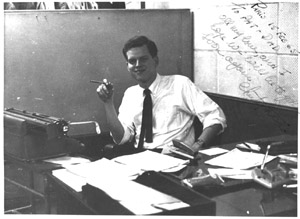
I decided to browse through the Internet and see what I could find out about my old signal corps outfit in Verdun, France.
I enlisted in the Army in 1955. For some reason, when I was taking various tests during basic, the E, I, S, H of morse code intrigued me and I paid particular attention to getting as many of the letters during the test as I could. After basic at Ft. Leonard Wood, MO, I was sent to radio school at Camp Gordon, Georgia. After six months, I was sent to Verdun, France. Unfortunately, after so many years, I don't remember the name of the company any longer. I do recall the words ADSEC and COMZ and our call letters of 9E7A through 9E7D. We had a fixed site in Verdun and three or four mobile units mounted on the back of 2½-ton trucks. We used morse code, primarily, operating the net at speeds up to 50/60 words per minute using a speed key. There was a teletype section down at the end of the hall from our location in the headquarters building and at the other end of the hall there was a crypto unit, but our radio unit was an entity unto itself and we never really socialized with those guys. From our fixed site we would communicate with other stations in our net of three other fixed sites south of Verdun. Our outfit was responsible for providing communications for a short TDY period at an MP location in Pirmasens, Germany in 1956. We were also sent to a small POL sub-depot outside of Rheims in 1956/57. The town close by was Mourmelon (?) Petit. Also, we were tagged to provide communications at the Epinal Military Cemetery in 1957 or 1958. We were there for a two week stint. I believe they were exhuming the body of a soldier for unknown soldier designation, but I no longer remember the exact details. We had two trucks at that location. My truck was at a small grass airstrip in Dogneville, where the brass arrived in small Cessnas, and Joe Flores had his truck at the cemetery on the other side of Epinal. I would like to find out what I could about the unit I was in, who it was attached to and other details that might be available. The only two members of the original company that I have been in touch with are Wickles Dupre, in Houma, Louisana, and Virgil Jurek, in St. Paul, Minnesota. They were members of my team. I vacationed in France a couple of years ago and took a side trip to Verdun to show my wife where I had been stationed. The caserne is now occupied by the French army. I had a heck of a time trying to make them understand why I wanted to go in and look around until a Captain who spoke English finally showed up at the gate. After I explained that I had been stationed there in the 50s and would like to look around, he was quite gracious. He gave me a guided tour of my building and even the room I had occupied. In the 50s, there were eight of us in one room on the third floor and we had one large common shower across the hall. Now, there are two soldiers to a room with their own private bath, television, internet connections, etc.. He said they had to have the ammenities in order to attract a better calibre of soldier. The overall location was the same, but the buildings were used for different purposes. We spent almost an hour back in his room just talking about the Army, his and my experiences, etc. When I was ready to leave he very graciously presented me with a shoulder patch of his outfit. The town of Verdun hasn't changed except for some newer buildings at the edge of town. The center of town was exactly as I remembered it, although the stores are different. Our favorite little restaurant beside the Meuse was now a disco joint for the younger generation. As we left the base, I explained to my wife that we had kept our mobile units about 5 clicks out of town at a location called Bevaux. There were several bombed out buildings that we had fixed up so we could keep spare parts there and work on our trucks. I told her that as you left the caserne, you would drive up a road with a slight upward grade. At the top you would turn left and go down the hill. Right at the turn there would be a small catholic church on the left with a statue of the Virgin Mary with a small concrete fence around it and, no matter what time of the day or night or time of the year, there were always fresh flowers at the base. (I had taken a picture of it when I was stationed there) As we got to the top of the hill and made the turn, there was the statue - with fresh flowers at its base, just as it had been forty some years ago. I am not embarrassed to say that it raised goose bumps on my arms an inch high. I took another picture of it and when I returned home, dug out the picture I had taken in the 50s. You would have thought they were taken at the same time. Sorry, didn't mean to ramble on. I'll bring this to an end in hopes of receving some information in the future. Jack Strimbu ADDITIONAL INFORMATION: The time I spent in Verdun, Rheims, Paris and other parts of France and Germany during my tour resulted in some of the best memories of my life. Most all of us had a wonderful tour of duty in France and I found the French people equally friendly and gracious during our visits in the last few years. I don't buy the propaganda about hostile feelings against Americans by the French people. Their government maybe, but the not the common folk. Of course, their will always be that segment of the intelligentia that harbor resentment or try to cause problems, but I believe they are definitely the minority.
I could relate many stories of our tour of duty in France, some quite humorous. Not to take much time, but one such incident occurred during the stay I mentioned at the military cemetery in Epinal. When we first arrived in France, we were young hotshots newly out of training. One of the first things we did was to "rewire" the BC610 transmitters (the big monster with two 100th tubes) that were in our mobile units. We tripled the range we could send and receive morse code and doubled the range for voice transmissions. When we arrived in Epinal, it was toward the end of the month. We had very little money with us, but we did have two fifty gallon drums of gasoline to run our power units. Fortunately, Dupre (who, being from Louisiana, spoke Cajun french) could communicate with the local frogs. We made an arrangement to siphon off enough gas to obtain francs, but not enough that we would run short. To make sure I didn't run short, I needed some from the Flores' unit at the cemetery. We switched to voice, put the transmitter on low power and made the arrangements. (Had a heck of a good time as a result) When we returned to Verdun, the first question we were asked by the other guys in the unit was how the sale went and did we have a good time. What we didn't realize was that even on low power we were transmitting far enough to reach Verdun and the frequency we had been working on was so close to AFN (Armed Forces Network) that, as improbable as it sounds, we were actually coming across on the radios in the caserne. We never heard anything from the brass about that little incident and, to this day, I don't understand why. There were many other adventures on trips to Metz, Dijon, Epinal and other parts of France, Alsace-Lorraine, Pirmasens and other parts of Germany, the TDY duty at the little POL sub-depot near Rheims (where we lived in a tarpaper shack with a pot belly stove in a box of sand to keep us wam in the winter while the engineers lived in luxury in a brick two story building, with a mess hall and rec room - pool table and all, at the other end of the depot) and two or three day trips to various parts of France and Germany to "tune our equipment." (We'd put everything on low power or do something else that would result in a 2/2 signal for awhile and when we were ready to return, we bump it up to high power, tune the transmitter or relocate our long wire antenna and come in 5/5). The nice thing was we had a permanent pass, so if we were not on duty or could arrange our schedule where we didn't have to be around for several days, we could go anywhere our limited funds would take us. With a very young second lieutenant for a radio officer, who didn't know the first thing about what we were doing, we pretty much had a free reign. As long as our outfit received good ratings and passed the NSA visits (which were easy because they didn't have the speed to monitor our net), our company commander, Capt. Nance, never interferred with our operation. I remember Capt. Nance very fondly because of a favor he granted to me one time in 1958 (an emergency leave to go to Paris to find a little Austrian girl I was supposed to have met in Graz, Austria during a leave in 1958 that was cancelled because of an "alert"). Her Aunt, who owned a restaurant on Rue Montyon, just 30 yards from the Follies Bergere, and a caberet a block away, said she hadn't returned from Graz and didn't want to see me. I didn't "find" her again until two years ago. An interpreter with the Graz police department (bless his sole) located her brother and, through him, I found out she was living in Vienna. I knew we would be accompanying my youngest son (Army vet - NSA) to Heidelberg to enroll him in college and planned a side trip to Vienna. I finally met her during that visit to Vienna. But that, with its beginning in Paris in 1956, is another story. We explored many many miles of the Maginot Line, underground from Verdun outward, even though there were many signs that said "Danger de Mort" - Danger of Death. It was fascinating down there in those miles of tunnels. We were always very careful about where we stepped and what we picked up. Especially up around Metz where entire areas were still cordoned off with barbed wire and signs of warning of mine fields. In 1956-58 France, it was still the time when a pound of coffee, a few gallons of gasoline or cigarettes could get you just about anything you wanted and, with the PX handy, we made good use of the barter system. I've never forgotten my morse code. I guess you never do. This was evident during a visit to see a German foreign exchange student that lived in Bargtheheide (outside of Homburg) that stayed with us many years ago. The occassion was to celebrate the 75th and 70th birthdays of her Father and Mother. It turned out he was a radio operator for the Luftwaffe in WWII. Still knew his morse code! Also, knew all of the old GI songs and did a good job of singing them in english. We had a great time. |
||||||||||||||||||||||||
| 1961 | ||||||||||||||||||||||||
| (Source: Email from Robert Rosenthal) | ||||||||||||||||||||||||
| I was assigned to 1st Signal Group from October 1961 to Oct 1962. I was a Lt and was the Pictorial Officer.
In 1960 I had graduated ROTC from the University of Pennsylvania and my 2nd Lts bars still had their original polish when I got transferred to the Army Pictorial Center in Queens, NY. The Berlin Wall was going up in October 1961 so I was transferred to fill out an open position in Orleans, France, at the 1st Signal Group. |
||||||||||||||||||||||||
1964 |
||||||||||||||||||||||||
| (Source: STARS & STRIPES, March 18, 1964) | ||||||||||||||||||||||||
| The quarterly 1st Signal Group Commanders' Conference was held recently at Orleans, France to discuss signal matters relating to the Communications Zone. Attendees:
|
||||||||||||||||||||||||
| [1] STATION LIST, Mar 31 1964 | ||||||||||||||||||||||||
| (Source: STARS & STRIPES, April 25, 1964) | ||||||||||||||||||||||||
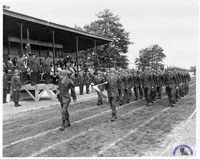
| On April 25 1964, 600 members of the 1st Signal Gp will assemble at Patton Field in Orleans, France to celebrate the Group's 4th Anniversary in Europe. The celebrities will include a fly over by 2nd Aviation and 56th Aviation Company aircraft, a parade, a static display of vehicles and equipment of the Group, and a picnic for soldiers and family members. Activities of the 1st Sig Gp include telephone, switchboards, communications centers, transceiver facilities, high frequency radio capabilities, photo facilities, telephone installation and repair, signal field maintenance shops, film and equipment exchanges, commercial telephone service, the Communications Control Center and the European Data Gateway Station. Personnel of the unit man communications posts stretching from Sandhofen, Germany to Captieux, France. The European Data Gateway Station at Maison Fort, under the direct control of the 269th Signal Co, handles data traffic between European points and the US and acts as net control station in the Com Z data net. |
||||||||||||||||||||||||
(Source: Email from Richard Martineau, US Army Garrison St. Nazaire, Dec 1963-April 1964; 1st Sig Gp, April 1964-June 1966) |
||||||||||||||||||||||||
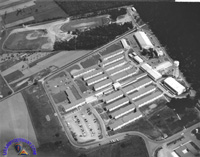
| I was in the Army from 1963-1966. the picture I am adding is of Harbord Barracks, not certain what year it was taken, but a friend of mine sent it to me a few years back... first of all, I am quite impressed with this site. A friend and former Army Buddy of mine emailed me this site yesterday and it was great checking out some of the stories and names of places that I was once a part of, as with everyone who has been in the service, those memories never fade, and for those of us who were fortunate enough not to serve time in combat, well they are mostly fond memories with dear friends. This is a great reminder of some great times which come back to mind no matter how many years have passed. I arrived in Bremenhaven, Germany on the USNS Patch in December 1963, and had orders assigning me to USA Garrison Unit, in St. Nazaire, France... with the M.O.S. for Personel Administration. I arrived there to find out that they were deactivating this base, and had but a skeleton crew with no mess hall or anything else functioning, and no one could figure out why I was sent there ??? Well a Capt. Robinson who was in charge at the time made up things to keep me active, and this lasted until April when I got my orders assigning me to Headquarters 1st Signal Group, Harbord Barracks, Orleans, France, where I served until June 1966. It sure was great to be a part of an outfit where there was actually a reason to get up... No more mess kits and K rations and cold showers while living in a cold quonset hut. I have only good memories of Orleans, France; the officers in charge, our CO. Col. Depau, and later Col. Myles E. Standish and EXO. Col Erastus W. Roberts and Capt. Robert Williams, and Sgt. Major Marshall were all quite professional. The staff were a great bunch of guys, and we had many French ladies as secretaries who were always friendly and helpful. The atmosphere and people were just great . |
||||||||||||||||||||||||
|
||||||||||||||||||||||||
1966 |
||||||||||||||||||||||||
(Source: Email from Anthony S. Sumida, 1st Sig Gp) |
||||||||||||||||||||||||
I am providing a document that identifies as best as I can recollect the units, their disposition, and their missions just before FRELOC. |
||||||||||||||||||||||||
|
||||||||||||||||||||||||
If you have more
information on the history or organization of the 1st Sig Gp, please
contact me . . |
||||||||||||||||||||||||
 |
||||||||||||||||||||||||
|
|
||||||||||||||||||||||||
| 256th Signal Company | ||||||||||||||||||||||||
1959 |
||||||||||||||||||||||||
(Source: Email from Harris Williams, 256th Sig Co, 1959-61) |
||||||||||||||||||||||||
I served with the 256th Signal Company from Oct 1959 thru July 1961 as a field radio repairman. We had a shop in the Chicago Area and served as a repair shop for the surrounding area such as Nancy, Toul , Vitry, and Etain Air Base. Most of my work was in the 2nd echelon shop and Ft. Regret radio site and at the other sites mentioned. My shop was located behind the main repair shop in the Chicago Area. I was on the road most of the time and if any thing major needed done I sent it to the 1st echelon shop in the Chicago Area. I do remember Allen Sorenson and Antone Johannes who worked in the main shop. I've often wondered what happened to them as we were together all the way back to Ft. Gordon, Ga. The army first sent me to Nancy, France, and they did not even have a slot for a repairman so I was then sent to Verdun. I do remember that the MOS 296.1 was frozen in grade and there was no advancement. Before my return to the states I had a pretty serious discussion with Col McGovern about that to no avail. He promised me the moon if I would reenlist for 6 years. I guess I did alright by getting out, missed Vietnam, and went to work for the postal service retiring 37 years later as a Postmaster. I enjoyed my tour of duty for during my off time I toured the old battlefields and American cemetaries in the area. |
||||||||||||||||||||||||
1963 |
||||||||||||||||||||||||
(Source: Email from Charles Schamenek, 256th Sig Co, 1962 - July 1964) |
||||||||||||||||||||||||
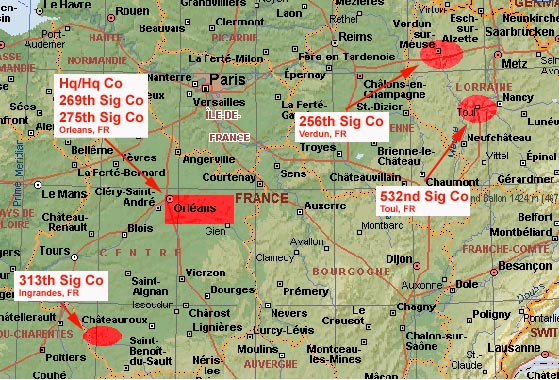
I was stationed in France as a radio repairman from 1962 to late July 1964, in the 256th Signal Company. My first 21 months were spent at the "Vatry" base near Chalons-sur-Marne, and my last six months were spent at the Maginot Caserne in Verdun. While going through some very old souvenirs that I had in my attic, I discovered a slightly yellowed copy of the "Advance" newspaper for the 4th Logistical Command. I have little knowledge worth talking about of the organization, mission and history of the 256th Signal Company. When I was stationed in France, the headquarters of the Company were in Verdun, and I think they had between 7 and 9 "detachments" in other places in Northwestern France.
One detachment was Detachment 6, in the "Vatry airbase", to which I was assigned from April 1962 until January 1964. I was a field radio repairman, at least officially, by training and MOS. But we only had one "radio", which was a 300 watt transmitter and two receivers in a "cab" in the back of a truck; it seldom needed service; when the official company clerk was reassigned and not replaced, I took his place since I knew how to type. At Vatry the main job of the detachment was to provide telephone service, and there was a telephone switchboard there manned by French civilians as much as possible. However, all of us in the detachment had to learn how to use it so that we could fill-in as switchboard operators when no or insufficient French civilians were available, either due to Holidays, sickness, or not enough personnel, or whatever. I know there was also a detachment in Vitry-le-Francois, and for some reason I think there was one in a place called "Brienne", but I have not been able to find any reference to a US Army and/or NATO site in Brienne, even though I remember that "Hey, somewhere near there was where Napoleon went to military school". Of course I knew all the French civilians who worked in our small building as telephone operators; there were men and women, although only the men were allowed to work there on the evening and graveyard shifts. When I re-visited France in 2000 and 2001 I was fortunate in being able to locate, and spend time with, three of those French civilians. One was a man named Jean-Claude who lived in Vitry-le-Francois; unfortunately he died almost a year after I saw him. THe other two were women, and when I visited them in France they actually put me up for the night in their homes !! Now THAT I never expected ! Being able to speak some French helped a lot, and we had a good time. Unfortunately, now that I speak even better French, and am retired, my poor health prevents me from returning to France. At the Vatry base, I still remember the open air ceremonies we had for the funeral of President Kennedy, and also Eleanor Roosevelt. I also remember the Cuban Missile Crisis which occurred when I was at Vatry. I was boiling mad, not because of the crisis, or the fact that we all had to pull guard duty around the clock; I was mad because my guard duty at night consisted of walking around a very small concrete blockhouse with an unloaded M1 rifle, a blockhouse which was well lit up at night and situated in the middle of a field, about the size of a football field. This field was surrounded on two sides by thick woods, and I could not see a thing beyond the perimeter of the blockhouse and its immediate surroundings because of the bright lights on it. The rumor was that there was ammunition and weapons inside this blockhouse. But if any enemy wanted to attack it, they could have done so easily by sneaking up through the woods, and there I was, well lit up by the bright lights at night, at most 50 yards away; they could have picked me off with a rifle shot even if they were not good shots. No way I could have seen them, even if they had been standing up just inside the edge of the woods. In any event, so what? I had an unloaded rifle, and no way to contact anybody to sound an alarm or to call for help. From January 1964 until July 1964 I was in Verdun, (company headquarters), repairing radios in a repair shop in what was called the "Chicago Area". I walked to work each day through several blocks of the city, just as though I had a regular 8 to 5 job. I enjoyed troubleshooting radios, and having to walk through the town each day to get to and from work. I was fortunate because I got out of the Army just before the Tonkin Gulf incident, and having put in my 3 years, there was no way I could get drafted. So I missed Vietnam and was instead able to finish college and get a good job. And of course I saw much of Europe on the American taxpayer's dime. The only large city in the world that I know better than Paris, France, is Houston in Texas, which is close to where I live. I've been in New York City, Philadelphia and Los Angeles many times, but I know Paris better than any of those places. |
||||||||||||||||||||||||
(Source: Email from Harold Jennings) |
||||||||||||||||||||||||
I was stationed at Verdun from Oct 1962 to Nov 1964 and was a photo lab technician at the 256th Signal Co (Spt) photo lab. I know three of the men mentioned in the article (above) about the photo and film section and was wondering in particular about two of them. If you have heard anything from James E. Beauchamp or Michael A Marsh I would love to contact them if possible. I am particularly interested in Jim Beauchamp who was promoted to Sp5 and transferred to Metz at his own request. I played in a band in Metz on the weekends and my friendship with Jim continued even after his transfer. This is the first time I've found anything about the 256th , let alone seeing names of people I actually knew. Thanks. Robert H Jennings |
||||||||||||||||||||||||
(Source: Email from David Askins, 256th Signal Company, 1963-66) |
||||||||||||||||||||||||
I was stationed with the 256th Sig Co in Verdun, France from 1963 to 1966. My Signal Company not only operated the Photo Lab mentioned under the logistics section, but was also a battalion-sized company. I was a Commcenter operator in Verdun. We operated a Telecommunications Center serving all the units in the Verdun area, and we operated a minor relay station with detachments at Nancy, Trois Fontaines, Toul, Metz, Vitry Le Francois, and Bar Le Duc. All message traffic from these depots came through our relay. Our major relay was in Saran, near Orleans. We were under the command of the 1st Signal Group in Orleans, which during my time (63 to 66) was commanded by Colonel Myles Standish III. We also had microwave transmission personnel and radio personnel who worked at Ft. Regret. We had direct circuits to Orleans and Pirmasens. The Pirmasens circuit was intended primarily for transmission of information on the nuclear weaponry. We began using data transmission equipment in around 1965. Our company HQ's was located at Maginot Caserne. Our barracks were old French Cavalry Barracks from shortly after the Franco-Prussian War of 1870. The stables which were originally located on the bottom floor of the barracks. Being stationed at Verdun gave those of us who were interested in history a fantastic opportunity to see first hand the Battlefields of Verdun, and also to travel to the St. Mihiel Battlefields as well as the Meuse-Argonne Battlefield of the AEF. We marched each year at the American Cemetery at Romagne Sous Montfaucon, as well as in a parade at Epernay celebrating the liberation of that town by the American Troops. David Askins |
||||||||||||||||||||||||
|
||||||||||||||||||||||||
|
|
||||||||||||||||||||||||
| 269th Signal Company | ||||||||||||||||||||||||
| (Source: Lineage and Honors Information - Signal Units - Center of Military History website, accessed June 20, 2020) | ||||||||||||||||||||||||
| 269th Signal Company (Note: Showing only information relevant to the unit's service in Germany) Activated 1 May 1960 in France Inactivated 1 July 1967 in Germany (Service in Vietnam, 1970-1972) Activated 1 June 1974 in Germany Inactivated 16 September 1990 in Germany. |
||||||||||||||||||||||||
1959 |
||||||||||||||||||||||||
| (Source: Email from Jorge Thompson, 269th Sig Co, 1959-62) | ||||||||||||||||||||||||
|
||||||||||||||||||||||||
| The 269th was a part of the First Signal Group under an Army Colonel. The bases were later closed when President Charles de Gaulle felt he had enough of us. This is all I remember. | ||||||||||||||||||||||||
1962 |
||||||||||||||||||||||||
(Source: Email from Greg Hodgen) |
||||||||||||||||||||||||
I just want to thank you for a wonderful site, one that just brought back so many memories of my service in Orleans France with the 269th Sig Co. I arrived at Harbord Barracks in Sep. of 1962 and was assigned to the Hq 1st Signal Group as a Private. After a taste of Class A uniforms and Brass I applied for a transfer to the 269th replacing Sp4 Morgan as their Company Armorer. Major Jose was the C.O. My supply officer was Lt. Battle. The Supply Sergeant was Sgt. Tushioki Matsuo. We moved into the field into Quonset huts in the Fall of 1963 and it was cold and desolate. I slept in the Arms Room building which was shared with the Mail room, and hand carried my stove oil. We went through the assassination of President Kennedy and the Cuban Missile Crisis at that location. Both times we thought we were going to war. They told us that if "Ivan" ever crossed the border in Germany he would also be dropping airborne troops on us, and that we had approximately 24 hrs to get to the coast to defend as a Army. Scary stuff to a young Sp4. The local French did not like us, and going into a bakery to buy something got real cool fast once they looked at our haircuts and shoes identifying us as American GI's. There was still a lot of bombed out buildings there then, as well as machine gun bullet craters in walls alongside the streets, and they were still repairing the church spire at the main cathedral that General Patton's spearhead had shot off to get at German artillery observers. But I really liked the people and their way of life and wish I could have met some and maybe lived amongst them when I was discharged. I remember the annual qualifications with the issued weapon M-14. The H&R manufactured rifles were unserviceable and jammed constantly on the range. All of them had to be sent to the Ordnance Facility for re-machining. The side rails weren't machined completely to allow the roller bearing to cycle the action. Think of us going to war like that? I had a lot of friends there such as Mamerto Sarno, Jim Holloway, George Petrowski, Gene Brady, and many others. At this stage of my life I look back and try to remember, but they will be with me forever. |
||||||||||||||||||||||||
1964 |
||||||||||||||||||||||||
| (Source: Email from Kenneth J. Rochon, 269th Sig Co, 1964-67) | ||||||||||||||||||||||||
I retired from the Army in 1986. I enjoyed the postings about 1st Signal Group. Here is some of what I can immediately remember: I was commissioned (ROTC) in May 1964 out of Providence College as 2LT/SigC, attended the SOBC course at Ft Gordon in Jul-Sep, and arrived in France in Oct 1964, assigned to the 269th Sig Co as the OIC COMMZ Commcenter at Coligny Caserne, Orleans. My Company Commander was CPT Moore, XO 1LT George Durenburger, ISG Yamada. Operations sections and who ran them as follows: Other officers arriving about the same time as I did but I cannot remember how they were assigned. One name I recall: A warrant Officer ran the unit supply and was assisted by a French National named Ramon Dauget(?) Capt Donald Hughes, who stayed in the same hotel as I did upon arrival was assigned as CO of the 275th in late 1964, replacing CPT Gene Erickson. I remember our housing was at St Jean DeBraye. Other quarters were at Olivet and another location down the Loire River on the way to LaChapelle Hospital. The Officers club was called Chateaux LeMothe. Landmarks in town were Joan of Arc (GI nicknames "Joanie on the Pony") and another more obscure statue nicknamed "Dottie on the Potty" because of its appearance, much like The Thinker by Rodin. COL Miles E. Standish commanded 1st Group. Deputy was LTC Carl(?) Dennis. A Mr Fred Silfies(?) monitored the network and outages. There was a LT Dutszak(?) in S1, a LT Richard B. Gurry in S/3. and MAJ Robert Williams as XO I believe. Harbord Barracks was originally a hospital. The CO when I arrived at 269th was CPT JAMES Moore. He was replaced by a CPT James Brown. Two Warrant Officers working with me in the Commcenter were CWO Clifford Hoyt (security), and CWO Gene Weber (maintenance). The NCOIC or Platoon Sergeant was SFC Jose Duron. There was also a Master Sergeant responsible for Commcenter Operations whose first name was Archie. There were about a half dozen other NCOs, but names escape me at the moment. Commcenter platoon was large given the three shift operation. A senior security guru, CWO Jim Holstrum(?) was assigned to GP HQ, but I remember him visiting our center periodically. I was reminded in another response of a LTC Erastus Roberts and a COL or LTC DePau who were there during my tour.I eventually moved up to the 1st Group HQ and worked in the S2/3 shop, primarily tracking units and commanders for the purpose of publishing a pocket phone directory of major commands during FRELOC. This was the wind-down of US Forces in France when President DeGaulle decreed that France was for the French. Interesting times. Units and personnel were transferred to Germany, Italy, England, Vietnam, and CONUS. A small cadre of 1st Group officers and enlisted carried the 1st Group flag to Ft Huachuca AZ to replace the 160th Sig Gp which was Vietnam bound. I remember a few of the officers - Major Robert Williams, CPT William DeLine, and I (promoted to CPT by then)- but would have to struggle for names of the others. A MAJ "Bud" Falk was with us in AZ but I cannot remember when he joined us. MAJ Williams was made XO when another MAJ replaced him as CO. That represents my recollections for now. I took a break in service from Aug 1967 to Jan 1969, after which I returned to AD and eventually retired in Feb 1986. I hope there is additional interest in this website. I have maintained contact with the Hoyts and Moseleys. It would be great to hear from others I have known and mentioned here, since I have no idea where they are today. ADDITIONAL INFROMATION COMZ HQ Command Telecommunications Center at Coligny Caserne. European Data Gateway Station at Maison Fort. |
||||||||||||||||||||||||
| European Data Gateway Station | ||||||||||||||||||||||||
| (Source STARS & STRIPES, Feb 24, 1964) | ||||||||||||||||||||||||
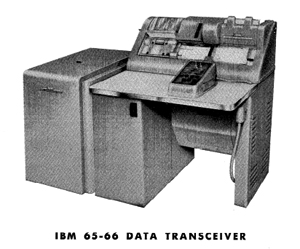
| The European Data Gateway Station, operated by the 269th Sig Co, is located at Maison Fort, France. The mission of EDGS is to receive, transmit, and relay data traffic from points within Europe and the US; to serve as a data entrance and outlet between Europe and the US; and to serve as the net control station for the Com Z data net. (Communications handled by EDGS is data traffic transmitted in IBM punched card format.) The Gateway Station was established in 1958 (originally designated as the Orleans Data Transmission Terminal) to handle the transmission of requisitions between the Army Supply Control Center and the Com Z depots. Since its formation, the EDGS has grown into a large, complex section of the 269th Sig Co. The volume of traffic between EDGS and the States averages around 800,000 - 850,000 cards per month. |
||||||||||||||||||||||||
|
||||||||||||||||||||||||
| All stateside traffic is transmitted and received via AUTODIN, a relatively new system that utilizes high-speed equipment that is full-duplex and can handle up to 100 cards per minute. (1) Click here to view a PDF copy of the IBM Equipment Summary  for 1957. for 1957. |
||||||||||||||||||||||||
| 1966 | ||||||||||||||||||||||||
| (Source: Email from Randolph Simpson) | ||||||||||||||||||||||||
| I was with the 269h Sig Co at Harbord Bks but worked at the relay center at Coligny (Caserne, Orleans). I
arrived there Nov 1966. The unit was already in the process of making the move to Worms Ger. Once in Germany it became Sig Svc Unit Worms under 4th Sig Gp in Munich.
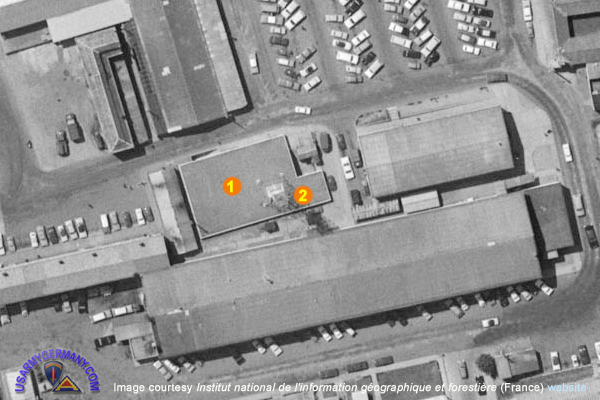
The supply sergeant and I arrived at the same time and both of us were promoted to E7. Strangely, when I left Germany for Nome in Dec 1969, I met up with him at Ft. Lewis also on his way there. We still keep in contact. You hit the nail on the head. No. 1 (photo above) was the bldg that housed the relay center with dial central office in the basement. If you look real close you can see a round aircond heat outlet on roof. We have to remember that back in those days a lot of the equipment still used tubes and we had to have a lot of cold air. As to other bldgs on Coligny, other than PX that I think is the last long bldg above the parking lot in photo??? There was also a snack bar in PX, I ate lunch there, do not recall where mess hall was. There was also a club there but I did not go there (did not want want to have to drive back Harbord after maybe too many beers). About the only thing I can add is that Group HQ was in one or more of the wings of the main bldg (Harbord Bks). I recall seeing some of the offices if I walked from 269th bks area all the way down the long central hallway out to parking lot. |
||||||||||||||||||||||||
|
||||||||||||||||||||||||
| 275th Signal Company | ||||||||||||||||||||||||
| (Source: Email from Eugene Dobrzelecki, 275th Sig Co, 1960-1962) | ||||||||||||||||||||||||
With the Berlin Wall Buildup I was assigned to the 275th Signal Company at Camp Des Loges in France as a brand new 2LT. I spent the first year there as the supply and radio officer.
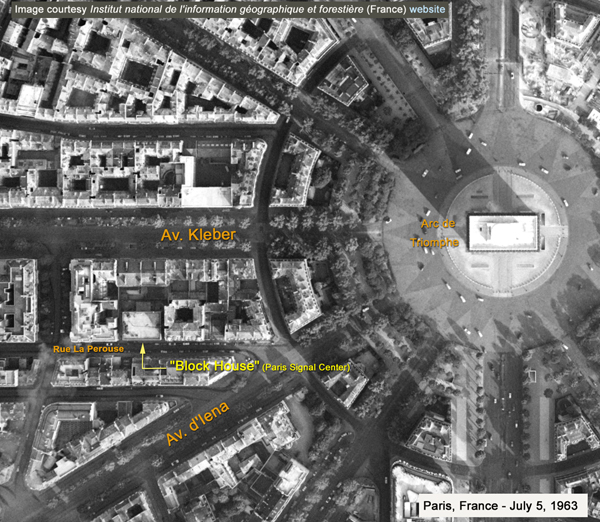
ADDITIONAL INFORMATION The Block House had 4 floors above ground and one below ground that I could find. Floor one had a photo lab and detachment; the second floor had a small barracks room, the detachment headquarters, SOTFE headquarters and WHACA detachment offices; the third floor was the manual telephone exchange and wire room and the fourth floor was the torn tape relay. All of the 275th signal was considered Paris Military. The below ground floor held the air start diesel generator, air recirculation equipment and the 100,000 liter water tank. There were a couple of maintenance and storage rooms down there as well. I have seen pictures of the block house being used as a Red Cross center. In my research the Block House was not taken over by the Signal Corps until around 1947-48. During my time, COMMZ headquarters was in Orleans FR. The only thing in Paris was the Paris detachment of the 275th and other agencies but no major military. Again, I believe that was because Charlie did not want US uniforms on the streets of Paris. The headquarters of the 106th Group (?) was also in Orleans and I know that because I made a number trips down there. It was located on a base not far from the “Joanie on the Pony” statue. The removal of all US forces from France did not take place until post 1963. While I was there they were bringing in new cross-bar switch equipment to the telephone exchange at Camp Des Lodges. They were not fixing them to the floor because they knew De Gaulle was kicking us out. As long as the equipment was not fastened to the building we could remove it when we left. |
||||||||||||||||||||||||
(Source: Email from Christopher Vock, 275th Sig Co, 1963-65) |
||||||||||||||||||||||||
|
||||||||||||||||||||||||
- There was a secret tunnel built by slave laborers to the Hotel Crillon and other hotels? - It was the most bomb proof bunker in the world until after the war (designed by Speer). - It was my office in 1964-65 (prior to that I was stationed at Harbord Barracks, Orleans). I was an SP/4 company armorer with supply duties, i.e local purchase (I spoke fluent french). - After the war the French tried to destroy this "eyesore", but they could not. They asked the US Army to do it, same story; so they "rented" the blockhouse to the US Govt. It was only in the late 1970's that they dynamited the entire bldg. If you go there today you can see the pitmarks on the stone façade of the opposite 19th century bldgs. - Apart from us (275th Signal Co.) there was a SOFTE office and WHCA office (White House Communications Agency) at Via rue Lapérouse; we were a 5 minute walk from the Majestic Hotel (Ave. Kléber) (which was) also a Wehrmacht HQ and not far from the Gestapo HQ (torture cells etc.) |
||||||||||||||||||||||||
|
||||||||||||||||||||||||
| 313th Signal Company | ||||||||||||||||||||||||
1966 |
||||||||||||||||||||||||
(Source: Email from Barry J. Fox, Det A, 313th Sig Co, Poitiers, April 1966 - January 1967) |
||||||||||||||||||||||||
| I was just nineteen and two months old when I arrived at our company HQ in Ingrandes. I was an 05C radio teletype operator. I had spent the previous three months at Fort Gordon, GA, so was thrilled to finally get to somewhere more modern. Upon arriving, I was told that I would be assigned to Detachment A at Poitiers. That’s one of the truly great things which happened to me in my life. Caserne Aboville sits on a hill to the east of the small city of Poitiers. On foot, the quickest way to town was to walk down about 200 stairs! Detachment A was composed of about fifty men. The commanding officer was CWO Earl K. Osborne. As the story goes, he had been General MacArthur’s personal photographer during the Korean War. Like Ingrandes, we had a communications center, where over a third of our people worked, a telephone exchange, a photo lab, microwave radio station, and one AN/GRC-26 HF radio teletype van. While I was there, 4/3/1966-1/27/1967, there were about 200 people working at Caserne Aboville. It was truly like a very small town. Detachment A was unique because of the detachment commander. Having been an enlisted man, he understood us pretty well. He was like a strict, but very fair father figure. He even smoked a pipe! He expected clean barracks, shined boots and brass, but was rather lax about haircuts. His hair was pretty long for the Army. If you conformed, you got to stay at Poitiers. If you didn’t, and there were very few who were dumb enough to transgress, you were immediately shipped out! It was easily the happiest unit in which I ever served. On the rare occasions that we had to go to Ingrandes, to get our 2½-ton truck serviced, we entered the dark side of the moon! Our company HQ was a very unhappy place. Ingrandes looked either like a U.S. Army base or a concentration camp. The first sergeant was a terror and morale was very low. We couldn’t wait to get back to Poitiers. In November of 1967, Colonel Miles Standish, commanding officer of the 1st Signal Group, decided to inspect all five signal companies, and their detachments, in the group. We had always had weekends off, since I arrived in Poitiers, but the inspection meant that we had to work a half day on Saturdays to get ready for the inspection. We also had to get extra short haircuts. When the big day came, Detachment A was ready. The 313th Signal Company came out #1 in the inspection, and Detachment A came out number one in the company. Our reward was that many of us were sent to a new base in the north of England. Close to half of our detachment made it to Burtonwood, England. Ingrandes eventually contributed a few people as well, but they were a totally different breed from our Detachment A crowd. All were draftees, and I remember how glad I was to see them rotate home. It’s funny what a good commander, fair treatment, and a beautiful city could create. |
||||||||||||||||||||||||
|
||||||||||||||||||||||||
| 532nd Signal Company | ||||||||||||||||||||||||
1964 |
||||||||||||||||||||||||
(Source: STARS & STRIPES, February 18, 1964) |
||||||||||||||||||||||||
| The Signal Field Maintenance Shop of the 532nd Sig Co at Croix Chapeau Depot was recently moved to Chalons Installation. A small annex was retained at Croix Chapeau. The shop provides third and fourth echelon repair services for all types of signal equipment for units located in southwestern France. The main shop retains its mobile repair capability for meeting emergency repair commitments and providing on-the-spot technical inspections. Other services provided by the main shop include repair of radio, teletype, and telephone instruments; repair of aviation equipment and generators; and maintenance of church organs at post chapels. The shop will also continue to repair dependent school equipment (motion picture projectors, tape recorders, etc.) within its capabilities. The annex at Croix Chapeau will provide radar maintenance and repair services for the Port Area Command at La Rochelle, Rochefort and St. Nazaire. The Chalons Signal Field Maint Shop will work in cooperation with the 313th Sig Co at Poitiers. |
||||||||||||||||||||||||
| (Source: Email from Curtis Burge) | ||||||||||||||||||||||||
| Well thank you for the website concerning my old outfit. Quite proud of that.
Got drafted in May of 1964 when so many were burning their draft cards and skipping to Canada. Did hard basic at Ft Leonard Wood, Mo and was subsequently sent to the 2nd Armored Divn 142nd Signal Company at Ft Hood, Tx. Did not have any AIT or
signal school training yet, so I did rotten ass details and KP and guard duty for about a month or six weeks. Finally I was sent to the NCO academy at Ft Hood to the CW operators course (I was a mere E2). |
||||||||||||||||||||||||
| 1966 | ||||||||||||||||||||||||
| (Source: Email from D. Randy Arnold) | ||||||||||||||||||||||||
| Looking for members of 532 Sig Co in Nancy and Toul, 1966-1967. I later transferred to Germany and am also looking for members of Signal Service Battalion 4, 1967-1969, Coleman Barracks, Mannheim, Ger
I was not in communications, I was in personnel and took care of all the records for all the signal companies under 1st Signal Group. I believe there where five separate companies in France, of which the 532nd was one. I do not know as much about the Toul base because I was only there until Feb 11, 1967 when myself and 10 others from the unit were moved to Coleman Barracks in Sandhofen, Germany. Signal Service Battalion 4 |
||||||||||||||||||||||||
| (Source: Email from Gary Conkle) | ||||||||||||||||||||||||
| I served in the 532nd Signal Service Company from June 1966, first in Nancy France Detachment A, commanded by Second Lt. Bob Schlesinger, if I spelled his name right. Then in December of 1966 Charles DeGaulle started kicking us out of France, so in the process of leaving France, we ended up moving down the road to Headquarters 532nd at Toul, France. We spent a couple months at Headquarters Toul, France and then we left Toul Military Depot and moved into Germany, even though the Toul Military Depot had not yet closed. Our Headquarters Company then changed names, from Headquarters 532nd Signal Service Company COMZ, to Signal Service Unit Sandhofen, Sandhofen, West Germany to which my Headquarters Company relocated on Coleman Barricks across from 3rd Armor Motor Pool. I was a Radio Teletype Operator and operated 26D radio's. When I was transfered to Signal Service Unit Sandhofen, I basically lost my job, because they took away our authorization for the 26D Radio Rigs. Basically, all I did then was pull maintainence on the 26D Radio Rigs we still had in our posession. I did this as a SP4 until I ETS out of the Army in on September 29th, 1967. Some of the guys I served with are: Joe Bessee, Lee Lore, Sp4 White, Tom Hannum our Personell Clerk and still my buddy and in contact today, we talk at least twice a week. Tom is from Mesa Arizona and I am from Lima, Ohio, also served with Bill Bellerdine, Henry Cougan, William Ford and the Commanding Officers of Headquarters Signal Service Unit Sandhofen were Captain Isiah James and Captain Paul Schwaubee our XO. Our old detachment commander Lt. Schlessinger became Captain and took over the 269 Signal Company in Worms Germany. While at Detachment 'A, 532nd Signal Service Company, Headquarters was commanded by Captain Falk. He was always messing with us at Detachment A, pulling suprise inspections, and our Detachment Commander Lt. Schlessinger would go over to Headquarters and mess with the Headquarter troops in retaliation for Captain Falk messing with his detachment. I liked my duty in Nancy France, it was far from the military strictness that we encountered at Coleman Barricks in Sandhofen, West Germany. Duty in France was a real pleasure and a lot of fun, but the French didn't like Americans because of our involvment in Viet Nam. I can actually say I loved my job as a Angry 26D Radio Operator, our officers gave us respect and treated us very well -- in most cases. Images: 1. Letter of Appreciation, October 1966 (Depot Complex Eastern France) 2. Letter of Appreciation, September 1967 (CO, SSU Sandhofen) 3. Letter of Appreciation, September 1967 (Exec Officer, SSU Sandhofen) |
||||||||||||||||||||||||
| (Source: Email from Bryan A. De Aro, Det D, 532nd Signal Co, Pirmasens; later SSU, Worms and SSU, Zweibruecken, 1966-69) | ||||||||||||||||||||||||
| I would like to add my time and memories of the 532nd Sig Co, 1st Sig Gp. I was stationed at Pirmasens from Feb 1966 till we got kicked out of France.
I was then assigned to Sig Svc Unit Worms then transferred to Sig Svc Unit Zweibrucken. My memories of Detachment D, 235d Signal Company, Pirmasens, Germany. February 1966 – June 1967 In February of 1966 five of us arrived at Bremerhaven on the good ship (USNS) Marcie Rose. We were fresh out of the RTTY School at Ft. Gordon GA. The names were: J. Viola, R. Amato, Hallbaker, Cougan (I think) and myself. When we all arrived at Pirmasens we were greeted by the Detachment Commander, a small black Lt with a booming voice, one Lt Murphy. There were two groups of communicators at Det D 532d -- the land line guys (72E’s) and the O5C’s. There was a radio repair guy – Grypt or something like that; a generator mech.; there were 2 NCOIC’S, one E6 for the RTTY guys and an E7 for the land line guy’s. Then there were the group of old radio guys. While I don’t remember most of them I do remember a guy talking about being a telegrapher for the RR’s, so after reading the part on the 532d, it turns out to be Curtis Burge – Hi Curtis! I was assigned to RTTY Rig D1 with someone everyone called “pop’s.” Seems like he was what I later came to call professional E4’s. These were the vets from WW2 and Korea doing their time until they could retire. It seems to me that they all rotated out within 6 months of our arrival. There were 5 or 6 Radio Teletype rig’s there – all AN/GRC-26D’s. I remember being told that the rigs were pulled from all the detachments of the 532d to this location. The NCOIC of the RTTY section was an acting Jack E6. He and I got promoted on the same day, he to E6 and I to E5. There was not too much to do as far as a mission but we had a net with Group HQ in Orleans, France, so we rotated this duty. One week on, 4 or 5 off. We had some exciting moments, however. When the Six-Day War broke out (in the Middle East) a few of our rigs and teams were sent down to Coleman Barracks airfield and their rigs loaded on to C-130’s. I remember many nights at the Polish and the Rod and Gun clubs at Pirmasens. The NCO club was an outstanding place with many bands and entrainment groups passing through. Somewhere around here I attended the 7th Army NCO Academy at Bad Tolz. The detachment got moved quite a few times and the last place we lived was just across the road from where the air strip was. The helicopters were the CH-34 Choctaws with a 9-cylinder radial engine. They were started every morning sometime around 6 am, if I remember right. No need for alarm clocks then the whole building was shaking by 6:15! I remember that my RTTY team participated in the 1966 First Signal Group anniversary day. Sgt. Body, Hallbaker and I had a good time. There was a start/finish line. We had to cross the line ; drive to a part of a field; set up our rig with dipole antennas; copy a RTTY message; tear down everything and drive back to the finish line. There the rigs were inspected for proper storage of equipment and a winner declared. I think we won, but cannot be sure anymore. Pirmasens was a quiet base till we got kicked out of France. First major change was a Transportation Bn was moved in. They had these International trucks. Starting sometime around August of 67 they started rolling 24/7 moving stuff from France into Germany. The Kaserne at Pirmasens is at the top of a hill and you could hear those trucks down shifting and screaming as they came up the hill. I was amazed at all the stuff that was brought in. They even stacked jeeps with something like bunk adaptors 5 tall! My RTTY rig was moved down to Worms in the early days of the redeployment of COMZ. The Kaserne there was unused and in the process of being activated. Long story short, my 26D rig was used as the first communication center for what would come to be TASCOM. With no rig and nothing to do we went back to Pirmasens. As the shutdown of COMZ progressed we got lots of “displaced” 72E’s. 4 or 5 of them were from the "blockhouse" (Webmaster note: large communications center and telephone exchane serving Paris area) located in Paris. They were not part of the Army. The lived on the economy, did not wear uniforms, had long hair, and lots of money! It was kind a funny to get them back into the Army frame of mind again – they all went kicking and screaming. We did get some O5C’s from the units in France but not too many as I recall. Everyone was always short of us RTTY dudes. Eventually we had to move all the remaining rigs down to Coleman barracks, (I think) and then the 1st Signal Group was disbanded. Names that I remember from the 532nd:  Lt Murphy – first Det COLt Schlessinger – second Det CO (I think) Did he drive a red convertible?Sgt. E. Body – O5C Team ChiefSgt. D. Luther – O5C up from a unit in France think.Sgt. Nicolson – a 72E guy from the DC area if I remember right.Sp4 Sparks – O5CSp4 Barnes - O5C - from OhioSp4 Matterley – O5C - A Ham operator and he ran the MARS station at Pirmasens.Sp4 Halsey – O5CSp4 Schultz – O5C - he had a mouth.Sp4 Lyons - 72ESp4 Cook – 72E Lt Murphy – first Det COLt Schlessinger – second Det CO (I think) Did he drive a red convertible?Sgt. E. Body – O5C Team ChiefSgt. D. Luther – O5C up from a unit in France think.Sgt. Nicolson – a 72E guy from the DC area if I remember right.Sp4 Sparks – O5CSp4 Barnes - O5C - from OhioSp4 Matterley – O5C - A Ham operator and he ran the MARS station at Pirmasens.Sp4 Halsey – O5CSp4 Schultz – O5C - he had a mouth.Sp4 Lyons - 72ESp4 Cook – 72E June 1967 – May 1969 I was then assigned to Signal Service Unit Worms. At first all we did was go to where the rigs were parked and do some inventory and PM (preventive maintenance). At this time I guess that Gary Conkle and I crossed paths but I don’t remember the name, but Hi to Gary anyway! At first the only duty was to monitor an AN/GRC-5 radio in the HQ’s of TASCOM for traffic of some sort. As I remember there was nothing but noise and once or twice we did receive a message. That job came to an end, thankfully. Sitting in front of that radio with all the brass around had me on edge. With no RTTY Rigs at SSU Worms we were assigned to the Land Line Communications Center. It was located in the basement of one building. It was interesting duty. One thing I remember is that there was a tunnel from WW2 that went to the train station or so I was told. Looking at what is left of the Kaserne at Worms on Goggle Earth, there is an old abandoned train depot nearby, so I guess it was true! Reading Randolph Simpson's article part about the temporary communications center was great. Seems to me I worked there for about 3 months before being transferred. I was assigned to the Signal Service Unit Zweibrucken. There I ran a single side band radio station that provided phone patch service to the Generals Cars. While learning a new radio was ok (A Collins KWM-2A – Army lingo an AN/FRC-93) – the process of sitting in front of it for 12 hours a day and having to activate the station anytime the CG wanted to use his “Car Phone” proved to be strain on the brain. The Signal Service Units were configured to provide fixed communication service’s like telephone and communication centers and the like. The radio teletypewriter guys were excess. Running the AN/FRC-93 was a job for the radio operators (O5B’s) – We were over qualified for the job. STRATCOM had us and did not want to let us go. All the time I was told that O5C’s were in critical demand throughout the Army. I departed SSU ZBN in May of 1969. I have many snippets of events and things that I was a part of during my tour in Germany that could fill a few more pages. I hope that a few others find this site as a few more memories can be shared. |
||||||||||||||||||||||||
|
||||||||||||||||||||||||
| Related Links: 256th Signal Co (SPT) - a website dedicated to those who served with the 256th Signal Co. (SPT) from its beginning in Verdun until being disbanded. |
||||||||||||||||||||||||
 Telephone Exchange