| If you do
NOT see the Table of Contents frame to the left of this page, then
Click here to open 'USArmyGermany' frameset |
||||
|
Bremerhaven Port of Embarkation |
||||
|
|
||||
|
||||
|
|
||||
| Bremerhaven Port of Embarkation (7802nd AU) | ||||
 Timeline - Transportation Terminal Commands in the European Theater between 1945 - 1990 (work in progress) |
||||
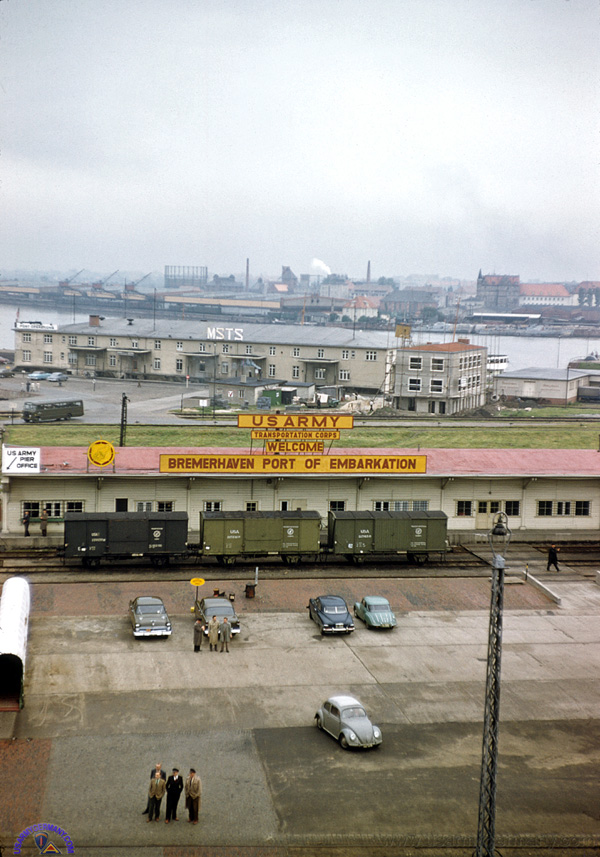 Bremerhaven Port of Embarkation, 1960s |
||||
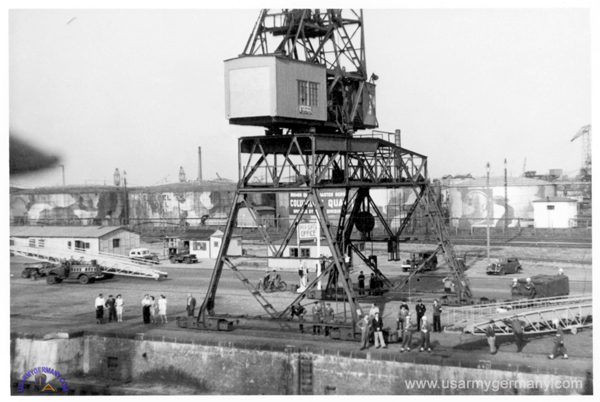
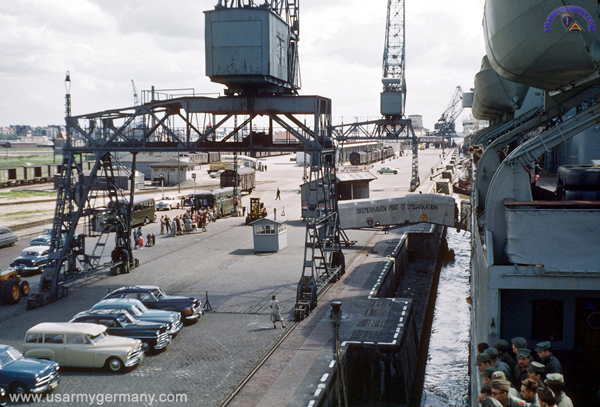 Columbus Quay, Bremerhaven POE, mid-1950s |
||||
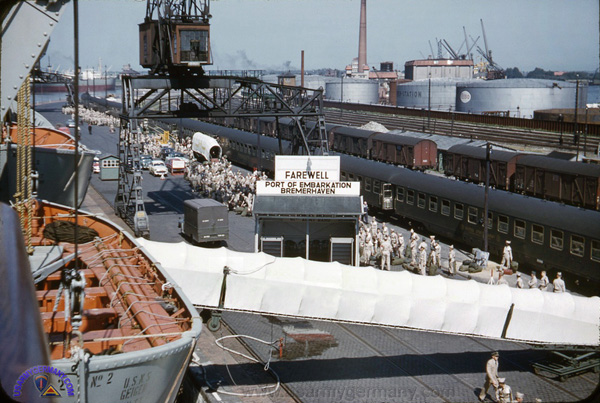 Columbus Quay, Bremerhaven POE, September 1958 |
||||
| 1945 - 1967 | ||||
| (Source: US Army Terminal Command, Europe Organization and Functions manual, 1968) | ||||
| Bremerhaven Port of Embarkation History The Port of Bremerhaven is located in Land Bremen. Land Bremen, the official name of which is Free Hanseatic City of Bremen, is the political successor to the old city-state of that name. The term "Bremerhaven" (Port of Bremen) was first applied to several strips of land along the embankment of the Weser River which had been purchased by Bremen from Hannover and Prussia in 1827 for the construction of a new Bremen port. This land was situated in approximately the same location as the present Bremerhaven port area. The City of Bremerhaven, as now constituted, did not come into existence until after World War II when the former Prussian City of Wesermünde became the Bremen City of Bremerhaven. Bremerhaven was about fifty percent destroyed as a result of Allied fire bomb raids during World War II. The area on both sides of Bürgermeister-Smidt-Strasse, the main street in Bremerhaven, was almost completely destroyed. No extensive damage was done in the port area. The US Port was established by the US Army on 7 June 1945, and the 17th Major Port took over the operation of a terminal port for Europe. |
||||
|
||||
| At that time units of the 17th were stationed throughout the entire
Bremen Enclave, in such places as Farge, Nordholz, Bremen and a replacement
center at Grohn, just outside of Bremen. Though northern Germany was
part of the British Zone of Occupation, the British granted the use
of the Enclave as a communications and supply point for the American
forces in southern Germany. Then, on 14 March 1947, the Enclave was redesignated as BPOE and the Bremerhaven Port of Embarkation was born as part of an entire command change throughout Europe. The mission of the port has changed very little since 1945. In March 1947, this description of port services was given: |
||||
|
||||
|
||||
|
On 16 August
1955, command of all US Army ports in the United Kingdom was extended
to BPOE and consisted of Burtonwood, Cardiff, Hull, Carin Byan,
Liverpool, and Southampton, of which only the last two remained
under PEB control with Detachment Headquarters (UK Subport) in London
until 31 December 1961, at which time the UK Ports were established
as a special foreign activity under the direct jurisdiction of the
Chief of Transportation, Washington, DC. |
||||
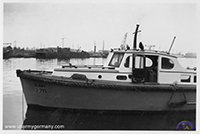
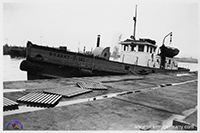
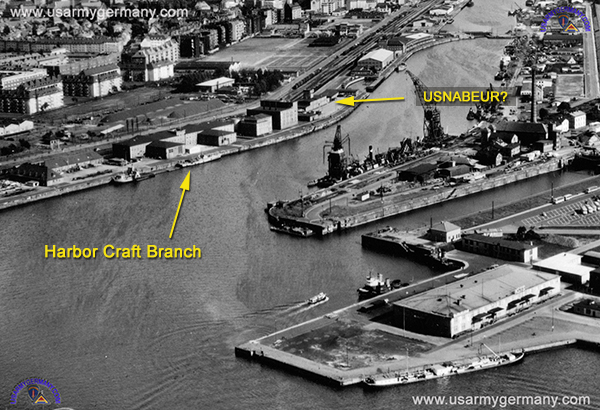 Harbor Craft Branch (Port Operations) and US Naval Advance Base, Europe |
||||
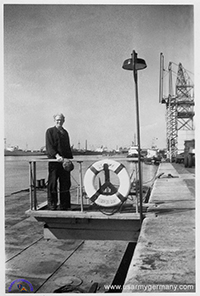
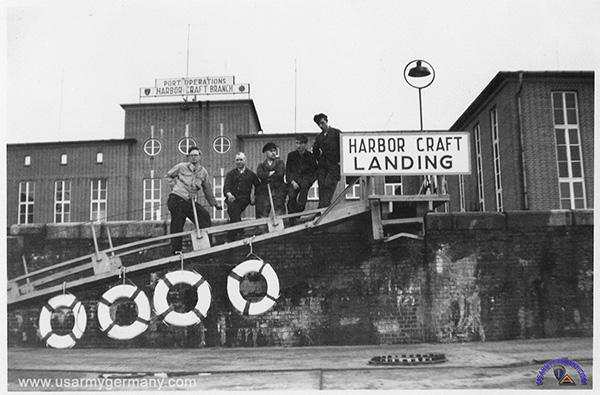 Several German members of the Harbor Craft Branch, Kaiserhafen I area (Walter Elkins) |
||||
|
||||
| 1950 | ||||
| (Source: STARS & STRIPES, March 19, 1950) | ||||
| The Bremerhaven Port of Embarkation (BPE) is responsible for operating the port of Bremerhaven for the Occupation Army in Germany. The command's mission is threefold: port operation; security and administration. BPE encompasses nearly 200 square miles, coinciding with the boudaries of the former Bremen Enclave. The command takes in Bremerhaven, where most of the troops are located, and Bremen, where most of the HICOG functions are concentrated (US diplomatic mission). Some statistics of port operations in 1949:  - 86,061 incoming and 79,391 US-bound passengers on Army transports processed;- 118,620 DPs processed through Bremerhaven for resettlement in US (transported on Army transports);- 1,720,865 tons of cargo destined for occupation forces handled (included POL); 79,115 tons of outbound cargo also loaded;- 129,843 pieces of outbound household goods moved and 34,184 pieces of inbound goods received;- 143,000 pieces of incoming baggage (excluding household goods) handled as well as
101,000 pieces of US-bound pieces;-
8,285 automobiles (owned by US military personnel) were received at Bremerhaven and 5,471 shipped from the port; - 86,061 incoming and 79,391 US-bound passengers on Army transports processed;- 118,620 DPs processed through Bremerhaven for resettlement in US (transported on Army transports);- 1,720,865 tons of cargo destined for occupation forces handled (included POL); 79,115 tons of outbound cargo also loaded;- 129,843 pieces of outbound household goods moved and 34,184 pieces of inbound goods received;- 143,000 pieces of incoming baggage (excluding household goods) handled as well as
101,000 pieces of US-bound pieces;-
8,285 automobiles (owned by US military personnel) were received at Bremerhaven and 5,471 shipped from the port;The vast volume of freight and passengers was m,oved by 303 cargo vessels, 97 tankers amd 217 passenger ships. Dependents processing inbound or outbound through Bremerhaven stay at the Dependents Staging Area. Troops process through the troop-staging area. Processing has been streamlined to a matter of a few hours. They are fed at a consolidated mess at Marine Barracks in Bremerhaven. Bremerhaven is reported to be the only post in Germany where active-duty members from all three US armed services as well as from the Coast Guard are stationed. |
||||
| 1951 | ||||
| (Source: STARS & STRIPES, Aug 12, 1951) | ||||
| Bremerhaven Port of Embarkation The Bremerhaven Port of Embarkation (BPE) operates the Occupation Army's (North Sea) port. BPE encompasses nearly 200 square miles coinciding with the borders of the Bremen Enclave. Responsible for the functions of the port are the 7802 BPE and its supporting units. In a recent year (1949?), the port processed 86,000 inbound personnel and 79,000 outgoing passengers on Army transports. Processing of incoming personnel now takes only a few hours, whereas it took several days just a few years ago. |
||||
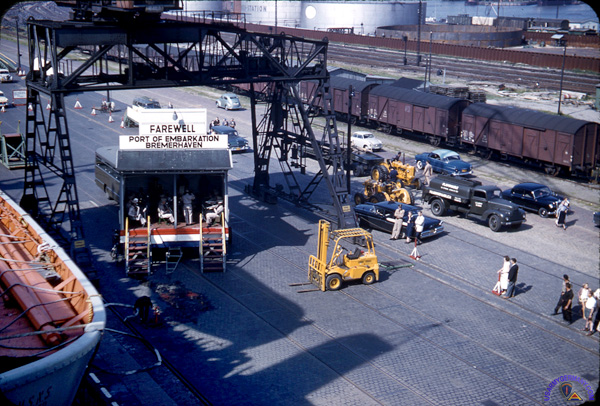 USNS Geiger with troops & dependents embarked is ready for its voyage back to the States, 1958 |
||||
| 1957 | ||||
| (Source: STARS & STRIPES, March 15, 1957) | ||||
POE officials estimate that about 3.5 million persons have been processed through the Port of Embarkation since its inception in March 1947. About 90 percent of US military personnel in Germany have been affected either directly or indirectly by port operations at Bremerhaven. |
||||
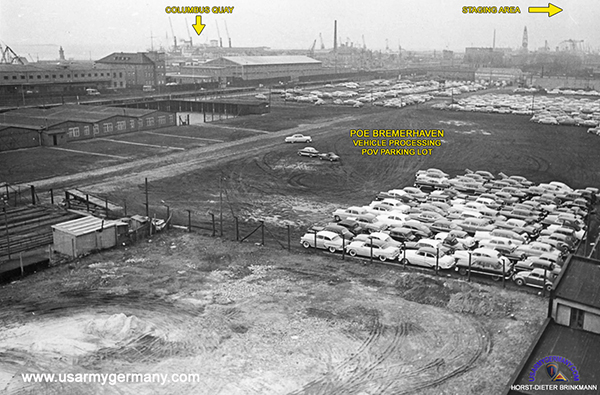 Original BPE Vehicle Processing Point, early 1950s (Horst-Dieter Brinkmann) |
||||
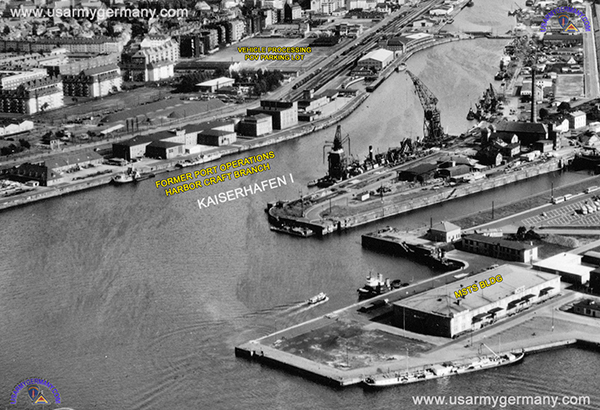 Location of former Vehicle Processing Point, Bremerhaven |
||||
| (Source: STARS & STRIPES, March 30, 1957) | ||||
| The BPE Vehicle Processing Center was moved to the Staging Area in March 1957. The move was prompted by economy and the desire to improve service as well as making the former property available for derequisitioning. The former location of what was also called the "largest used-car lot" in Europe, was one block across from the Dependents' Hotel on Bürgermeister in the Kaiserhafen I area. The VPC served as the pick-up and turn-in point for privately-owned vehicles of US military and US civilans working for the US Government in Europe. During 1956, the Vehicle Processing Center delivered 21,520 cars to their owners while, at the same time, processing 16,732 for shipment to the U.S. This figure was more than 10 times the number of cars handled 10 years before when the shipment of POV's of military personnel stationed in Europe was initiated. One of the disadvantages of the old location was that the QM gasoline station was several miles from the processing point. Formerly cars unloaded from ships arriving from the States were limited to three gallons of gasoline which was put in the cars at dockside. The cars were then driven to the processing point. After the owner claimed his car he had to drive more than four miles to the QM gasoline station before he could fill his tank for the return trip to their duty stations. On several occasions newcomers to Bremerhaven used the three gallons before finding the QM pumps at the Troop Staging Area. Now the gasoline station is next door to the vehicle processing point, as is an EES repair and parts facility for those few cars that do not pass the pre-delivery inspection. (Webmaster note: If you worked at the VPC at either the original site (near the Dependents' Hotel) or at the Staging Area once it moved there, have photos of the VPC operations and/or remember how it was organized and how the pick-up/turn-in process worked, please contact the webmaster (see email link at top of page). |
||||
| ROLL-ON, ROLL-OFF Concept Arrives | ||||
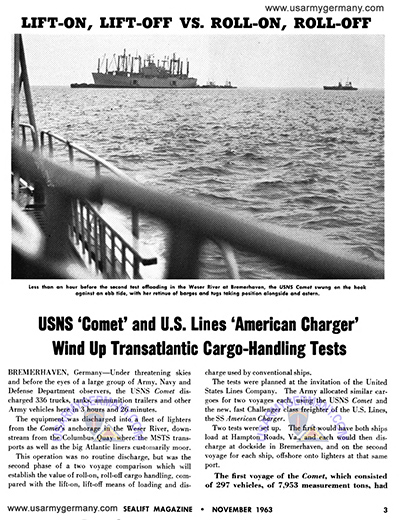 SEALIFT Magazine, Nov 1963 |
||||
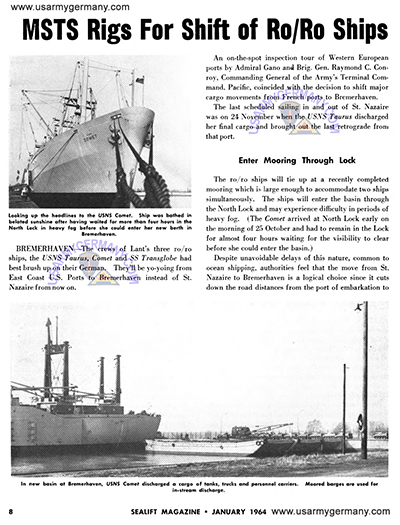 SEALIFT Magazine, April 1964 |
||||
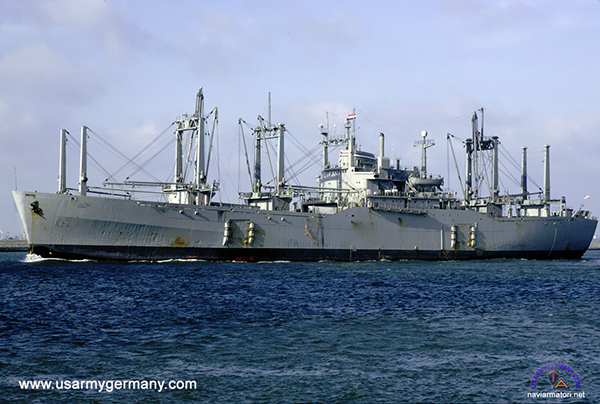 USNS Comet at sea (naviarmatori website) |
||||
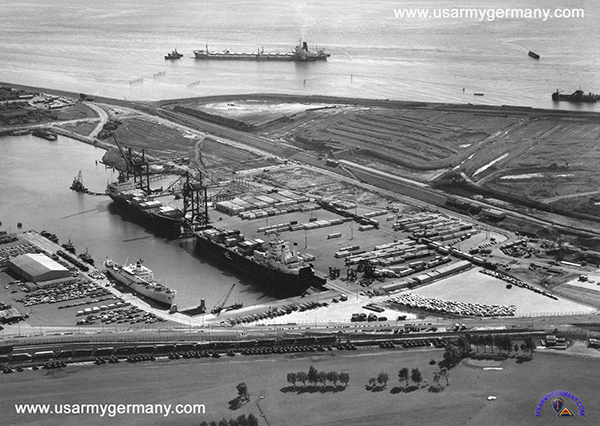 North Basin, Port of Bremerhaven, 1969 (Webmaster's collection) |
||||
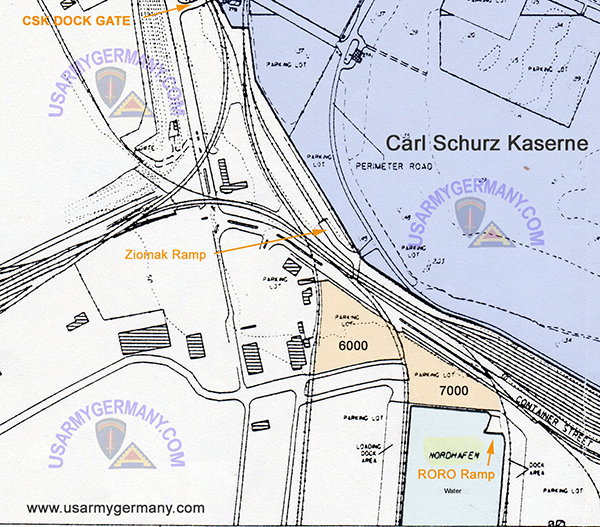 North Basin, Port of Bremerhaven, 1969 (Ulrich Urban) |
||||
| 1970s | ||||
| (Source: Email from Ulrich "Uli" Urban) | ||||
| The 1969 aerial photo of the North Basin seen above shows Areas 6000 and 7000 and the RORO ramp (with the small tower, just in front of the large white ship). The area at the bottom of the photo is part of Carl Schurz Kaserne. Area 6000 was used to park military vehicles that were offloaded from Roll-On/Roll-Off vehicle cargo ships such as the USNS Comet or USNS Admiral Callaghan. POVs belonging to US military personnel that were shipped from the States on these ships were parked in Area 7000. (Obviously, the same areas were used for parking vehicles - military and POVs - being shipped back to the States before they were loaded onto the ships.) The US Army also had a loading ramp - called a Ziomak ramp - in Area 6000 that allowed loading and unloading of vehicles directly onto or off of flatcars for rail transportation to US installations in southern Germany. Sometimes two Navy vehicle cargo ships would be moored in the North Basin at the same time. At that time the two areas 6000 & 7000 would be packed with POVs, tanks, trucks, etc. |
||||
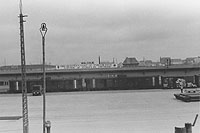
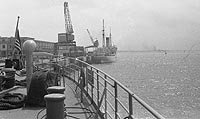
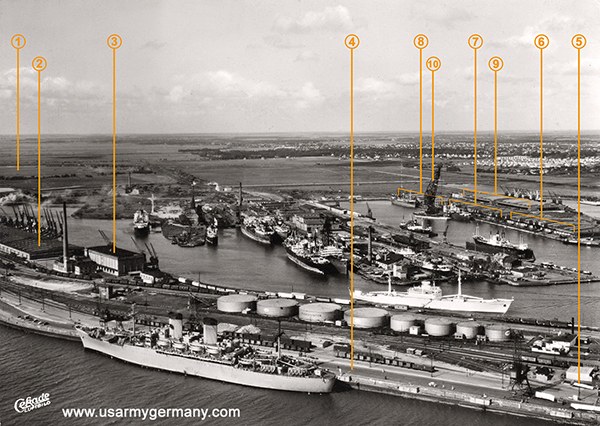 Columbus Quay and Kaiserhafen III, Port of Bremerhaven (Webmaster's collection) |
||||
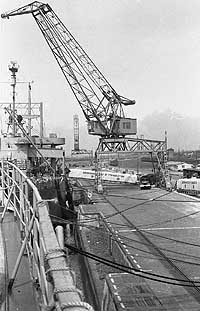
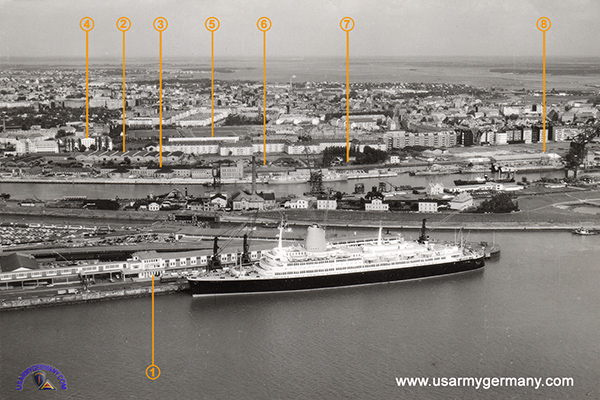 Kaiserhafen I, Port of Bremerhaven (Webmaster's collection) |
||||
| 1985 | ||||
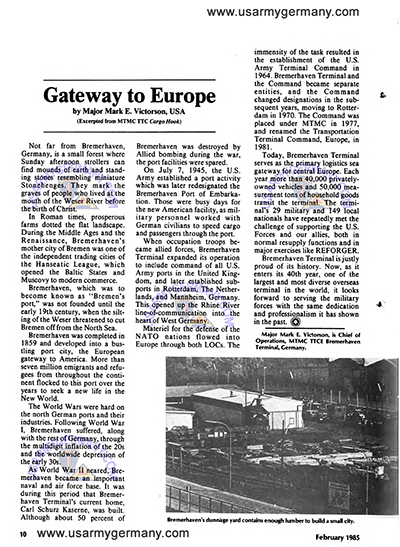 Some History on Bremerhaven, 1985 (TRANSLOG) |
||||
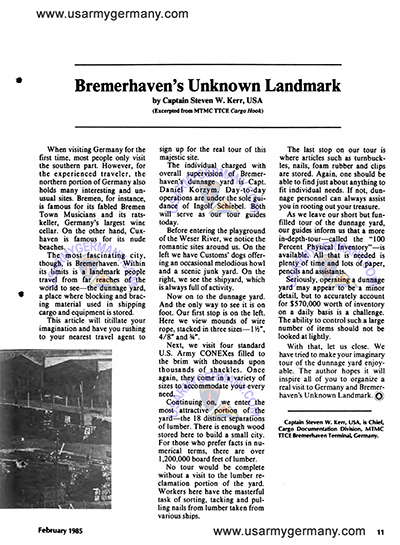 Dunnage Yard, Port of Bremerhaven, 1985 (TRANSLOG) |
||||
 |
||||
| Farge POL Storage Depot | ||||
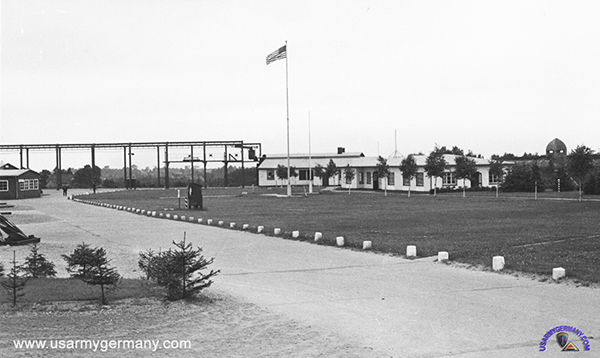 Depot Headquarters building, Farge POL Depot, 1952 (Hugo Kann) |
||||
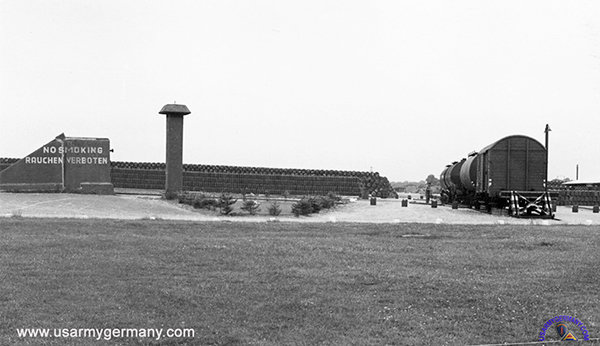 Shipping area at Farge POL Depot, 1952 (Hugo Kann) |
||||
| 1954 | ||||
| (Source: STARS & STRIPES, Apr 29, 1954) | ||||
| An agreement has been signed between Army authorities in Bremerhaven and the German enterprise VTG (Vereinigte Tanklager und Transportmittel GmbH) of Hamburg that enables the VTG to utilize portions of the Army-controlled POL Depot at Bremen-Farge. The VTG is an organization primarily concerned with the storage and transport of peroleum products. It maintains several storage depots, more than 10,000 tank railcars, and an inland tanker fleet, as well as a pipeline system. (Webmaster note: If you worked at the Farge POL Depot, have photos of the POL depot operations and/or remember how it was organized, please contact the webmaster (see email link at top of page). |
||||
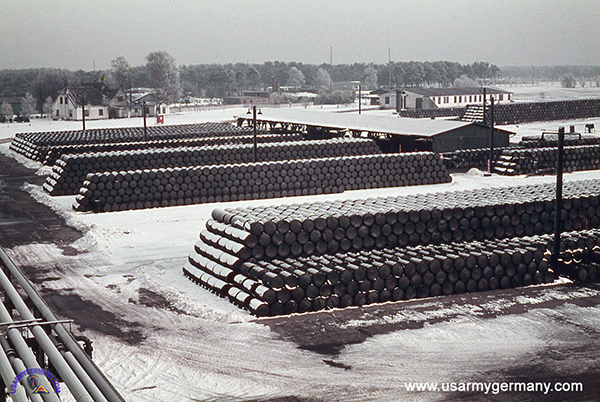
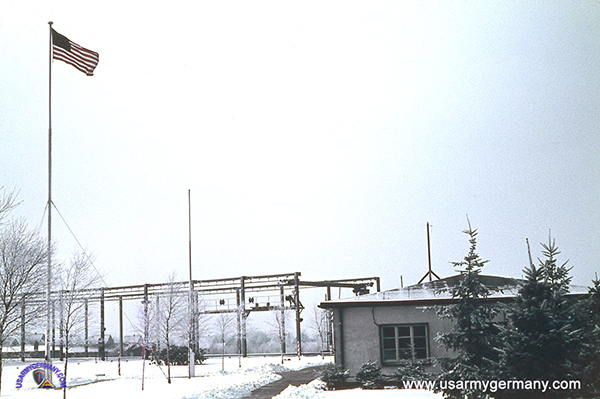 Farge POL Depot, 1950s (Webmaster's collection) |
||||
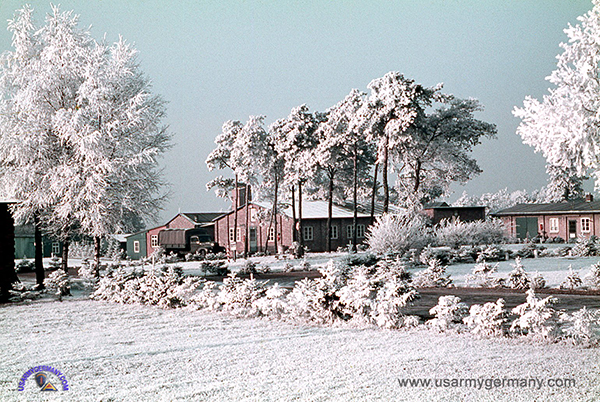
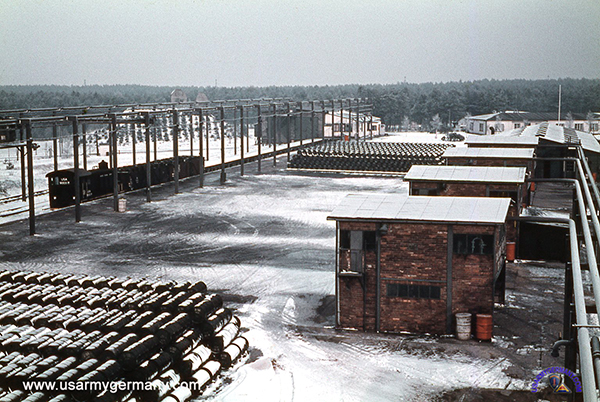 Farge POL Depot, 1950s (Webmaster's collection) |
||||
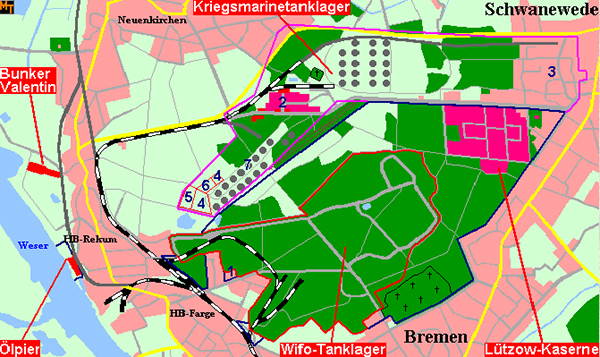
 Farge POL Depot, 1950s (Webmaster's collection) |
||||
 Farge POL Depot, 1950s (Webmaster's collection) |
||||
|
||||
| 1957 | ||||
| (Source: STARS & STRIPES, April 1, 1957) | ||||
| US Army Depot Farge The Farge POL Depot is part of the Army's Port of Embarkation, Bremerhaven, and serves as USAREUR's principal ocean terminal for petroleum products. The Farge installation was originally constructed by the Germans during WWII as a bombproof underground fuel storage depot. Although raided on many occasions by British and US bombers during the war, the plant remained relatively undamaged and in operation until the war's end. Today, the depot is operated by the US Army and holds 8 million gallons of fuel for the US Armed Forces in Europe. In the 800-acre, wire-enclosed, wooded area encompassing the depot there are 80 miles of underground pipeline, 15 miles of railroad track, 16 storage bunkers and nearly 100 permanent-type buildings, many of the latter underground. 46 main pumps are installed in the various bunkers and pumping stations, capable of transferring fuel products from one storage tank to another, from one bunker to another, to and from the riverside pier and from storage to the railroad sidings for loading and unloading tank cars. |
||||
 The Farge POL Depot (Courtesy www.relikte.com) 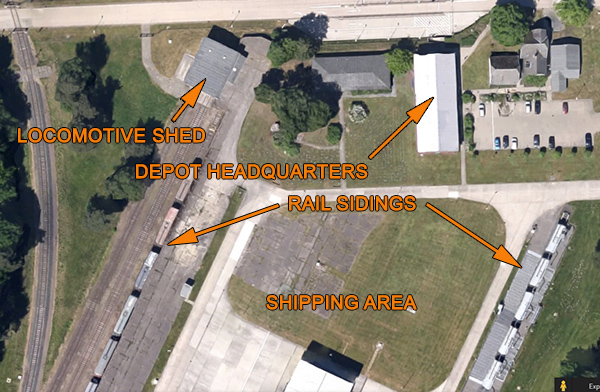 Recent satellite view of the former POL depot at Farge (GOOGLE Maps)
|
||||
| Originally there were 80 tanks of more than a million gallons each distributed between the 16 huge concrete-reinforced bunkers. Two of those (in Bunker #13) were destroyed during the bombings toward the end of the war, leaving 78 that make up Farge's total capacity. Ordinarily, 25 of the 78 storage tanks are devoted to regular motor gasoline, the kind that is dispensed at Quartermaster gasoline stations throughout USAREUR. Seven others hold special motor gasoline, eight diesel oil, five jet fuel, 13 are utilized for aviation gasoline and the remainder are used for kerosene and cleaning solvents. 15 of the tanks are used by a commercial company on a lease arranged with the Army. In a typical operation, Farge can unload 120 railroad cars a day. However, there are facilities to load 288 cars with bulk fuel each day, or enough to fill 12 trains of 24 tank cars each. The depot can also fill, stencil and stack as many as 1,000 55-gallon drums of fuel daily. The receiving capability is limited by the pumping capacity of the ship (super tanker) being unloaded - generally more than two million gallons a day. The task of handling more than 100 million gallons of POL products a year is accomplished by a small, technically skilled staff of Army personnel headed by Capt Edwards T. Molloy, depot commander. He is assisted by four officers and 19 enlisted men. The depot also employs nearly 250 German civilians from the surrounding communities of Blumenthal, Vegesack and Neuenkirchen. About 25 of them were employees of the depot when the Americans first arrived there in May 1945 to begin operations for the occupying forces. Due to the nature of the installation, the depot is one of the most security minded installations in the Army. Open flames, smoking and other means of possible ignition are not permitted. Each of the 16 storage bunkers has an automatic fire extinguisher system utilizing a deadly, smothering gas, under pressure. Should a fire start while a person is down in one of the fume-filled bunkers, his first thought is to race up the stairs for the heavy steel door guarding the entrance. There an automatic device can be tripped flooding the atmosphere of the bunker with the extinguisher. The central pumping station, 70 feet underground, is similarly equipped. Machinery spaces and anterooms are meticulously clean and free from fire hazards. Persons entering one of the underground rooms must go directly to the spark-proof telephone and report their presence to a central switchboard. Otherwise, an electrical watchman will flash an alarm that an unauthorized person is in the area. |
||||
| 1960 | ||||
| In February 1960, the US Forces returned the Bremen-Farge POL Depot to the German government. Details of the agreement signed between the US and FRG governments can be found in the following document: Memorandum Agreement of February 26, 1960 |
||||
|
||||
| Related
Links: |
||||
 .
.
 USARPEB Hq Co