If you do
NOT see the Table of Contents frame to the left of this page, then
Click here to open 'USArmyGermany'
frameset |
US Army Transportation Terminal Command, Europe
US Army, Europe
Looking for more information from military/civilian
personnel assigned to or associated with the U.S. Army
in Germany from 1945 to 1989. If you have any
stories or thoughts on the subject, please contact me . .
|
|
|
|
|
|
| US Army Transportation Terminal Command, Europe 1968 |
| |
| 1945 - 2003 |
(Source: 598th TTG History Sheet, MTMC website, 2003)
598th US Army Transportation Terminal Group |
|
|
|
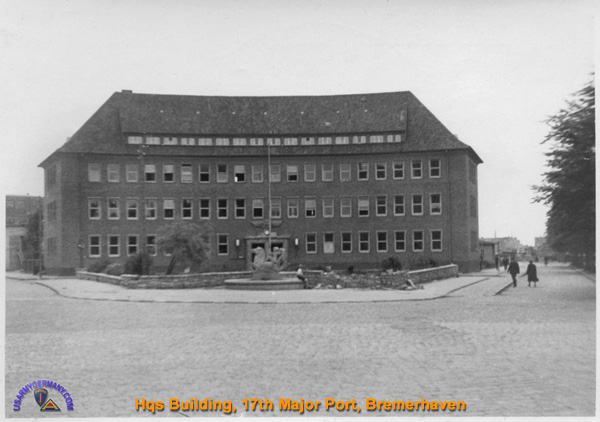
The Terminal Command, Europe HQ building in Bremerhaven (Webmaster's collection)
This building served as the command building for several higher
headquarters,
such
as the
17th Major Port seen in the above photo from 1945, that were located in Bremerhaven after 1945. |
| |
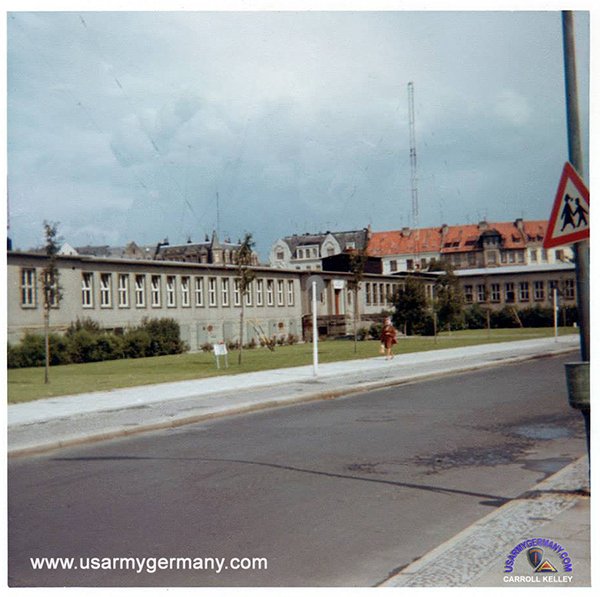
The Communications Center building in Bremerhaven, c. 1967 (Carroll Kelley) |
| |
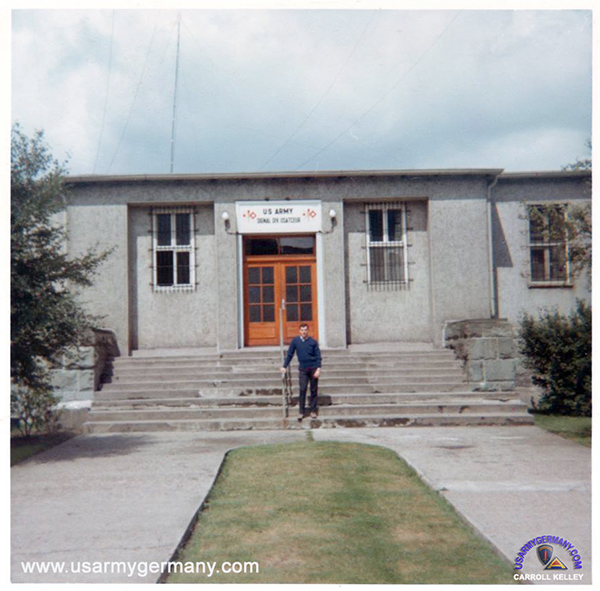
The USATCE Signal Division building in Bremerhaven, c. 1967 (Carroll Kelley) |
| |
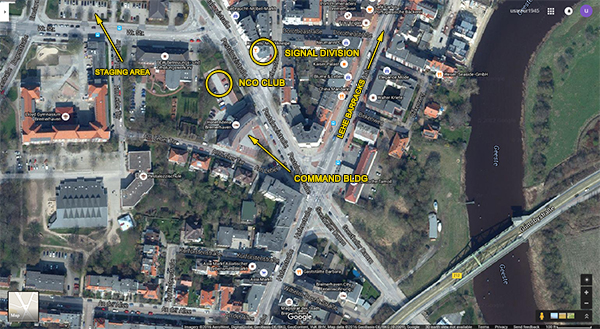
GOOGLE sat view of the area around the former Command Building, Bremerhaven (GOOGLE)
Looking at the sat view above, my guess is that the place identified as 'Kuddels' would be where
the
Signal Building was located. As I recall, coming out of the front entrance of the Signal
Building,
the
NCO Club was across the street (Pestalozzis Str.) and to the left a little bit - at the present parking lot. |
| |
| 1966 |
| (Source: Carroll Kelley, 'Carl Schurz Kaserne Bremerhaven Weddewarden' Facebook Page) |
The building that housed the Terminal Command's Signal Division (above) is no longer in existence. It was located near the Command Headquarters building near downtown Bremerhaven.
It was directly across from the NCO club.
This building was my duty station for 15 months.
The OLD Command Headquarters building is still there and has been converted into a Hotel.
There was a tunnel going from the Command Headquarters building over to the Comm Center where I worked. When there was an alert, the War Room was 4 stories below my building .
Behind the Sig Div building was a tall VHF antenna tower. I climbed it several times. The view was spectacular.
If anyone has additional details on the Signal Division, its organization, equipment and role in supporting the Transportation Terminal Command in Europe, please contact the websmaster (see email link at top of page)
|
|
|
| 1981 |
| (Source: TRANSLOG, February 1981) |
The Military Traffic Management Command, Transportation Terminal Group, Europe (MTMCTTGE) has been re-designated MTMC Transportation Terminal Command, Europe (MTMCTTCE), effective January 31, 1981.
The commander interfaces routinely with the United States Army, Europe; United States Air Forces in Europe; and Supreme Headquarters Allied Powers, Europe to insure mobilization require ments are met.
The name change more accurately reflects the scope of opera tions for the command, which has terminal units in the Netherlands, Ger many, England, Italy, Portugal, Spain, Greece and Turkey.
Additionally, ground breaking is set for April 1981 for a new headquarters building for the European subcommand.
The new building, to be located in Schollavear, a suburb of Rotterdam, will provide 50,000 square feet of space for MTMCTTCE and other tenant activities. Completion is expected by November 1, 1982.
Commanded by Col. Robert A. Lawson, MTMCTTCE has a headquarters staff of 15 Army officers, 31 enlisted personnel, and 41 civilians. It has fulltime port operations personnel in Rotterdam and seven other European cities, and contract operations in an additional 12 cities. It also supervises terminal units in Spain, Turkey, and Greece.
Planning for a new headquarters site began in 1976 when the city of Rotterdam notified MTMC that the city had long-range plans to turn the present site into a residential area.
MTMCTTCE provided port operations management for all Department of Defense cargo going to and leaving Europe by sea, including privately owned vehicles and household goods. |
|
| |
| 1982 |
| (Source: TRANSLOG, August 1983) |
MTMC Transporation Terminal Command, Europe
Although the Military Traffic Management Command Transportation Terminal Command, Europe has been operational since January 1981, its history can be traced to the early days of post World War II.
On June 7, 1945, a U.S. Port was established to Bremerhaven, Germany under the command of the 17th Major Port. Later, the Bremerhaven Enclave was designated the Bremerhaven Port of Embarkation and assumed control of all the U.S. Army ports in the United Kingdom.
In 1957, the sub-ports of Mannheim, Germany, and Rotterdam, the Netherlands, were activated and added to the Bremerhaven Port of Embarkation to support of U.S. Forces in the Central European Theater of Operations. Then on May 1, 1964, the Bremerhaven Port of Embarkation was redesignated as the U.S. Army Terminal Command with jurisdiction extending to the port of Saint Nazaire, France. With the withdrawal of U S. forces from France, three years later, the Saint Nazaire facility was deactivated.
The United Kingdom Terminal was assigned to the United States Army Transportation Command, Europe in April 1968 while the Lisbon Terminal was simultaneously activated and joined the Command in support of DOD activities in Portugal.
The expanding European-wide Transportation Terminal Group was again renamed the United States Amy Transportation Terminal Group, Europe, in 1969 and organized as a subordinate unit of the United States Army Transportation Command, Europe. With this redesignation, the Command assumed control of all DOD terminal activities in Northern Europe, the United Kingdom and Portugal. In 1970, the Headquarters was relocated from Bremerhaven to Rotterdam.
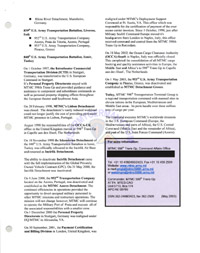
Reassignment of the U.S. Army Transportation Terminal Group, Europe from the 4th Transportation Brigade, USAREUR, to the Military Traffic Management Command Eastern Area occurred in July 1976. The Rotterdam based headquarters then became known as the Military Traffic Management Command, Transportation Terminal Group, Europe (MTMC TTGE).
MTMC TTGE became a major subordinate command of HQ, MTMC with the addition of transportation terminal units in Japan, Greece, Spain and Turkey in 1977.
In recognition of the vital service and important wartime mission which MTMC TTGE provided for the projection of U.S. Forces into Europe, MTMC TTGE was redesigned in January 1981 as the MTMC Transportation Terminal Command, Europe (TTCE) and the Cargo Booking and Contract Administration functions belonging to MSC (Military Sealift Command) were transferred to MTMC worldwide.
This change resulted in the formation of the Military Export Cargo Offering and Booking Offices (MECOBOs) in Bremerhaven, Germany; Naples, Italy; and London, England. |
| |
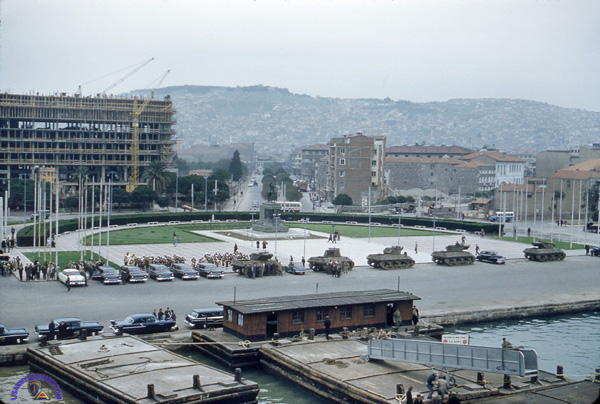
TTU Izmir, Turkey (Webmaster's collection) |
| |
In June 1982, Detachment 33-1, TTU Istanbul became an outport under Detachment 33-2. TTU Izmir, and in July 1983, TTU Iskenderun also became an outport of TTU Izmir.
The present MTMC TTCE organization includes the Command headquarters, seven terminals, six manned outports and three MECOBOs extending over eight countries. MTMC TTCE's mission is to command assigned water terminal operations in the European area; provide transportation terminal planning in support of mobilization plans and military operations; and perform Military Sealift Command (MSC) functions in specified ports and cargo booking clearance and contract administration functions.
MTMC TTCE's Workload
During 1982, MTMC TTCE was responsible for the port handling and routing of almost 100,000 containers. Approximately 15,000 of these were used for the shipment of privately-owned vehicles (cars, motorcycles, campers) belonging to service members and U.S. civilians, arriving or departing from Europe. Also shipped in containers are Army Air Force Exchange Service goods, Commissary goods, spare parts and household goods.
The primary responsibility of all MTMC TTCE terminals is to ensure that the documentation (customs forms) for these containers is available and correct when they are discharged or loaded and to make timely transportation of the cargo to final destination possible.
MTMC TTCE supervises the discharging or loading of privately-owned vehicles to or from roll-on/roll-off ships. Since nearly all cargo handling activities in MTMC TTCE controlled ports are performed by local contractors, MTMC TTCE personnel constantly monitor the contractors' performance. Cargo is monitored from the vehicle processing parking area, to the ramp and into the ship until it is properly secured on one of the ship's decks.
In addition to containerized cargo, MTMC TTCE also supervises the handling and distribution of general cargo, such as goods on pallets, in bundles or in cartons. Because of the relatively small and often odd-shaped sizes of the individual pieces of cargo, the loading or discharging of a vessel carrying this cargo is a time-consuming and intricate process. The high quality control standards on the documention and supervision efforts conducted by MTMC TTCE personnel make the job even more difficult.
The most regulated operation under MTMC TTCE responsibility is the discharging or loading of ammunition. Each year the Command handles more than 100,000 tons of ammunition through its terminals. Close liaison with representatives of the host nation government, railroad officials, local contractors and representatives at the ultimate destination are an absolute requirement to ensure an uninterrupted and safe operation.
In a number of MTMC TTCE controlled ports, local legislation does not allow for an ammunition vessel to berth at a pier in the port area. The discharge or loading operation is then performed while the vessel is anchosed several miles off-shore.
The ammunition which is transported to or from the vessel by small coasters, adds significantly to the safety and related planning difficulties because of the importance of timing at both the pier and the ship. Also, changes in the tide, which at times in the United Kingdom can fluctuate as much as 50 feet, must be considered in the plans.
Next to military or commercial highway and railroad systems, the inland waterways are regularly used by MTMC TTCE to transport cargo to or from inland distribution points.
Self-propelled barges carry the cargo across the various rivers and canals. Barges are frequently used to transport ammunition to and from an ocean-going vessel over nearly 500 miles of inland waterways.
Proper timing of shipments and assuring that all the required cargo documentation is available, are key responsibilities of MTMC TTCE personnel when barges are used for transportation.
Despite the day-to-day pressures of working in an overseas environment, the capable men and women at MTMC TTCE are dedicated to carrying out their mission with pride and a feeling of accomplishment.
|
|
| |
| 2010 |
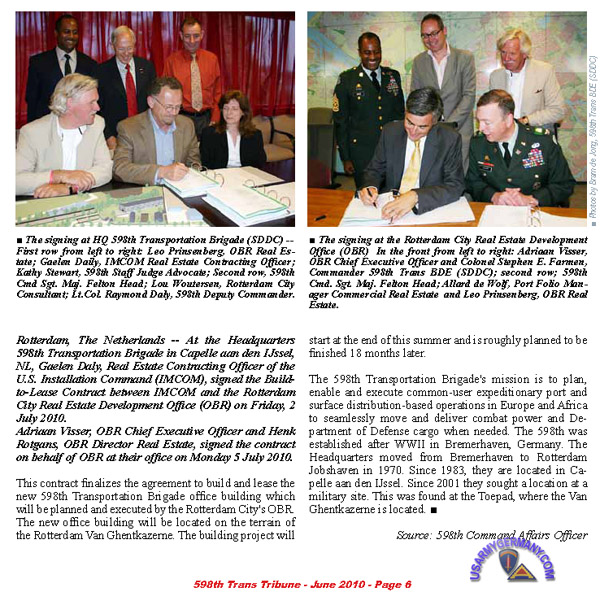
| (Source: Trans Tribune, June 2010, 598th Trans Bde ) |
|
 |
|
|
| Military
Traffic Management Command Europe |
| |
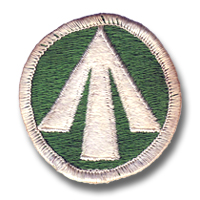 Military Traffic Management Command Patch Military Traffic Management Command Patch |
| |
| 1964
- 1983 |
| Source: Military
Traffic Management Command Europe Command History, accessed on former MTMC
web site |
The Military Traffic Management Command Europe has been operational under that name since January 1989. Prior to this, it was known as the Military Traffic Management Command, Transportation Terminal Command Europe.
The command was established in Bremerhaven, Germany, under the 17th Major Port on June 7, 1945. It was subsequently named Bremerhaven Port of Embarkation on March 14, 1947.
On Aug. 16, 1955, the Bremerhaven Port of Embarkation assumed control of all U.S. Army ports in the United Kingdom. Subports at Mannheim, Germany, and Rotterdam, Netherlands, were activated in 1957. They were added to the Bremerhaven Port of Embarkation to support U.S. forces in the Central European theater of operations.
On Dec. 31, 1961, the United Kingdom Terminal was established as a special activity of the Chief of Transportation. The Bremerhaven Port of Embarkation was redesigned as the U.S. Army Terminal Command on May 1, 1964. The jurisdiction of the newly established command was extended to the Port of Saint Nazaire, France, on July 1964. Three years later, in March 1967, the Saint Nazaire facility was deactivated due to the withdrawal of U.S. forces from France.
The expanding European-wide Transportation Terminal Command was again renamed in July 1969, this time as U.S. Army Transportation Terminal Group Europe. It assumed control of all Department of Defense common-user terminal activities in Northern Europe, the United Kingdom and Portugal. In 1970, The headquarters moved from Bremerhaven to Rotterdam.
On July 1, 1976, the command was transferred from the 4th Transportation Brigade, U.S. Army Europe, to the Military Traffic Management Command, Eastern Area. The name of the command became Military Traffic Management Command Transportation Terminal Group Europe.
In January 1977, the command became a major subordinate command of Military Traffic Management Command headquarters, which is located in Falls Church, Va. Terminal units in the Azores, Italy, Greece, Spain and Turkey were added to Military Traffic Management command Transportation Terminal Group Europe.
In January 1980, Transportation Terminal Unit Azores was transferred to MTMC Eastern Area. Military Traffic Management command Transportation Terminal Group Europe provided vital service and an important mission for projection of U.S. power into Europe. Therefore, MTMC Transportation Terminal Group Europe was redesignated in January 1981 as MTMC Transportation Terminal Command Europe.
Export cargo booking and contract administration functions performed by the Military Sealift Command were transferred to MTMC in October 1981. This resulted in the formulation of the Military Export Cargo Offering and Booking Office, subsequently renamed Ocean Cargo Clearance Activity, in Bremerhaven.
In June 1989, Ocean Cargo Clearance Activity was relocated to Rotterdam with offices in Naples, Italy, and London, England.
In June 1982, Transportation Terminal Unit Istanbul became an outport under TTU Izmir, Turkey. On July 14, 1983, TTU Iskenderun was also added.
Since July 1983, Headquarters MTMC Europe has been located in Capelle aan den IJssel, adjacent to the city of Rotterdam in The Netherlands. Today, MTMC Europe is a regional transportation command with staffed sites in 11 nations in the European, Mediterranean and Middle East areas. Its ports handle more than three million tons of cargo per year. The command executes MTMC's worldwide missions in the U.S. European Command and in parts of the U.S. Atlantic Command and U.S. Central Command's areas of operations. |
|
|
|
| (Source: TRANSLOG, July 1976, Vol. VII, No. 7) |
|
|
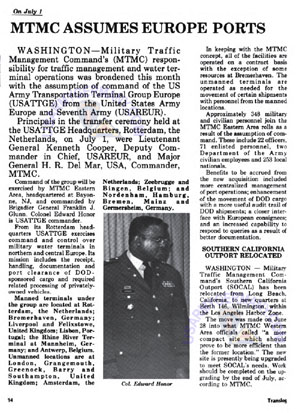
On July 1 1976, the US Army Transportation Terminal Group, Europe with headquarters in Rotterdam, the Netherlands, was relieved from assignment to US Army, Europe and reassigned to the Military Traffic Management Command. |
|
|
|
|
| Rotterdam Terminal |
| |
| 1959 |
| (Source: STARS & STRIPES, August 21, 1959) |
|
Three years ago, the US Army decided to initiate port operations at Rotterdam, the Netherlands. Operating as a sub-port of Bremerhaven POE, the operation handles about 18,000 long tons of cargo each month.
Lt Col Robert P. Flint is the commander of the sub-port.
The personnel strength of the sub-port is 21 (including three officers and six enlisted men). Loading, shipping and other operations are performed primarily by Dutch stevedores and barge contractors.
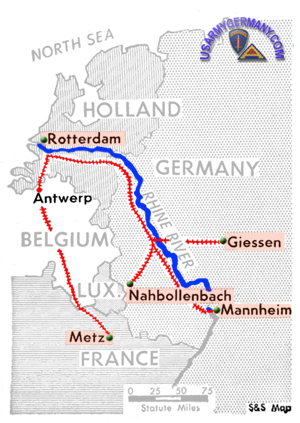
Most of the cargo received at the port is transferred directly from ocean freighters to barges and shipped up the Rhine to the sub-port at Mannheim, Germany. Some of the
cargo is transported by rail to its final destination such as the huge Quartermaster depots at Metz, France, and Nahbollenbach and Giessen in Germany. The remainder of the cargo goes by truck.
The determination of which mode should be used is
made based on rates, type of cargo and other considerations. For example, the huge rolls of newsprint is transported by truck. Damaged newsprint can cause problems for the presses so additional handling is minimized by sending the rolls directly to STARS & STRIPES at Griesheim.
|
|
Most of the cargo shipped by barge up the Rhine River consists of food and subsistence for Army installations. Mannheim is the "breakdown" point for rations. Food shipments delivered by the barges are stored in warehouses there and then trucked to the various supply areas.
Another important type of cargo that arrive by barge are vehicles such as trucks, tanks and evfen Army airplanes.
General cargo makes up the bulk of the remaining cargo.
Cargo returned by barge from Mannheim to Rotterdam for shipment to the US consist primarily of CONEX containers filled with household goods of military personnel and their families as well as worn military vehicles that have been replaced. |
|
|
| |
| (Source: STARS & STRIPES, March 9, 1964) |
The Benelux Terminal with headquarters at Rotterdam (the Netherlands) handled 350,000 tons of cargo in 1963. The Terminal is subordinate to the US Army POE Bremerhaven in Germany and includes operations at the Belgian ports of Antwerp and Zeebrugge. (Rotterdam handles 84 percent of the terminal's cargo; Antwerp takes care of 10 percent and Zeebrugge, the ammo port, handles the remaining 6 percent. Most of the cargo passing through the terminal consists of food for the commissaries; EES/AFEX goods; vehicles of all types; and ammo.)
CO of the Terminal is Lt Col Edmund V. Harnstrom (his office is located at the US Consulate in Rotterdam). He has a staff of 54: 3 officers, 7 EM's, 2 US civilians and 42 local employees. (Loading and unloading of ships is done by local stevedores.)
About eighty American-owned or MSTS ships are handled by the terminal each month. After the cargo has been discharged, the District Traffic Management Office arranges for transportation to depots in Germany or France (see article above).
The Benelux Terminal also works with the US Navy and the Coast Guard -- an MSTS (Navy) commander acts as shipping agent and a Coast Guard commander investigates accidents involving Merchant Marine ships. Plans also call for an Air Force representative to join this multi-service team to help coordinate USAFE shipments. |
|
|
|
| (Source: TRANSLOG, July 1977, Vol. VIII, No. 7) |
|
|
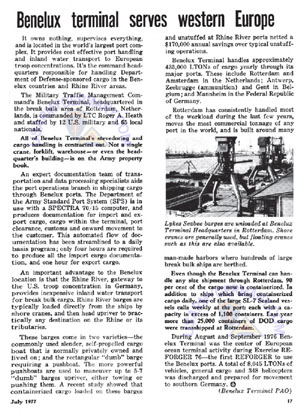
Located in the world's largest port complex, the MTMC Benelux Terminal in Rotterdam, the Netherlands, is responsible for handling DoD-sponsored cargo in the BENELUX countries and Rhine River areas. |
|
|
|
|
| Rhine River Terminal |
| |
| 1966 |
| (Source: STARS & STRIPES, May 9, 1966) |
The Rhine River Terminal is an activity of the US Army Terminal Command in Bremerhaven, Germany.
The Rhine River Terminal was opened in 1956. Between 1956 and May 1966, more than 1.8 million tons of cargo have been processed at the terminal.
The inland waterway route between the US docks at Rotterdam and the ports of Antwerp and Zeebrugge in Belgium and the Rhine River Terminal at Mannheim is 750 miles and takes from 5 to 7 days by barge.
There are 22 sites along the Rhine River were US military cargo can be off-loaded. Bingen is one of them, there are three cranes there for that operation. Usually there are eight to ten barges being off-loaded on a daily basis. Another site is Karlsruhe where ammunition arriving at Zeebrugge is off-loaded.
Terminal Chief is a Major.
(Webmaster Note: another S&S article in 1968 mentioned that the Terminal consisted of 28 different sites in the Mannheim-Ludwigshaven area. In addition, there were two other main ports (Germersheim and Bingen) as well as four other sites along the Rhine River which the Terminal used exclusively for loading and unloading ammunition.) |
|
|
| |
| (Source: STARS & STRIPES, September 20, 1968) |
The Rhine River Terminal is located along the waterfront of the large inland port at Mannheim, near the junction of the Rhine and Neckar Rivers. The Terminal is responsible for shipments of cargo to military installations throughout Germany.
The facility is the only inland port operated by the US Army in Germany. The unit uses contractor-operated flat-bottom river barges to move a major portion of the cargo. Most of the cargo handled by the terminal comes from the Benelux Terminal in Rotterdam.
Loading and unloading of the cargo at the terminal is done by stevedores also under contract to a major Mannheim shipping company. There are 19 locations (along the Rhine River between the ports and Mannheim) with 21 cranes for loading and unloading. (One of the cranes is the 100-ton Goliath crane at Mannheim, thought to be one of the largest in Germany.)
All cargo (there are four classes: general cargo; bulk foods; vehicles; ammo) coming through the Mannheim terminal is further transported to its final destination by rail or truck. The 501st Trans Co at Ruesselsheim handles most of the line-haul movements (using 12-ton trailer-trucks). |
|
|
|
| 1984 |
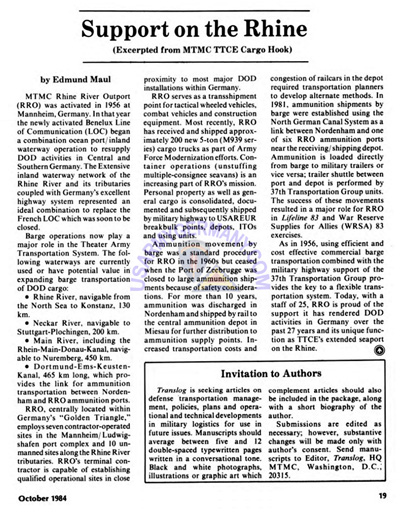
Article on Rhine River Outport (TRANSLOG, Oct 1984 issue) |
|
| |
| (Source: 598th Trans Tribune, December, 2007) |
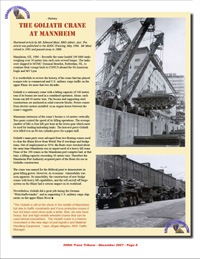 Article on Goliath Crane
|
|
Article discusses 100-ton crane used at the Rhine River Terminal to load and unload M60 tanks and other heavy equipment from barges at the Inland Port of Mannheim. |
|
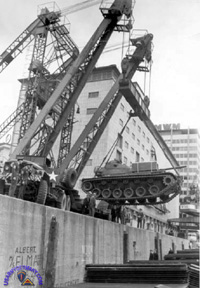
1. Goliath at work |
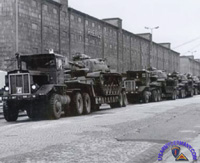
2. IH Dragon Wagons
|
|
|
|
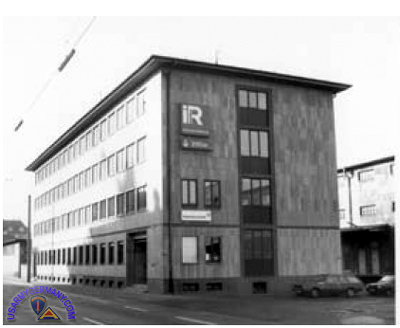
3. Former Rhine River Det Bldg at Parkring 47, Mannheim
|
|
|
|
|
| United Kingdom Terminal |
| |
| 1987 |
| (Source: TRANSLOG, April 1987, Vol. 1, No. 1) |
|
|
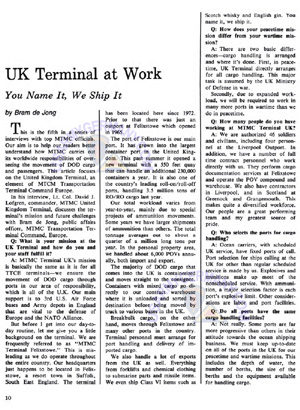
Article, written by Lt Col David J. Lofgren, CO of the UK Terminal, discusses the terminal's mission and future challenges.
The UK Terminal is an element of the MTMC Transportation Terminal Command, Europe and is located at Felixstowe, England. |
|
|
|
| Outport Felixstowe |
| |
| 1968 |
| (Source: Email from Randy Erwin) |
I was among the first to served at the Port of Felixstowe, England in 1968. The Lt. Colonel David J. Lofgren used the term “outport,” and that Felixstowe was opened in 1965, and indicated that full operations did not begin until 1972. This is incorrect, we started exporting and importing all types of cargo in 1968. We also became the terminal to receive and ship POVs and Household Goods.
Initially, I served at the London Terminal, starting in the early winter of 1967 and was subsequently promoted to E-5 from E-1 by 1968. I was placed in charge of Exporting, and another gentleman my age was placed in charge of Importing. I am now 68 years old and must say that this was the most enjoyable job I have ever had. This is notwithstanding the fact that I have owned or ran at least 4-5 businesses after returning from England in 1969.
The main reason I am writing you is to see if you would be able to give the contact information for some of men I served with during my time in London and Felixstowe. My entire command was probably less than 20 persons during this time. Those guys were extremely important to me in appreciating our greatly diverse society during some very turbulent times.
My MOS was a Transportation Movement Specialist (71N20), when promoted to E-5 this was probably bumped to 71N40.
In late 1966 I attended Transportation School at Fort Eustis, VA. We were told at the time that this was the only Transportation School in the US Armed Forces. After graduating our class was dispersed to Army Port Terminals throughout the world such as Karachi, Pakistan, Rotterdam Benelux and even Beirut, Lebanon. We were an odd group in the Military, nothing clandestine just a group of specially trained personnel in all modes of transportation. Therefore, we were dispersed throughout a lot of governmental agencies. For example, some of us went to work for AID (Agency for International Development), and some the Department of Transportation.
In early February, 1967 while still at Fort Eustis I finally received my Orders to go to the Borough of Middlesex, England. It also stated that I would be on Civilian Status and was given $300 to go to downtown Norfolk, VA to buy suits and other clothes. Since I was a prankster while awaiting orders at Fort Eustis, I thought someone was returning this prankster activity to me. So I immediately when the Commanding Officer of my temporary unit and asked him if he or someone was pulling a prank on me with these orders. He asked me what was I referring to, and I showed him my orders.
He read them once, then again, and looked up at me and said, "Ervin, you are luckiest Son-of-a-B... I have ever seen." Then I asked him where in the hell is Middlesex, England. He said, "Hell, I don't know." I said "Thank you Sir!" I immediately went to the base library to look up Middlesex, England because I knew it somewhere in the boonies. To my surprise, it was a borough smack dab in the middle of London. After this library trip, all I could think of were "mini skirts and the Beatles."
London Terminal
Within a few days I was on an airplane to Middenhal AFB and the Douglas House (D-House) on Lancaster Gate, London (The Douglas House was a hotel run by the US Air Force and that evening was bustling with with Mini Skirts that evening). After arriving at the D-House, I had additional orders to report the Keysign House (an Office Building Near Marble Arch). After arriving at the Keysign House in my civilian clothes and processed in, I was told my duty assignment would be at London Terminal on Leadenhall Street-The Bank (I was still an E-1,and lowest ranked person in the unit, will leave the reasons for another day).
At the London Terminal we were tasked with exporting and importing all DOD related cargo. This entailed coordinating with British Transportation Authority, Freight Forwarders, Air Force Bases (US and RAF), Whiskey Distillers, Individual Armed Forces Personnel, Customs, and anyone or entity that needed to export or import materiel. This entailed preparing, signing off on all documentation related to shipping including but not restricted Cargo Manifests, Bills of Lading, Custom Certificates, Stowage Plans and others. We shared an office with British counterparts that were tasked with some of the same shipping activities.
Initially, as the lowest persons on the
Totem Poll, we had to learn and operate the manual Switch Board, and make coffee each day (these duties rotated among us). There were about 6-8 member of our contingent comprising of a Major, Lieutenant, Staff Sargent and 3 of us very junior members (E-1 and E-2). By the end of summer of 1967 I think we were all E-4's. The higher ups were very impressed with how quickly we were able to perform in this environment without hardly any supervision. In addition to performing the duties required, I learned to use the Telex Machine on my own time (The British ladies were the only ones able to operate the Telex Machine, and I felt an Army Person should be able to do so as well).
Addressing a question you posed: Was there a Military facility for us? The answer is of course no. We were able to live in any part of London we desired and could afford, and we ate at any restaurant our budget could afford during each month. Although our Base Salary comported to our rank, we were given many allowances that allowed us to live very comfortably on the local economy.
Felistowe Outport
I believe I was promoted to E-5 in January 1968, making among the first from our group to do so. This along with my expertise with the Telex made me an ideal candidate to go open the Felixstowe Terminal, to my regret (what 21 year old would want to leave London for Felixstowe?), so I was told. I was told that since I was now an E-5 I would be able sign all of the necessary documents if needed to facilitate the operation. I was told I would be in charge Exporting and my friend Charlie Collins (He was promoted to E-5 after me and would be charge of Importing.
Felixstowe at that time did not have a US Armed Forces presence. It was close to RAF Bentwaters, a U.S. Air Force Base primarily. Our unit was not apart of that operation, although we could use the base facilities.
At Felixstowe, we were tasked with the same activities of Leadenhall Street Terminal and now reported to it as well. Our unit was arranged kind of odd. At first, we had an E-7 who was in charge of Stevedore related activities with no authority over Charlie or me. We also had an E-6 (different guy from the London E-6), and two other E-5's. One of the E-5's worked with the E-7 overseeing the Stevedore activities, and the other E-5 had been in the Army for over 15 years and was one of the smartest persons I have ever met. His name was Larry McGinnis (I can tell all kinds of stories about him). Larry was there to advise Charlie and me, but he had no tangible responsibility. The E-6 was there to kind of monitor the activities I guess. He was able to stay out the way of day-to-day activities (God Bless his soul, his car got caught in a Snow Storm and was trapped and deceased).
Our operation proceeded along these lines for about 3-4 months with Charlie and me run the administrative part of things, then we were sent a Captain, Captain Peter Boss. Captain Boss was great guy, but he too kind of stay out of the way during his period. I believe he was subsequently sent to Rotterdam. The Felixstowe Terminal was again without an Officer for a period until the Summer of 1969. Then we got another Captain. He too was a nice guy trying take command, but by this time Charlie and I were Short Timers and were anticipating completing our enlistment in the Army.
I can honestly say that serving in England during this period was great time spent.
Finally, the gentlemen I referred to in my earlier email are:
1. Charlie Collins, Montana
2. John Brown, North Carolina
3. Tom Bateski, New York
4. Joe, Atlantic City, New Jersey
5. Any others served in England during this time
These were some great guys I served with, and will forever hold warm thoughts for each and every one of them.
|
|
|
|
Related
Links:
|
| |
| |
| |
| |
|