If you do NOT see the Table of Contents frame to the left of this page, then
Click here to open 'USArmyGermany' frameset |
552nd US Army Artillery Group
59th Ordnance Brigade
Looking for more information from military/civilian personnel assigned to or associated with the U.S. Army in Germany from 1945 to 1989. If you have any stories or thoughts on the subject, please contact me . .
|
|
|
CUSTODIAL DET |
SUPPORTED UNIT |
CTRY |
|
CUSTODIAL DET |
SUPPORTED UNIT |
CTRY |
|
I GE Corps, I NE Corps |
|
|
|
I NE Corps |
NE |
|
I GE Corps, I NE Corps |
|
|
25th USAFAD |
3rd Pz Div Arty |
GE |
|
I GE Corps Arty |
GE |
|
|
1st Pz Div Arty |
GE |
|
11th Pz Gren Div Arty |
GE |
|
81st USAFAD |
7th Pz Div Arty |
GE |
|
I NE Corps |
NE |
|
|
|
|
|
|
| |
| History |
|
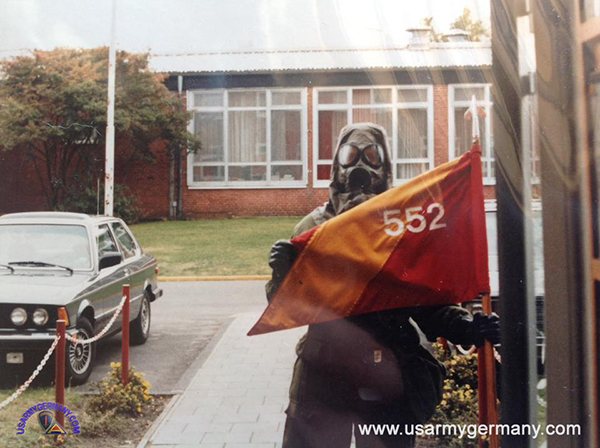
PVT Browning, in MOPP gear, holds the 552nd USAAG guidon
in front
Headquarters building in Soegel, 1987 (Morris Adams) |
 552nd US Army Artillery Group DI 552nd US Army Artillery Group DI |
(Source: A Look Back ... at the 59th Ordnance Brigade. Final issue of the 59th COURIER, the command newspaper, published in 1992.) |
| 552nd US Army Artillery Group |
The 552nd U.S. Army Artillery Group was activated in August 1943 at Fort Bragg, N.C. as the 552nd Field Artillery Battalion.
The battalion deployed to Europe and participated in five campaigns during World War II.
Following the cessation of hostilities, the battalion returned to the United States and was inactivated at Camp Myles Standish, Mass. in November 1945.
The 552nd was redesignated as the 471st Field Artillery Battalion in June 1947 and allotted to the organized reserves. The 471st was active in Chicago, Ill. from June 1947 through November 1950.
In March 1952, the battalion was redesignated as the 552nd Field Artillery Battalion. In December it was withdrawn from the Army Reserve and allotted to the regular Army.
Headquarters and Headquarters Battery, 552nd Field Artillery Battalion, was redesignated as Headquarters and Headquarters Detachments, 552nd U.S. Army Artillery Group in September 1959. The batteries of the former battalion were concurrently disbanded.
The 552nd U.S. Army Artillery Group was activated at Fort Sill, Okla. in October 1959.
Five months later, in March 1960, the 552nd arrived in Germany and moved into its new headquarters in Ludensheid, Germany.
The 552nd was assigned to the 514th U.S. Army Artillery Group when the 514th was established as a SASCOM intermediate subordinate headquarters in December 1961.
In August 1963, the 552nd Artillery Group Headquarters moved to Soegel, Germany.
The 552nd U.S. Army Artillery Group was the only 59th Ordnance Brigade artillery group with detachments located outside of Germany.
The 552nd USAAG inactivated in June 1992.
1st U.S. Army Field Artillery Detachment
The 1st U.S. Army Field Artillery Detachment was organized in October 1963 as the 1st U.S. Army Missile Detachment. The 1st USAFAD was activated at Fort Sill, Okla. in September 1964. In March 1965, the unit arrived in Germany and was assigned to the Special Ammunition Support Command. The 1st was further assigned to the 570th U.S. Army Artillery Group which was Army Artillery Group subordinate to the 514th U.S. Army Artillery Group.
In October 1978, the 1st U.S. Army Field Artillery Detachment was assigned to the 552nd U.S. Army Artillery Group. The 1st was located in Wesel, Germany and inactivated June in 1992.
5th U.S. Army Field Artillery Detachment
The 5th U.S. Army Field Artillery Detachment was activated at Fort Sill, Okla. in June 1962 as the 5th U.S. Army Missile Detachment. The detachment arrived in Germany in February 1963 and was assigned to the 552nd U.S. Army Artillery Group. The 5th was located in Gross-Dunsen, Germany and inactivated in May 1992.
8th U.S. Army Field Artillery Detachment
The 8th U.S. Army Field Artillery Detachment was activated at Fort Sill, Okla. in December 1961 as the 8th U.S. Army Missile Detachment. After successfully completing training, the 8th USAFAD arrived in Germany in June 1962. The unit was assigned to the 552nd U.S. Army Artillery Group and temporarily located with the 26th U.S. Army Detachment.
In February 1963, the 8th moved to Havelterberg, Netherlands. In September 1964, the 8th USAFAD was reassigned to the 570th U.S. Army Artillery Group, but returned to the 552nd in June 1966.
The 8th was one of only two 59th Ordnance Brigade units stationed in the Netherlands and was inactivated in June 1992.
23rd U.S. Army Field Artillery Detachment
The 23rd U.S. Army Field Artillery Detachment was organized at Fort Sill, Okla. between February and December 1958 as the 23rd U.S. Army Missile Detachment. Activated in January 1960, the 23rd USAFAD arrived in Germany in June 1960. Although initially assigned to the 570th U.S. Army Artillery Group, the 23rd Detachment was transferred to 552nd U.S. Army Artillery Group in June 1966. The 23rd, located in T'Harde, was one of only two brigade detachments located in the Netherlands.
The 23rd USAFAD was inactivated in June 1992.
25th U.S. Army Field Artillery Detachment
The 25th U.S. Army Field Artillery Detachment was activated in January 1961 at Fort Sill, Okla. as the 25th U.S. Army Missile Detachment. Arriving in Germany in May 1961, the 25th USAFAD was assigned to the 552nd U.S. Army Artillery Group.
The 25th was located in Barme and inactivated in May 1992.
32nd U.S. Army Field Artillery Detachment
The 32nd U.S. Army Field Artillery Detachment was activated in March 1951 at Fort Sill, Okla. as the 32nd Field Artillery Counter-mortar Radar Detachment. It deployed to Korea and participated in the UN Summer-Fall Offensive. For its service, the 32nd USAFAD was awarded the Republic of Korea Presidential Unit Citation. The 32nd was activated at Fort Sill in 1959 and arrived in Germany in March 1960. The unit was assigned to the 552nd U.S. Army Artillery Group.
The 32nd was located in Nienburg and inactivated in June 1992.
81st U.S. Army Artillery Detachment
The 81st U.S. Army Field Artillery Detachment was activated at Fort Sill, Okla. in February 1966 as the 81st U.S. Army Missile Detachment.
The unit arrived in Germany in June 1966 and was attached to the 26th U.S. Army Missile Detachment of the 570th U.S. Army Artillery Group.
In August 1966, the 81st moved to Duelmen, Germany. The detachment was reassigned to the 552nd U.S. Army Artillery Group in October 1978.
The 81st inactivated in June 1992.
162nd Ordnance Company
The 162nd Ordnance Company was constituted in the Army of the United States as the 162nd Ordnance Platoon and it was activated in June 1942 at Camp Edwards, Mass. Following training at the Amphibious Training Center, Corabeele, Florida, the unit moved to Brisbane, Australia.
The 162nd was redesignated as the 162nd Ordnance Company, 2nd Engineer Brigade. The unit served in two campaigns in the Asian-Pacific Theater. After the war, the 162nd returned to the United States in October 1946 and was stationed first at Fort Ord, Calif. and then at Fort Warded, Wash.
With the outbreak of the Korean War, the unit was transferred to Japan and it later deployed to Korea earning credit for seven campaigns. The 162nd was redesignated as the 162nd Ordnance Company, Amphibious Assault Brigade and allotted to the regular Army in August 1952.
The company was inactivated in Japan in July 1955. It was reactivated in May 1959 at Sandia Base, N.M. as the 162nd Ordnance Company (Missile) (General Support). The unit arrived in Germany in April 1960 and was assigned to the 552nd U.S. Army Artillery Group.
The unit was located in Soegel and was inactivated in June 1992. |
|
|
|
| SPECIAL AMMUNITION STORAGE SITES - 552nd ARTILLERY GROUP |
| SAS LOCATION |
US CUSTODIAL UNIT |
SUPPORTED NATO UNIT |
SAT (Google) |
|
| Darp (Havelte) |
8th USAFAD |
Corps Arty (NE) |
|
|
| Diensthop (Dörverden) |
25th USAFAD |
2rd Arty Regt (GE) |
|
|
| Doornspijk (t'Harde) |
23rd USAFAD |
Div Arty (NE) |
|
|
| Dünsen |
5th USAFAD |
11th Arty Regt (GE) |
|
|
| Lahn (Werlte) |
162nd Ord Co (b) |
I GE Corps; I NE Corps |
|
|
| Liebenau (Treysa) |
32nd USAFAD |
1st Arty Regt (GE) |
|
|
| Stilleking (Lüdenscheid) |
162nd Ord Co (a) |
BE div units |
|
|
| Visbeck (Dülmen) |
81st USAFAD |
7th Arty Regt (GE) |
|
|
|
(a) Stilleking was the corps-level SAS operated by the 162nd Ord in the 1960-1963 time frae.
(b) In 1963, the 162nd moved to Sögel and took over the newly constructed corps-level storage site at Lahn (Werlte). |
 |
|
|
| Headquarters/Headquarters Det, 552nd USAAG |
| |
| 1959 |
| (Source: Letter from Dalyn Simmons, HHD 552nd Arty Gp, 1959-61) |
I was with the Hq/Hq Detachment, 552nd Artillery Group from October 1959 until August 1961, as a FA Operations Intelligence Assistant. I was previously stationed with the 20th Aviation at Fort Bragg, N.C., when they moved the unit to Fort Sill in August 1959.
In October of 1959 Headquarters & Headquarters Detachment, 552nd Artillery Group was activated from the Headquarters & Headquarters Battery, 552nd Field Artillery Battalion at Fort Sill, Okla. The unit began recruiting personnel from other units to make up a Headquarters Detachment immediately. They told us we were going overseas but would not tell us were.
In December 1959 a group of 17 personnel were picked to go on the advance party. Around the 20th of December we all went home for Christmas and were told to report at Fort Hamilton, N.Y., on the 27th for departure to Luedenscheid, Germany ( ). ).
We departed Fort Hamilton the next day and flew to Shannon, Ireland where we took on fuel and then on to Frankfurt, Germany. On the 28th of December we were transported to Dortmund, Germany where we were stationed with the British and Canadians. While we were at Dortmund, we would go to Luedenscheid daily (approximately 50 miles) until the Headquarters and Barracks were ready for use.
We moved to Luedenscheid around the 20th of January 1960.
The main body of the 552nd arrived in Ludenscheid in the middle of March 1960 and the 162nd Ord Co in the middle of April 1960.
The barracks was a two story building made of cut stone in the shape of a (T). Both the 552nd and the 162nd shared the same building, with the Headquarters on the ground level and the billets on the 2nd floor. The Kaseme was a combined NATO force. The Germans were security, with Dutch and Belgium transportation at the start, later they brought in the Scottish and British as security. There were also French, British, and German units coming and going.
The Kaserne was located on Buckesfelder Strasse on the edge of Ludenscheid. The Americans just called it the Kaseme, but the Germans called it Flak Kaserne and it was renamed by Belgium as "Quartier La Lys." This is where our motor pool and Barracks were located.
Our weapons site was located some distance from the kaserne near the village of Sanssouci. (Webmaster Note: there is a very small village by that name northeast of Lüdenscheid, north of the town of Balve.) They were also other sites located around Ludenscheid, near the villages of Hellersen and Baukloh which was renamed "Yser" by Belgium (Webmaster Note: the old German Kaserne Baukloh was named Quartier Yser by the Belgians. Both Belgian kasernes, Yser and La Lys, had ammo depots nearby). We were told the reason this location was picked was because it was a weapons storage area during WWII that was never found by the Americans or Russians.
We were part of the Special Ammunition Support Command with units stationed inside and outside of Germany, this was the United States commitment to NATO. The weapons included the 8" atomic cannon, Honest John, Lacross, and Corporal surface to surface missiles.
While I was with the 552nd we never had an insignia, or shoulder patch everyone wore the USAREUR shoulder patch, and all personnel were cleared for the highest security.
I cannot remember all of the support units call numbers, some that vaguely come to mind are:
 23rd FA Det------------------------------ `t Harde, the Netherlands 23rd FA Det------------------------------ `t Harde, the Netherlands
25th FA Det------------------------------ Barme, Germany
32nd FA Det----------------------------- Nienburg, Germany
162nd Ord Co---------------------------- Ludenscheid, Germany
I do not remember if they were any US Artillery units stationed with them or not but we worked with the British and Canadians located in Dortmund, Germany. A German unit located around Dusseldorf - Koln area and also a unit near Pirmasens.
Every year NATO would play mock war games in Bonn, Germany and the Hq & Hq Det 552nd Artillery Group would participate.
Back to the start-up. The first couple of weeks the 552nd was in Ludenscheid, we would go to Dortmund, Germany and draw rations and supplies from the British and Canadians. After that we went by convoy to Giessen, Germany where we would get all of our rations, mail and also the payroll. We used German civilians to run our mess hall until the 162nd arrived.
We had no PX on the Kaserne until around August of 1960 and it was the bare necessities. In November or December we opened a small lounge with food and a bar.
Ludenscheid was a very friendly and clean village. The relationship with the German civilians in Luedenscheid was great, they received us very well and we them. Some of the most frequent hangouts were the Gaststatte Westfalenhof, Gasthof Zur Krone, Trocadero and the Schuetzenhalle where most of the larger events were, such as the October Fest. Always something going on there.
I cannot remember all the personnel in the unit but will name the ones I remember:
552nd Group Commander---------Colonel Badger
Major ---Philopena.
Captain ----Serbenski
Captain ----Grannan
1st Lt--- Love
1st Lt--- Jenkins ---------------Hq Det Co
|
Sgt Maj ----Hayes |
|
Spc DeMatties |
|
MSgt----Waterman |
|
Spc Sommerville |
|
Sgt Bagnell |
|
Spc Green |
|
Sgt ----Poe |
|
Spc Reed |
|
Sgt ----McCauley |
|
Spc Gaylord |
|
Spc Errol McNearney |
|
Spc Yoshiokia |
|
Spc Simmons |
|
Spc Shuttleworth;Col Badger's driver |
|
Spc Collins |
|
|
|
Spc Nicholas |
|
|
We also had a Lt Colonel who was second in command and three Warrant Officers but I cannot remember their names.
That is all the personnel I remember, but I am still in touch with McNeamey who now lives in Idaho. His wife is from Ludenscheid, and still has family there, also one of her best friends who is from Ludenscheid to now lives in Calif. Between the four of us and their families who are still in Germany we will work on trying to update the early history of the 552nd.
I have copied some pictures that Errol McNeamey and I had and hope that you can use them. I also had one document with the 552nd letter head on it that I am sending. I hope this will clear up a few questions that you might have between the 552nd in Luedenscheid and the 552nd in Soegel. |
|
HHD 552nd Arty Gp
Lüdenscheid |
|
|
|
|
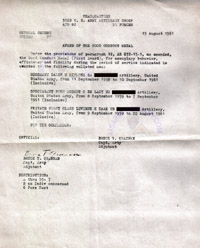
1. GO #27, 15 Aug 1961 |
|
|
|
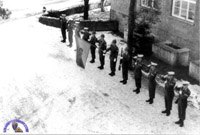
2. 552nd Arty Gp Honor Guard |
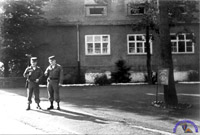
3. McNearney & Simmons
|
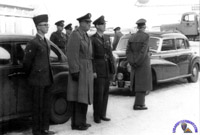
4. Col Badger, Gp CO
|
|
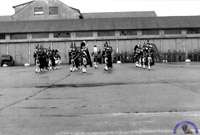
5. Scottish Highlanders |
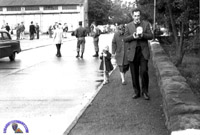
6. Maj Philopena, Det Cmdr
|
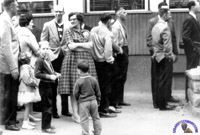
7. Sgt Maj Hayes
|
|
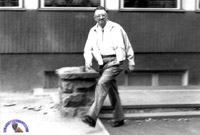
8. Col Badger, Gp CO |
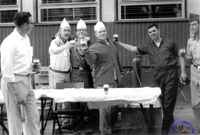
9. Several det members
|
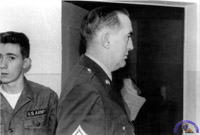
10. MSgt Waterman
|
|
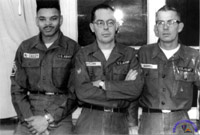
11. McCauley, Gaylord & Bagnell |
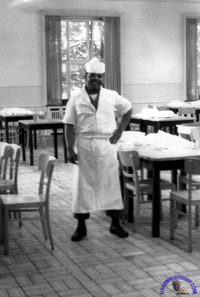
12. Spc Sommerville
|
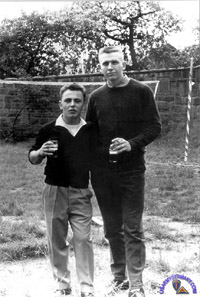
13. McNearney & Shuttleworth
|
|
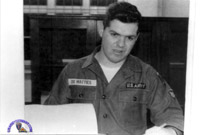
14. Spc De Matties |
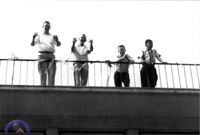
15. Several det members
|
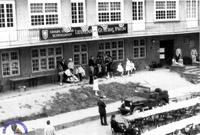
16. Officers Club
|
|
|
|
|
|
| 162nd Ordnance Company |
| |
| 1960 |
| (Source: Email from Paul Agostino, 162nd Ord Co, 1960-62) |
I was stationed in Lüdenscheid,Germany from 1960 through July of 1962.
I was with the 162nd Ordnance Company that was moved from Sandia Base, New Mexico to Germany in April of 1960 (April maybe wrong.) We traveled from Sandia Base to the Brooklyn Army Terminal by train, 9 days, from Alburqueque, where we boarded the MSTS Gen W. Darby to Bremerhafen, Germany. In Bremen we then traveled 2 days by train to Lüdenscheid, Germany.
We were stationed on a Belgian base on Heedfelder Strasse in Lüdenscheid. We were an atomic weapons maintenance and delivery unit for guided missiles. We setup a storage depot across town, aprox. a 20 minutes ride, where we stored missiles and 8” howitzer shells.
While there we maintained the interior guard force and NATO troops secured the outside. These forces consisted of Bundeswehr infantry and transportation, also Dutch, Belgian and the British Army of the Rhine consisting of the GORDON HIGHLANDERS and ROYAL SCOT GREYS whose home base was in Sellar, Germany.
We delivered missiles to Holland, Belgium and around Germany by truck and helicopters.
I left Germany in July of 1962 for Brooklyn Army Terminal to be discharged. I have not been able to find any info on my unit
It was my understanding we were the first unit to bring atomic weapons into Europe. |
|
|
|
| (Source: Email from Dennis "BJ" Bjornson) |
 |
|
I was a member of the 162nd. Ord. Co. Military Police platoon that was deployed to Ludenscheid, Germany in April 1960. My old buddy Paul Agostino has provided you with the route we took to get to Germany.
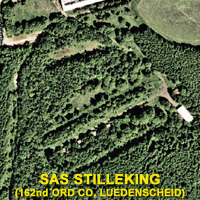
There seems to be some question as to where the storage site was located. The site was located South of Ludenscheid in what is now called the "Stilleking Nature Reserve". The site is in a valley, but there are a couple of hills within the valley.
The Belgium Army was responsible for the "outer" perimeter security of the site and they worked out of a building located at the bottom of the hill. The storage site was located on top of the hill. The heliport was located between the Belgium occuppied site and the U.S. Army occuppied storage site.
There were two fences around the storage site. The visiting NATO nations were assigned security responsiblity between the two fences. The U.S. Army occupied the storage site and was responsible for "inner" security. The site consisted of six igloos, a maintanance building, a guard house at the perimeter and the M.P.'s dispatch/rest area building.
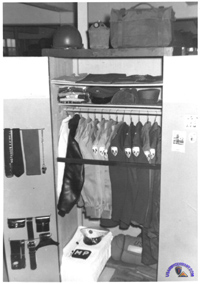
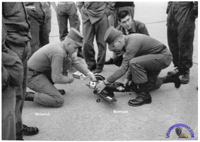
If you are interested, I have attached a few pictures. The wall locker picture shows the shoulder patch that we couldn't wear in Germany. I have also added the names to the picture of the M.P.'s that were part of the 552nd. Honor Guard provided to you by Dalyn Simmons. The other picture is just me and Cpl Ralph Molovich and his model airplane. |
|
|
| |
| 1963 |
| (Source: Email from Gerna Benz, 162nd Ord Co, 1963-66 and 1970-) |
GOOGLE EARTH
|
|
I was assigned to the 162d Ordnance Company in early spring of 1963 following an assignment with the 96th Ordnance Company at Red River Army Depot, Texarkana, Texas. I believe the Commander of the 162d was William C. Powell and our First Sergeant was Dicky Henderson (both excellent individuals).
I enjoyed the city of Luedenscheid where the 162d was first stationed at in 1963 as it had a large population and a very energetic night life. Our weapons site (Sansucci) (1) was located some ways from the company's headquarters (a combined Belgium/German/American Kaserne) in the town of Luedenscheid and it was an adventure each time we had to drive to work. I recall that the site was within a valley, surrounded by hills on both sides with our site in the center. The Germans supported our transportation and security at the site and the Belgians supported our supply and security at the Kaserne.
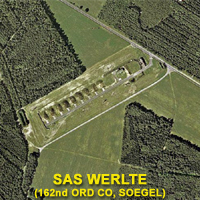
I was with the initial security team (two vehicles, eight men USA, Germans also had a team) that drove from Luedensheid to Soegel to reconnaissance both the primary and alternate routes and the final destination to our new site in Lahn. Sogel was a total opposite from Ludenscheid, in all aspects but a superb location for what our units mission was to entail. Site Lahn (SAS Werlte) was large, new and self sufficient. We had an excellent tri-perimeter area for security and our new igloo's were large enough to easily move our containers with out the problems that we had in our older location. The new maintenance building was designed to handle individual shop sections and a main bay for receipt and shipment of items. Overall, S&I, Operations, Security USA and German Security forces were all in one simplified location, with facilities capable of running a 24/7/365 operation. |
|
|
My duties were amplified in 1963-66 due to my TS security clearance. I started in Security and also worked in Operations, S&I, Maintenance and finally Documents Custodian. I took the first German helicopter flight from Lahn to Massweiller, Pirmasens, Verdun and Orleans, France. A combination flight for calibration of equipment and Documents transfer. I averaged a flight every two months with the German Helicopter unit from Rheine Bentlage until I went to Vietnam in April 1966.
I was assigned to the 1st Cavalry Division in my initial PMOS of 11C in April 1966. I served four years in Vietnam with the 1st Team and returned to Soegel on a Congressional Direct Assignment in April 1970 as a SSG E6.
I was assigned to QA/QC for Site Lahn and also as the Senior Demolition Instructor/Trainer for all units within the 552d USA Arty Group. Major John M. Hebert was commander 162nd Ordnance Company, from 1970 - 1973. He was very supportive of our Emergency Destruct plan and instrumental in our ability to modify and implement that change. If there was ever a person who was the soldier's commander, it was John M. Hebert.
I implemented the pre-cut/pre-cap/pre-mold demo system for Emergency Destruction of all weapons systems in 1970-71 at Site Lahn and reduced the Emergency Destruct time for all systems from 1.5 days to 3 hours and I think our best time during a major NSI/TPI was under two (2) hours for complete site ready. We also incorporated complete the NATO Hazardous Marking Symbols into all our sites and did a dual bi-lingual text for information concerning the hazardous markers. Prior to this, all hazardous markings at US site facilities were following US markings and in some cases, not appropriate to NATO symbols.
I inspected all Class V ammunition and explosive stocks at each USA missile site facility and gave 'live' explosive demolition training to all 552d USA Arty Group units utilizing electrical, non-electrical blasting caps, 1/4 block of TNT, C-4, detonation cord and 15 lb shape charges. Each man in every unit was tasked to support the weapons destruct plan and as such were required to understand and undertake this live training. I used more 15 lb shape charges for training in Europe then any other unit in the army, at any time. We excelled in readiness at Site Lahn and maintained the highest standard for Emergency Destruct training through out the Army.
I found some pictures of the original first group of members from both the 162nd and the 552d USAAG in Sogel (Photo #1). This snap shot was taken at our recently acquired all ranks club. I'm in the dark suit standing, second row on the right.
In 1963 when Siet Lahn first became operations, we had three perimteres: outside, inner fence and exclusion area. My last visit there in 2004, I noticed many changes to the entrance gate area and facilities within the site. The two housing area's of Von Steuben Strasse and Im Eikel were turned over to East German refugee's in the middle 90's and many of them came from East Germany, Russia, Ukraine, Bosnia, etc....
I still maintain a close relationship with many of the citizens of Sogel and we often speak of the many men and women from the 162/552 that passed through, many of the citizens of Sogel still reflect highly on the Americans.
A very good friend to all was Fidi Schmale and his family. His gasthaus was right outside of the gate and he allowed us to run decals until payday. He and his wife passed away a few years ago.
(1) Webmaster: is this possibly Balve-Sanssouci, northeast of Lüdenscheid or just south of Hemer? |
|
| |
ADDITIONAL INFORMATION provided by Gerna Benz:
1. Sansucci was a little town/area outside of Ludenscheid, where our site was located. It was not a large facility, a small maintenance area, holding area and perhaps five or six igloos. German security was on the outer perimeter and USA inside.
2. Because I was at Ludenscheid only for a four or five month period, my understanding is that the 162nd mission at that time was support to various NATO units (Belgium, British and German). I am in contact with some of the members who were in Ludenscheid and I can check with them. Ludensheid was not far from Köln and all of the units were within two+ hours maximum.
3. The mission for the 162d at Soegel was (SA/GS or SW/GS).
4. The mission surely increased in size: in Ludenscheid we supported only a few units which; with our move to Soegel, I think we gained an additional four or five and also two in Holland.
5. Site Lahn was the largest SW/GS site in Europe. I have been to the other sites under SASCOM. |
|
162nd Ord Co - 1963-66
Lüdenscheid -- Sögel |
|
|
|
|
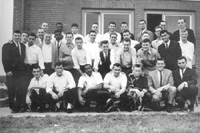
1. Group photo, 1963
|
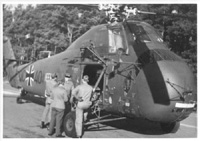
2. Gerna's 'ride,' TDY 1963/64
|
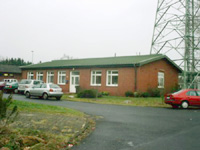
3. 162d Admin Bldg, 2004
|
|
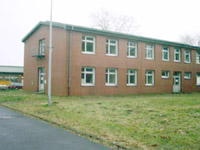
4. Old Trp bldg, Maint Plt, 2004 |
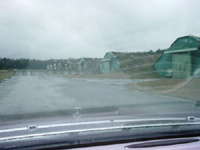
5. Site Lahn; Road inside perimeter, 2004 |
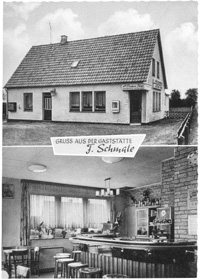
6. Fidi's Gasthaus, 1963 |
|
|
|
|
|
| 1st US Army Artillery Detachment |
| |
| Supported Command: Artilleriekommando 1 (link) |
| |
| The 1st US Army Missile Detachment supported the 150th Rocket Arty Bn and the 110th FA Bn. |
| |
| 1964 |
| (Source: Email from Paul Herbold, 1st USA MSL Det, 1964) |
I recently found some online info about the 1st US Army Missile Detachment and the 150 Bn (German SERGEANT missile unit) under the 59th Ordnance page.
I was one of the 2 second lieutenants who was charged with organizing and deploying the detachment to Germany in 1964. I have a very good recollection of its early history and many of the individuals both US and Bundeswehr with whom I served. I was with the detachment for 2 years. I would be very happy to provide my recollections "for the record" if you are interested.
1st USA Missile Detachment (Sergeant) - Recollections of Paul E. Herbold, Maj, FA, USA (Retired)
Alphonse (Al) A. Masella and I were in the same class at the FA OCS School at Ft. Sill. We graduated in class 5-64 in April 1964 and were both assigned to the 3rd Bn, 38th Artillery (Sergeant) at Ft. Sill. We both attended the Sergeant Missile Officer course in spring of 1964.
One day in early summer we were both summoned to the Bn Cdrs office. After reporting, the Commander handed me a DA Telex addressed to him. It read: “You are hereby directed and authorized to organize the 1st USA Missile Detachment, TO&E 6-500D, to deploy an advance air detachment to the Federal Republic of Germany (FRG) on/about October 1964”. The colonel handed me the “twix” and said: “Lt, your mission. Since Al and I had the same date of rank, it became a matter of age, who was senior. Al was a couple of months older than I, so technically he was in charge. In practice we shared responsibility. We obtained the TO&E and begin recruiting personnel for the advance detachment. The individuals were: SFC James Allen; SGT Bryce Holcomb (MN); SP4’s Gilland; Watts (TN); Koepnik (IA) & Frye, plus me (WA) and Al (NJ). These individuals were selected after interviews from within the ranks of the 3/38 th. We begin requisitioning our equipment and materials, and training for a Ft. Sill and then a 4th Army nuclear technical proficiency inspection/nuclear safety inspection (TPI/NSI).
The TPI/NSI format included a simulated convoy, during which there would be an air or ground attack, then movement to a launch site where the missile would be assembled (rocket motor; guidance section; and warhead). Then we would go through the process of enabling the warhead and missile pre-fire procedures. The process was very structured and every task was read from the manuals by a reader, and then executed and checked. We continued recruiting personnel to leave behind with the main detachment, and I believe we were at about 50% strength when we deployed, but the Det Cdr had not yet been assigned.
I drove my POV from Ft. Sill To Charleston to put it on a ship to Germany, then met the other 7 member of the Advance Air Detachment at LaGuardia (I think). We flew a commercial jet to Rhein Main in Frankfurt, then took the train to Muenster where the 570th Arty Group was located (This was our higher HQ). We billeted there for the next several month’s, during which time we contacted the various elements of the 150th RAK Arty Bn. The 150th was spread all over N. Germany, with 6 Batteries, each in a different location. We conducted joint training with these elements, and successfully completed TPI/NSI’s conducted by the 514th Arty Group (Next higher HQ above the 570th), SASCOM (Special Ammunition Support Command), and USAREUR (U.S. Army Europe).
During the USAREUR TPI/NSI, I was serving as the “Courier Officer” for the simulated Nuc Wpns Convoy when I was involved in a very serious motor vehicle accident. I was initially treated at a local German hospital, but was transferred that same day to the British Military Hospital in Muenster. This was because we were still attached to the 570th Arty Group, and they received their support from the British. Despite me being out of the picture, Lt Masella stepped in and our team successfully passed the inspection.
These SASCOM units operated under an agreement between the U.S. and the FRG called the “Service to Service Technical Agreement”. It specified the relationship and responsibilities of each party, particularly logistics and support. We were to provide immediate custody and control of the warheads, and technical training to our supported unit, and they were to provide the outer layers of security forces, and virtually all logistical support. Our TO&E was extremely lean. We had individual weapons (M-14’s and M1911 .45 Auto pistols), some tools, off line cipher equipment (TSEC/KW-7), electronic equipment for enabling the warheads when authorized by Presidential Authority and we were provided with the codes. In accordance with our “Service to Service Technical Agreement” the 1st USA Missile Det was to receive virtually all other support from the FRG. This included everything from German tactical vehicles (with drivers, since we had NO vehicle of our own), primarily DKW jeeps and 5/4 Ton Mercedes Unimog’s, to toilet paper and typewriters. Some of the detachment members we left at Ft. Sill had been in Germany before and were wise enough to fill a conex container with good old U.S. toilet paper. (The German variety was similar to paper towel material). Our clerks had to get used to the German typewriters because several of the keys were different. It fell to me to do most of the negotiating with the German Standortverwaltung (Similar to our General Services Administration) to secure the support the unit needed. Despite the agreement, nearly everything we got required some negotiating, and I was the only unit member who spoke German.
After a major surgery for a ruptured spleen, performed by a Colonel Newton (British Army) and a couple weeks of recovery, I was transported by Huey on a stretcher to the 97th General Hospital in Frankfurt where I completed my recovery. When I returned to the unit, it had moved from our temporary quarters in Muenster to the Schill Kaserne in Wesel, and had been joined by the remainder of the personnel and dependents who had remained behind at Ft. Sill. This included our 1st Detachment Commander, Capt. Bill James. Later he was replaced by Capt. Chuck Fleming during my tenure there.
While the Detachment was in Muenster, Lt Masella met Claudine Montfort, the daughter of Sergeant Major Montfort and his French War Bride. After the unit moved to Wesel, the relationship continued and they were married at the great gothic cathedral in Muester. This would have been sometime in 1965 or 1966. I was not able to attend the wedding because the Detachment had become operational and we had a 7-24 on site duty officer requirement. With only 3 officers in the unit, the commander elected to go and I had the duty that day. Al and Claudine are still together, and he has an insurance agency in partnership with their daughter.
Although the unit was operational, our warheads were temporarily stored with another unit, pending completion of our own storage facility near Wesel. If necessary we would convoy to this facility, pick up our warheads and deploy with the 150th to the field.
The officers of the 150th Bn all spoke very good English, some even with a noticeable British accent, and most of the NCO’s spoke at least some English. Many of the Senior officers and NCO’s had served in the “Wehrmacht” during WWII. Some 150th Bn personnel I remember were its Commander, Oberst Leutnant Kuhne; Deputy Commander Maj. Karl Conrad Woerple; Hauptman Michael Gerischer and his wife Antje (my younger daughter is named after her); Leutnant’s, Luetten; Von Der Mosel; OberStabsFeldwebel Hoek; OberFeldwebel Glaetzel. Michel Gerischer and his wife lived on the first floor of the two story duplex we shared at Juelicher Strasse 9 in Wesel.
Most of the German Officers and many of the NCO’s had spent time at Ft. Sill receiving training on the Sergeant Ballistic Missile. I remember a very funny incident involving my comrade Hauptman Michael Gerischer. We both parked our cars in the vacant space between our duplex and our neighbors (and my life long friends: Theo and Marianne Wassenberg. They have both passed away, but we still have some contact with their children who were 7 to 12 years old when we were neighbors). One fine Saturday, I was there washing my car when Michael pulled in in his Opel Record. He was the epitome of a fine German Officer in the Gray uniform. He climbed out of the car, and then said in a voice loud enough for me, and anyone nearby to hear: “G__ Damn GERMAN drivers”, then slammed the door. Mike and Antje became very good friends and when he was promoted to Captain, my ex-wife and I were invited to celebrate with them with a bottle of the “wine of the century” which was a 1959 Riesling (“Trocken Auslese”) from the vineyard of Aloys Fischer on the Mosel. He and his father always bought a supply of wine from that vineyard. By the time we drank it in 1965, it was selling for nearly $100 per bottle. We 4 spent several hours sipping it a drop at a time. Later when I was promoted to Captain he gave me a bottle of it to celebrate. Michael retired from the Bundeswehr as an Oberst Leutnant.
I have more to tell about how the Detachment was welcomed to Wesel by the Burgermeister, field maneuvers with the 150th, joint weapons familiarization with the 150th; life in Wesel; St Barbara’s Day Parties in the German Kasino (Officers Club); “Dining in with the officers of the nearby British 154th Forward Ammunition Depot in Wuelfen”.
I will continue this later. Let me know if this is the kind of stuff you are interested in, and also perhaps questions you might have. Those might help jog my memory. |
|
|
|
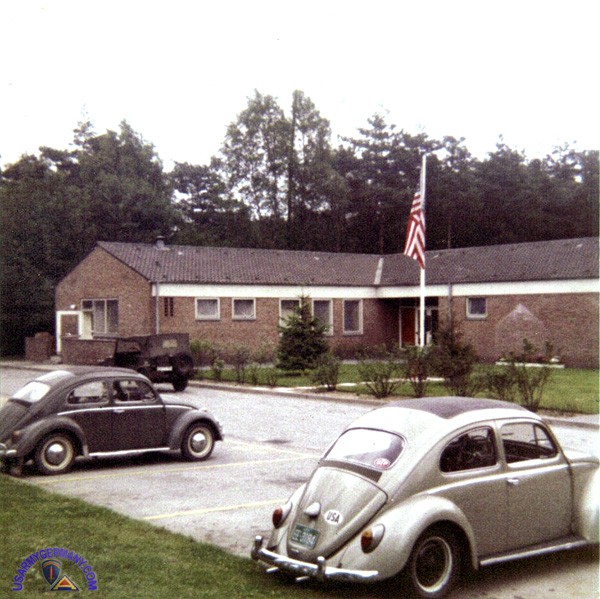 1st Arty Det Headquarters Building, Hamminkeln
|
| |
| 1971 |
| (Source: Email from Dean Rectenwald) |
On my first overseas tour duty tour in Germany, in March 1971 I arrived at the 1st US Army Artillery Detachment, a Sergeant Missile unit. At the time, I was a PFC, trained in MOS 15E10, Pershing Missile Crewman. Because of the MOS mis-match, I was put into a 15B10 slot.
This was the on Schill Kaserne, some distance SSE of Arnhem, Holland. The Kaserne was physically located outside the village of Hamminkeln, and Wesel was the nearby city (where the Lippe River flows into the Rhine). A favorite son of Wesel was Peter Minuit (or Minuet) , who purchased the island of Manhattan from the (Native American) Indians.
This was a small detachment, commanded by a captain, supporting a German Army (Deutsche Heer) unit which had Sergeant Missile System equipment. (In the short time I was there, I never learned the designation of the German Army unit.). The detachment’s purpose was to maintain custody of and provide security for the warhead sections for the missiles. The lower ranking, field artillery trained enlisted personnel who received their Secret clearances thus became Custodial Agents.
The unit had one single-story building (with the typical “H“ floor plan seen in Germany), containing commander’s office and orderly room, small “dining hall“, supply room, mail room, and billeting for single or unaccompanied personnel. The concrete flooring was continually breaking down under the weight of bunked bed frames, and had to be repaired under work orders to the German facility maintenance office.
As evidenced by the soft-top vehicle in front of the Det building (see above photo), all military transportation for the unit was provided by German Army personnel; a small vehicle and duty driver on a daily basis, and trucks for field exercises. Encrypted messages addressed to the unit had to be picked by the assistant CQ at the German radio room of the nearby Reitzenstein Kaserne, brought back and delivered to the crypto specialist who was on standby that day.
The Special Ammunition Storage (SAS) site (where warhead sections in containers were stored in bunkers) was located separate from the main Kaserne, so those scheduled for duty there each day had a short drive after breakfast.
Behind the detachment building was a unit lounge building. Open Friday, Saturday and Sunday evenings, it had a bar and a “theater“ room where movies picked by the mail clerk (through the US Army Theater Program) were shown for 25 cents admission, for personnel and dependents.
When I first arrived, the attached Signal team operated out of the main detachment building. Then a separate radio operations building with radio tower was built for them behind the unit lounge. A corner of their security fence can be seen in Photo #3.
For sick call, detachment personnel and dependents could go to the German dispensary. US medical services were a considerable distance away.
In July 1971, the USAREUR Personnel Center notified the detachment that four individuals were to be re-assigned to their proper units. Three of us were Pershing 15E’s, and would go to the 85th Artillery Detachment; I never found out what the fourth fellow’s actual MOS was, or what unit he was going to.
(Click here to read about Dean's assignment to the 85th Arty Det) |
|
1st USAFAD - 1971
Hamminkeln |
|
|
|
|
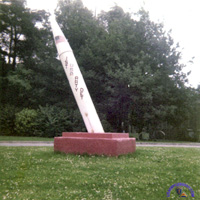
1. "Sergeant" marks Det Bldg
|
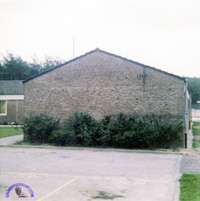
2. Other end of det bldg and paved parking area
|
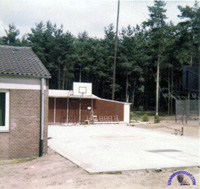
3. Basketball court and perimeter fence for radio tower
|
|
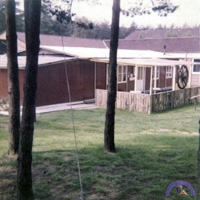
4. Day room building |
|
|
|
|
|
|
|
| 5th US Army Artillery Detachment |
| |
| Supported Command: Artillerieregiment 11, Panzergrenadierdivision 11 (link) |
| |
| The 5th US Army Missile Detachment supported the 112th Rocket Arty Bn and the 111th FA Bn. |
| |
| 1975 |
| (Source: Email from John Vallor, 5th Arty Det, 1975-76 and 552nd Arty Gp, 1976-77) |
I was browsing your website after searching for information about the 5th Artillery Detachment in Duensen, Germany. I was stationed at the 5th from March 1975 through August 1976. Do you know when the Det closed? I was also at the 552nd Artillery Group in Soegel from Aug 1976 to Aug 1977 when I left the service.
I was S-2 of the 552nd from August of 1976 to August of 1977. I've got to think about who was the Group Commander, a Lt. Col (I remember he was a West Pointer). My boss was Jake Wiekel (probably misspelled), an ADA Major who was XO.
We supported both the First German and the First Netherlands (and only Netherlands) Corps Artillery. The 552nd had, I think, nine FA dets and perhaps four ADA dets, each with four teams. The unit was actually based on a Luftwaffe base in Soegel. We had an Ordance Company in Soegel with us as part of the Group. In fact, I roomed with the Ord Company commander, a Major, who's name also escapes me.
I'll keep searching through papers and picture and will scan and send what I have. I think I have pics of the 5th in Duensen (don't remember the "Gross" part of the town name). Duensen (actually spelled with an umlaut over the u and only one e) was a tiny little town (same spelling applied to Soegel). Interestingly, the Det was located right next to the bunkers where V-2 rockets had been stored during WW2. Many of the bunkers (earthen) were still in place but not used and not safe.
I was one of several Lts in the unit (promoted to Captain in August 1976), typically numbering from one to four of us. The unit had about 36 troops total and was commanded by a Captain. My team supported an 8" battery commanded by Baron Schultz, a German Captain. Very nice guy. For the life of me I can't remember what specific Bundeswehr units we supported. I'll keep thinking. |
|
|
|
|
| 8th US Army Artillery Detachment |
| |
| Supported Command: I NE Corps Arty (link) |
| |
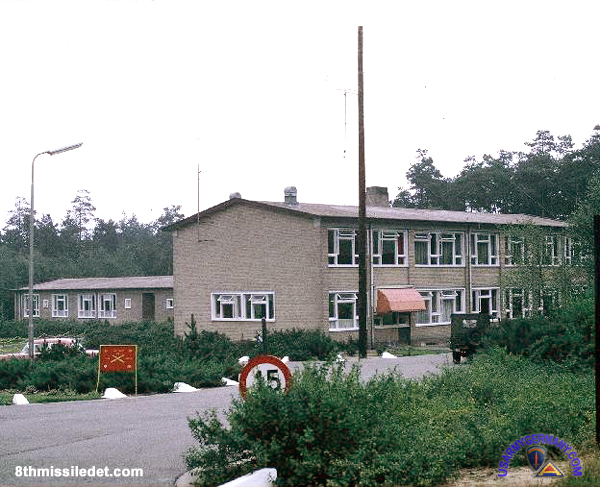 8th Missile Det Hqs Building, Havelte, the Netherlands (8th Missile Det website)
|
| |
| |
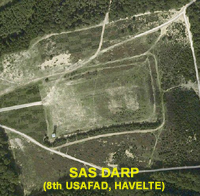 GOOGLE
|
|
The SAS was located just south of the Dutch Johannes Post Kazerne in Havelte, the Netherlands.
The warheads stored at the SAS were originally earmarked for the Dutch 109th Field Artillery Battalion (Honest John) and later (after 1978?) for the Lance missiles of the 129th Field Artillery Battalion (LANCE). (Still doing research on the accuracy of this statement - if you know more or have corrections for me, please contact me!)
|
|
|
|
|
|
| 23rd US Army Artillery Detachment |
| |
| Supported Command: I NE Corps Arty (link) |
| |
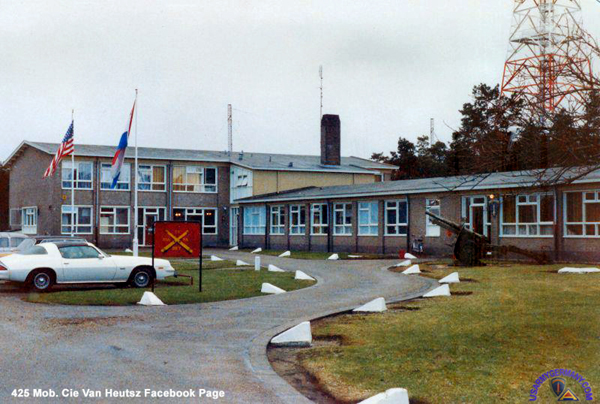 23rd Arty Det Hqs Building, t'Harde, the Netherlands (425 Mob.Cie.Van.Heutsz Facebook)
|
| |
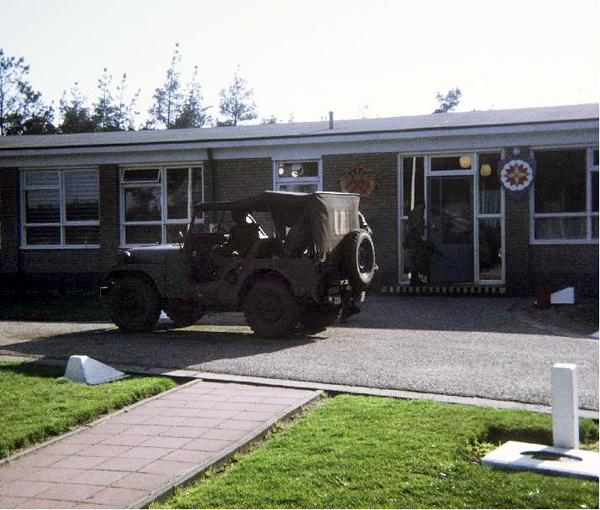 23rd Arty Det Headquarters Building, t'Harde, the Netherlands (Gary Brandeberry)
|
| |
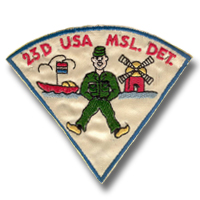 23rd Missile Detachment Patch (courtesy Harold H. Bergers, the Netherlands) 23rd Missile Detachment Patch (courtesy Harold H. Bergers, the Netherlands) |
| |
| (Source: Email from Harold H. Bergers, the Netherlands) |
| Last week I obtained an old and rare patch of the 23rd U.S. Army Missile Detachment which was stationed at SAS Doornspijk in 't Harde, The Netherlands. The patch shows a U.S. soldier on wooden shoes, a traditional Dutch windmill and a boat with the Dutch flag. Today I made a picture of it and I hope you can use it for your website. You built a fantastic site! |
|
|
| |
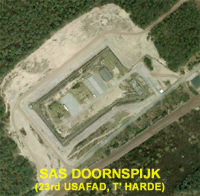 GOOGLE
|
|
The SAS was located just southwest of the Dutch Lt Col Tonnet Kazerne in t'Harde, the Netherlands.
The warheads stored at the SAS were earmarked for the self-propelled 8-inch howitzers (originally M-55, then M-110) of the Dutch 19th Field Artillery Battalion and later (after 1978?) also for SP 8-inch howitzers and rocket launcher batteries of the 119th Field Artillery Battalion, when it was activated as a mixed-battalion. (Still doing research on the accuracy of this statement - if you know more or have corrections for me, please contact me!)
|
|
|
|
|
%20Detachment%20website%20300.jpg) 23KL (US) Detachment website
23KL (US) Detachment website
|
|
(Source: Email from Willem Lensink, The Netherlands).
Willem submitted the URL (link) for a Dutch website that provides information, photos and stories by veterans of the 23KL (US) Detachment, a Ducth Army outfit that provided transportation services to the US 23rd USAFAD in t' Harde, The Netherlands.
The content is primarily written in Dutch.
Willem and his colleagues are looking for US Army vets who served with the 23rd USAFAD to share stories and photos.
A nice surprise was a link (LINKS section) to some great information (Order of Battle 1985) on the 1 (NL) Corps Artillery and the nuclear-capable artillery units supported by the 8th and 23rd USAFADs. That information is in English. |
|
|
|
|
|
| 25th US Army Artillery Detachment |
| |
| Supported Command: Artillerieregiment 3, Panzerdivision 3 (link) |
| |
| The 25th US Army Missile Detachment supported the 32nd Rocket Arty Bn and the 31st FA Bn. |
| |
| |
| |
| |
| |
| |
|
|
|
| 32nd US Army Artillery Detachment |
| |
| Supported Command: Artillerieregiment 1, Panzerdivision 1 (link) |
| |
| The 32nd US Army Missile Detachment supported the 12th Rocket Arty Bn and the 11th FA Bn. |
| |
| 1962 |
| (Source: Email from George Cannon) |
I came across your web site this evening while I was looking for for information on the old 32nd USA Missile Detachment.
I trained at Ft Sill, Ok and was assigned to the 32nd in September of 1962 and was stationed there until January of 1965. During that time the detachment was assigned to the 552nd Arty Group headquarters.
It was about a 4 hour drive but I don't remember the name of the town that it was in. We were located on the south side of Nienburg on a German Army base and trained the German Army soldiers to perform mating and pre-fire of the warheads. We also had the 8" How and land mines that were trained on as well.
We kept the special weapons and they trained on the regular rounds. On the north side of Nienburg there was a large Royal Engineers post. (approx 10,000) Of course this was all up in the British zone.
We only had about 20 enlisted and 3 officers and we had to make weekly runs to Bremerhaven for PX and mess hall items. (about a 3 hour drive)
I was just checking to see if I could find out anything about the old place and if it still was in place. From what I was reading it doesn't exist any more and the 552nd doesn't either. Do you know when the name was changed from 32nd USA Missile Detachment to the 32nd Arty Detachment? |
|
|
| |
| Click here to read an email from Steven Pein who served with C Company, 447th Sig Bn and was NCOIC of the Cemetery Network tributary site (CEM 33) at Nienburg in 1968. |
|
|
|
|
| 81st US Army Artillery Detachment |
| |
| Supported Command: Artillerieregiment 7, Panzerdivision 7 (link) |
| |
| The 81st US Army Missile Detachment supported the 72nd Rocket Arty Bn and the 71st FA Bn. |
| |
| |
| |
| |
| |
|
|
|
Related Links:
Das Sonderwaffenlager Lahn - the special weapons depot at Lahn operated by the 162nd Ord Co; a very nice page (in German) that is just one of many informative pages of Manfred Tegge's Relikte in Niedersachsen & Bremen web site. Great current photos of what is left of the depot!
Das Sonderwaffenlager Diensthop - the special weapons depot near Dörverden operated by the 25th USAFAD; another page (in German) on the Relikte in Niedersachsen & Bremen web site. Great current photos of what is left of the depot!
425 Mob. Cie Van Heutsz  - The former Dutch security company at t'Harde has a Facebook Page. - The former Dutch security company at t'Harde has a Facebook Page.
8th Missile Det (FAD) - Edward Stark's website dedicated to keeping the memory of the 8th MSL Det (later 8th USAFAD) alive and serving as a forum for former members of the warhead custodial units stationed in the Netherlands during the Cold War. |
|
|
|
| |
| I (GE) Corps - Warhead Custodial Detachments & Supported Formations |
| |
 I GE Corps I GE Corps |
| |
|
|
ORGANIZATION (1959 - 1970):
I GE Corps (Münster)
1st Panzergrenadierdivision (Hannover)
3rd Panzerdivision (Buxtehude)
6th Panzerdivision (Neumünster)
ORGANIZATION (1970 - 1979):
I GE Corps (Münster)
1st Panzergrenadierdivision (Hannover)
3rd Panzerdivision (Buxtehude)
6th Panzergrenadierdivision (Neumünster)
7th Panzergrenadierdivision (Unna)
11th Panzergrenadierdivision (Oldenburg)
ORGANIZATION (1980 - 1992):
I GE Corps (Münster)
1st Panzerdivision (Hannover)
3rd Panzerdivision (Buxtehude)
6th Panzergrenadierdivision (Neumünster)
7th Panzerdivision (Unna)
11th Panzergrenadierdivision (Oldenburg)
|

1st PzDiv |

3rd PzDiv |

6th
PzGrenDiv |
 7th PzDiv
 |

11th
PzGrenDiv |
|
| |
Related Links:
Atomwaffenlager in Niedersachsen Brocken Link - covers special weapons depots in the State (Land) of Niedersachsen - one of the very many pages of the excellent 'Relikte in Niedersachsen & Bremen' website. (German language only!) |
|
| |
| Artilleriekommando 1 |
| |
| Warhead Custodial Support: 1st US Army Missile Detachment (link) |
| |
| (Source: Dein Standort Münster, Mönch Verlag, 1981) |
| In 1980, the 1st Artillery Command of I (GE) Corps consisted of the following units: |
| UNITS |
HOME STATION |
| Feldartilleriebataillon 110 |
Dülmen |
| Raketenartilleriebataillon 150 |
Wesel |
| ABC-Abwehrbataillon 120 |
Emden |
| Nachschubbataillon 120 |
Werlte |
|
|
| |
| Between 1963 and 1965, the Raketenartilleriebataillon 150 was located at Warendorf. (At this time the battalion was probably being equipped with the MGM-29 SERGEANT missile system which started to arrive in Europe between 1963-65. It is probable that the battalion was relocated once the transition to the SERGEANT was completed.) |
| |
| (Source: Homepage of the Traditionsvereinigung of the 150th Rocket Artillery Battalion.) |
The Formation of the Raketenartilleriebataillon 150
The original NATO plans at the end of the 1950s envisioned equipping several German corps artillery units with the first operational guided missile system, MGM-5 CORPORAL, similar to the US and British units that had already been equipped with the CORPORAL. However, because development of the much more advanced replacement system, MGM-29 SERGEANT, was making good progress and would soon become operational, the decision was to wait and equip the German units with the SERGEANT when it became available.
Between 1960 and 1962, a cadre of officers and enlisted men was formed for the three MAP [1] battalions, 150th, 250th and 350th, and underwent language and technical training at different military schools in Germany as well as at Fort Sill, Oklahoma.
On October 25 1962, the cadre of the 150th Rocket Artillery Battalion left Germany to conduct final cadre training under US Army supervision at the US Army Artillery and Missile School, Fort Sill. The "Weapon System SERGEANT" courses were followed by unit training hosted by the 9th Artillery Group (US Army). In February 1963, the cadre - organized into two firing batteries - deployed to the Oro Grande Range (part of the Fort Bliss training area) where they conducted two missile launches on February 19, 1963. These constituted the first guided missile firings by German troops since the end of World War II. On March 4 1963, the cadre personnel returned to Germany, joining up with the 150th which was now stationed at Warendorf, Germany.
On October 1 1961, the 150th Rocket Artilery Battalion was activated per Aufstellungsbefehl (similar to a general order?) #459A. Home station of the battalion was Eschweiler. As of January 1 1962, the Battalion comprised a headquarters and service battery (1st Battery) and a training battery. In September 1962, the battalion was moved to Warendorf, occupying temporary billets in a building that had served as a state school for fire fighters after the war. The battalion occupied a section of a large training complex used by German Olympic pentathlon and equestrian teams. The battalion was reorganized during this period, now comprising a Hqs & Svc battery and two firing batteries (2nd and 3rd Battery).
The first two launchers arrived around April 1963. The 6th Battery (the security battery) was activated around the same time at Hildesheim.
On April 1 1964, filler personnel were added to the cadre of the 4th Battery and it was brought up to full strength. The Battalion now consisted of Hqs & Svc Btry, three firing batteries (2nd, 3rd, 4th Btry) and a security battery (6th Btry). The problem was that the battalion was still spread out over three different garrisons. |
|
| |
| (Source: Email from Ulrich Peschen, Oberfeldwebel (d.R.)) |
From 1981 - 1993, I served in the German Army. As a SFC (Oberfeldwebel), I served as a platoon leader in the 6th Battery, 150th Missile Artillery Batallion (RakArtBtl 150) in Wesel. I was responsible for securing with my soldiers and the comrades from 1st USAFAD the Special Weapons Site Diersfordt. When I found your page, I remembered these times and got a little homesick and a slight touch of the "Bluea" came over me. Are any other veterans out there, who remember the times like I do ... and served together in our alliance at Diersfordt or Dülmen / Visbek? My best greetings to them and thanks a lot for accomplishing the mission - preserving the peace for my home country ... far away from their own homes!
The 6th Battery was the security unit of the Missile battalion. By the way ... my father, Karl-Heinz Peschen, a retired Seargeant Major, was the first platoon leader who served as the German Site Security Force Commander in the SAS Diersfordt, and the funniest thing: I was the last one! My platoon had been on duty when after "the wall" came down. The political decision at the beginning of 1990 was for all the LANCE warheads to be taken out of the IGLOO Bunkers.
And what about the interactions between U.S. Forces and us during my time of services? I grew up in a row of houses where german and american NCOs lived together with their families, so since that time we always used to have a close relationship. On Duty: We trained together, were tested together on NSI (later NWTI), field exercises, weapon and shooting training, a few of the members of 1st USAFAD allways joined us to take a chance for an achievement of the German "Schützenschnur". (I am also the proud owner of the rifle badge as a "Qualified Expert" on the M-16). Also, as the NCO responsible for sports and physical fitness we trained together to make sure, that our american comrades could achieve the "Sportabzeichen" from the "Deutscher Sportbund".
During times of Duty on the site I initiated for the soldiers of my security platoon to get familiar with the U.S. Weaponry and equipment like the NBC Kit; First Aid Kit to ensure that in "the worst case" each of my men would be able to give professional help to a wounded or endangered american soldier. Also we offered special courses for them in using german standard infantry weaponry like MG 3 (machine Gun), G-3 Panzerfaust, Granatpistole 40mm and the newly developed night view target devices and googles.
Private activities ... can't count the number of parties, barbecues and beer calls where we killed a few brain cells, mostly ending with a few good old very dirty songs, hehehehe... I remember one comrade in a very personal way. Sgt Cliff Walker and his family, who lived in my neighborhood.
After the soldiers of the 1st USAFAD left the garrison SCHILL-KASERNE, their facility first became a shelter for asylum-seeking immigrants and later for persons immigrating to Germany from the former Soviet Union. It is kind of funny to think about! A few years before that, an unknown number of the current inhabitants of the kaserne were probably serving in the RED ARMY in areas that were target-points!
Best whishes from a little place in the Ruhr Area |
|
| |
| (Source: Bundeswehr in Dülmen, @ http://www.reservistenkameradschaft-duelmen.de/art-duelmen.html) |
The Feldartilleriebataillon 110
Bei der Aufstellung der Bundeswehr hatten die Einsatzverbände der „ersten Linie“ und die sie unterstützenden Einheiten absolute Priorität. Zusätzliche Verstärkungskräfte der „Heeres-artillerie“, die in den Planungen der 50er Jahre auch vorgesehen waren, mussten mit ihrer Aufstellung warten. Angesichts der Mitte der 60er Jahre auftretenden wirtschaftlichen Probleme verlangsamte sich der weitere Aufbau der Bundeswehr nachdem der Rahmen von zwölf Divisionen seit 1963 in der Masse stand.
Bei der Aufstellung der Korpsartillerie hatten aufgrund der damaligen Strategie die Einsatzbereitschaft der Raketenartilleriebataillone als mögliche Kernwaffenträger Vorrang. Dementsprechend wurde in diesem Bereich bis Mitte der 60er Jahren zuerst das Raketenartilleriebataillon 150 in Wesel aufgebaut. Die auf Korpsebene vorgesehene Verstärkungsartillerie konnte im I.Korps dagegen nicht im vorgesehenen Zeitplan entstehen.
Im Jahre 1968 stellte das Korpsartilleriekommando 1 drei nicht aktive Bataillone (FArtBtl 120, FArtBtl 130, FArtBtl 140) auf, die dank des durch die Wehrpflicht mittlerweile beträchtlich gewachsenen Reservistenpotentials nach Alarmierung mobilisiert werden konnten. Es fehlte aber noch das aktive Feldartilleriebataillon als Kader für die Ausbildung und den Aufwuchs eines korpseigenen Rohrartillerieregimentes (ArtRgt 100 z.b.V.) mit drei Bataillonen. Hier bot sich erst 1970 durch Auflösung des Dülmener Raketenartilleriebataillons 72 und dessen Ersatz durch einen Lehrverband in Geilenkirchen die Möglichkeit, Personal und Mittel für die „Bemannung“ von freigewordenem Gerät freizusetzen und den Aufbau des Feldartilleriebataillons 110 zu beginnen.
Zur Erstausstattung verwendete man die oben vorgestellte Feldhaubitze 105 (L), die durch M109 G in den Brigaden abgelöst worden waren. Als Zugfahrzeug diente der Munitionstransporter Faun 912-21, der vor der leichten Feldhaubitze etwas überdimensioniert wirkte. Die Version als Artilleriezugmaschine war mit einer Plane zum Schutz der mitfahrenden Geschützbedienung versehen. Durch die Ausstattung mit dem Kaliber 105 mm war das Bataillon für protokollarische Saluteinsätze prädestiniert. Von 1971 bis 1980 erschienen seine Batterien deshalb regelmäßig auf dem Flughafen Köln-Wahn . Die Aufstellung des Dülmener Feldartilleriebataillons 110 zog sich bis in das Jahr 1971 als der Verband endlich mit drei Feuerbatterien komplett war.
Nur vier Jahre später musste das Bataillon seine 2. Batterie zur Aufstellung des Panzerartilleriebataillons 205 abgeben und seine Aktivstärke reduzieren. 1980 erfolgte ein weiterer Eingriff in die Substanz des Bataillons als die 1. Batterie zur Aufstellung des neuen Beobachtungsbataillons 73 ausgegliedert und die 3./110 in die neue 4. Batterie des Feldartilleriebataillons 71 umgewandelt wurde.
In der Heeres-Struktur IV war das Feldartilleriebataillon 110 nur noch als teilaktiver Verband mit einer aktiven Batterie vorgesehen. Nur noch die 2./110, vormals 4./110, diente als aktives Kader für die beiden schwere Feldartilleriebataillone 110 und 120 des nicht aktiven ArtRgt 100 und hatte vor allem den Auftrag, diese Mob-Bataillone bei der Ausbildung ihrer Reservisten zu unterstützen. Allerdings erhielten die Dülmener Korpsartilleristen auch eine neue Geschützausstattung und man avancierte zum schweren Bataillon, als die M107 der Divisionen an die Korpsartillerie abgegeben und bald darauf auf M110 A2 Standard (s.o.) umgerüstet wurden. Einige M107 wurden erst später umgerohrt, um die noch vorhandene 175-mm-Munition für Ausbildungszwecke verschießen zu können. Erst 1985 wurde der letzte Schuss dieses Kalibers abgefeuert.
Im März 1986 wurden das Feldartilleriebataillon 110 und das noch übriggebliebene nicht aktive FArtBtl 120 in Unna-Massen mit der Umsetzung der Artilleriestruktur 85 aufgelöst. Die freiwerdenden M 110 A2 wurden zur Aufstockung des Feldartilleriebataillons 71 in der 4. und 5. Batterie auf je 9 Geschütze genutzt. Die Tradition des Feldartilleriebataillons 110 wurde ebenfalls vom Feldartilleriebataillon 71 übernommen. |
|
| |
Related Links:
Traditionsvereinigung RakArtBtl 150 - veterans of the 150th German Rocket Artillery Battalion (SERGEANT/LANCE) |
|
|
| |
| Artillerieregiment 1 (Panzerdivision 1) |
| |
| Warhead Custodial Support: 32nd US Army Missile Detachment (link) |
| |
 ArtRgt 1 ArtRgt 1 |
| (Source: Achtung - ich zähle: 5-4-3-2-1-Feuer - Letztes Schießen für Raketenartilleriebataillon 12 @ http://uk-bmvg.de/berichte/) |
Raketenartilleriebataillon 12
Hauptmann (Cpt.) Rieke assumed temporary command (and also served as the S-3) of the newly activated Heavy Artillery Battalion 140 on 19 March 1959. At that time, the battalion was located at Lager Donnerberg, near Eschweiler, home of the Rocket Artillery of the German Bundeswehr.
In October 1964, Hvy Arty Bn 140 was redesignated as the Rocket Artillery Battalion 12 and placed under the command of the 1st Artillery Regiment.
On Novemebr 7, 1991 the batteries of the battalion eauipped with the LARS (Leichtes Artillerie Raketen System) weapon system transitioned to the new MARS (Mittleres Artillerie Raketen System) system. |
| |
| In 1970 RakArtBtl 12 was located at Clausewitz-Kaserne, Langendamm b. Nienburg. |
| |
Related Links:
Eickhofer Heide Liebenau - a German website with great details on Raketenartilleriebataillon 12 (RakArtBtl 12) and its supporting SW storage site Liebenau. |
|
|
| |
| Artillerieregiment 3 (Panzerdivision 3) |
| |
| Warhead Custodial Support: 25th US Army Missile Detachment (link) |
| |
(Email from Manfred Tegge, author/webmaster of Relikte.com)
(Webmaster Note: The following article "auf Deutsch" contains a short history of the Begleitbatterie 3 in Doerverden. This German Bundeswehr unit was responsible, together with the 25th USAFAD, for providing secutiry at the SW Ammo site in Doerverden. I will provide a loose translation of the article sy domr point.) |
Begleitbatterie 3 - Wechselvolle Geschichte einer Batterie
Die Begleitbatterie 3 wurde als 5. Batterie des Raketenartilleriebataillons 32 (5./32) im April 1961 in Beetenbrück nahe Walsrode aufgestellt. Ungewöhnlich der Auftrag: Bewachung und Sicherung eines speziellen Munitionslagers in enger Zusammenarbeit mit einer amerikanischen Einheit. Damit war und ist die Begleitbatterie 3 eine der wenigen Einheiten im Heer, die ihren "Ernstfall" bereits im Frieden hat.
Die Soldaten der Batterie dienen dem friedenssichernden Abschreckungskonzept des Nordatlantischen Bündnisses unmittelbar. Ungewöhnlich auch die Personalstärke der Batterie: Über 300 Soldaten und 7 Zivilbedienstete, darunter 5 Diensthundeführer; damit übertrifft sie personell ein Panzerbataillon und hat die 5-fache Stärke einer normalen Artilleriebatterie.
Im Dezember 1971 zog die Batterie nach Dörverden-Barme in die Niedersachsen-Kaserne um; der Auftrag blieb - nur an anderer Stelle. Auch das 25th US Field Artillery Detachement wurde in der Niedersachsen-Kaserne untergebracht. Mitte 1980 gliederte das Raketenartilleriebataillon 32 um: die Kurzstreckenrakete Honest John wurde ausgemustert, die schießenden Batterien auf zwei verringert. Die "Vier" war nun nicht mehr besetzt" kurzerhand benannte man daher die "Fünfte in Vierte" um.
Die einschneidenste Veränderung vollzog sich zum 1. 10. 1987. In einem feierlichen Appell wurde die Batterie aus dem Raketenartilleriebataillon 32 verabschiedet und der nächst höheren Kommandobehörde, dem Artillerieregiment 3 unmittelbar unterstellt. Damit einhergehend war die Selbständigkeit der Batterie und Umbenennung zur Begleitbatterie 3.
Trotz ungenügender Infrastruktur und mancher Stolpersteine ist die Batterie aus dem Schatten des Raketenartilleriebataillons herausgetreten, und hat sich als selbständige Einheit in der Niedersachsenkaserne etabliert. Das Batteriewappen der Begleitbatterie 3 ist eine gelungene Mischung aus dem Wahrzeichen von Dörverden und Niedersachsen, dem des Raketenartilleriebataillons 32 mit der aufsteigenden Rakete sowie den gekreuzten Gewehren, Eichenlaub und der Kanonenkugel - den Symbolen der ehemals 5./32 mit unmittelbaren Bezug zum Auftrag der Batterie. Ihren Sicherungs- und Wachauftrag nimmt die Batterie inzwischen an anderer Stelle wahr.
Das I. Korps hat der Batterie ab Mitte diesen Jahres einen zusätzlichen ständigen Grundausbildungsauftrag im Rahmen eines Ausbildungsverbundes gegeben. Auch wenn die Begleitbatterie 3 offiziell nach Unterstellung immer zur Kampfunterstützungstruppe Artillerie gezählt wird, ist sie in Wahrheit eine "grüne" Einheit. Die Soldaten kommen vorwiegend als Jäger, Grenadiere und Fliegerabwehrkanonensoldaten; die schwerste Waffe ist die Feldkanone 20 mm. Erst im Einsatz, wenn der Batterie die - im Frieden beim Feldartilleriebataillon 31 Diensttuenden - Artilleriespezialzüge unterstellt werden, tragen die Soldaten der Batterie ihre rote Waffenfarbe zu Recht. |
| |
Related Links:
Traditionskreis Raketenartilleriebataillon 32/Begleitbatterie 3 - veterans of the German 32nd MSL Arty Bn and Security Battery 3.
Eickhofer Heide Liebenau - although this German website is focused primarily on Raketenartilleriebataillon 12 (RakArtBtl 12) and its supporting SW storage site Liebenau, the website also has a very good page with photos on SAS Diensthop (Barme) that supported RakArtBtl 32 of the German 3rd Artillery Regiment. |
|
|
| |
| Artillerieregiment 7 (Panzerdivision 7) |
| |
| Warhead Custodial Support: 81st US Army Missile Detachment (link) |
| |
 ArtRgt 7 ArtRgt 7 |
| (Source: 20 Jahre Artillerieregiment 7, Mönch Verlag, 1980)) |
| In 1980, the 7th Artillery Regiment of the 7th Panzerdivision consisted of the following units: |
| UNITS |
HOME STATION |
|
| Stabsbatterie Art Rgt 7 |
Dülmen |
headquarters battery |
| Beobachtungsbatterie 7 |
Dülmen |
target acquisition battery |
| Feldartilleriebataillon 71 |
Dülmen |
field artillery battalion |
| Raketenartilleriebataillon 72 |
Geilenkirchen |
rocket artillery battalion; serves as a training unit |
|
|
The 7th Artillery Regiment was formed on July 1, 1960 in Ahlen.
In 1964, the subordinate units of Artillery Regiment 7, with a personnel strength of 2100 soldiers, are located in Handorf, Warendorf, Lippstadt and Ahlen. Plans call for the consolidation of all units in Dülmen by the end of 1965.
On August 20 1966, Headquarters and Headquarters Battery, 7th Arty Regt was moved to the newly constructed St.-Barbara Kaserne in Dülmen.
The 71st Field Artillery Battalion is the tube artillery unit of the regiment. The 4th Battery of the battalion was formed on July 1 1959 at Münster-Handorf. On November 16 1961, the battery was assigned to the 7th Arty Regt.
On July 18 1962, the battery was moved to Lippstadt (with elements in Haltern?) where the other batteries of the battalion were organized.
The 71st FA Bn was moved to Dülmen on August 22, 1966. At this time, the battalion was equipped with the M-107 175mm self propelled gun (2nd and 3rd Battery) and the M-110 8" (203mm) self propelled howitzer (4th Battery).
The 2nd Battery of the 72nd Rocket Artillery Battalion was established on April 20, 1960 in Eschweiler. The other elements of the battalion were formed on January 2, 1965 in Münster-Handorf.
On December 6 1966, the battalion was relocated to Dülmen where it joined the other units of the 7th Arty Regt.
On January 16 1970, the battalion was reorganized, forming two new battalions: the 72nd Rocket Artillery Training Battalion (Raketenartillerielehrbattalion) which was moved to Geilenkirchen and the 110th FA Bn with home station at Dülmen. (The 110th would be assigned to the 1st Artillery Command of I Corps.)
In the late 1970s, the 72nd was equipped with the MGR-1 Honest John 762mm rocket (2nd Btry) and the 110 SF Light Artillery Rocket System (3rd and 4th Btry). |
| |
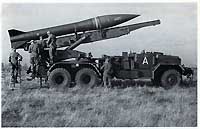 1. 2nd Btry, 72nd Rocket Arty Bn (137 KB) 1. 2nd Btry, 72nd Rocket Arty Bn (137 KB)
|
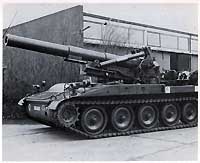 2. 4th Btry, 71st FA Bn (150 KB) 2. 4th Btry, 71st FA Bn (150 KB) |
|
|
| |
| 81st US Army Missile Detachment |
|
|
The 72nd Rocket Arty Bn and the 71st FA Bn were supported by the 81st US Army Missile Detachment.
The 81st U.S. Army Field Artillery Detachment was activated at Fort Sill, Okla. in February 1966 as the 81st U.S. Army Missile Detachment. The unit arrived in Germany in June 1966 and was attached to the 26th U.S. Army Missile Detachment of the 570th U.S. Army Artillery Group.
In August 1966, the 81st moved to Duelmen, Germany.
The detachment was reassigned to the 552nd U.S. Army Artillery Group in October 1978.
The 81st inactivated in June 1992. |
|
| |
| Artillerieregiment 11 (Panzergrenadierdivision 11) |
| |
| Warhead Custodial Support: 5th US Army Missile Detachment (link) |
| |
 ArtRgt 11 ArtRgt 11 |
| (Source: 25 Jahre Artillerieregiment 11, Oldenburg (1985)) |
| |
| In 1980, the 11th Artillery Regiment of the 11th Panzerjägerdivision consisted of the following units: |
| UNITS |
HOME STATION |
|
| Stabsbatterie Art Rgt 11 |
Oldenburg |
headquarters battery |
| Beobachtungsbatterie 11 |
Oldenburg |
target acquisition battery |
| Feldartilleriebataillon 111 |
Oldenburg |
field artillery battalion |
| Raketenartilleriebataillon 112 |
Delmenhorst |
rocket artillery battalion; serves as a training unit |
|
|
| |

FArtBtl 111
|

RakArtBtl 112
|
|
|
|
|
|
| |
(Email from Manfred Tegge, author/webmaster of Relikte.com)
CORRECTIONS
I just found your new pages about the 59th Ord Bde. Great job - I really like this growing mass of Information!
Just a little mistake on your PAGE 3 - Details on German Army Nuclear Artillery Units:
In 1980, the 11th Artillery Regiment was part of the of the 11th Panzergrenadierdivision (PzGrenDiv) not the 11th Panzerjägerdivision.
UNIT HOME STATIONS:
Stabsbatterie, Art Rgt 11 was at Oldenburg, not Dülmen
Beobachtungsbatterie 11 was also at Oldenburg, not Dülmen
Feldartilleriebataillon 111, again, Oldenburg, not Dülmen
Raketenartilleriebataillon 112, did not serve as a training unit and was located at Delmenhorst, not Gelsenkirchen
Your Locations are all right for the Art Rgt 7. |
|
| |
(Email from Manfred Tegge, author/webmaster of Relikte.com)
(Webmaster Note: The following article in German contains a short history of the Raketenartilleriebataillon 112 in Delmenhorst. This outfit was supported by the 5th USAFAD in Duensen. I will provide a loose translation of the article in a week or so.) |
Raketenartilleriebataillon 112: Von "Honest John"-Raketen zu Mehrfachraketenwerfer
Bataillonsgeschichte begann in Delmenhorst
Die Geschichte des Raketenartilleriebataillons 112 begann im April 1960 in der Delmenhorster Caspari-Kaserne mit der Aufstellung einer selbständigen Batterie, ausgerüstet mit dem Feldraketenwerfer 762 Millimeter vom Typ "Honest John". Erst ein Jahr später sollte die offizielle Gründung des Raketenartillerie-Bataillons erfolgen, nachdem man in der damaligen Boelcke-Kaserne von Delmenhorst, der heutigen Feldwebel-Lilienthal-Kaserne, eine weitere "Honest John"-Batterie und in Dünsen eine Begleitbatterie aufstellte. Nach Integration der bereits bestehenden 2. Batterie im April 1961 in den Verband gab im November desselben Jahres die Übung FRIESENSTURM dem Bataillon Gelegenheit, auf dem Truppenübungsplatz Bergen die erste "Honest John"-Rakete abzuschießen.
Seit Ende 1963 Standort in der Barbara-Kaserne Die 1962 erfolgte Aufstellung einer zweiten schießenden Batterie schloß sich an, so daß nunmehr mit einer Stabs- und Versorgungsbatterie, drei schießenden Batterien und einer Begleitbatterie die für lange Zeit vorherrschende Gliederung erreicht war. Besonders die 5. Begleitbatterie arbeitete mit dem 5th US Field Artillery Detachment, das seit Februar 1963 in Dünsen stationiert ist, eng zusammen. Seit Dezember 1963 ist das Raketenartilleriebataillon 112 endgültig in der Barbara-Kaserne in Adelheide stationiert. Sie wurde 1951 als "St.-Barbara-Barracks" vom 12. Königlichen Artillerieregiment bezogen, 1963 an die Bundeswehr übergeben und ab 1970 mit neuen Unterkünften ausgestattet.
Mehrfachraketenwerfer als neuer Waffentyp
Die Einführung des neuen Mehrfachraketenwerfers 110 Millimeter auf Selbstfahrlafette im Jahre 1971 machte eine erneute Umgliederung notwendig. Während die 2. Batterie zur "Großbatterie" mit vier Systemen "Honest John" umfunktioniert wurde, rüsteten die 3. und 4. Batterie um auf je acht Raketenwerfer von 110 Millimeter. Ausbildungskurse an den neuen Waffensystemen wie auch zahlreiche Vorführungs- und Belehrungsschießen schlossen sich an, um Erfahrungen zu sammeln.
Zwei neue Batterien
Von 1987 an Den Erfordernissen der Heeresstruktur 4 entsprechend, stellte die Auflösung der mit "Honest John"-Raketen ausgerüsteten 2. Batterie einen wichtigen Schritt im Rahmen einer weitergehenden Umgliederung des Bataillons dar, welches sich im Oktober 1980 in Form einer Stabs- und Versorgungsbatterie, einer 2. und 3. Batterie mit Mehrfachraketenwerfern sowie einer Begleitbatterie präsentieren konnte. Ab 1987 wird das Bataillon zusätzlich zwei MLRS-Batterien mit mittleren Raketenwerfern erhalten. Im Zuge der Umgliederung wird die Begleitbatterie selbständig.
Einsätze bei Katastrophen
Einsätze bei der Flutkatastrophe im Februar 1961 und der Schneekatastrophe 1979 forderten mehrfach die Leistungsbereitschaft der Raketenartilleristen in hohem Maße heraus. |
|
| |
Related Links:
81st USAFAD, Dülmen - Homepage of the Dülmen Warthogs!
Bundeswehr in Dülmen, 1966-2005 - German history of the Dülmen Garrison, includes lots of information on Artillerieregiment 7 |
|
|
| |
| I (NE) Corps - Warhead Custodial Detachments & Supported Formations |
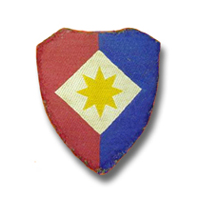 I NE Corps Formation Insignia I NE Corps Formation Insignia |
| |
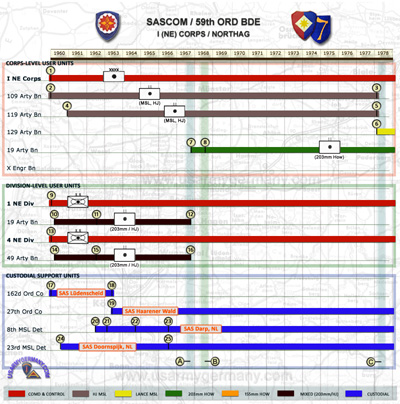 I (NE) Corps Nuclear Artillery Timeline (1960-1978)
(1978-1992 as well as National SW support units will be added at a later date)
Anyone interested or who has knowledge of the Dutch I Corps
Nuclear-capable artillery or support units - please contact me |
| |
I (Netherlands) Corps, NORTHAG - Nuclear-Capable Artillery and Support Units:
 Unit History/General Information Unit History/General Information
Artillery Command
19th Artillery Battalion ()
49th Artillery Battalion ()
109th Artillery Battalion ()
119th Artillery Battalion ()
129th Artillery Battalion ()
Support Units (Logistics and Security)
Warhead Custodial Units (US Army) |
Personal recollections submitted by former members of the US Army warhead custodial detachments can be found in the corresponding USAAG sections on Page 1!
Personal recollections submitted by former members of Dutch nuclear-capable outfits can be found in the corresponding unit sections on this page! |
|
| I (NE) Corps - Unit History and General Information |
| |
| |
 |
|
Infanterie Beveilingscompagnie RvH - There is a Dutch Wikipedia page on the special Dutch infantry companies (Regiment van Heutsz) that provide security for the US warhead custodial detachments and their special ammunition storage sites. The page contains some good historical data relevant to the Dutch nuclear capable units. Also, has some links to websites for the various Dutch artillery units that were supported by the US warhead custodial units. (Content is in Dutch but can be translated using Google.) |
|
|
|
| (Artillery Command) |
| |
| |
| |
|
| 109th Artillery Battalion (109e Afdeling Veldartillerie) |
| |
| |
The 109th battalion was formed in May 1959 as an Honest John unit.
In 1978 the HJ's were phased out of the Dutch Army and the battalion was inactivated (Dec 1978). |
| |
|
| 119th Artillery Battalion (119e Afdeling Veldartillerie) |
| |
| Warhead Custodial Support: 8th US Army Missile Detachment (link) |
| |
(Source: Ed Starks  , webmaster of the 8th Missile Detachment website - NOTE) , webmaster of the 8th Missile Detachment website - NOTE) |
|
That's Ed Starts with the 8th MSL Det standing next to an Honest John launcher of the 119th Dutch Field Artillery Battalion (119 Afdva).
The Dutch battalion was formed in Nov 1960 as an Honest John unit. The unit was stationed at Steenwijkerwold/Havelte, the Netherlands.
In 1978 the HJ's were phased out of the Dutch Army and the battalion was inactivated (July 1978).
Click here for additional pictures of the 119 Afdva and the Dutch Honest Johns (41AFDVA.net website). |
|
| |
|
| 129th Artillery Battalion (129e Afdeling Veldartillerie) |
| |
The 129th Artillery Battalion was formed in May 1978 (probably using personnel from the inactivated 119th Arty Bn, Honest John) as a LANCE battalion. It appears that personnel from the 109th Arty Bn, another Dutch HJ unit, also joined the 129th when the 109th battalion was inactivated later in the year.
The 129th became operational in March 1979. The battalion comprised two firing batteries and a headquarters and service battery.
The battalion remained active until 1992. |
|
| |
| (Source: various notes made during research - information still "fluid"!)) |
109th Field Artillery Battalion (Honest John), Joh. Postkazerne, Havelte, 1970
119th Field Artillery Battalion (Honest John), t Harde
19th Field Artillery Battalion M-110 at Tonnetkazerne, 't Harde, The Netherlands, in the 1970s; A, B, Hqs & Svc Btry
107th Field Artillery Battalion M-107 at 't Harde, late 1960s, 1970s; Hq & Svc Btry, A, B Btry
129th Field Artillery Battalion (LANCE) - 1st Firing Pltn (1e lanceer plt); |
| |
Related Links:
19e Afdeling Veldartillerie - Dutch field artillery battalion stationed at Tonnet Kazerne, Havelte, The Netherlands; the unit was equipped with the Honest John rocket and later the M110 howitzer (Dutch language only - has pics)
129 afd Veldartillerie Lance Raketten (dead link) - Dutch LANCE battalion stationed at Johannes Post Kazerne, Havelete, the Netherlands. (Dutch language only)
425 Mob Cie van Heutsz 't Harde - Pieke van der Schaaf's blog dedicated to the history of the 425 Van Heutsz Company (Mobile), the Dutch security unit at 't Harde, the Netherlands.
435 van Heutsz - an Multply Group page dedicated to the Dutch security unit at Büren.
434 IBC (van Heutsz) - a website for former members of the 434 IBC at Havelte (Steenwjik), NL (incl. photo of the SAS at Darp). |
|
|
| |
| |
|