If you do
NOT see the Table of Contents frame to the left of this page, then
Click here to open 'USArmyGermany'
frameset |
5th
US Army Artillery Group
59th Ordnance Brigade
Looking for more information from military/civilian
personnel assigned to or associated with the U.S. Army
in Germany from 1945 to 1989. If you have any
stories or thoughts on the subject, please contact me . .
|
|
|
|
CUSTODIAL DET |
SUPPORTED UNIT |
CTRY |
|
CUSTODIAL DET |
SUPPORTED UNIT |
CTRY |
|
26th Fla Rak Btl |
GE |
|
|
520th & 521st BA |
FR |
|
25th Fla Rak Btl |
GE |
|
|
23rd Fla Rak Btl |
GE |
|
13th Msl Wing |
BE |
|
|
9th Msl Wing |
BE |
|
24th Fla Rak Btl |
GE |
|
|
2nd GGW |
NE |
|
22nd Fla Rak Btl |
GE |
|
|
1st GGW / 12th GGW |
NE |
|
21st Fla Rak Btl |
GE |
|
|
|
|
|
| ** The 357th was not a subordinate unit of the 5th USAAG |
|
|
| History |
|
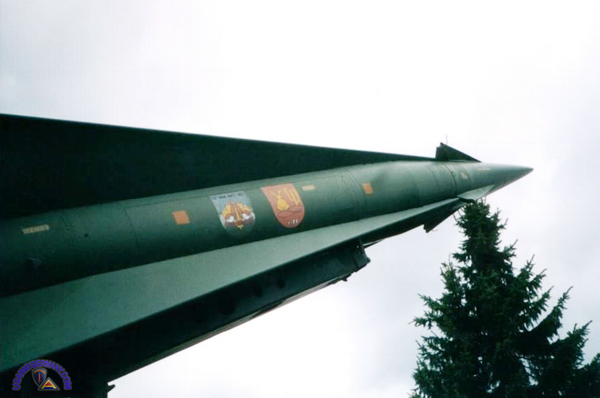
Nike-Hercules with insignia (Charles Everett) |
|
| 1963
- 1988 |
| (Source: 59th
Ord Bde PAO) |
The 5th Artillery Group
BIG UNIT – BIG HEART
The 5th Artillery Group is the Brigade's largest group, both in the number of service members it has and the number of detachments it contains. It's also the most spread out group, with detachments as far south as Frankfurt and as far north as the cold North Sea.
In all, the group has 10 detachments and one company divided into 30 teams in 31 different locations throughout central and northern Germany.
“Why is it so big?” one might ask. This giant serves as the Brigade's only air defense artillery group, which is different from the land combat groups and ordnance battalions that make up the rest of the 59th organization.
The group has a history dating back to World War II. Activated on Sept. 5, 1942, the 5th is the oldest artillery group in the U.S. Army. It participated in combat in North Africa and Sicily in 1943 and in France and Germany in 1944 and 1945. It also fought in Korea.
The group came to Germany again in 1963 and currently maintains an assigned strength of over 1500 personnel. It provides custodial support, technical support and custodial maintenance for several weapons systems in support of units from the German, Dutch and Belgian Army and Air Force. In so doing, the group works closely with its supported nation counterparts, both in training and in day-to-day operations.
Because the headquarters of the 5th Group's organic detachments support the headquarters of large German, Dutch and Belgian battalions, ample support facilities exist on 5th Group kasernes not found on most NATO installations. These include medical and athletic facilities; movie theaters and saunas; and officers, NCO and enlisted clubs.
The group has had many notable successes in its history, most importantly in its training programs. The 5th Group detachments have a well known history of receiving superior ratings on inspections; and 5th Group soldiers are also known for high scores on their Skills Qualification Test.
The organic units of the 5th Group, in brief:
The Headquarters and Headquarters Company are situated in Bueren (described by one 5th Group soldier as being “just like home”), along with the 27th Ordnance Company. Bueren serves as a subcommunity with a commissary, education center, finance office, all ranks club, post exchange, post office, theater and Stars and Stripes Bookstore. Medical care is available on the Belgian kaserne and in town. For school children, there is an elementary school, with junior and senior high schools in Frankfurt.
The 35th Artillery Detachment is headquartered in Hohenkirchen, about 30 minutes from the beaches of the North Sea. Community support here comes from Bremerhaven. The detachment has four teams; Alpha in Hohenkirchen; Bravo, in Rodenkirchen; Charlie, in Wiesmoor; and Delta, in Dornum.
The 42nd Artillery Detachment, headquartered in Barnstorf, supports the 25th FlaRak (German) Battallion's Nike-Hercules missiles. Situated about 100 miles due south of Bremerhaven, the unit's members take advantage of the sailing, swimming, fishing and wildlife preserves to the southwest of them, near the Duemersee. Alpha Team is colocated with the headquarters, while Bravo Team is 20 kilometers south.
The 43rd Artillery Detachment headquarters, in Dueren, enjoys the best of the nearby cities of Cologne and Aachen. It supports the 13th Belgian Missile Wing and receives community support through the Giessen military community. Alpha Team is colocated with the detachment headquarters while Bravo Team is an hour away from the headquarters in picturesque Kaster; Charlie Team is in Euskirchen and Delta Team in Blankenheim, both less than an hours drive from the headquarters. The detachment sponsors a soccer program for each of its teams.
The 51st Artillery Detachment, headquarters on the northwest corner of the German metropolis of Bremen in Adelheide, is the only detachment in the group without an Alpha or Bravo team; the two split off during a Brigade reorganization. The 51st places great pride in the quality of training of its soldiers. They hold annual military skills competitions among soldiers of similar military occupational specialties. The 51st also operates a free lunch program for American elementary school children in nearby Delmenhorst. The detachment has a Charlie Team in Westerscheps, near Oldenburg, and a Delta Team in nearby Syke, south of Bremen.
The 52nd Artillery Detachment, headquartered in Burbach, is close to the 557th Artillery Group headquarters in Herbornseelbach, and about an hour and a half north of Frankfurt. It receives its community support from Giessen, 50 miles distant.
The 66th Artillery Detachment, headquartered in Buecke, is just a foosball’s toss away from the group headquarters in Bueren, enjoying the convenience of the nearby city of Soest. Although they support the 21st (German) FlaRak Battalion, they have their own kaserne four kilometers east of the headquarters in the heart of a Belgian training area.
The 501st Artillery Detachment, headquartered in Kilianstaetten, sits on the north-east section of Frankfurt and is the groups southernmost unit. It supports the 23rd FlaRak Battalion. The detachment is the most spread out detachment in the Brigade, with four teams scattered over an area the size of Rhode Island. The detachment receives most of its Community support from the Hanau military community and its medical support from Frankfurt. Three of the detachments four teams are located close to major military communities.
The 507th Artillery Detachment, headquartered in Grefrath with its Alpha Team, is close to Duesseldorf and supports the 9th Belgian Missile Wing. Although it ostensibly receives community support from Giessen two and a half hours away, service members of the unit may go to the nearby Schinnen, Netherlands, headquarters for Allied Forces Central Europe (AFCENT), for exchange and commissary facilities, as well as other community support.
The 509th Artillery Detachment, headquartered in Voerden, 50 miles southwest of Bremen, supports the 12th Netherlands Missile Group. While the colocated headquarters and Alpha Team receive support from the Norddeutschland military community in Bremerhaven, Bravo Team in Schoeppingen and Charlie Team in Borgholzhausen receive their support from the Giessen military community to the south.
Although the 5th Group is the largest group in the Brigade, it gives personal attention to the needs of every soldier, right down to the ones in its 25 man teams. It shows its heart is a big as its numbers are large.
The 5th U.S. Army Artillery Group was constituted in the Army of the United States in September 1942 as Headquarters and Headquarters Detachment, 5th Armored Artillery Group. The unit was activated that same month at Camp Young, Calif. The Group was created by taking the Division Artillery Command from the 5th Armored Division and making a separate command. As the first unit of its kind, it was an experiment by the War Department designated to attach a tactical command element to its subordinate battalions. Thus, the Headquarters and Headquarters Detachment was attached to the 65th Armored Artillery Division, which became a separate battalion assigned to the group. The command deployed to the African-Middle Eastern Theater, arriving at Casablanca in January 1943. While in Africa, the 5th Group received credit for participation in the Tunisian Campaign. Next up was the invasion of Sicily; the 5th was assigned to II Corps. The group was awarded battle credit for the Sicilian Campaign. At the close of the Sicilian Campaign in August, the unit was reorganized and redesignated as Headquarters and Headquarters Battery, 5th Field Artillery Group. In November 1943, the 5th Group left for the United Kingdom and arrived in Scotland in December. The group remained there until July 1944, when it moved to Normandy and participated in the closing days of that campaign as an element of XX Corps. In the month that followed, 5th Group, now attached to VII Corps, was an integral element of the push across France into Germany. The Headquarters Battery was awarded approximately 100 combat decorations. For service in the European Theater, the 5th Field Artillery Group received credit for five campaigns. The unit returned to the United States and was inactivated at Camp Myles Standish, Mass, in October 1945.
The 5th Field Artillery Group was reactivated in August 1946 at Fort Sill, Okla. The group performed routine training and administration of the post until August 1950 when, after the outbreak of hostilities, the 5th Field Artillery Group was ordered to action in Korea. Arriving in Korea in late September 1950, the 5th Group actively engaged in combat operations. The 5th received battle credit for its participation in the UN Defensive and UN Offensive Campaigns, the 5th Field Artillery Group was awarded an ROK Presidential Unit Citation. Following participation in the Communist Chinese Forces Intervention, the 5th Group was allotted to the regular Army in October 1951.
For action in February 1952, the 5th Field Artillery was awarded a second ROK Presidential Unit Citation. For service during the period December 1952 through April 1953, the 5th Filed Artillery Group received the Meritorious Unit Commendation.
The group was redesigned as Headquarters and Headquarters Detachment, 5th U.S. Army Artillery Group, and it was activated in July 1962 at Fort Sill. In February 1963, the 5th U.S. Army Artillery Group arrived in Germany along with one subordinate unit, the 27th Ordnance Company. The groups new home was established in Bueren.
In March 1963 , the 5th Group was assigned to the 514th U.S. Army Artillery Group. Thus, the 5th assumed command of units providing support to the I Belgian Corps, I British Corps, and Second Allied Tactical Air Force.
On 1 July 1967, the 5th Group was transferred from the 514th U.S. Army Artillery Group to the 548th U.S. Army Artillery Group for administrative control.
In October 1978, the 5th U.S. Army Artillery Group was reorganized as the 59th Ordnance Brigades all-air defense detachment group.
The 1980s saw the reduction of mission requirements and a corresponding inactivation of teams as the user nations withdrew the aging Nike Hercules weapons system from service. The 5th USAAG, along with its subordinate units, was officially inactivated in October 1988. |
|
|
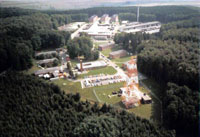 Stockerbusch
Kaserne
Stockerbusch
Kaserne |
|
Aerial
view of Stockerbusch Kaserne in Büren. This was home to
the 5th US Army Artillery Group and the 27th Ordnance Company.
Click on the thumbnail to view Kurt Kimble's photo on The
27th Ord Co web site. |
|
|
|
| If you have more
information on the history or organization of the 5th Artillery Group/USAAG,
please contact me. |
|
| |
| (Source: Email from Charles I. Everett Jr, C Tm, 35th USAAD; various other sources) |
The information presented below was from the 1970s till the closure of all custodial warhead teams in 1987/1988.
The former site of HQ and Team A, 35th USAAD (Hohenkirchen - Wangerland Kaserne) has been bought by a Dutch company. The Lauching area is to be turned into a go cart area and the administration area is being demolished for a tourist area.
The German SOC (SOC 1) located in Brockzetel that for the entire northern air defense corridor will close at the end of 2007 - 2008 and be moved to Erntebrueck near Kiel.
The major in the southern German town of Lenggries (former US army Quartermaster School and Signal School) has petitioned the federal German government to demolish the former Prinz Heinrich Gebirgsjaeger Kaserne (US troops 1945 to approx 1974, I believe). |
|
| |
| TEAM LOCATIONS: |
US Army Artillery Detachments supporting German Luftwaffe NIKE units -
35th USAAD
(1) |
| |
TEAM |
LOCATION |
UNIT SUPPORTED |
COMMENTS |
| |
HQ |
Hohenkirchen |
|
|
| |
A Team |
Hohenkirchen |
Btry 1, 26th Rak Art Btl |
|
| |
B Team |
Rodenkirchen |
Btry 2, 26th Rak Art Btl |
inactivated in 1989, last NIKE battery in Germany |
| |
C Team |
Wiesmoor |
Btry 3, 26th Rak Art Btl |
|
| |
D Team |
Aurich; Dornum |
Btry 4, 26th Rak Art Btl |
initially billeted in Aurich, moved to Dornum in 1980s (?) |
|
| (1) Arty Det initially consisted of five teams. E Team was located in Elsfleth. Elsfleth apparently later became a non-nuclear capable NIKE site. |
| |
| 42nd USAAD |
| |
TEAM |
LOCATION |
UNIT SUPPORTED |
COMMENTS |
| |
HQ |
Barnstorf |
|
|
| |
A Team |
Barnstorf |
Btry 2, 25th Rak Art Btl |
|
| |
B Team |
Wagenfeld |
Btry 3, 25th Rak Art Btl |
|
| |
C Team |
Lohne |
Btry 4, 25th Rak Art Btl |
closed March 1979 |
| |
D Team |
Varrelbusch |
Btry 1, 25th Rak Art Btl |
closed March 1979 |
|
| |
| 51st USAAD (2) |
| |
TEAM |
LOCATION |
UNIT SUPPORTED |
COMMENTS |
| |
HQ |
Adelheide |
|
|
| |
(no team) |
Elsfleth |
Btry 1, 24th Rak Art Btl |
|
| |
(no team) |
Adelheide |
Btry 2, 24th Rak Art Btl |
|
| |
C Team |
Edewecht |
Btry 3, 24th Rak Art Btl |
|
| |
D Team |
Syke |
Btry 4, 24th Rak Art Btl |
|
|
| (2) Batteries 1 and 2 of the 24th Fla Rak Btl did not have US custodial teams assigned to them. That would mean that they were not equipped with nuclear warheads. |
| |
| 52nd USAAD |
| |
TEAM |
LOCATION |
UNIT SUPPORTED |
COMMENTS |
| |
HQ |
Burbach |
|
|
| |
A Team |
Burbach |
Btry 2, 22nd Rak Art Btl |
|
| |
B Team |
Waldbroel |
Btry 3, 22nd Rak Art Btl |
|
| |
C Team |
Marienheide |
Btry 4, 22nd Rak Art Btl |
closed 1985 |
| |
D Team |
Oedingen |
Btry 1, 22nd Rak Art Btl |
closed 1987 |
|
| |
| 66th USAAD |
| |
TEAM |
LOCATION |
UNIT SUPPORTED |
COMMENTS |
| |
HQ |
Möhnesee |
|
|
| |
A Team |
Möhnesee |
Btry 2, 21st Rak Art Btl |
|
| |
B Team |
Holzwickede |
Btry 3, 21st Rak Art Btl |
|
| |
C Team |
Datteln |
Btry 4, 21st Rak Art Btl |
|
| |
D Team |
(Warendorf) |
Btry 1, 21st Rak Art Btl |
See Richard Leslie's correction |
|
| |
| 501st USAAD |
| |
TEAM |
LOCATION |
UNIT SUPPORTED |
COMMENTS |
| |
HQ |
Killianstädten |
|
|
| |
A Team |
Lich |
Btry 1, 23rd Rak Art Btl |
prob closed in 1985 or before |
| |
B Team |
Killianstädten |
Btry 2, 23rd Rak Art Btl |
|
| |
C Team |
Kemel |
Btry 3, 23rd Rak Art Btl |
prob closed in 1985 or before |
| |
D Team |
Westerburg |
Btry 3, 23rd Rak Art Btl |
|
|
|
| |
| (Source: various sources) |
| TEAM LOCATIONS: |
US Army Artillery Detachments supporting Belgian Air Force NIKE units -
43rd USAAD |
| |
TEAM |
LOCATION |
UNIT SUPPORTED |
COMMENTS |
| |
HQ |
Düren |
13th Missile Wing |
The 13 WMsl was a French speaking Wing with Walloon personal. |
| |
A Team |
Nideggen |
50th Squadron |
|
| |
B Team |
Kaster |
51st Squadron |
|
| |
C Team |
Euskirchen |
52nd Squadron |
|
| |
D Team |
Blankenheim |
53rd Squadron |
|
| |
E Team |
Kaster |
57th Squadron |
became Tm B, 507th USAAD in 1971 |
|
| 507th Arty Det |
| |
TEAM |
LOCATION |
UNIT SUPPORTED |
COMMENTS |
| |
HQ |
Grefrath |
9th Missile Wing |
The 9 WMsl was a Dutch speaking Wing with Flemish personal. |
| |
D Team |
Xanten |
54th Squadron |
|
| |
A Team |
Grefrath |
56th Squadron |
|
| |
C Team |
Kapellen |
55th Squadron |
|
| |
B Team |
Kaster |
57th Squadron |
|
| |
E Team |
Fort Bliss, TX |
. . . |
never deployed to Germany; disbanded |
|
| |
| (Source: Email from Jim Duffy, 43rd & 507th USAAD, 1969-72 and 1973-76) |
I spent time in the 43d USAAD & 507th USAAD from Dec 1969 - Dec 1972 & Sep 1973 - Dec 1976 in Euskirchen, Kaster, Kapellen & Grefrath.
I started as a 16B Security Guard and got as high as Scty SGT, A&M SGT and acting Team Sergeant.
I am also the first US Soldier to marry a local from Grefrath (4 Aug 72). When I PCS'd from Germany I did a tour at 2/52ADA (STRAFF) and Tm E, 507th USAAD at FT Bliss, another tour in SETAF with HHD, 34TH USAAD (Ceggia, IT) before joining the Btry C, 2/43d ADA (PATRIOT) for deployment and eventual retirement in Hanau, GE.
I did notice that the below locations are incorrect. Kaster was Team E, 43d USAAD until it was absorbed by the 507th in 1971 when it became Team B, 507th USAAD. Euskirchen was always Tm C, 43th USAAD. Xanten (Tm D, 507th USAAD) & Erle (which was to have become Tm E, 507th USAAD were never certified). Erle failed the JAFFI certification and the Team which had been stood up in Ft Bliss never deployed and was disolved (I was the Security Sergeant).
After deactivation of the 507th USAAD, Grefrath was used as a USAREUR ASG which had previously been located in Rheinberg, GE.
508th USAAD
TEAM LOCATION UNIT SUPPORTED COMMENTS
HQ Kaster 2nd GGW
A Team Schöppingen 220th Squadron
B Team Kaster 221st Squadron unit closed after merger of 1 & 2 GGW
C Team Euskirchen 222nd Squadron unit closed after merger of 1 & 2 GGW
D Team Rheine 223rd Squadron
509th USAAD
TEAM LOCATION UNIT SUPPORTED COMMENTS
HQ Grefrath 1st GGW
B Team Vörden 118th Squadron
A Team Handorf 119th Squadron unit closed after merger of 1 & 2 GGW
D Team Borgholzhausen 120th Squadron
C Team Böhmte 121st Squadron unit closed after merger of 1 & 2 GGW |
|
|
| |
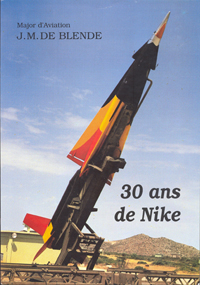 Book cover
 |
|
30 ans de Nike, by Major d'Aviation J.M. De Blende, 1990. Published by the Forces Belges en Allemagne (Belgian Forces in Germany).
There are about 300 pages. About half of the book is history of the Belgian units who commanded, operated and supported the Nike missiles; the other half contains rosters, order of battle and other charts.
I just received a copy of this book (end of October 2007). I selected the French language version (there is a Flemish version also). It will take some time for me to review the book, but I will post some excerpts from the book in the future.
Anybody interested in obtaining (purchasing) a copy of the book can contact the webmaster and I will forward the request to the appropriate persons. |
|
|
| |
| (Source: various sources) |
| TEAM LOCATIONS: |
US Army Artillery Detachments supporting Dutch Air Force NIKE units -
508th USAAD |
| |
TEAM |
LOCATION |
UNIT SUPPORTED |
COMMENTS |
| |
HQ |
Kaster |
2nd GGW |
|
| |
A Team |
Schöppingen |
220th Squadron |
|
| |
B Team |
Kaster |
221st Squadron |
unit closed after merger of 1 & 2 GGW |
| |
C Team |
Euskirchen |
222nd Squadron |
unit closed after merger of 1 & 2 GGW |
| |
D Team |
Rheine |
223rd Squadron |
|
|
| |
| 509th USAAD |
| |
TEAM |
LOCATION |
UNIT SUPPORTED |
COMMENTS |
| |
HQ |
Grefrath |
1st GGW |
|
| |
B Team |
Vörden |
118th Squadron |
|
| |
A Team |
Handorf |
119th Squadron |
unit closed after merger of 1 & 2 GGW |
| |
D Team |
Borgholzhausen |
120th Squadron |
|
| |
C Team |
Böhmte |
121st Squadron |
unit closed after merger of 1 & 2 GGW |
|
 |
|
|
| 27th Ordnance Company |
|
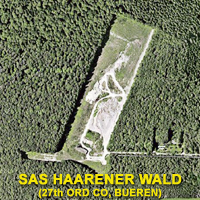 GOOGLE EARTH
|
|
|
|
|
|
|
| 35th
Artillery Detachment/USAAD |
|
| 1962
- 1988 |
The 35th U.S. Army Artillery Detachment was activated in 1944 and served in the European Theater earning five battle credits. In September 1945, the unit returned to the United States and was deactivated.
For a brief period in 1947-48, the detachment was reactivated as the 35th U.S. Army Artillery (Coast) Maintenance Detachment in the Hawaiian Area Command and subsequently inactivated.
In December 1958, the unit was reactivated as the 35th U.S. Army Artillery Detachment (Warhead Support) (Nike-Hercules). It was assigned to Fort Bliss, Texas and reorganized.
In April 1962, the 35th transferred to Germany and it was attached to the 2nd Missile Battalion, 56th Artillery headquartered in Pirmasens.
In October 1962, the detachment was reassigned to the Special Ammunition Support Command and moved to northern Germany under the command of the 552nd U.S. Army Artillery Group.
The 35th was transferred to the 5th U.S. Army Artillery Group in October 1978, and was inactivated with the group in 1988. |
|
|
|
| 1963 |
| (Source: Email from Andrew J. Johnson, 35th Arty Det, 1963-65) |
From June 1963 to January 1965, as a new 2nd Lieutenant, I was assigned to the 35th USA Artillery Detachment located at Jever Flugplatz, Germany west of Wilhelmshaven. When I got to Bremerhaven, they had to open a safe to find out who to call to come get me. The information was in a secret document.
We were co-located there with another detachment pending completion of the construction of German Nike Hercules Battery sites near the North Sea.
Since we did not have an active site, our job was to practice taking warheads out of the container, preparing them for mating with the rocket on the launch pad, working with our German Air Force counterparts to mate the warhead to the missile on the launcher, and then reverse the process. (We did not have a SW storage site. We only had training devices.) We also ran practice convoys with our German counterparts. (During my tenure, the 35th had only a training mission at the flugplatz. Another detachment was co-located with the 35th at Jever and had the same issue. There was another detachment at Oldenburg.)
Since we did not have an active warhead custodial mission to worry about, myself and other officers, were frequently loaned out to fill out Nuclear Surety Teams. On one occasion, I was loaned out to an artillery detachment near Hamburg, Germany and took a NSI with them, passing with no comments and no deficiencies.
I also have another recollection. During exercises, we went to a German radar site at Brockzetel. When a “flock” of Soviet aircraft were encountered with a nuclear NIKE blast, we were asked to estimate how many of the “flock” were destroyed. Of course we had no information regarding that. So, we made up scoring rules based on the nuclear yield selected for the warhead.
The 35th detachment was part of a larger unit known as SASCOM.
OER Data - 35th Arty:
OERs dated April and Decmber 1964: Rater = Commander 35th Artillery Detachment; Reviewer = Commander 552nd Arty Gp.
(Click here to read Col Johnson's recollections of his other assignments to 59th ORD units: 525th Ord Co; USAREUR IG; 197th Ord Bn.) |
|
|
|
| 1965 |
| (Source: Email
from Dave Williams, 35th Arty Det, 1965-67) |
I was hoping to find out or read about my old unit, the 35th Artillery Detachment, which consisted of teams A, B, C, D, & E stationed between Wilhemshaven south to Wiesmoor. You have all the teams of the 35th listed correctly. Each team was only made up of maybe 30 US personnel and everyone knows what our main job was. There was a British unit stationed as well and I think they may have been involved with the radar.
I was with headquarters at Jever on the German Air Base as was "A" Team. We were attached with the 552nd Group out of Soegel, which in turn was attached with the 514th Bn. I went thru your web site best I could and only found one mention of Jever.
Dave Williams
(Webmaster Note: In the early 1960s, the teams were located as follows: |
|
|
UNIT
DESIGNATION
|
LOCATION |
COMMENTS |
| A
Team |
Jever
(German Air Force Base) |
|
| B
Team |
Rodenkirchen
|
|
| C
Team |
Wiesmoor |
|
| D
Team |
Aurich
|
|
| E
Team |
Elsfleth
|
|
|
|
| |
| 1966 |
| (Source: Email from
Louis "Phil" Phillips, Team B, 35th Arty Det, Sept 1966 - Nov 1968 ) |
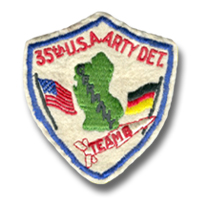 Team B Pocket Patch, 1960s
 |
|
I have attached a picture of our unauthorized patch for "B Team" 35th USAAD stationed in Rodenkirchen, West Germany. We had 12 of these made up and we also had the patch done in concrete in front of the US Building.
Even after all the years, the vets of Rodenkirchen still talk to each other. I am writing my memories of Rodenkirchen and will pass it along someday when I finish.
Louis "Phil" Phillips |
|
|
|
| |
| 1983 |
| (Source: Email
from Charles Everett, C Team, 35th USAAD, 1983 - 1985) |
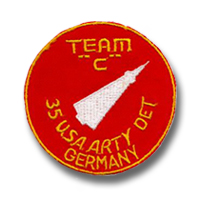 Team
C Pocket Patch, 1960s
Team
C Pocket Patch, 1960s |
|
Here
is some additional information on the 35th USAAD:
Alpha Team was located in Hohenkirchen with Headquarters
company in the 1980s and was the last team to be deactivated.
Hochenkirchen converted to Roland batteries and the garrison
deactivated last year in 2003.
Bravo Team in Rodenkirchen - the German administrative
garrison there has been demolished. The Launching area
with the improved security control tower can still be
seen from the German Bundesstrasse.
Charlie Team was located in Wiesmoor at the Fehn Kaserne
which closed operations in the late 1990s and now stands
abandoned. The Launching area and IFC were located in
Hinrichsfehn - both have been sold to private parties
and most of the facilities have been dismantled. |
|
|
Delta Team was in Dornum and was the first Nike team to deactivate. The US Team buildings have been taken over by civilians for private housing.
I saw what remained of all of C Team in October 2003. As of B Team in Rodenkirchen, I last saw the Launching Area and what was left of the Admin area in 2002. The Air base in Jever in scheduled to be closed in 2005 according to my German sources, the German 38th Fighter Squadron "Friesland" is stationed there at this time with Tornado jets.
There is another reunion of the 3/26th FlaRak planned in Wiesmoor to coincide with the Wiesmoor Flower festival in Sept 2006 to the best of my knowledge.
The 59th Ordnance Brigade was deactivated in Pirmasens and has been reactivated here in the United States once again, I believe in Huntsville, Alabama - would have to some more research on that.
Charles Everett |
|
|
|
|
| 42nd
Artillery Detachment/USAAD |
|
| 1962
- 1988 |
The 42nd U.S. Army Artillery Detachment was activated in June 1962
at Fort Bliss, Texas.
The unit deployed to Europe in December 1962 and was assigned to the
552nd U.S. Army Artillery Group.
In June 1966, the detachment was transferred to the 570th U.S. Army
Artillery Group, and in May 1967, it was reassigned to the 552nd.
Finally, in October 1978, the 42nd Detachment was assigned to the
5th U.S. Army Artillery Group.
The 42nd was inactivated with the group in 1988. |
|
|
| 1970 |
| (Source: Email from Dn Johnson, 42nd Arty Det, 1970-71) |
Here are some of my thoughts. It has been a long time since being in Barnstorf and thinking about it has brought back a ton of memories.
I was stationed at the 42nd USA Arty Det from August 1970 till I got out in June 1971. We had about 35 Americans at HQ including A Team and HQ personnel.
Communications: As I recall, we received some of our coded messages first by radio through our in-house radio room, then an encrypted hard copy would follow through the German communication (teletype, I think) across the street in the same compound. I would decode the message, re-code it in different format and sent it to the teams as needed. I don't remember the type of radio we had, but it was noisy and it seemed that someone always turned it off. It was mostly not possible to reach the teams by radio. If we needed to contact them, someone who spoke German would use the telephone system. We had to turn the crank, then tell an operator who we wanted to call. After they made the connection, they would ring us back and we could talk. A couple of our teams were out of range for the radio anyway and that was how we transmitted messages to them. Our teams were in Elsfleth, Lohne and Wagenfeld. I can't remember that we had any others. I don't think I ever met any of the people from the other teams unless they were transferring in or out. Once a German officer brought me a plain text message that had come in. These messages were mostly classified Secret Noforn; noforn mean't that they were not to be viewed by non-Americans. I looked at the message and looked at him with a very shocked and confused look on my face, apparently. He then pointed out all the parts of the message and what they meant. I took the message directly to a meeting with the CO, XO, 1st Sgt, and security officer and told them what had happened. They were scared to death of having to deal with anything related to security anyway, and didn't know what to do. During the meeting, the German officer called me and said he had to have the message back because it was classified and he had to account for it. My security team didn't know what to do and directed me to give it to him and pretend it never happened.
There were no recreation courts or things like that, other than an occasional Saturday volleyball game on the back lawn, but we did have a bar in the basement. Beer was $.25 whether German or American. A number of Germans would come there - I believe the exchange rate for marks-dollars was about 3.5:1. In our bar, a mark was the same as a quarter so the bartender would cash out the marks at the end of the night and get a small tip through the exchange. Every week a supply truck would come with food and beer. The guys who frequented the bar would set up a bucket brigade passing the cases down the steps and to the storeroom behind the bar. We always had some cases under the bar for the Germans because they didn't like the beer to be cold. Of course, we had a foosball table in the basement that was always busy. There was more than one bar in town, but we spent most of our off-base time in Werner's Gasthaus. We drank beer and apfelkorn with the locals. There would be an occasional Schützenfest which was followed with lots of beer and korn and brats. The whole town would turn out for this.
We had one American cook. He was assisted by local German women who helped prepare the meals and run the mess. The food was quite good and my uniforms were much tighter when I left after a year. I frequently shared beers with the cook in our bar. After he had a few, he would always tell me that when he got back on the street he was "going to get a gun and kill Whitey". Then we would laugh. (I was from small-town Midwest farm country and I had never had an opportunity to talk to someone other than whites before, except for one fairly short-term Chinese girlfriend from college. There were ZERO non-whites in the town where I grew up.) He re-upped a week before he was to get out. I can't remember his name but do remember that he was from Detroit.
Louis Davis Jr was the First Sgt. He was a black man. He was from Nowhere, USA. I think he told me where he grew up but it wasn't important to him. He was all Army and didn't really claim a hometown. I had a great deal of respect for him. He did all he could to make me happy and in turn, I did the best job I could to keep the security room in order. About 6 weeks before I left they got two guys to be my replacement. Top told me to tell them what to do, and if they had any questions at all, they were to come to me, otherwise I was to stay clear of the room. Goof off. He wanted to be sure they would be able to carry on. I spent a lot of time shooting flies with rubber bands.
I got a "European Out", which meant that I didn't have to go back through the States to become a civilian. I had 6 weeks before I had to be back home so I traveled to Sweden, Denmark, Netherlands, Belguim,Germany and Italy during that time. For the first week, I was accompanied by Mike Rose (from somewhere in Wisconsin), who took a leave to travel with me. After that I joined up with a guy I met in Amsterdam and we traveled together till I went home. We had planned to go to Spain but there was a cholera outbreak (or some health concern that would have meant a period of isolation at the border coming out) so we skipped that. Part of the European Out deal was that within a year I had free transportation back to the States. For the last month or two of the Army I didn't get a haircut. My First Sgt looked out for me and kept me away from any brass that was around and would have made me get it cut. By the time I caught a ride home from Frankfurt I looked (and smelled) pretty ragged and got a lot of weird stares.
I had a number of good friends.. Besides Mike Rose, Gene Lawson from Missouri and Richard Spinney from Rhode Island were a couple of guys I liked to hang out with. I spent a lot of time playing foosball with them. There was another guy from McCook Nebraska, but I can't remember his name right now. It has been too many years and some other names escape me now.
The kaserne is now marked on maps as Eydelstedt at the NE edge of town. What we knew as Eydelstedt at the time is now called Neu Eydelstedt, not sure what's up with that. I |
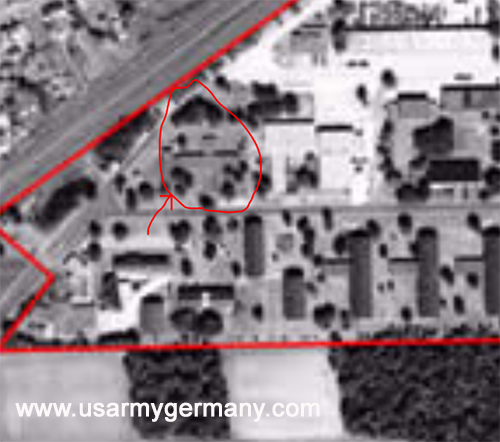 Possible location of the Detachment house on Hülsmeyer-Kaserne in Barnstorf
 |
|
The aerial photo on the left shows the Hülsmeyer Kaserne in Barnstorf-Eydelstedt in 2006.
Looking at GOOGLE Maps, it appears that the building we occupied is no longer there. The vacant area across the street from the RR tracks on the first block to the NE from the gate is where our building was located.
To see the building
you'll have to find an older photo. I don't remember if I have any. I don't think we were supposed to be taking photos there at the time. It's kinda weird - it was supposed to be a security violation to use the name of the town and the name of the unit in the same document; the same went for the weapons, to say that we had Nike and special weapons was a no-no. Once they had an open house where anyone was allowed into the missile site and could see what was there. I think we were told it had to do with community relations.
I think the circled area in this photo was the American building.
To the left was the kitchen/dining area. Barracks to the right. Admin offices/security room/weapons room between. The radio room stuck out to the north I think.
The bar was under the kitchen.
There was an incinerator north of the west part of the building (near the trees) where I disposed of documents scheduled for destruct.
It doesn't look quite like I remember but it has been a long time and I never saw it from above. The resolution isn't that great either.
The building just across the street to the south of us, I believe, was German HQ & communications.
The building just to the east and north of ours was a little sandwich shop. Nobody there spoke English but i bought a lot of liverwurst brotchens there. There were nice ladies working there, always smiling. Once we had to go 'downrange' for an exercise and I ran to the shop to get a bunch brotchens to take along. I figured we would be gone for a couple of days and didn't want to just eat c-rations. I can't remember how many I ordered but the ladies acted like they had never had a larger order before. |
|
|
|
|
|
| 43rd
Artillery Detachment/USAAD |
|
| 1963
- 1988 |
The 43rd U.S. Army Artillery Detachment was activated in May 1962 at Fort Bliss, Texas.
The detachment arrived in Germany in January 1963 and was assigned to the 552nd U.S. Army Artillery Group. In March 1963, the 43rd was reassigned to the 5th U.S. Army Artillery Group.
The 43rd was inactivated in 1988. |
|
|
| |
| 1965 |
| (Source: Email from Michael E. Williquette, 43rd Arty Det, 1965-67) |
My recollections of serving in a Nike Hercules Missile Battery supported by the Belgium Air Force.
After basic training at Ft. Leonard Wood, Missouri, I was sent to Ft Bliss, Texas, in March of 1964. I was immediately placed in a class with an MOS of 225.10 (Electronics Maintenance Specialist) and attended Electronics school, an 8 week course. After finishing I was put on hold pulling monotonous details while waiting for my security clearance to come through, which took about 3-4 Months. Once I was clear to attend class again I was placed in a new class and sent to Park. I don’t remember why we called Missile School "Park," but we did.
Once we finished Park which consisted of Guidance, Propulsion, Launcher Maintenance and all diagnostic of the Missile system, we were sent to Nuclear Warhead School while all visiting nation students went on to Hi Explosive Warhead School (they were not permitted to attend).
This is probably all a little mundane for those of you reading this but for some who never had the experience or may want to relive it, it may be of interest. After school I was given orders for Germany and was sent to Ft Dix, New Jersey, for deployment.
My luck was not the best when I got to Dix because I was put on one of the last Troup carriers (boat) going overseas. I sailed on the USNS Guyger in the spring of 1965 and believe me, the North Atlantic is not the most hospitable place in March. It took 8 days to get to Bremerhaven, Germany. 1500 soldiers throwing up for 8 days is not my idea of a cruise.
Once in port almost all were put on troop trains going to larger installations throughout Europe. I, however, was placed on a private train headed for the 5th Artillery (Group), 43rd Detachment in Dueren. I stayed at Headquarters for about a week and was ultimately sent to D Battery (i.e. D Team) in Blankenheim, Germany. I got there approximately 6 Months after the unit was placed in Blankenheim and all of our Warheads were Hi Explosive at the time.
Manpower at our installation was some thing like this:
Two cooks, a 1st Lt as CO, a 2nd Lt as XO, a Master Sgt as 1st Shirt, myself and 3 other 225.10s and approximately 20 Security Agents (Infantry).
We were supported by approximately 300 Belgian Air Force personal. These consisted of app. 5 NCOs who were trained the same as we were at Bliss but had no access to the Warhead panel or the PAL arming device.
The Belgians pulled monthly maintenance on the Missiles and we had to be with them at all times. When we pulled our maintenance they were not allowed in the Barns (of which there were two) at any time we had a warhead hatch open.
The daily grind was somewhat boring, as I have seen in other articles on the subject -- we were subject an ungodly amount of inspections. There were the regular headquarters inspection along with SASCOM (special ammunitions support command) inspections but for some reason we were held to a higher standard at Delta Team. We had weekly barracks inspections away from the Missiles. This included in ranks with full field laid out on our bunks inspections. They were always fun because on Friday night everyone slept on the floor because your bunk had your field kit on it. We had a gung ho 1st Lt. named Berlingame who, after being promoted to Capt., received orders for Viet Nam. About 6 weeks later we received word that he had been killed in action. We then got a Capt. (I forget his name) right out of West Point. He had no idea what we were doing there and the gung ho stuff went away. I don’t think West Point necessarily makes you a soldier. He was short lived as a Missile Commander so we got another 1st Lt. who was a little bit easier to live with. (Also for got his name but he was a pretty nice guy)
As I said, our headquarters was in Dueren, Alpha Team was in Nideggen, Bravo Team was in Kaster, Charlie Team was in Euskirchen and Delta Team in Blankenheim.
We were supported by the 13th Belgian Missile Wing.
Transportation was supplied by the Belgians and that was our only mode, so a Belgian driver lived in our barracks with us in his own room. I am sorry to say it was our opinion that their hygiene was not what we were used to. Rank for the Belgians was hard to come by and the pay was exceptionally low. Somewhere’s in the $15.00 per month rang. Most of them spoke French but there were a few that spoke Flemish and for some reason they were looked upon as lesser people than those speaking French.
Rank for the American security agents was also hard to come by (most ending up as Sp 4s but for those of us holding the MOS of 225.10 later change to 22F20 Sp 5 was pretty much awarded to us. We were told at Bliss that our job called for a Sp 5 rank and so it was.
The initial welcome we received from the Germans in Blankenheim was that expected for the invading soldiers during the war. We were somewhat hero’s as we were the first U.S soldiers they had seen since the war ended. Well that changed shortly after our arrival. I think it had a lot to do with some daughters getting pregnant and our sometimes fighting with the Belgians in their bars. When talking to the older gentlemen we were immediately told that during the war no one in Blankenheim shot any Americans and most of them were sent to Oklahoma to a POW camp and that’s where they sat out the war. I don’t doubt this since the Battle of the Bulge was fought not from there. I do have to say the German people treated us pretty nicely and confrontations although did occur they were seldom.
I don’t know that the number of missiles is important or still a security breach as I believe Patriot Battery’s have probably replaced the Nike and numbers may well be important, so other than to say we had more than a dozen and two sizes of warheads. I believe our mission to be that of guarding the northern borders of Germany and to be readily available to move in to Belgium should the Belgium Government allow the placement of Nuclear Missiles in their country.
I now live in Green Bay, Wisconsin, married for almost 40 years, have 2 children a son and a daughter and 2 Grandsons. I would love to hear from any one else who shared my experiences and I would love to hear theirs.
ADDITIONAL INFORMATION
Personnel at D Team, 43rd Artillery, 5th U.S. Army Artillery Group in Oct 1965:
Commanding Officer-Capt. Lewis Bowker
Exec. 2nd LT. Allen Kaiser
22F20
Duane Allenegui SFC, First Sgt.
Duane Wells Sp4
MIchael Williquette PFC
Larry Hanks PFC
David Hawkins PFC
177.10 Cooks Co. Clerks
H.C. Lewis Sp4 Leonard Johnson SSG James Gutierrez
Prince Boyd Sp4 Tink Benjamine PFC Robert Baker
Casimir Jaworski PFC
Frederick Jourdeans PFC
Bobby Moore Sp5
William Blackwell Sp4
Sandy Forrester Sp4
Billy Newton PFC
George Smith Sp4
Fred Collier Sp5
Paul Hall PFC
Arliss Agee PFC
Robert Frederick PFC
Jack Gorro PFC
William Ciscle PFC |
|
|
| |
| 1975 |
| (Source: AIR DEFENSE TRENDS, JUL-SEP 1975) |
|
|
Article written by the then CO of the 43rd US Army Artillery Detachment.
Page: 1, 2 |
|
|
|
|
|
| 51st
Artillery Detachment/USAAD |
|
| 1973
- 1988 |
The 51st U.S. Army Artillery Deatchment was activated at Fort Bliss,
Texas in December 1951 as the 51st Radio Controlled Airplane Target
Detachment.
The unit was reorganized and redesignated in October 1952 as the 51st
Anti-Aircraft Detachment.
It was inactivated in September 1958.
The unit was activated in March 1967 as the 51st U.S. Army Artillery
Detachment at Fort Bliss.
The detachment deployed to Germany in September 1973 and was assigned
to the 552nd U.S. Army Artillery Group.
In October 1978, the 51st was reassigned to the 5th U.S. Army Artillery
Group.
The 51st was inactivated in 1988. |
|
|
|
| 52nd
Artillery Detachment/USAAD |
|
| 1962
- 1988 |
The 52nd U.S. Army Artillery Detachment was activated in December 1961 at Fort Bliss, Texas. The unit received movement orders to Germany in March 1962.
In June 1962, the 52nd was assigned to the 552nd U.S. Army Artillery Group.
In March of the following year, the 52nd was reassigned to the 5th U.S. Army Artillery Group.
The detachment was transferred to the 557th U.S. Artillery Group in May 1966, but returned to the 5th Artillery Group in October 1970. |
|
| ORGANIZATION (1970): |
UNIT DESIGNATION |
LOCATION |
COMMENTS |
| HQ, 52nd USAAD |
Siegerland Ksn, Burbach |
|
| A Team |
Siegerland Ksn, Burbach |
|
| B Team |
Nutscheid Ksn, Waldbroel |
|
| C Team |
Hermannsberg Ksn, Marienheide |
|
| D Team |
Sauerland Ksn, Oedingen |
|
|
|
| The detachment was inactivated with the group in 1988. |
|
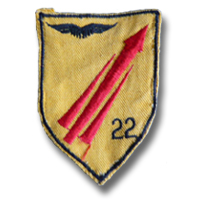 Fla Rak Btl 22 - old version shoulder patch Fla Rak Btl 22 - old version shoulder patch |
|
| 1961 |
| (Source: Email
from Jim Taylor, 52nd Arty Det, 1961-65) |
I was assigned to the 52d Arty Det with units located in Burbach, Waldbrol, and two others further north. The 52d's Bn HQ was in Ludenscheid, designation unknown. I wanted to see if you had any info on them. I do know that the unit in Burbach was eventually taken over by the Germans. That was our original plan. To train the Germans to handle certain missions. The 52d HQ was always at Burbach. I just remember that I had to go up there several time to personnel.
Here is a short synopsis of the unit before I get into the personal activities. The 52d U. S. Army Artillery Detachment was activated in December 1961 at Ft Bliss, Texas; the Commanding Officer was Captain Joe Heflin. The unit received movement orders in March 1962. In June 1962, the unit was assigned to the 552d U.S, Army Artillery Group (USAAG). In March 1963, the unit was re-assigned to the 5th USAAG. The Detachment was transferred to the 557th USAAG in May 1966 and returned to the 5th USAAG in October 1970. The 52d U.S. Artillery Detachment was inactivated with the 5th Group in 1988. |
|
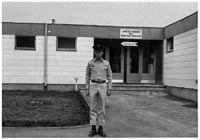 In front
of HQ & Tm A Bldg
In front
of HQ & Tm A Bldg
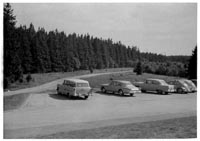 View
from quarters
View
from quarters |
|
I
had an MOS 225.17, Nike Hercules Universal Electronic
Maintenance Technician, and graduated from the Nike school
in December 1961, and joined the unit as it was formed.
We were formed into five units, A Team, B Team, C Team,
D Team, and the Detachment Headquarters. We trained for
six months in the assembly, testing, and firing preparation
of the Nike Hercules Missiles that we would be in charge
of. In June 1962 we all went on leave and reformed at
the pier in New York City, ready for departure to Europe.
Before we left Ft Bliss we were given language books on
Holland. This was nice and everyone studied so that we
could be fluent by the time of our arrival. We set sail
on the USS Buckner in July 62 from New York to Holland.
About half way the Detachment Clerk came around and picked
up our language books and issued us books on Belgium.
We thought that, well ok they are next to each other.
A couple of days later he (the clerk) picked up those
books and gave us nothing. The C.O. informed everyone
that we didn’t really know where we were going. We would
now land in Bremerhaven, Germany and get our orders from
there. When we arrived at Bremerhaven, we waited in barracks
until our orders were finished which took a couple of
days as I recall.
|
|
|
We were to board trains to our next destination. The Commander explained how the German trains worked and how quickly they departed the station. So we broke our unit down into four or five different sections so that when the train pulled in we should be at five different cars. We threw our bags on and just as we got everything on, the train started leaving. As we got to our next destination which I think was Elspe with orders to go to different locations. If looking on the map our new locations would be such as to provide mutual artillery support to each other. We were put onto buses to our new locations. The final destinations would be for the teams to be located at Oedingen, Marienheide, Waldbroel, and Burbach. The break down would be, HQ and A Team would be located at Siegerland Kaserne, Burbach, with B Team located at Nutscheid Kaserne Waldbroel, C Team located at Hermannsberg Kaserne Marienheide, and the D Team located at Sauerland Kaserne Oedingen. The teams for Waldbroel and Marienheide went directly to their locations. The teams for Oedingen and Burbach, and the headquarters team went to Lager Stegskoph, (German basic training camp). The reason that we stayed at the camp was that we had no building to go to.
While we were at Stegskoph all we did was sit around and travel back and forth to the hotel where we had our meals. The travel took about twenty minutes each way and there were several bus trips due to the number of personnel. Stegskoph was about fifteen minutes from Burbach where our A team and Detachment HQ would be located. While we were at Stegskoph we were getting rusty from doing nothing. We asked the C.O. if we could work with the Germans at the missile site. The only missiles that they had were Nike Ajax. That was ok since some of us were trained on both types. I was at the missile site one night sleeping when one of the German lieutenants woke me and said they had a problem and would I mind seeing if I could figure out what was wrong. Coming from the 101st Airborne Division to a laid back artillery unit was quite a shock but to be “asked”, if I could help instead of being told to do so, set me back a little. When I got to the launch trailer the operator was sitting at the console looking at red lights which should have been green. I asked the electronic maintenance tech what he was looking for. He stated that they had a Hercules transponder on the mast (simulating that there was a Nike Hercules missile to be launched), and the console operator kept getting a reject for launch. He and I went to the rear of the console to troubleshoot the system electronically. Everything checked out just fine. He said I have no idea what is wrong. I went to the front of the console to talk with the operator and go over his checklist with him when I noticed that he had his switches positioned for a Nike Ajax instead of the Hercules that he had on the mast. I reached over to the console and moved the acquire switch from Ajax to Hercules and the console went from red to green. It was like a Christmas tree. The German electronic tech had several years of experience and looked at me with dismay. I stayed there until all their tests were complete to provide support, and I couldn’t get back to sleep anyway. That night I couldn’t buy anything. The beer flowed. They were able to pass their requirements and everyone was happy, especially the lieutenant, and me.
Finally our buildings were complete and we could move in. The Oedingen team went to their location and we (A Team and HQ) went to Burbach. The building was a bungalow affair. The HQ was located in one section and the team in the other. Being the oldest (22 years old), of the enlisted they used to call me Uncle Jim, I was also the senior tech. Our Detachment Sergeant was a SFC Vick. It was funny because in German his name means something else. The sign on the front of the building was “The Whitehouse 1600 Pennsylvania Ave”. I remember that one of the guy’s mothers called the real White House looking for her son.
Since we were the first Americans to be in the area since WWII we were quite an attraction and on the weekends the local town’s people would come to see what we looked like and to talk to us. They were curious about our building and what we were doing there. Our orders were to tell anyone who asked that we were a transportation unit. That was odd because we had no trucks. In the fall we started training in earnest and that was to prepare the host unit to prepare them for being able to accept other missiles.
After about six months we prepared for our first ORI, (Operational Readiness Inspection). We passed. Even after the first inspection there were points to refine and better and faster ways to mate the missile and warhead, etc. We worked as a team and after about six months of us getting our selves working as a unit we had the Germans to teach and the first thing was that they had to remove the metal plates from their boots which they didn’t like very much. I still, after 42 years have a German field jacket that I got while working in the missile building.
In early to mid 1964 I was transferred to the team at Waldbroel as senior tech to assist their team. The atmosphere was really different but the people were nice. I stayed there until my departure in May 1965. |
|
|
| |
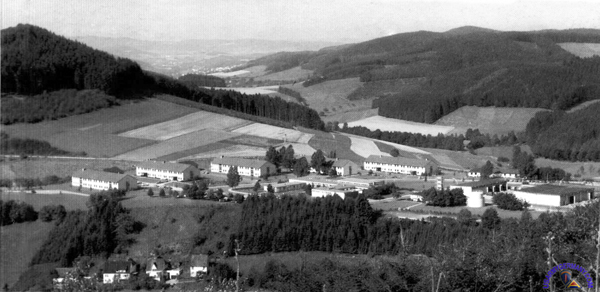
Sauerland Kaserne, home of Delta Team (Charles Everett) |
| |
| 1963 |
| (Source: Email from Charles Everett; translation of a German newspaper article about the 52nd USAAD) |
1963 Anti Aircraft Missile Battalion 22 becomes “Host Nation”
The growing unequality in the strength of conventional forces between Eastern and Western Europe lead to the decision to integrate nuclear weapons into the defensive concept of NATO. Therefore, in the beginning, NATO did not rely that heavily on the conventional use of the Nike missile system in order to deter the East. However, later on the nuclear aspects of the Nike system were used for this purpose. The establishment of the planned Nike missile belt, stretching from the North Sea to the Alps, will have a high deterrent factor in the high to medium air spaces.
The Federal German Government decided in 1954, that no nuclear weapons should be in the possession of the German Federal Army. It is because of this decision, that nuclear weapons would stay in the possession of the Americans. This means, that every Nike Battery, if German, Belgium or Dutch, would have American soldiers detailed to them who have the authority to release such weapons if the situation warrants such.
In May of 1963, the first soldiers of the 52nd United States Army Artillery Detachment (USAAD) arrive at the 22nd Battalion (Fla Rak Btl 22, a German Nike air defense battalion). This unit was activated on January 15, 1961 at Fort Bliss and was placed under the command of the First Guided Missile Brigade. On the 21st of May 1962, the unit departed Fort Bliss with 10 Officers, 1 Warrant Officer and 93 soldiers, in order to carry out their assignment in Germany. At first, this unit came under the command of SASCOM (Special Ammunition Support Command), then under the command of the 514th United States Army Artillery Group, then it was placed under the command of the 552nd United States Army Artillery Group, and with the most recent change on March 07, 1963, the unit was put under command of the 5th United States Army Artillery Group. At this time the unit is tasked with special warhead custodial support for the 22nd Battalion.
To supply the (firing) batteries with special warheads, many construction and security measures had to be initiated. So called Site Security Inspections (SSI) – security inspections of the site – have to be passed. The Inspectors are from the American SASCOM and the German Military Intelligence command. Very strenuous conditions are placed on the American and the German security forces. The supplying of special ammunition takes place till 1967 for the batteries. The 52nd USAAD has to deal with a peculiar command structure. It is positioned on the boundary between North and South, between 2 ATAF and 4 ATAF, between CENTAG and NORTHAG. During the time that the 22nd Battalion was under the command of 2 ATAF, the command structure of the American unit changed constantly. This change of command structure was to change back and forth for 15 years, at times under control of the South, then under the control of the North. In March of 1968 the name of the 52nd USAAD is even changed for a time. In December 1972 the 52nd USAAD once again retains its original name. Since October 1978, the 52nd USAAD has been under the command of the 5th USAAG and the northern command area.
|
|
|
|
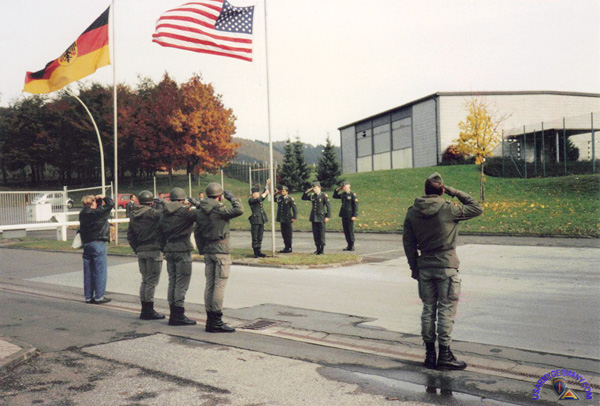
A final lowering of the Stars & Stripes marks the end of D Team, 52nd USAAD
, Oct 1987 |
| |
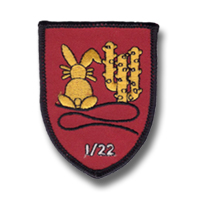 1st Battery, Fla Rak Btl 22 shoulder patch 1st Battery, Fla Rak Btl 22 shoulder patch |
| |
| 1985 |
| (Source: Email from Fred Stoldt) |
Some of my old Army buddies and I happened across your 59th Ordinance Brigade Website some time back and I had bookmarked it for future reading. I finally got around to poking around on your website a little bit and was curious to know if you are still actively updating this website, and if so, what type of things are you looking for?
To introduce myself, I was an MP ( Spec 4 ) assigned to the 51st, the 52nd and the 501st Teams as they were being deactivated. I was there when they were closed.
It's somewhat difficult to recall all the specifics of my time and tenures throughout my assignments in Germany.
I basically had the same ideas as most of my fellow soldiers in boot camp. We wanted to be Police Officers but were too young so we joined the Army to do so. Well, we got a rude awakening on that idea. I believe it was around December 1985 when I completed my AIT as a 95B ( Military Police ).
I took a brief leave back home to my family in Ohio then returned to Alabama to be sent overseas to Germany. It seems that the Army was beginning the transitioning of replacing the U.S. Custodial Teams Security, Infantry Men, with Military Police M.O.S.'s. and I was to be one of them.
My first assignment was the 501st (USAAD) in Westerburg which was also shared with a German Panzer Division. After several months, maybe close to a year, I was eventually re-assigned to Killianstadten HQ while the team was dismantled and the 501st then completely closed down.
I was then re-assigned to Syke, the 51st (USAAD), where I once again spent several months and took part in the final dismantling of the 51st.
Being known for my creativity and awesome cooking ( one of my nicknames was Freddy Crocker ) I was asked to make a cake for our closing celebration to share with our host nation friends. Pitfalls to the closing of our teams and the re-assignment of personnel often left us fending for ourselves for meals so we managed to utilize the kitchen as best we could. I don't think I did too terribly bad for a cop. :-)
My last assignment was to the 52nd (USAAD) in Oedingen, ( although I did spend about 2 months in Burbach before getting sent back State Side for my separation/discharge ) and probably home to my most favorable of memories during my assignment in Germany. I still keep in touch with a couple of my brother soldiers from this Team and took part in the Honor Guard for the last lowering of our Nations Flag. I even managed to retain a copy of the German Newspaper article depicting this event which I will be sending to you along with a few other photo's that you may find of interest to include the German Newspaper article of the closing of the 501st and a scanned image of the 1st battery/ 22nd Fla Rak patch that co-hosted with the 51st USAAD Team D in Oedingen.
Shoulder patch of 1st battery / 22nd Fla Rak (see above) -- The story behind this patch was to be that, during a test fire exercise with a non lethal Nike Herc. After the firing of the missile, the team went to the site of the impact and found a cactus knocked over and a dead rabbit with a broken ear. Thus the reason for the two images on the patch and the bent ear on the rabbit. |
|
|
|
|
|
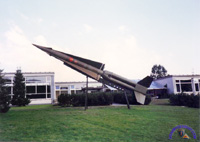
1. Sauerland Kaserne |
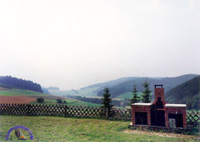
2. Oedingen site |
|
|
|
| |
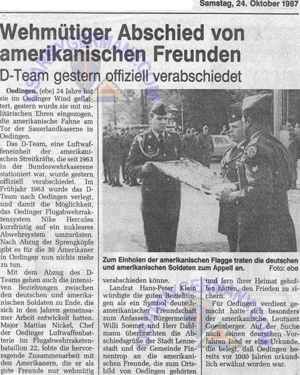 Inactivation of D Team, Oedingen
 |
|
Article in the local German newspaper in October 1987 reporting on the farewell ceremony held at Oedingen on the occasion of the inactivation of D Team.
Pictured left to right are, Specialist's Livingston, Stoldt ( myself ) and Cunningham. |
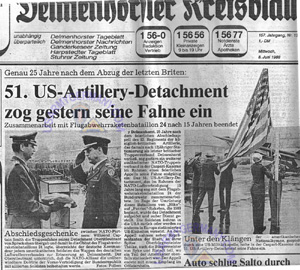 Inactivation of the 51st USAAD
 |
|
Article in the Delmenhorster Kreisblatt newspaper in June 1988 reporting on the inactivation of the 51st USAAD which had been stationed in Delmenhorst in support of the German AF Fla Rak Btl 24 since 1973. |
|
| |
|
|
| 66th
Artillery Detachment/USAAD |
|
The 66th U.S. Army Artillery Detachment was organized and activated in October 1962 as part of the U.S. Forward Support Group, U.S. Army Southern European Task Force in Vicenza, Italy.
In December 1962, the 66th Detachment was reassigned to the Special Ammunition Support Command and it was further assigned to the 552nd U.S. Army Artillery Group.
In March 1963, the unit was transferred to the 5th U.S. Army Artillery Group.
The unit was inactivated with the group in 1988. |
|
|
| |
| 1962 |
| (Source: Email from Bob Hetzel, 34th Arty Det & 66th Arty Det, Italy and Germany) |
RE: 66th USA Artillery Detachment (Four Nike-Hercules Warhead Custodial Teams and HQ Detachment)
I was an original founding member of the U.S. Army's 66th USA Artillery Detachment. In October 1962, I was a member of the 34th USA Artillery Detachment stationed in Vicenza, Italy. Volunteers were sought to form a new Detachment (the 66th) for deployment to Germany, from both the 34th and 35th Detachments at Caserne Ederle in Vicenza.
The newly formed 66th travelled by train from Vicenza to Soest, Germany in December of 1962. We were met by members of the German Air Force's 21st Fla Rak Bat (whom we were there to support) and were driven by truck to the small farming villlage Büecke, nestled in the hills above Soest. The population of the village, when we arrived, was approx. 125 people.
We were to occupy a newly constructed one-building Kaserne of our own locatedon the edge of the village overlooking a Belgian tank training area, about 4 km from the Luftwaffe's Nike-Hercules missle launch site. The 66th was comprised of four teams:
 Team A & HQ personnel was stationed at Soest/Bücke. Team A & HQ personnel was stationed at Soest/Bücke.
Team B at Unna
Team C at Datteln
Team D at Westkirchen
I served out the rest of my enlistment at Bücke and was discharged in September of 1964.
I have some photos and copies of old orders from those times as well as a Thanksgiving menu that bears the names of theTeam A/HQ personnel. |
|
| |
| ADDITIONAL INFORMATION: |
34th Arty Det, ITALY
Q: Can you give me some details on your assignment in Italy with the 34th Arty Det?
A: When I arrived in Vicenza, Italy in May of 1962, the 34th USA Artillery Detachment was fully formed but not operational. The Italian Air Force unit (don't remember the unit designation) had not yet received the NIKE Hercules missiles, although the NIKE site was prepared to do so. I believe they were operational with Ajax missles at the time.
We spent hours and hours daily in manuals training, preparing to perform our duties if and when the Hercules missles arrived. We did have the occasion to deploy to the Italian Nike site one time, for mutual training, for a few days. Although not much training occured, it was a helpful "get to know each other" event.
ANECDOTE: When we first arrived at the site, we all met in the mess hall dining room. Our rather stern Mess Sgt (Master Sgt) had the opportunity to inspect the kitchen he would be using to feed us all....and he blew his cork!! It seems the Italians had a habit of cutting vegetables and meat on the work tables and scraping the table scraps onto the floor, where they were left for days on end. The situation turned into an immediate scene of all "asses and elbows" with our rather irate Mess Sgt barking orders to the Italians and Americans alike to clean this filthy place up NOW!!
At our first lunch meal, the Italian airmen were served wine, as was their custom, and I had milk to drink, as was MY custom. I remember the Italian airman sitting next to me staring at my milk....it seems cold milk was a rarity for them back then.....and, communicating with hand signals, offered to trade me; my milk for his wine. I did take him up on his offer!
The NIKE Hercules missiles did not arrive before the Army formed the 66th and I left for Germany.
Q: Were your responsibilities at the 34th the same as subsequently at the 66th?
A: The duties were identical, identified as "warhead custodial" duties. My MOS was 177.0.
66th Arty Det, GERMANY
Q: Did the 21st FlaRakBtl have Nike Ajax initially (before you guys arrived) or did they go directly to the Hercules?
A: When we arrived, the 21st FlaRakBtl folks already had the Hercules missiles, with conventional warheads, and they were operational. I do not know if they previously had Ajax missles.
Q: What did the US soldiers at an LA site do day-to-day?
A: We spent our days in our one building 4 miles from the launch area.....going through the same, by now "old," training.....over and over again.....and again. The only time we spent at the launch area was for occasional warhead destruction training or to stand guard duty at the entrance to the inner warhead building area, which we did on a 24 hour a day, 7 days a week schedule all the time we were there, although the building was always completely empty (unless the Germans were working on a conventional warhead).
I always thought we were putting up a front. There were often Russian military mission vehicles driving by to check things out and our presence might have led them to believe we were already fully operational and, indeed, had "special" warheads in our custody.
Q: Were there any US soldiers at the IFC site?
A: No, our "warhead custodial duties" were all to be carried out at the launch area. We did have a warrant officer who would help provide Hercules tech support to the Germans at both the radar and launch sites.
Q: I am sure you guys did a LOT of training. Were there dummy warheads used for that?
A: You are soooooooooooo right! We were trained to death.....every day.....the same training.....over and over again. We did have a dummy warhead to train with and live and dummy destruction equipment....detonation "det" cord and shaped charges. Warhead destruction was a big part of our training.
I do remember our commanding officer in Büecke was one Capt. Singletary.....later promoted to Major. We were a sort of "showplace" unit I guess, as we often had very high-ranking visitors from USAEUR headquarters....even Navy Admirals and Air Force Generals now and then.
|
|
| |
Interesting story:
During my time in Büecke, I learned to speak very fluent German without the usual GI accent. I still retain most of that ability today. This allowed me to make some very good friends and aquaintances among the villagers of Büecke. There was an older, rather gregarious and friendly man, in his 60s at the time, named Anton Haas who operated a "Gasthaus" down in the woods next to the Belgian tank training area. The place was almost exclusively visited by Belgians and avoided by the village residents. He was always willing to buy one a beer at the more popular Trompeter's Gasthaus and I was aquainted with him. On a rare occasion, I (sometimes we) would pay him a visit at his place and I did notice a younger (in her mid 30s), not very attractive female, Slavic in appearance, on more than one occasion. As our visits were usually unannounced, she would be in the gasthaus when we arrived but would always immediately disappear without greeting us. Asking around in the village, I was told she not German....maybe Polish.... and was Anton's live-in girlfriend.
Shortly before I left, Anton purchased a piece of property directly across the road from our HQ building and began the construction of another gasthaus. Everyone in the village was talking and wondering where Anton, a man of lesser means, had come by the money to do so. The gasthaus was not yet completed when I left.
About 30 years later, while corresponding with another former member of the 66th, I learned that, not long after I left, Anton Hass was arrested, tried and convicted of spying for the Soviet Union along with his "girlfriend"....a Russian national. It seems the Russians had been bankrolling Anton for years, to get info on the Belgian and Canadian (and now the American) operations in the area, and the mysterious woman was not his girlfriend at all but his "handler".
|
|
|
| |
| 1967 |
| (Source: Email from Benjamin Carlos, Tm B, 66th USAAD, 1967-68) |
I can't add to your historical information about 5th Group, SASCOM or USAREUR, but I was stationed at Team B, 66th US Army ADA Det in Holzwickede (Unna), Nordrhein-Westfalen in 1967-69.
I was drafted while carrying less than the 12 credit-hours required for student deferment in college, and after basic training at Ft. Ord was sent to Ft. Bliss for training as a 16B. I was chosen distinguished grad after the original winner (photographic memory) got into trouble for disobedience or something like that. My reward was to be allowed to become a troop pusher with the training brigade at Bliss. After a few months of this, I volunteered anywhere just to get away from 18 hour days in the desert baby-sitting guys just like me.
I landed in Germany, and the replacement battalion folks in Frankfurt decided that my German was good enough to be assigned to a remote area, hence the assignment to 5th Group's 66th Det. I ended up at Team B, and spent a month as a custodial agent -- with no chance to play with the launcher, etc, except for emergency destruct practice. My Det Sergeant, SFC Minor, found out I could type, so he fired Sp4 Larry Warnock from Ohio and put me in as the team clerk. I spent my time answering phones, scheduling PX and medical runs (with the Germans' vehicles) to Giessen, and phonying up training schedules. I also got to train on deciphering procedures, and I kept everyone's security clearance records.
When the next inspection was about to begin, the team commander found out that I was not cleared because I had been born outside the U.S.! Panic ensued, and the powers-that-be decided to hide me, first at Soest, Det HQ; but then deemed that not hidden enough, so they sent me to Buren and 5th GP H. I spent a few weeks helping the 1SG clean the dayroom, then he sent me to help the personnel folks, and finally they gave me permission to go to Italy on leave "until we call for you."
A month later, they decided to call me back from my stay at Ligure, near Genoa in Italy. I returned to my job as team clerk in Holzwickede. I got very bored with the routine, especially all the rigamarole with special weapons, and even though I had a local girlfriend, I 1049'd (US Army Reassignment Request Form) to Vietnam.
I spent a year at MACV hq in Saigon, then returned to Germany to marry my girlfriend prior to going off to Officer Candidate School at Ft Sill, Oklahoma. Upon commissioning, guess what my assignment was? Yep, special weapons duty in Germany -- Sergeant missiles, then Lance missiles in Crailsheim, half way between Stuttgart and Nurnberg.
28 year later, I retired (Colonel of Artillery) and became a poli sci professor at a university in Spain, but that's another story.
Thanks for allowing me to enjoy your work on the ADA and Ordnance units, and especially for giving me the chance to stroll down memory lane. I believe that most Americans do not understand the sacrifices offered in their defense. Draftees and lifers, the people I worked with had to sacrifice in order to perform their duty, many times in direct opposition to the "system" and ingrained bureaucracy. Somehow the mission was always accomplished satisfactorily, and I for one am in awe of the inventiveness and perseverance of the average G.I. Joe. Thanks, guys. You're in my memories and in my heart forever |
|
|
|
| 1968 |
| (Source: Email from Alexander Varga) |
I happened to look up the 66th Artillery Detachment (where I served) tonight and see it was disbanded in 1988. I served with the 66th (Soest, Germany) from February 1968 to February 1971.
I was sent to the 66th in early 1968 after having served at a NIKE Hercules Fire Battery located outside of Travis AFB, Fairfield, CA. I was initially a Spec 4 E4 when shipped to A Team, 66th located on the outskirts of Soest, but was promoted to Spec 5 E5 some 9 months later. Both HQ and A Team were housed together at the time. The total number of US Army personnel at this facility was no more than 35 soldiers in total. Our primary duties at the time were custodial in terms of Nuke warheads to go onto the Nike Herc missiles that belong to the German Luftwaffe. I
mmediately next to the housing/HQ office facility were the remains of an old WWII German Army basic training facility that we used during winter training exercises. This training was to simulate destruction of our regular HQ/troop housing in the event war broke out with Russia.
Officers and soldiers above the rank of E5 were offered housing in a Germany Military Housing area located approximately 2 miles from the Unit HQ. These quarters were what the German government provided German Officers to live in with their families.
Soest was considered within what we called, “The NATO Sector.” That meant we were within close proximity, were three Canadian Forts and one Belgium Unit’s housing. We therefore had regular contact with both NATO nation’s soldiers. The Canadians has a large contingency of soldiers made up of Infantry, Mechanized Infantry (Armored Units) and had a Commissary where we’d go to stock up on food for those who lived “off base.” The Canadian Fort also had a Movie Theater, Medical Services (both medical and dental) which they provided to the US personnel in the area. In fact, we had regular interplay with the Canadians who’d we see in the area as well at the German Guesthouses in the area. And boy could those Canadians drink beer. But back in those days, a large glass of beer cost the equivalent of $.50 (US) so you could get a cheap buzz compared to todays prices of beer here in the US. As an aside, we did have a very small Supply Room/Office that had a small amount of supplies that most on- base personnel used primarily to buy cigarettes, personal hygiene, close washing goods, chips, etc, etc.
As for the Belgiums, who were strictly Infantry personnel, they didn’t have much to offer other than friendship. In fact, their soldiers were mostly drafted, some enlisted but served 17 month stints. They’d come by our Unit mostly to buy Cigarettes as they were only given two packs a week by the Belgium government. But something UNIQUE they were supplied, were “Puffenstrasse” cards which gave them access and free services to “Ladies of the Night” which they would barter away to some US personnel in exchange for cigarettes. So on that regard, the Belgiums did provide “support” for “the needs” of some US troop personnel.
I’d have to say the greatest joy and benefit that happened to my wife (who flew over and joined me for the rest of my German tour once I made E5) was the birth of our two children, both born at Wiesbaden Air Force Hospital where our major medical needs were served. The other aspects of my military tour of Germany was our travels around Germany and neighboring countries (when we could afford it), plus we walked on the streets of Auerbach, Oberpfalz (Southeast Bavaria), where I was born in 1947 to Hungarian parents who fled Hungary when the Russians invaded Hungary (again) while claiming to help America defeat Adolf Hitler’s German Army. And we all know how well teaming up with the Russians worked out.
But all in all. it was both an adventure and my honor to have served in the 66th US Army Artillery Detachment. One great outfit manned with wonderful and great US Soldiers, the majority who served their country with honor and distinction. I also consider it was a privilege to have served in the 66th and set me on a path of success and fulfillment in many years to come and even now in retirement. You might say, the 66th changed me from someone with few goals in life to finding out who I was and where I wanted to go. Now some 40+ years later, I’ve realized those goals, in part, thanks to the personnel at the 66th US Army Artillery Detachment, Soest, Germany.
ADDITIONAL INFORMATION
As I recall, the 66th HQ building was located on the south side of Soest with the "main road" leading into the main part of town (to the west), in front of our building some 100 yds or so. And then to the south side of our HQ building was a dirt road that you'd drive down (eastward) to get to the old German basic training bldgs from WWII. You could stand behind the HQ building and look down upon the old relics in the small valley below our unit.
As I recall also, the German Kaserne and launchers were located between the main part of town (Soest) and our Unit because the German transport trucks would always come to our location from the north and then head back north when leaving our building. This was the same road the married guys with families in the Unit would drive to get to the Housing Area where we lived.
Post whatever you like that I wrote or write. Who knows, maybe some of the guys I served with will chime in with their recollections of our time in Soest.
By the way, I did forget to mention that the Belgiums did provide us air support in the form of a helicopter (a French Alhouette) that your's truly would get to fly in occasionally when transporting money/pay in from 5th Grp on paydays. That's how we got our money (greenbacks) on payday.
And that Belgium pilot was a character who'd been grounded from flying fighter jets because of jet jockeying and his commanders knew nothing a Fighter Jet Pilot hated more than having to fly a helicopter. So you can imagine some of the unbelievable stunts this pilot would show me while enroute 5th Grp. Never knew a helicopter could do such things as this pilot pulled. |
|
|
| 1973 |
| (Source: Email from Richard Leslie) |
| In your history of 5th Group you mention that Team D of the 66th USAAD was located in Warendorf. The team was located in Westkirchen. I was its Team Commander in 1973. |
|
|
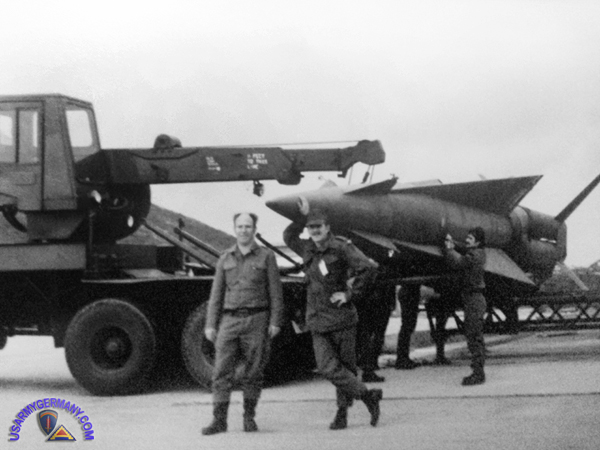
Edmondson (middle, with hand on NIKE) with Belgian NIKE personnel (Bruce Edmondson)
|
| |
| 1976 |
| (Source: Email from Bruce Edmondson) |
| I served at 1st and HQ Batteries of the 66th USAAG from mid 1976 thru late 1979.
I have been reminiscing of late (old age I suppose) and was quite happy about finding your site. Should have done so years ago. Our life and times spent in Soest and the 66th were probable the best times of my years in the service. Not only have we maintained contact with some of the guys and families we served with but also with a family we met at the first apartment we rented. It was, by the way, a small place over the horse barn in Bad Sassendorf. I had the pleasure of traveling to Dusseldorf in 2011 and was able to travel to Soest and visit for a day with Stewart and Brigetta. They still reside in the house/pub next door to the apartment. Everything looks the same!!
I enlisted in 1974 and after basic graduation as an E-3 was sent to Ft Bliss Texas for AIT 16R Vulcan crewman. After which, I was stationed there for about 15 months. I excelled and was promoted to Spec 4 and allowed (sent) to cross train as a Nike Hercules crewman. Just before completion I received orders to Germany as a 16R. From what I had heard I wasn't looking forward to that. So speaking with one of the traning staff it was suggested I should wright to Frankfurt and tell them I was coming and suggest since I had just completed training that the Army might be better served sending me to a NATO site as a Nike crewman. I was shocked it worked so well. Spent 3 days in Frankfurt while orders were issued for the 66th USAAD outside Soest. So that is how I arrived there.
I served in A Battery about a year and was promoted to Sergeant. Shortly A Btry 1st Lt Mike J Connally was promoted to Cpt and made CO of HQ. I campaigned for HQ clerk and began working for the Cpt soon thereafter. Eventually ask for and got an extension for 6 months and by the time that was complete most of the "crew" including the Captain and his wife Marty, Randy and Gail, Freddy and Cindy, Kirk and Suzy, Tim and Sandy and a host of others I can't remember at the moment, had rotated out. Well when I arrived I was an E-4 so we were not offered "military housing" as it were. As I mentioned we rented a couple different places with landlords that were older and quite friendly. After promotion to Sergeant I was eligible for housing. This was basically a half block of houses in town. Keep in mind that we all worked at the same location and knew everyone so it was both cozy and supportative.
Cars were not hard to come by so transportation was not really a problem. Once a month the Germans provided a tour style bus and all the wives and troops not working were taken to Frankfurt to shop at the US base there. I was responsible for both the downstairs bar and the on-site PX so I was able to travel to Frankfurt each month and help my wife with the shopping. At other times she shopped either at the Belgium Army base or at local kiosk's with the Germans. Generally speaking both my wife and I really enjoyed the time we spent at the 66th. I'm attaching a photo of myself with the ober sergeant of the host missile crew. I have been looking and can't seem to find many pictures at the moment. I'm not sure if this gives you any insight to how things were but that is the overall story and I have a lot of short stories that are more about life and times in general.
Eventually all good things come to an end and I was reassigned to the 2nd Armored Division Ft Hood Texas for about 18 months. But that is another story!!! (You know, long story short and all. Usually too late as this is.) |
|
|
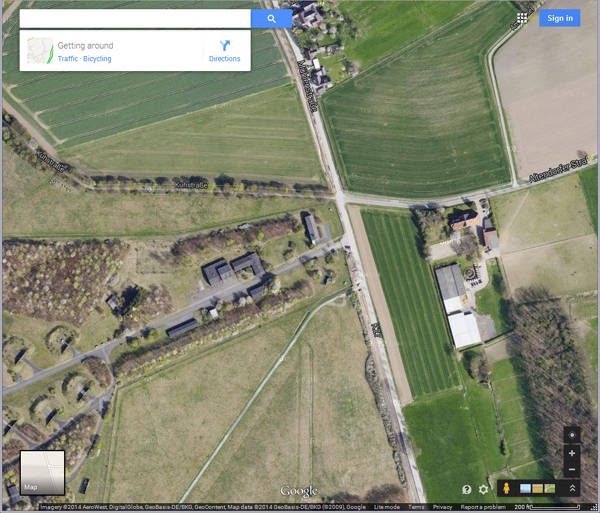
Former LA Area of 3rd Btry, 21st GE FlaRakBtl (Air Defense Missile Battalion) (GOOGLE)
(The 26th German NIKE battalion was supported by the 66th USAAD. After the 26th was
inactivated,
the Holzwickede site was converted to an IRP site for a German Patriot Battalion.)
|
| |
| 1977 |
| (Source: Email from Bill Burrell) |
| I served with B Tm, 66th USAAD in Holzwickede from August 1977 until August 1980. We were not located on our host unit's kaserne. The team was approximately 50 feet from the front gate of the missile site located at the Altendorfer Straße - Mühlenstraße intersection south of a small village called Opherdicke. I was my understanding that the village was part of Holzwickede.
When I arrived, I was a newly promoted Infantry sergeant. I was assigned as the security section's assistant NCOIC. This meant, I had to learn the responsiblities and duties of the NCOIC as well as pull duty as a sergeant of the guard. This was due the team always being short of security personnel. The full compliment should have been a NCOIC, an Asst. NCOIC, Sergeant of the Guard (SOG) x4, and Sentries x8 for a total of 14 personnal. For most of my time, the security section had only 10 personnel assigned. The usual work rotation for the grunts in the security section went as follows: Day 1:
6 AM -- Reveille formation for physical training followed by personal hygiene, barracks clean up, and breakfast.
9 AM -- Work/training formation - If you were not guarding an open bunker or the maintenance shed, you were training.
5 PM -- Retreat formation. Day 2:
6 AM -- Reveille formation followed by breakfast and prep for guard mount
7:30 AM -- Guard mount conducted to be immediately followed by the on coming guard team walking down range to relieve the previous day's guard team. Most of your time on guard duty consisted of controlling the entrance into the restricted area and guarding open bunkers for dailies and weekly exercising of the missiles, maintenance, and conducting training. Since we did not receive AFN radio. During the day, we were allowed to listen to the British Forces Broadcasting Services radio. At night, we listened to the English programs of Radio Luxembourg until they switched to another language. Day 3:
7:40-ish AM -- The new guard team arrived, and the inventory of the LAW's, 5.56mm ammo, keys, crypto code books, etc. was conducted.
8:45 - 9:00 AM -- Guard team from the prior day departed for up range.
9:00 AM -- Guard team members clean their rifles and place the weapons in the arms room.
9:15 AM -- Sentries are released. SOG begins to conduct paperwork check with the NCOIC of the security team.
10:00 AM [or whenever the paperwork check was completed] -- SOG is released. [sweet sleep] If you were the guard team coming off duty on Friday morning, you had the entire weekend off. The guard team going on duty on Sunday morning had Saturday off. The Saturday guard team didn't really receive a day off. It continued with the cycle. This meant you had one full weekend off every third weekend. The cycle was continuously repeated. Unless someone went on leave. Only one sentry and/or SOG were allowed to be on leave at any given time. Most people took their leave in 30 day blocks. Meaning, the two remaining SOG's did back to back guard duty for 30 days straight. It wasn't quiet as bad for the sentries, but it did increase their amount of guard duty, too.
Despite the tediousness and boredom for everyone assigned to Bravo Team, the men took great pride in knowing their duties and responsibilities. For any inspection, the goal was always to receive a report of "no comments and no deficiencies" from the inspection team. On a couple of inspections, we received a report with one comment. You would have thought everyone had received word that their mother had died. We were utterly dejected. After receiving the second report of one comment, the chief inspector wanted to know what was wrong with us with our hang-dog expressions. He told us that most teams would be happy and patting each other on the back for such a successful inspection. Not us, we had failed to achieve perfection. Several things happened that were beyond the normal day-to-day routine during my time with Bravo Team. 1. Our payroll officer and guard were shot at while driving to the finance office in Münster to pick up the payroll. The lieutenant's wind shield was hit. Neither the lieutenant nor the guard were injured. The local police investigated, but nobody was apprehended. 2. The team's payroll safe was robbed. The robbery took place at night. Evidently, someone had been able to see the payroll officer dial the safe's combination since the safe was not forced open. The safe had been kept in the office used by the team's officers. The door to the office was never locked, and everyone had access to the room. An investigation insued. The findings were inconclusive. No one was accused of the robbery, and no one was blamed for the way the safe was maintained [to the best of my knowledge]. All security protocols in place at the time had been followed. Needless to say, the security protocols for the payroll safes at the teams and detachments were revamped.
3. One evening, an encrypted message was received by the SOG. After decoding the message, the Staff Duty Officer (SDO) was called. The SDO verified the message's content after he arrived. The two-man safe with the launch authorization cards was opened as had been done many times before. This time, things were different. The SDO and SOG did not open a training card. The encrypted message called for them to open an actual launch authorization card. The card was opened. The authorization code on the card did not match the authorization code within the message. Several calls were made to have the message retransmitted. The codes still failed to match. The Team Commander and Staff Duty NCO were called. After a summary investigation by the Team Commander and SDNCO, the SDO and SOG were relieved of their duties and sent up range to the team building. An incedent report was sent up the chain of command. Word came back down the line. The SDO and SOG were read their rights and a formal investigation began. In the end, the SDO and SOG were found to have correctly followed procedures and were without fault due to circumstances beyond their control and/or knowledge. My time at the Bravo Team was not what I would call my favorite assignment. What kept you from going nuts were the people sharing this "adventure" with you. Some of the ones who I can still recall by name were: 1LT Coppell, 1LT Dietz, 1LT Mears, and 1LT Ray
MSG Snook
SFC Smith and SFC Flick
SSG Driscoll, SSG Gardner, and SSG Yasagar (SP?)
SGT Stribling
SP4 Garcia, SP4 Jackson, SP4 Jones, SP4 Miller, SP4 Stokes, SP4 Lynus Williams, and SP4 Perry Williams
First Names Only: (SSG) Dale, (SGT) Denny, and (SP4) Hector.
Nicknames: (SP4) Country and (SP4) Cowboy As I write this, it has been over 33 years since I walked through the doors of the team building on my way to Frankfurt and back to the USA. My appologies if I have misspelled your name, stuck you with the wrong rank, or can't remember your name though I can still see many of you in my mind's eye. |
|
|
|
| 357th
Artillery Detachment |
|
 721e Groupe d'Artillerie Guidée crest 721e Groupe d'Artillerie Guidée crest |
 Mr. Gaston Dessornes, a former French Army air defense artilleryman who served with a French NIKE unit in the late 1950s, has written a history of the French units that operated the NIKE-HERC and HAWK missiles as part of the Integrated Air Defense System in southern Germany. This project is still ongoing and Gaston expects to make additions and changes in the near furtue based on input from other former members of the French units. Gaston would also appreciate any information that others might have on this topic, including US Army and Air Force personnel who worked side by side with the French units in the defense of Europe. If interested in helping, please contact the webmaster. Mr. Gaston Dessornes, a former French Army air defense artilleryman who served with a French NIKE unit in the late 1950s, has written a history of the French units that operated the NIKE-HERC and HAWK missiles as part of the Integrated Air Defense System in southern Germany. This project is still ongoing and Gaston expects to make additions and changes in the near furtue based on input from other former members of the French units. Gaston would also appreciate any information that others might have on this topic, including US Army and Air Force personnel who worked side by side with the French units in the defense of Europe. If interested in helping, please contact the webmaster.
NOTE: The manuscript is a Adobe Acrobat (PDF) file. Adobe Acrobat reader required).
1. French Army Air Defense Missiles - Nike & Hawk, (Warning: 8 MB) A Unit History. |
|
|
ATTENTION READERS!!
I must remind all readers that the manuscripts provided by the above authors or any other contributors on this web site (www.usarmygermany.com) are protected by copyright which prohibits the reproduction, reuse or resale of all or part of these documents. |
|
|
|
| 1958 |
| (Source: Email from Gaston J. Dessornes, French Army) |
I am a former French Army NCO, Nike trained in Fort Bliss in 1958. We formed the 721st GAG (Groupe d'Artillerie Guidée) . It comprised three French Army NIKE batteries and one French Air Force NIKE squadron. The unit's first Commander was Colonel Raspaud.
This "funny" mix was probably due to some squablings between Army and Air Force brass as to who was to do what . . . similar to what wnet on between the US Army and Air Force regarding the DEW Line and the discussions between the Bomarc and the Nike!
When the French Air Defense establishment found that their localy brewed missile (Parca) would not do, they turned to the US HAWK.
They looked for the best trained personel available and found them with the NIKE units. Giving the French Air Force the whole (NIKE) cake, the 1st, 2d and 3rd Batteries went back to El Paso to create the 401st, 402nd and 403rd French AA Hawk regiments. They later took position in Bavaria until about 1967 when they returned home, etc...
ADDITIONAL INFORMATION
The Early Days of NIKE Deployment (721st GAG)
The 721st GAG was the name of the French NIKE unit. The Hawk units (401,402, 403 ) came after the French Army completely abandoned the NIKE to the French Air Force. They were no direct links between Nike and Hawk, except at operational army level through mission assignment, etc...
|
|
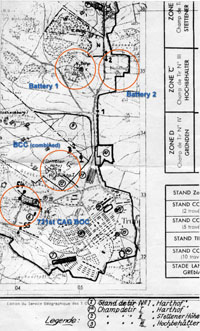 Camp Stetten (East)
 |
|
The 721st HQ was in Stetten, Germany where the 1st (possibly at Waldhof) and 2nd (possibly at Ochsenkopf) batteries were also located. A third battery was located at Muensingen and a fourth at Mengen. A small road going to Ebingen separated the 1st and 2nd batareis. All sites were fenced in. Note that we never used those names and this is the first time I see them. Also, that road to Ebingen was a very very dangerous road in the winter... The weather was not "nice" in addition to the cold we also experienced very strong lightening strikes. The tall masts seen on some pictures by the radar vans are sometime confused with the MTR's collimations masts.
Stettener Hoehe was the site for both 1st and 2nd Battery Command center and its PARs, TTRs, MTRs. The French Army had bulldozed the area to elevate the PARs by about 2 to 3 meters and carved out accesses and positions for the other radars. In the two "depression" that resulted, we installed the control vans and generators (mounted on small rails for ease of maintenance !!) The collimation masts were located between NUMBER 11 and 12 near by the end of the dark marker on the map.
|
|
|
The BOC and its radars was situated between NUMBERS 5 and 6, on the top of the small hill there, probably where there is a BLACK mark above "6" . I have send this map to a gentleman who was then an Air Force Sergeant working on the AN/TPS at the BOC for his comments. ( The response back from that gentleman inidcate that the radar equipment located at the BOC included -- AN/TPS-1D, MPS-11 (azimuth) & MPS-14 (elevation) .
The unit structure was typical of the French Army Air Defense regiment organization. The mission assignments went through the BOC and its radars (also in Stetten) that in turn was subordinated to the Air Operation at Drachenbronn (France) and the through the NADGE network etc..
3rd echelon logistics and signal were in Stetten and mostly manned by French Air Force personnel (but I must check this out!).
All four units were equipped with Ajax AND Hercules; none were nuclear capable.
Indeed the 520th (was it already named 520e GBA ?) took over the whole operation and stepped into the Army shoes. A number of Army personnel remained for about a year and/or until the next firing practice in 1963 at McGregor to help with the transition.
An interesting historical note: 2d Battery, 721st GAG was on high readiness status and my PAR was the last friendly military radar following President John F. Kennedy during his flight to Vienna to meet with Khrushchev. The sky was clear of air activity, and we had orders to shot at any aircraft approaching Air Force One. The IFF return was giving the largest bananas I ever seen on any scope since ! All missiles were UP and the control van was full of brass standing behind us. Outside, in the cold night, other lesser military creatures were freezing until JFK disappeared from the scopes...
|
|
721st GAG
Stetten, Germany |
|
|
|
|
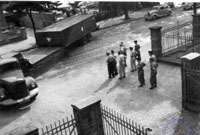
1. (KB) |
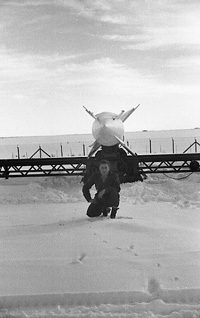
2. Nike site at Camp Stetten |
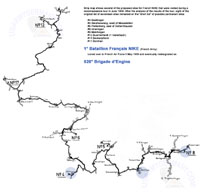 3. Some of the original proposed French NIKE sites 3. Some of the original proposed French NIKE sites |
|
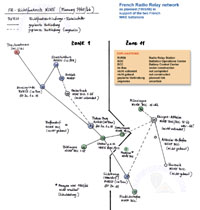
4. Radio Relay in support of French NIKE units |
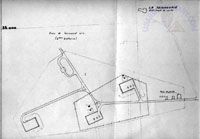
5. Launcher site - Ochsenkopf
|
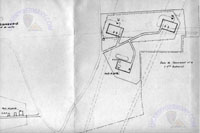
6. Launcher site - Waldhof
|
|
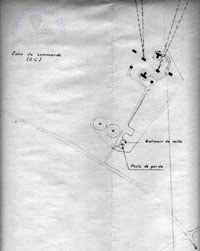
7. BCC site for Btry 1 and 2 - Stettener Höhe (168 KB) |
|
|
|
|
|
Formation of French HAWK battalions
(Webmaster: HAWK information will be moved to a separate NATO HAWK Page in the near future)
The 401st RAA was assigned to the Air Defense School in Nimes (France). One battery was dedicated to training.
The 402nd RAA, after receiving the equipment in Kehl (the final manufacturing assembly was in Germany) and qualifying on the HAWK system, moved to the Munich area with HQ in Dachau, Germany.
The 403rd RAA moved to Landau, Germany. The 403 never left Landau and was under French control at the highest level (Army /Division?)
The 402nd was fully deployed and fully operational. I do not remember the dates of the 1st ORIs, all were very successful.
As for the 402nd, three batteries (1st, 3nd and 4th) were "on the barrier" while the 2d (stationed at the infamous Dachau camp, a few hundred feet from the "ovens") was at the ready to "move" and / or take over other pre-selected positions as needed. Logistics and part supply for all European Hawk was in Kappelen, Luxemburg.
When the French Army in Germany was removed from direct NATO command and the US forces left France (I will not comment on that one...), the French Air Force gave back the "electronics" to the US, sold the acquired missiles to other allies and destroyed those not sold -- probably the non nuke one?
The French Air Force also destroyed the BOC and BTE (AN/TSQ 18, etc..) while the French Army was buying the very same for its Hawk. In fact, spare parts lots were "saved" form the dump after two old friends, one Air Force and one Army, happened to meet a private party!!!
Most of the Air Force personnel ended up at the French nuclear missiles silos (part of the triad submarine-Mirage bomber- missile) in the Provence area.
The 402 Hawk was relocated yo Laon and made good use of a former US Air Force base at Couvron. The 403rd did the same but at Chaumont.
In 1997, after a NEW realignment where the Air Defense school was reattached to the "regular" Artillery command and school in Draguignan near the 1944 US landing beaches in South France (was it a model for the present plan to close Fort Bliss and move to Fort Sill?) and with the aging Hawk, the 401st was deactivated, the 403rd and 402nd merged to form a NEW 402nd.
All the while the Hawk was constantly improved and modified along with the US doctrine of the day...
Slowly dying of old age (yet still of value) the 402nd is waiting for its new ASTER system that is a cousin (or so it seems) of the Patriot PAC 3.
Another historical note: on Sept 7 1987, the 402nd shot down a Tupolev 22 (bomber) from the Libyan AirForce that was attacking the capital of Chad. I was in Chalon en Champagne this very last Sept 7th to commemorate the anniversary of the event.
|
|
|
|
|
|
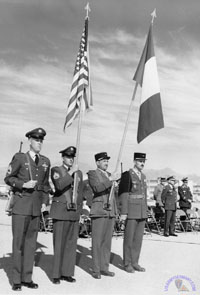
1. (KB) |
2. USA General DALY; USA Col STACY; French Army Lt Col HAUPRICH (1st commander of the 401 RA); behind him is an unidentified French W/O interpreter |
3. (KB) |
|
4. (KB) |
|
|
|
5. Phase 1, Deployment of 402nd RAA (KB) |
6. Phase 2, Deployment of 403rd RAA (KB) |
|
|
|
|
|
| (Source: Email from Rick Anders, Germany) |
With regards to the 721e G.A.G. (see Gaston Dessornes' email above), it was formed in Karlsruhe in Feb 1959 from C.I. (Compagnie d'Instruction?), 485e G.A.A., and deployed to Stetten am Kalten Markt ("Staten") and Muensingen in July 1959, where it was equipped with NIKE AJAX and HERCULES.
The HQ (Etat-Major) was at Stetten (disbanded in Dec 1960), the Batterie de Commandement et des Services at Stetten (also disbanded in Dec 1960), 1e Batterie at Stetten (became Escadron d'Engines 4/520 in July 1962), 2e Batterie at Stetten (became E.E. 2/520 in July 1961), and 3e Batterie at Muensingen (became E.E. 3/520 in July 1961).
The 2nd Battery site was indeed at Stetten's Ochsenkopf launch site, as the map proves. Only problem is that the launch zones have different numbers from the batteries. The map, officially dated 16.9.1959, carries a small handwritten note that it was "mise a jour le 8.4.1964". So it would still have been valid in Gaston Dessornes' days.
Regarding the French HAWK units:
A German acquaintance who is researching the history of German garrisons claims that the 402 was located as follows:
P.C. and B.C.S. at Dachau (at the former SS and then police barracks),
1 Batterie at Oberschleissheim airfield,
2 Batterie at Erding airfield (I have found no proof of this),
3 Batterie at Bad Aibling airfield (again, no proof),
4 Batterie at Murnau (Kemmel, or Kimbro, Barracks, respectively).
He adds that the 402 stayed in Bavaria from July 1965 to Nov/Dec 1966 and that the 403 should have deployed to the Munich - Regensburg area, although I guess that it was really destined to form a new sector south of Munich.
From the German military archives I know that Oberschleissheim (which was originally to be taken over by a German HAWK unit, was turned over by the US 23 Aug 1965 and returned to the US again 10 Nov 1966. Murnau was turned over by the US 19 Aug 1965 and returned to the US again 2 Dec 1966 before becoming a German HAWK site.
(Rick also provided the two maps showing Phases 1 - 4 of the planned deployment of French HAWK units in southern Germany. It appears only Pahse 1 was actually completed.)
|
|
|
|
| (Source: Email
from Claude Leriche, author of the web site "Les missiles NIKE
de Boettingen") |
 1er Commandement Aérien Tactique (French 1st Tactical Air Force)
 |
|
Claude is collecting information on the mission and role of the NIKE-AJAX and NIKE-HERCULES weapon systems operated by the French Air Force in the early 1960s and the US Army special weapons custodial detachment (357th US Army Artillery Detachment) that supported them.
We both have some questions that I am posting below. If one of our readers has the answers, please contact me. |
|
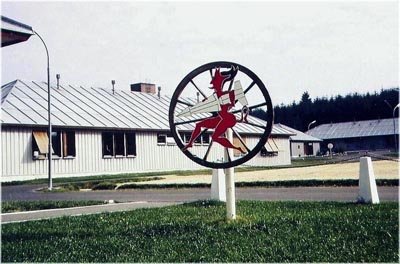 Dragon
Caserne, Böttingen
(courtesy
"Les missiles NIKE de Boettingen")
Dragon
Caserne, Böttingen
(courtesy
"Les missiles NIKE de Boettingen") |
|
1.
Was the 357th the only custodial
unit that supported the NIKE units?
2. Which of the French NIKE sites
(there were eight) were equipped with nuclear warheads?
(There are some conflicting reports. It seems that at
least two of the French sites were nuclear certified,
one being Böttingen.)
3. How many nuclear warheads (2
kt) were available for the French NIKE units and where
were they stored?
4. Was there an ordnance company
attached to the 576th US Army Arty Gp that operated a
special ammo storage (SAS) depot for the
units supporting the French armed forces in German? |
|
|
|
| Source: Email
from a veteran of the 357th (still waiting for a response with his
name) (williamsj@HAWTHORNE-DZHC.com) |
Responses to the questions posted above:
Question 1. As far as I can remember we had four teams supporting two French battalions (squadrons). I arrived in December 1963 and left in late 1964. We had a Team at Inneringen and Böttingen fully manned supporting the 520th and I remember some people being at Mengen and Münsingen, that would be the 521st. I will do some research in my old military records and see what I can come up with. I know we had two warhead teams at Stetten and only trained ourselves, but no security personnel.
2. After I went North, the former detachment Warrant Officer, Chief Burke, was assigned to SASCOM and was on the inspection team for C Team, 42d. All he would say was it was a mess. Seems they rushed to get them stocked and then had to figure out how to get the heads out of there. I doubt he is still around to help us, he was a WWII vet. I think I can locate some names of the people assigned to some of those units and we will do some research.
3. Not there to know and probably classified.
4. I never saw one listed anywhere. When I was there the 576th was in Karlsruhe. |
|
|
|
| 1964 |
| (Source: Email from Lewis Jordan, 357th Arty Det, 1964-66) |
Out of curiosity I did a search on 357th Arty Det. This was my outfit when I was in the Army. I was stationed in Boettingen from August 1964 until it was disbanded when France pulled out of NATO in July 1,1966. I left in Aug 1966.
I was a missile maintenance specialist. Original MOS 225 Later change to 22F20.
When I arrived at the 357th it had 3 sites:
HQ and Team A were at Stetten
Team B at Boettingen
Team C at Inneringen
At that time we just trained on war heading with no real mission.
Dec 1964 Hq at Stetten was moved to Boettingen. Team A was split up between Teams B and C.
I believe it was about Feb 1965 when we (Teams B and C of the 357th) were ordered to Ravensburg to pick up our nuclear warheads.
We went operational some time in March as I remember. Our mission was to protect the port of Marseilles, France.
We remained on operational status until July 1,1966 when DeGaulle pulled France out of NATO.
We demated the warheads and turned them back to Ordnance. I was site maintance chief at that time. I believe I signed the last warhead over to Ordnance about 10:30 am July 4 1966. After that it was a matter of deactivating that unit.
There were several "War Head Teams" in West Germany at that time. Both French and German. I believe we were the only operational unit. I know there were no operational German units at that time. Obvious political reasons at that time.
As I stated before, Ref Question 4, or ordnance was out of Ravensburg. I don't rember the unit.
We had sort of an unsual command structure. We were under the 576th Group in Karlsruhe which was under the 548th Group in Heidelberg. The 548th answered (directly) to US Army Europe. |
|
|
SOME FOLLOWUP QUESTIONS FROM THE WEBMASTER:
WM:. You mentioned a trip to "Ravensberg" to pick up the warheads. Could that possibly be "Radolfzell" which we know had a SAS (Special Ammunition Site)? Also, can you provide any details on that event (I know it was a long ago!). In latter years, warheads would have typically been transported to the site via Chinook helicopter. Would be interesting to know if your warheads were moved by truck or CH-34.
Lewis: I think it was Ravensburg, I could be wrong. I am sure it was somewhere just north of the Bodensee. We convoyed them ourself. The French supplied the trucks and drivers. We used the French version of a duce-and-a-half. The French drove and the Americans rode shotgun with M14's. We kept in constant radio contact with the command jeep which kept in constant radio contact with, I believe, the 576th Group HQ. I think they relayed through helicopters. I know direct contact was impossible in those days due to the mountains.
WM: You mentioned the mission to protect the port of Marseille in France. That was pretty far away. Many of the NIKE sites in Germany were primarily tasked with protecting river crossing points/bridges on the Rhine, Army Depots, and - probably - wartime headquarters for the various major commands.
Lewis: This was a (strategic) French NATO base. It was felt that any air attack from the Eastern Block on the West would include an attack on the port of Marseilles. The French were charged with it's protection. It was felt that there was two routes of attack. One would be to the south of the Swiss Alps via Northern Italy. The other route would be over the Schwaebische Alps or up the Danube River Valley. Our job was to protect anything west of us. That could included Tuttlingen, Freiburg but the prime location was Marseilles.
WM: What was the cooperation between the French and US soldiers like? I image that there were some tensions already due to DeGaulle and his politics. Did that have any effect on the way the troops interacted with each other?
Lewis: Actually we got along very well with the French. There was no love lost between the French Air force that we were stationed with and DeGaulle. When the site was deactivated, many of the enlisted men stayed in Germany and most of the Officers took assignments to North Africa or Madagascar rather than return to France. The French commandant's favorite description of DeGaulle, off the record course, was "La grande fromage" or "That eagle beaked idiot in Paris".
WM: Did the US troops live in the same area as the french unit, or did you have your own kaserne?
Lewis: We had our own barracks on the base in both Boettingen and Inneringen. |
|
|
|
| (Souce: Email
from Rick Anders, Germany) |
| I actually found the first French source mentioning the 357th. On the occasion of an open day at Camp de Stetten-Heuberg on 22 Sep 1963, it says: "357 Detachement d'Artillerie US, unite accolee a la 520e Brigade Aerienne". |
|
|
| Some Historical
Facts
collected by Rick: |
| 1959 |
|
The Bataillon
Mixte Ter-Air is activated in STETTEN, Germany, to help
train personnel for the French NIKE units. The battalion is
later known as the 1er Bataillon Français NIKE. |
| 1
Jul 1959 |
|
Escadron
d'Engins (EE) 1/520, a company-level unit, is activated
at LAHR replacing the 1er Bataillon Français NIKE. |
| 1
Jan 1960 |
|
EE 1/520
is moved from LAHR to MENGEN. |
| Jan
1961 |
|
The 520°
Brigade d'Engins (BE), a battalion level unit, is activated
in STETTEN. |
| Oct
1961 |
|
The 521°
Brigade d'Engins is activated in FRIEDRICHSHAFEN. |
| 1
Dec 1961 |
|
The four
firing batteries (escadrons) of BE 521 become operational. |
| 1961 |
|
EE 2/520
and EE 3/520 are formed. |
| 1961
|
|
EE 1/520
is still equipped with NIKE-AJAX missiles. |
| 1962 |
|
EE 4/520
is formed. |
| 1
Jan 1963
(?) |
|
The 500°
Groupement de Brigades Aériennes (GBA), a command and control
organization meant to provide administrative (and logistical)
support to the two French NIKE battalions, is established at
FRIEDRICHSHAFEN. |
| 1
Apr 1963 |
|
French
NIKE units are redesignated: Brigades and Escadrons d'Engins
(BE and EE) become Brigades and Escadrons Aériennes
(BA and EA) |
| 1963 |
|
Additional
redesignations:
EE 1/520 is redesignated as EA 3/521 at MENGEN.
EE 2/520 remains unchaged, located at STETTEN.
EE 3/520 is redesignated as EA 4/521 and moved from STETTEN to
MÜNSINGEN.
EE 4/520 remains unchanged, located at STETTEN.
EE 1/521 remains unchanged, located at FRIEDRICHSHAFEN.
EE 2/521 remains unchanged, located at FRIEDRICHSHAFEN.
EE 3/521 is redesignated as EA 3/520 and moved from FRIEDRICHSHAFEN
to INNERINGEN (1 Apr 1963).
EE 4/521 is redesignated as EA 1/520 and moved from FRIEDRICHSHAFEN
to BÖTTINGEN. |
| 1966 |
|
The 500°
GBA is inactivated. Also inactivated are the EA 2/520, 3/520
and 3/521. (It is possible that all the firing batteries were
dissolved during this timeframe after De Gaulle had announced
France's intention to withdraw French troops from NATO control.
|
| 1967 |
|
The 520°
BA (and maybe also the 521° BA) was inactivated. |
|
|
|
| French
NIKE HERCULES Units and their US Army Support Detachments |
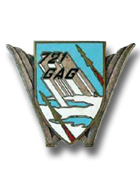 721° GAG
|
 500° GBA
|
 520° BA
 |
521° BA |
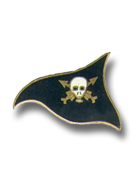 EE 1/520
EA 3/521
Mengen |
EE 2/520
EA 2/520
Stetten |
 EE 3/520
EA 4/521
Münsingen
|
 EE 4/520
EA 4/520
Stetten
|
EE 1/521
EA 1/521
Friedrichshafen
|
EE 2/521
EA 2/521
Friedrichshafen
|
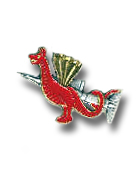 EE 3/521
EA 3/520
Inneringen
|
 EE 4/521
EA 1/520
Böttingen
|
|
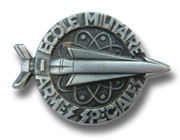 French Special Weapons School
|
|
|
| |
Related Links:
Les missiles NIKE de Boettingen - Claude Leriches' very interesting web site featuring the history of the French NIKE units stationed in Germany with special focus on the NIKE site at Böttingen, Germany.
NIKE Homepage - Rolf Goerigk's super detailed web site also features a page on the French NIKE units in Germany. |
|
|
|
|
| 501st
Artillery Detachment/USAAD |
|
| 1962
- 1988 |
The
501st U.S. Army Artillery Detachment was activated in October 1962
at Fort Bliss, Texas.
The detachment was assigned to the 548th U.S. Army Artillery Group,
which further attached it to the 552nd U.S. Army Artillery Group.
In May 1966, the 501st was transferred to the 557th U.S. Army Artillery
Group.
Finally, in October 1978, the detachment was assigned to the 5th U.S.
Army Artillery Group.
The 501st was inactivated in 1988 with the group headquarters. |
|
|
|
| 507th
Artillery Detachment/USAAD |
|
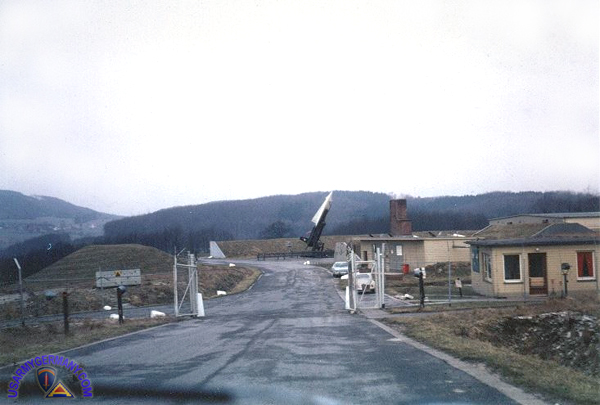
Entrance to a Belgian LA site (Charles Everett) |
|
| 1970
- 1988 |
The
507th U.S. Army Artillery Detachment was activated in 1970 and was
assigned to the 5th U.S. Army Artillery Group in August of that year.
The unit was inactivated in 1988. |
|
|
| 1972 |
| (Source: Email from Bob Campbell, Team C, 507th USAAD, 1972-74) |
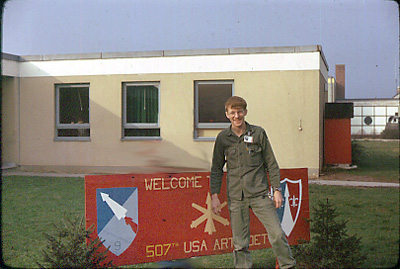 Bob Campbell, Tm C, 507th Arty Det , 1972
 |
|
My little contribution to the protection of the European continent, was between Feb 1972 and Mar 1974, while assigned to Team C, 507th USAAD. Worked on a NH warhead custodial team.
Team C, was located in Kapellen/Erft, a bit west of Neuss (Dusseldorf). Our other teams were in Xanten (Alpha Team), Hinsbeck, and Erle. Not sure of the teams associated with the latter two towns. Our "headquarters" was in the town of Grefrath.
|
|
|
The nearest U.S. PX/commissary, was in Schinnen, Netherlands. About once a week, the mess steward would make the trip to replenish food stocks for our mess hall. Occasionally, spouses would accompany the run to Schinnen to replenish their pantries as well.
All our specials (SW warheads) were on-site, on the rails, and ready (mostly) for launch. They were of course, locked up inside "barns", behind double fences. Early on in my tour, we were "downsizing" warheads. We performed numerous de-mating operations while swapping warheads during that time period. All the weapons were being transported by ground convoys. The security during those operations was really impressive.
Mostly the next two years were pretty ho-hum in nature. The notable exception, being 6 October, 1973. Out of the blue, we received a coded message, to prepare all dependents for immediate evacuation. We were also instructed to issue basic load ammo to all troops. We changed Defcon posture as well.
Really got the blood pumping there for a while. Being so far off the beaten path, and out of range of AFN (Armed Forces Network), none of us were aware of the mischief happening in the Mideast. Apparently, things got pretty dicey, and word went down (to us) to get ready in case the "balloon went up". It didn't. If memory serves, we were kept on edge and hour or two, before being told to stand down. |
|
|
|
| 1974 |
| (Source: Email from Jose L. Sandoval, Jr., HQ, 507th USAAD, 1974-76) |
| I arrived from Frankfurt to Buren on June 1974. After a week, we rode a volkswagon to Grefrath. Hq and A Team for 507th Arty Det.
I was assigned as a supply clerk in Hq. We supported the Belgium Army. As a supply and a courier for the 507th, I did a lot of traveling for the detachment. I visited all the teams resupplying and delivering paper work. I also went to Buren 2x a week for supply and any soldiers who neede to clear. It was a long ride specially if you were on the back of the Bedford truck.
Every 6 months, along with my driver, we went to Wildfliken to pick up ammo for our rifles.
Our housing was in Kempen about 10 kilometers away from the Detachment. As a new recruit and a married soldier, my family arrived and we stayed at another soldier's house until we got our own place on the economy.
At first it was very hard for me. I was catching a ride every morning with any American or Belgium national going to the Detachment.
I got out from the military on Nov 1976.
Then, on my 2nd carrier in military, I was able to visit Grefrath again in the summer of 1989. The signal tower was gone and the site looked empty.
I was friends with a Belgium soldier who worked as a medic at the dispensary. And until now, we have remained like family. He has visited me twice in Hawaii and 3 times here in Oklahoma. He plans to visit me again this coming September and go on a Caribbean cruise. |
|
|
|
| 1976 |
| (Source: Email from Gary Price) |
I was at C Team 507th USAAD at Kapellen, 1976-78
As I remember, I arrived there from the 21st AG Replacement Bn., Frankfurt, having processed through Bueren HQ near Paderborn.
When I was in CONUS, I was one of the first to be promoted to Corporal E-4, but as the 507th had no Corporals on their list, they were
dumbfounded as to what to do about my rank.
People tried to find through time, if there was some disciplinary action that could be taken to demote me to PFC, but as I was a good NCO,
they had to wait their time and promote me to Sgt E 5.
Lt Lunn was my team leader, Capt Pechinski was the CO at HQ. (I hope I spelled his name correctly). My Asst team leader was 2nd Lt Emeret.
My team SGT was SGT Stinnett. I was his orderly room clerk, but served as a guard down range, since I had an 11B primary and 71L secondary MOS. He was replaced by a SGT (SFC) McKenzine, from Ft. Bliss. I was close to Greg Mills E 4 and Pete Saunders E 4 from Bradenton, FL and Richmond, VA respectively. We had an SFC Bowers on Maint side from NC and they brought in his buddy, SGT Perea, from Albuqurque, NM, who unfortunately was 'set up' by the men, as he had a drinking problem, so they got him drunk at the Belgian NCO club and then reported him for being drunk on duty. Like Bowers, he played 'Army' too seriously, as most of the guys there just considered it fun and games. The WO1 in charge of Maint was WO1 Downey, who sort of took me under his wing and protected me from SFC McKenzie, so if I needed a day off, I would as the Warrant officer, since I was responsible for his record keeping. He made WO1, having been an SSG. E 6. Our cook was SGT Biggers, who reminded me of the Pillsury dough boy, and Hardy, the latter married a German lady and probably still lives in Cologne, if living. We had another guy, SP4 Emerson, who married a German lady also. I used to be in charge of the ration run truck to Schinnen Mine, NL once a month. We were assigned a Belgian soldaten who would drive for us. Everyone would give over their ration cards for cigs, whiskey, etc and we usually had to bribe the Dutch guards with coffee at the border.
Our shift ran day down range on guard with 4 hour sleep shifts, which means working the next day or no sleep shift and go home. Usually, it was day on, day off, day standby in garrisson. We went on volunteer Infantry training in Belgium and the soliders were quite professional, if NCO's and ran a good program. I lived in Grevenbroich, Belgian housing, and used to ride in a lot with Lt Brown from Rhode Island, who replaced Lunn as Team leader. Other than breaking SANRAS messages with this short, Italian-American SGT, who's name escapes me, and guarding, typing, there wasn't much to do except go to Rheindalen Royal AFB and try to pick up British WAC's. There were other members of the team. This is easy to remember, as teams are generally small. We had SGT DeJesus, who the Belgians had a hard time with, as they thought his name was Jesus, and when making a Dr appt for him, they thought we were pulling their leg. The one guy that stood out was Sp4 Anthony McPherson, from NY. He was a practical joker for the most part. The thing I remember the most was the New Years Eve parties, as I arrived from Paderborn on Dec 31, 1975. The Belgian Commandant's wife liked to chase new GIs around the party to see if she could dance with them, and date with them. I was told not to take the bait toward her advances, as it would result in a transfer. My best friend was Sp4 Reynolds from Tillamook, OR. I met him later in Tilamook in the early 1980s. His wife, Kathy, me and his family used to drive to Holland a lot. I remember SSG Emmett Bowers wanted to buy his Nissan truck, but Leonard wouldn't sell, so Bowers had it failed for inspection, though there was nothing wrong with it, and it remained in storage until Reynolds left Germany. I guess the most impressionable thing was the closeness of the families. My former wife (now deceased) was with me from KY and my son was born in a Belgian AF hospital in Eherenfeld, Cologne. He is now a Sr. Chief E8 in the Navy. I left the Army for the Navy in 1978 and finished my Naval service at Naval HQ London, UK in 1987. |
|
|
|
| 1986 |
| (Source: Email from Bruce Reynolds, Army dependent) |
My father was stationed at headquarters in Grefrath from 1986-1988. He was the mess sergeant for the mess hall.
I was only 12 when we moved there and I can remember staying at the Hotel Garni in Grefrath for about a month until we found housing in Viersen, Dülken.
I've read that many of the bases have closed down. I can remember us going to JHQ Rheindahlen and there was eventually a commissary in a large building that seemed like it was out in the middle of nowhere. I just can't remember where it was located.
I can even remember attending the 8th grade in an old German carpet factory office building that was converted to a DOD school. It was K-8 and I can remember only have a total of 103 kids. I eventually attended AFCENT in the Netherlands when I started high school.
Now with all that being said, I have very fond memories from that time and like to find the places we once lived on Google earth. I just can't remember exactly where the base was located in Grefrath. I remember it being on the outskirts and was very small (at least that's how I remember it). If you could tell me the street that the headquarters buildings were located I'd appreciate it. Even if you can remember the small commissary and PX that eventually opened that would be great too. I can remember us having to travel to Schinnen in the Netherlands for our PX and commissary needs prior to the one in Germany opening.
I've just been doing some traveling down memory lane and can easily look up stuff about Grafenwöhr where we were stationed from 78-82. Thank you for your time and any info. |
| |
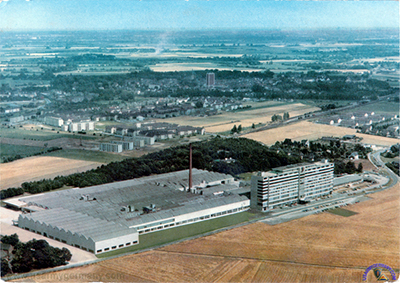 |
|
Webmaster note: I sent Bruce the photo on the left and here is his response:
That's the building I was talking about. Wow! That just brought back a flood of memories.
I can remember it being such a big deal when it opened and not having to go to Schinnen anymore. I can remember a "food court" in the factory portion and there being a Burger King that operated out of a food truck. lol that was a big deal then.
If you have any information on the actual headquarters building that was in Grefrath I'd appreciate it.
Now off to Google Earth to find Rheinberg and try and refresh my memory. For some reason I felt like it was very far from where we lived in Dülken, but more than likely it wasn't. Thank you! |
|
|
|
|
| 508th
Artillery Detachment |
|
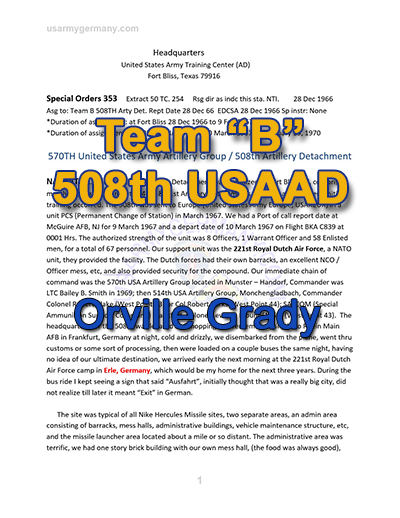
Personal narrative, PDF format (Orville Grady) |
| |
| 1967 |
| (Source: Email from Orville Grady, "B" Team, 508th Arty Det, 1966-70) |
I served in Team "B," 508th USAAD for a little over three years, was knee deep in most of the training for the custodial agents.
It seemed to me that others would really enjoy a fairly comprehensive history of the unit written by someone that had been in the 508th.
I served seven years total and was one of those guys that kept all of his military documents, including pay vouchers. Feel free to forward my contact info to any individuals you think might have served there at the same time. |
|
| ADDITIONAL INFORMATION |
| 1. To see a roster of personnel assigned to Team "B," click here. |
|
2. Additional comments on certain personnel:
1st Lt. William Burnett was promoted to Captain and became Team Commanding Officer
1st Lt. Michael Briggs promoted to Captain, Team CO after Captain Burnett,1969
2nd Lt. Ponte, bought a 1965 silver Ferrari
SP4 Wilbur E. Rayl, settled in Fremont, NE, became an electrician for school system
SP4 McNeely, Team cook (from Falls City, NE)
SSG Boetler, cook, NCO in charge of the mess hall, career soldier
SSG Hegwood, promoted to SFC and essentially ran the show, career soldier
SSG Holly, a roommate for a while and drinking buddy, career soldier
SP5 Matthews, a little on the wild side, hoisted his laundry bag up the flag pole once
SP4 Anderson, Charlie. One of the few blacks in the unit
SP4 Belfiore, returned to Omaha (the Italian district of South Omaha)
SP4 Burns, became a career soldier, last I saw him was an E7
SP4 Fann, became a career soldier.
SP4 Hudson, went to NCO school in Germany, Promoted to E6, became a career soldier
SP4 Love, a 20-year lifer, had seen grades of E4 & E5 several times, liked booze, nice guy.
SP4 Merli, Team cook
E3 Patkin, liked to fight after drinking, great on the “Fussball” machine
E3 Watkins, another of the few blacks in the unit
Note: PFCE3 Duvall, Samuel R. Listed on Port of Call manifest but not included in main body roster would make the main body consist of (60). See Letter Order 2-6 dated 9 February 1967 for main body and advance party listing.
Lindsay & Washington introduced me to Jazz & The Blues. Bates, Stephens, Dietrich, Perry, Mc Neely, Rayl were drinking buddies. Guitard was a damn good cook.
There were very few blacks in the unit and no racial issues arose to my knowledge or else I did not notice them if there were. |
|
3. The Team: Overall it was a talented group of people, most did an excellent job performing their assigned tasks, there were a couple of loose cannons, very few disciplinary issues and everyone got along better than one would expect.
For the number of soldiers in the unit there was a fairly high number which decided to go career.
Remember several others I hung out with: Darley, Odell, Southwick, Brooks, Hamby, Badillo, Blazic, Proffit, Trotta, Davis, Larry Anderson, none of them went career that I know of.
I don’t remember all the replacement personnel, but by the time I rotated back to the US after three years in the unit nearly all of the original personnel had either been reassigned, or discharged. Twenty-four of the replacement personnel are documented above, which constitutes nearly half of the original soldiers assigned to the 508th during the three years I served in the unit.
The three year tour of duty in the 508th was in retrospect the best assignment of all during my seven years of service.. |
|
| 4. Note: Transcribed Port of Call Orders (from original) shown below was for both Teams A & B of the 508th U.S. Army Artillery Detachments. There were personnel listed for Team “A” (7 Officers & 52 enlisted) and for Team “B” (6 Officers, 1 Warrant, 53 enlisted). |
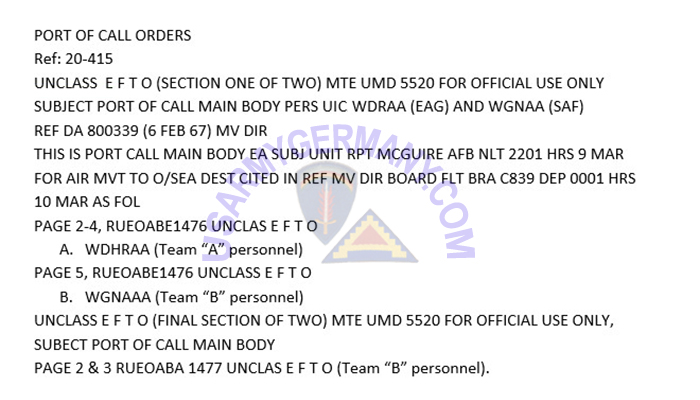 |
|
| 5, INSTALLATION CLEARANCE RECORD (DA form 137) Notes depart date for USAREUR (PCS) as 18 Feb 1967 per Letter Orders 2-6 HQ USAADCEN. |
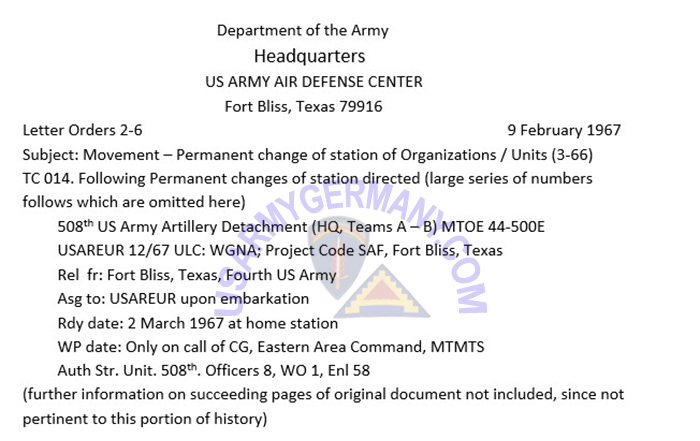 |
| |
| 6. Transcribed Movement orders from original. |
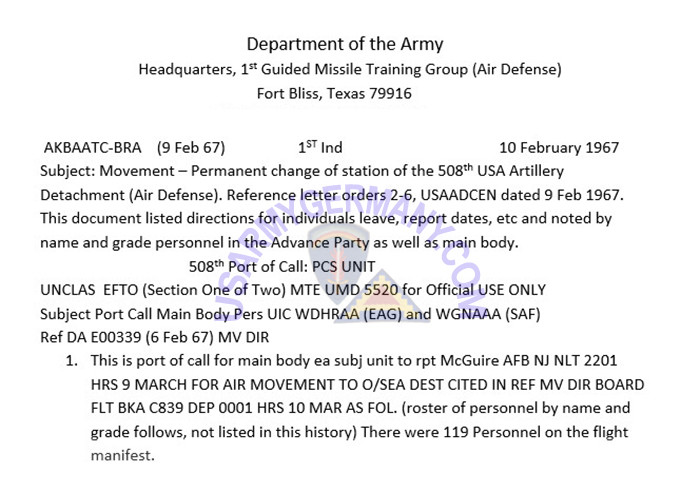 |
|
|
| 1968 |
| (Source: Email from Terry Duber, "B" Team, 508th Arty Det, 1968-70) |
Enjoyed reading about the old days in Germany - on your site and on others! Seems to be conflicting info re locations of teams of the 508th USA Artillery Detachment in northern Germany. I was at 'B' Team in Erle from Nov. of 1968 to June of 1970. We supported the 221st Royal Dutch Air Force Nike Squadron. We had the Nike Hercules and the "special warheads." Team 'A' was at Schoeppingen - that was 508th HQ, and Team 'D' was definitely at Rheine during that time. Don't recall where or if there was a Team 'C' - guess there must have been. As they say - I'm trying to think but nothing's happening!
I was sent over there, a draftee, fresh from Fort Sill, a 13A10 cannon-cocker. Not bad considering where else I might have been sent. Flew into Rhein-Main from Fort Dix, a couple nights at old dungeon-like Gutleut Kaserne in Frankfurt, then (wonder of wonders) a Deutsche Bundesbahn up the Rhine River - a German man in the compartment with me pointing out the sights: "Lorelei - singen!" Ah yes - this was not going to be bad duty! Two days being trucked through the November German gloom from Group HQ to Detachment HQ to Team HQ - each site becoming smaller and more remote. I was destined to become a 16B security guard, but the First Sergeant at 'B' Team was unhappy with his clerk, an 18 year-old who a few months ago, faced by a civilian judge, had been given the classic choice of enlistment or incarceration. The First Sergeant had heard I was a "college guy who could type", so he made me the clerk. The 18 year-old was only too happy to become a security guard, getting out from under the wing of his Army father-figure and so everybody was happy.
Just a followup from yesterday. It now seems, from other info on the web and from my fading memory, that the proper alignments of the four teams of the 508th USA Artillery Detachment in northwest FRG were as follows (at least in the late '60s - early '70s timeframe):
Team A (and HQ) in Schoppingen, supporting the 220 Dutch AF Nike Squadron,
Team B in Erle, supporting the 221 Dutch AF Nike Squadron,
Team C in Nordhorn, supporting the 222 Dutch AF Nike Squadron, and
Team D in Rheine, supporting the 223 Dutch AF Nike Squadron.
ADDITIONAL INFORMATION
A funny story I believe illustrates some of the "wheeling and dealing" that went on in postwar Germany.
The relationships between the US forces in West Germany and the host nation were (and are) governed by SOFAs - status of forces agreements - outlining who was responsible for what services and determining jurisdiction in legal matters. The situation became more complicated when US forces were stationed with foreign NATO troops within West Germany.
Let me give you an example I remember well. I was the unit clerk at B Team, 508th USA Arty Detachment in Erle, in NW FRG from 11/68 to 6/70. We were located on a Dutch AF base and were there to act as custodians of special munitions (nuclear warheads) which would have been released to the Dutch and fitted onto Nike Hercules missiles if the world situation had seemed to call for that. We had a total of 25-30 officers and enlisted men, about half of whom lived off base. It was an isolated post and the Dutch provided much of our support, including a German civilian driver with a vehicle for our daily mail runs to HQ and our weekly PX runs south to Giessen. Our on-site PX was basically a closet with only basic essentials and was run by one of the Fort Bliss-trained missile mechanics who endeavored to keep it open an hour or two per evening and perhaps more on weekends.
When I was about to be drafted in 1968 some friends and family, perhaps trying to get me to look on the bright side, had told me that maybe the Army would do some dental work for me. For almost seven years I had been wearing a removable bridge in my mouth, consisting of a plastic upper middle tooth attached to a larger piece that molded to the roof of my mouth to keep it in place. I could pop it in and out in a second. Once in the Army, though, it bacame apparent that as long as I was functioning well with my "flipper", the military was not the least bit interested in giving me anything more permanent - like a gold bridge.
But when I ended up at B Team the wheels in my head began turning. I learned that the Dutch AF had a civilian dentist on base several days a week and that he was available to us for "immediate needs." I decided to force the issue by deliberately destroying my flipper, claiming it had been an accident. The least that would happen, I figured, was that I would get a new flipper - either locally or from a US dentist in Bremerhaven.
So I poured out my collection of flipper pieces for the Dutch dentist to evaluate, and he thoughtfully rubbed his chin. He said it would be easy enough to make a new flipper, but that there were other options. I was interested! He told me it wasn't clear just how much work he was authorized to do, but that he would consult the appropriate regulations. He mentioned also that there was a favor I could do for him. He wanted to purchase a set of Samsonite luggage from the American PX - had it all picked out: stock number, color, price and everything. How he knew all this I don't remember - maybe he had a catalog. We certainly didn't have it in our local closet PX, but I said sure, if he put up the money I would order him the set of luggage.
When I saw him next, the dentist told me he had found nothing in the regulations forbidding him to install a gold bridge in my mouth, but that he would have to consult AF HQ in the Hague for an opinion. In the meantime he would begin work on my gold bridge. I think he suspected what the opinion from the Hague would say, so he either delayed sending his request or sent it by the slowest way possible.
It took more than a week to complete the bridge, which turned into a three-tooth affair, but he never sent me out of his office without a temporary in place. That Dutch dentist did a great job; his work was admired by civilian dentists I had back in the States, until I had to have it replaced more than thirty years later. Some time following the completion of the work I was able to deliver his set of luggage, and he told me that he had been informed from the Hague not to perform any more similar services for the Americans.
I would bet that right up to the end of the 1980s, when this type of basing arrangement largely ended, there existed this uncertainty concerning who provides what for whom, and how and when and under what circumstances. |
|
|
|
|
| 509th
Artillery Detachment/USAAD |
|
| (Sources: various) |
| ORGANIZATION (late 1960s): |
UNIT DESIGNATION |
LOCATION |
COMMENTS |
| Headquarters |
Vörden |
supported 1st GGW |
| A Team |
Handorf |
supported 119th Sqd |
| B Team |
Vörden |
supported 118th Sqd |
| C Team ? |
Böhmte |
121st Sqd (nuc-certified?) |
| D Team |
Borgholzhausen |
supported 120th Sqd |
|
|
| ORGANIZATION (late 1970s): |
UNIT DESIGNATION |
LOCATION |
COMMENTS |
| Headquarters |
Bramsche |
supported 12th GGW |
| A Team |
Vörden |
supported 118th Sqd |
| B Team |
Schöppingen |
supported 220th Sqd |
| C Team |
Borgholzhausen |
supported 120th Sqd |
|
| The 12th GGW had a fourth NIKE battery (the 223rd at Rheine-Bentlage). It appears that there was no D Team, 509th USAAD which could only mean that the 223rd was not nuclear-certified. |
|
|
| 1967
- 1988 |
The 509th U.S. Army Artillery Detachment was activated in May 1944 as the 148th Anti-Aircraft Artillery Operations Detachment. After a brief period of organization and training in England, the detachment deployed to the continent where it receives credit for participating in two campaigns. The 148th was inactivated in Germany in October 1945.
In October 1948, the unit was redesignated as the 509th Anti-Aircraft Artillery Operations Detachment and allotted to the regular Army. The 509th was assigned to Seventh Army, Europe, and activated in July 1952.
In October 1954, it was redesignated as the 509th Artillery Detachment.
The 509th was inactivated in June 1957 and remained in that status until December 1962. At that time, the detachment was redesignated as the 509th U.S. Army Artillery Detachment and activated at Fort Bliss, Texas as a Warhead Support, Nike-Hercules unit.
The unit was again inactivated in July 1963.
In March 1966, the 509th U.S. Army Artillery Detachment was activated at Fort Bliss, and in March 1967, the unit deployed to Germany.
In October 1978, the 509th was reassigned to the 5th U.S. Army Artillery Detachment.
The 509th was inactivated in 1988. |
|
|
| |
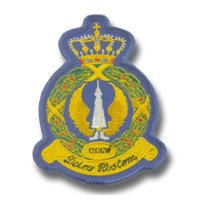 12e Group Geleide Wapens (12th Missile Group) Patch 12e Group Geleide Wapens (12th Missile Group) Patch |
| |
| (Source: Air Defense Artillery, Jan-Feb 1996) |
Royal Netherlands Armed Forces Air Defense
by Lt Col Cees de Looze
From 1968 to 1974 (1), the RNL AF had two Nike battalions each with four batteries (three of the four had a nuclear capability), three Hawk battalions each with four batteries and one logistics battalion (2) that supported Nike with 80 percent of its capacity and Hawk with the remaining 20 percent. |
|
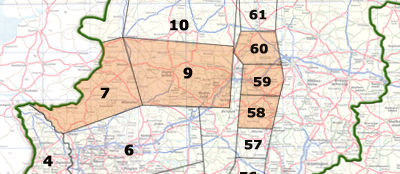 AOR - RNL AF Nike (7 & 9) and Hawk (58, 59, 60) sectors
 |
|
The battalions were all located in the northern part of the Federal Republic of Germany and were elements of the NATO Integrated Air Defense organization, operating in both forward (Hawk) and rear (Nike) belts.
To make things a little more complicated, one Hawk battalion operated in the German Army Corps area, one in the British Army Corps area, and the third on the boundary line between these two corps. German Hawk battalions were assigned to the Netherlands Army Corps area.
|
|
|
Slowly the Air Force diminished in strength. In 1974, one Hawk battalion (3) withdrew to the Netherlands and reconfigured to eight Hawk assault fire platoons (AFP's) to defend air bases -- a reaction to "lessons learned" after the Egyptian / Israeli war.
By adding strength and capabilities to the Nike and Hawk battalions, the Dutch were able to eliminate the logistics battalion in 1975. (The remainder of the article covers topics outside of the scope of this page.) |
|
| |
(1) The first Dutch Nike battalion (1 GGW) was actually formed in 1959 and consisted of four batteries (called squadrons; A - D). The batteries were equipped with Nike Ajax and Nike Hercules missiles. A second Nike battalion (2 GGW ) was formed in April 1963, also with four lettered batteries.
(2) The logistics battalion was called "Groep Techniek en Materieel Geleide Wapens" (GTMGW). This unit was located at Hesepe, Germany.
(3) 4 GGW at Hessisch Oldendorf. (This site with several of the former HAWK sites were then taken over by USAF mobile radar units (407L)) |
|
| |
| (Sources: Ed Burki and others) |
| 1 GGW ORGANIZATION (mid-1960): |
|
|
| |
| In 1964, all the Nike squadrons were redesignated from lettered to numbered units: |
|
| (4) A new fourth squadron for 1 GGW (the 121st Sqdn) was formed in 1966 and assumed operations at the Nike site near Bad Essen () in 1967. |
| |
| 2 GGW ORGANIZATION (mid-1960): |
UNIT DESIGNATION |
LOCATION |
COMMENTS |
| Headquarters |
Schöppingen |
orig Hq at Rheine; moved to Schöppingen in 1967 |
| 220th Sqdn |
Schöppingen ( ) ) |
operational 1964 |
| 221st Sqdn |
Erle () |
operational 1965 |
| 222nd Sqdn |
Nordhorn () |
arrived from Twenthe in 1967 |
| 223rd Sqdn |
Rheine-Bentlage () |
possibly did not join 2 GGW until 1967 |
|
| |
| In 1967, six of the Dutch Nike squadrons (118th, 119th, 120th, 220th, 221st, and 223rd) became nuclear capable when the 509th Arty Det was attached to the Dutch units to provide warhead custodial support. |
|
|
| |
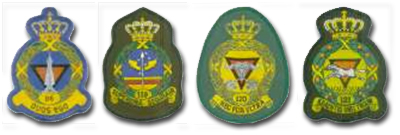 1 GGW Patches (118th, 119th, 120th, & 121st Sqdns)
|
|
|
| |
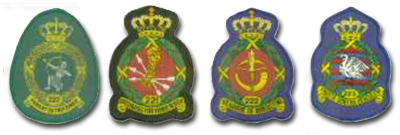 2 GGW Patches (220th, 221st, 222nd, & 223rd Sqdns)
 |
|
|
|
|
| |
|
Related Links:
Belgian NIKE Memorial Site - covers the 9th and 13th Wings
12th Missile Group website - Dutch language website with many photos of the various Dutch Air Force Nike launch and IFC sites
Rolf's Nike Pages  - Rolf Görigk's wonderful website - covers all NATO units equipped with the NIKE HERC missiles stationed in Germany - tons of detail. - Rolf Görigk's wonderful website - covers all NATO units equipped with the NIKE HERC missiles stationed in Germany - tons of detail.
|
| |
| |
|
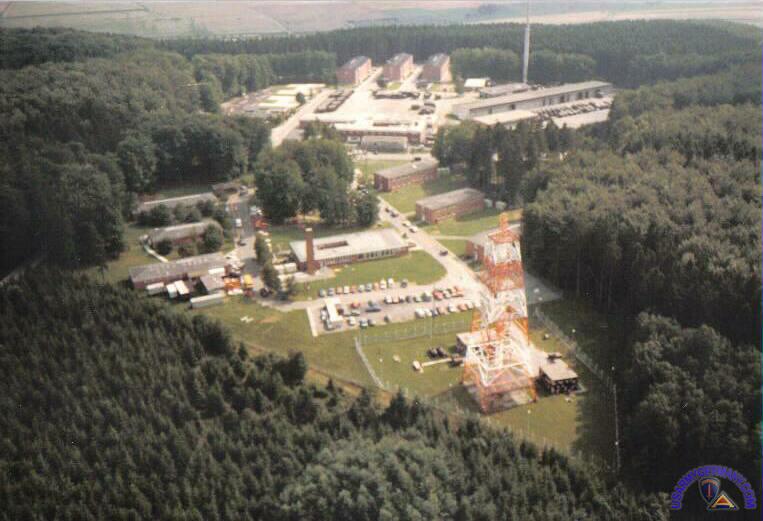

 118th Squadron, 1 GGW