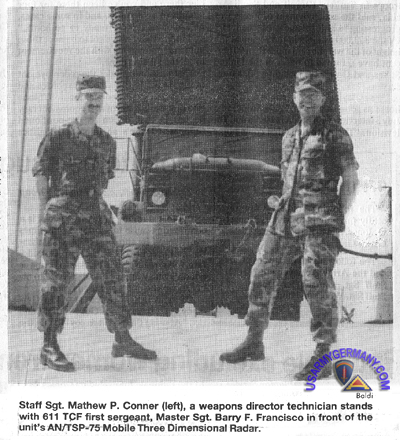
Tactical Air Control System
Page 7 - 407L Tactical Air Control System
US Air Force, Europe
Looking for more information from military/civilian personnel assigned to or associated with any units of US Air Force, Europe that operated or supported the Theater Air Control System. If you have any stories or thoughts on the subject, please contact me . .
|
|
|
|
|
| The 407L TACS |
| |
| 1970s - 1980s |
| General Information |
| |
| (Source: 601st Tactical Control Wing - A Historical Perspective) |
| FIXED RADAR SITES WITH 407L SYSTEM |
RADAR STATION |
OP UNIT |
COMMENTS |
| Alzey "MUTATE" |
611th TCF, 603rd TCS |
|
| Grafenwöhr "CONSOLE" |
632nd TCF, 602nd TCS |
|
| Pruem "JEREMIAH" |
612th TCF, 601st TCS |
|
| Rhein Grafenstein "CALORIE" |
622nd TCF, 603rd TCS |
|
| Bad Münder "CITRIC" |
619th TCF, 609th TCS |
|
| Schwelentrup "BAHMA" |
629th TCF, 609th TCS |
|
| Bremerhaven / Basdahl "GALLEY" |
606th TCS |
|
| Wanna "COMPOSE" |
626th TCF, 606th TCS |
|
| Wanna "EDUCATE" |
636th TCF, 606th TCS |
|
| Wiesbaden "BELIEVE" |
621st TCF, 601st TCS |
|
| Würzburg "CHALET" |
631st TCF, 602nd TCS |
|
|
| |
| USAFE 407L RADAR UNITS |
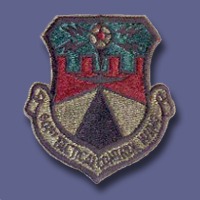 601st TCW Patch
 |
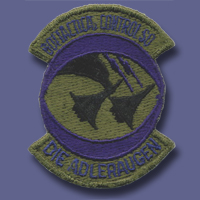
601st TCS Patch |
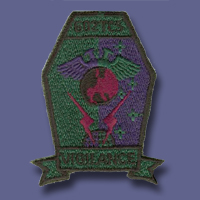
602nd TCS Patch |
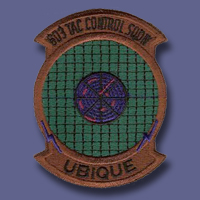
603rd TCS Patch |
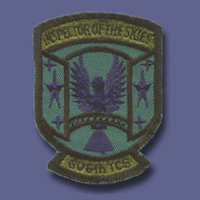
606th TCS Patch |
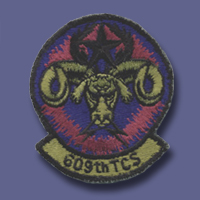
609th TCS Patch |
|
|
|
 |
|
|
| 601st Tactical Control Squadron |
| |
| (Source: Email from Bob Baylor) |
I was stationed with the 601st TCS from 1989 to 1991. The unit had just moved from Pruem to Zweibruecken when I got there in late 1989.
The 601st went by “MORPHA” when it arrived at Zweibrucken AB, the 612th TCF kept “JEREMIAH” and was located at an Army casern in the downtown area.
We controlled DACT and ACT missions in the Temporary Airspaces (TRAs). We worked with all of the fighter units in Germany, as well as the Canadians (from Lahr and Solingen), the British and occasionally the Dutch out of Soesterberg. For refueling missions, we had to go to Rhein Main and control from the German Air Traffic Control Center.
We regularly had to practice “crash outs” -- tearing the site down, moving out to another location, and erecting the site back up within so many hours.
The 601st was still controlling during OPERATION DESERT SHIELD and OPERATION DESERT STORM even though much of our equipment and personnel (along with the rest of USAFE) were deployed down range.
Zweibrucken was one of the first bases to be closed in 1991, the 601st was closed and its equipment and personnel reassigned. I believe the 601st was stood back up years later in Italy but that was after I was out of the career field.
Hope this helps!
|
|
|
|
|
| 602nd Tactical Control Squadron |
| |
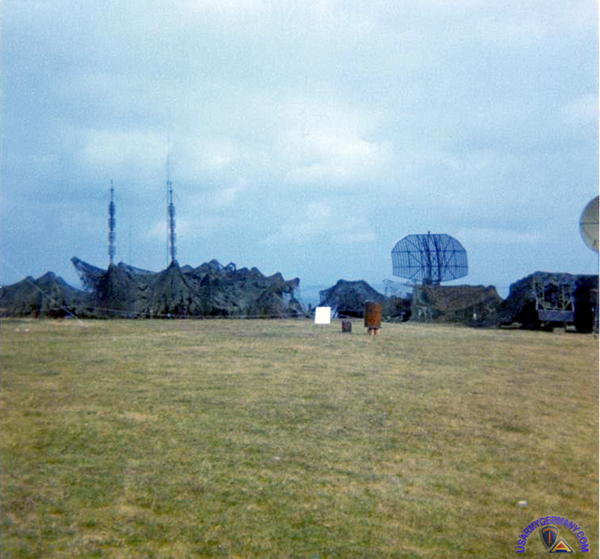 Würzburg Radar Site, c. 1975 (Michael Miles)
 |
| |
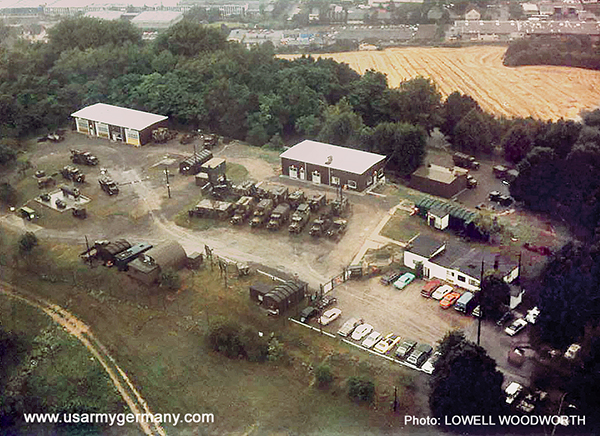 631sr TCF site, Leighton Barracks, Würzburg, mid-1980s (Lowell Woodworth)
 |
| |
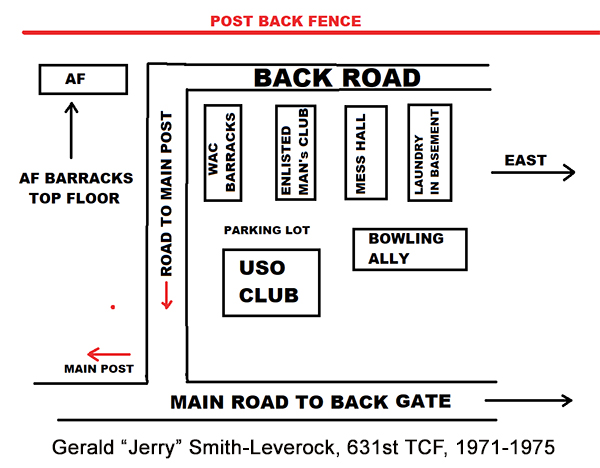 Location of the 631st TCF billets at Leighton Battacks (Gerald Smith-Leverock)
 |
| |
| 1971 |
| (Source: Email from Gerald Smith-Leverock, 631st TCF, Würzburg) |
631st TCF - "The Hill"
Hi, my name is Gerald Smith-Leverock or Jerry "Smitty" Leverock as the troops called me. I served with the 631st from 1971 to 1975.
I think Dicky Bennett was in charge of the shop then because Salzgiver had been medevaced back to the States due to a TB infection.
I see you have a picture of me digging a trench to lay the power cables for the site. However, I left the unit to go to Korea in 1975. I don't remember Maj. Flanagan. The commander who was there for most of the time I was stationed there, was a LTC. Charles Linville.
I served with Michael Miles and Marty Martinez. Miles first came into the 631st in 1972 and Miles and I built the fixed fuel ground section on the site. We were put in charge of all the fuel to include taking care of the fixed fuel ground section, the fuel truck (1200 gals.), and fuel trailer (600 gals.). We had JP4, Diesel, and Mogas. We were responsible for deployment, positioning, and delivery of fuel while in the field, and all fuel management matters while home in garrison.
I do remember where the motor pool and mess hall were. The mess hall was right down the street where our barracks on that back road and i could see the motor pool from the guard tower on the hill. It was towards to rear gate of the post
The Leighton Barracks map is not complete because it does not show our barracks (see above drawing).
Our barracks was not in line like the ones in the map. It was farther to the west. I'm not sure about the motor pools because I didn't have anything to do with that.
I do remember that one time, after a deployment, we cleaned our trucks at the motor pool closest to the site. The mess hall and club , as I remember, were on the back road like in my map. I had to stay out of the club because I had a few fights their with some of the Army guys.
I played in a band at the club a couple of times before I was banned from it. I also tried to stay away from the mess hall for the same reason.
Once, I remember, one of our guys broke into the WAC barracks and he was arrested after punching out the 631st Commander.
I also remember that the German girl who worked in the laundry was very pretty and all our guys would hit on her all the time. Finally, she ended up marrying one of our guys. I think his name was Feltman or Feltner. Or something like that.
|
|
|
|
| 1976 |
| (Source: Email from A. Roy Olson, 602nd TCS, Neu Ulm) |
I happened on your website by accident yesterday and was pleasantly surprised to see all the information on the USAFE TACS. I was with the 602 TCS at Neu Ulm from 1976 to 1979. I'd be happy to relate the history of the unit while I was a member. That period was a time of big changes for the 602nd and I was proud to be part of the effort. Thanks for producing the mobile TACS history.
602 TCS, Neu Ulm, GE 1976-1979
I was assigned to the 602 TCS (BIFORM) at Nelson Barracks, Neu Ulm, Germany in October of 1976. I was an Aerospace Ground Equipment Technician, AFSC 42375. I actually became familiar with the mobile TACS a year before as a technical instructor at Chanute AFB. I was teaching the EMU-30 gas turbine generator set to technicians who were being assigned to the various TACS sites in Germany. I went TDY to Wiesbaden AB in 1975 for eight weeks to teach several classes on the equipment and met folks from most of the sites including the 602nd.
At the time the EMU-30 generators were being maintained by Civil Engineering Power Production mechanics and some higher headquarters decided that the jib wasn’t getting done because of the turbine engine. So it fell to the aircraft-oriented AGE techs to take over. I was part of this operation in the fall of 1976 and by the following year the equipment was being maintained solely by AGE personnel.
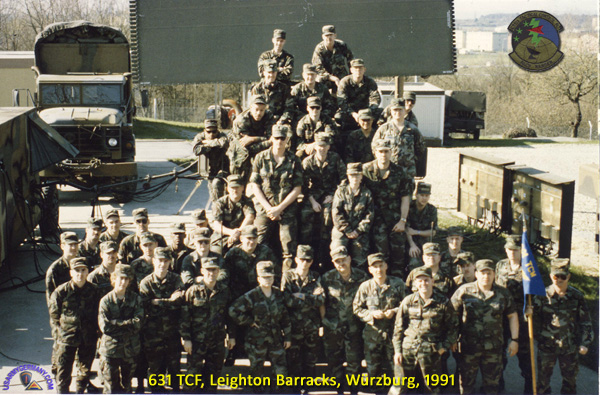
The 602nd had two sister flights under its umbrella, 631 TCF (CHALET) at Würzburg and 632 TCF (CONSOLE) at Grafenwöhr. We deployed with them several times during my tour.
One of the big changes for the 602nd came in 1978 when the entire squadron moved to Türkheim Air Station in the hills surrounding the Ulm-Neu Ulm metro area. Tuerkheim was an old German installation and well suited for the TPS-43E radar mission. The original site was at Nelson Barracks, located in a valley, not a good place for a radar to see from, nor was it very handy for microwave communications. It was rumored that a squadron member had contacted Sam Nunn of Georgia about the abysmal radar coverage available from the site at Nelson Barracks. Whether this was true or not, we did move the squadron to Türkheim. The move was accomplished very efficiently. We returned from a deployment supporting the annual Reforger exercises and, instead of returning to Nelson Barracks with all of the equipment, we just hauled it all to Türkheim, took the weekend off and started getting operational on the following Monday morning. This worked flawlessly and the 602nd was back on the air in no time. I should mention that there were some German hard sites that came up to provide radar coverage when the TACS went down at 5 PM every day. Our German counterpart was at Messtetten, a small city to the west of Neu Ulm almost directly south of Stuttgart. We socialized with the personnel there on occasion. They were a great bunch and it was nice to be able to meet with them.
So from the time of the move until my departure in October of 1979, we worked the skies from Türkheim every day. Most of us still lived in Neu Ulm and bussed to the new spot. A small contingent lived at Türkheim for security and equipment maintenance functions.
A few months into my tour I was asked to work in the squadron’s job control function. There apparently was a need for someone who understood site power production functions, especially when deployed. I jumped at the chance and was very happy in the position. It gave me a real insight into the everyday workings of a mobile CRP and how all that equipment interacted. I had opportunities to sit in the “bubble” during live missions and listen in to the intercepts being directed. It was an opportunity not to be missed.
The squadron had two commanders during my tour. The first was LtCol Peter Cyr and the second was LtCol Ted Kerr. They were as different as night and day. I don’t recall the names of any other key squadron personnel.
After I left I stayed in contact with some of my closer friends from the unit but all that has faded away by now, except for one who happens to live here in Tucson. We are in close contact. That’s about all I can remember for now but will certainly contact you if I find or recall anything more. I never followed the unit after my departure so I never knew what took place after October 1979 or what led up to the demise of the mobile TACS.
|
|
|
|
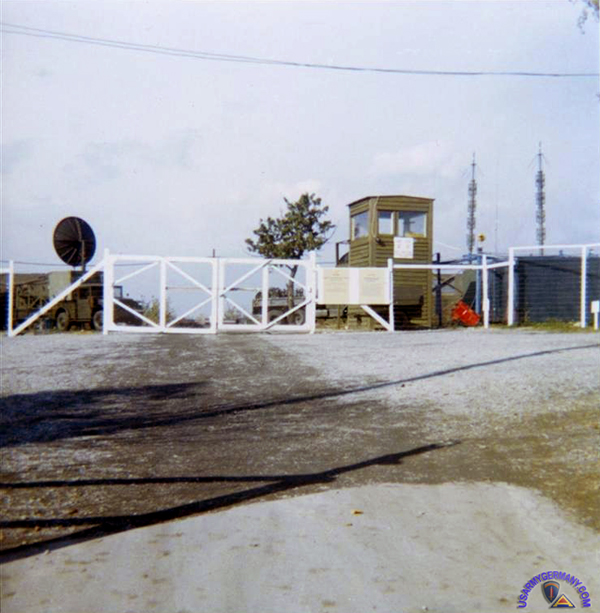 Main gate, Würzburg Radar Site (Michael Miles)
 |
| |
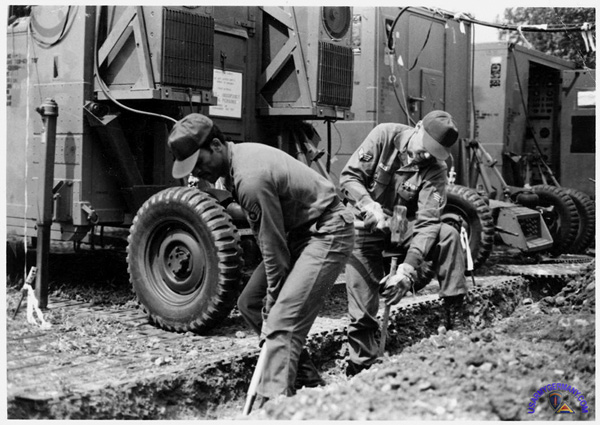 Two members of the 631st Power Pro section digging a 100 ft. cable trough at the site to place
power
and
communications
cables underground. This effort is part of a site beautification
project
ordered
by
Maj Robert E. Flanagan, 631st TCF commander (Michael Miles) |
| |
| (Source: Email from Bill Onderlinde, 631st TCF) |
The 631 TCF a.k.a. "CHALET" ("6-30-wurst"; "Jordan, Jordan, this is Chalet, Chalet, radio check, over") at Würzburg, Germany, Leighton Barracks (Army 3rd ID, Marne Div.) was my 1st assignment after graduating from power production tech school in 1975. As a young, dumb, (fill in the rest) airman, I was concerned with working towards my 5 skill level and having a good time. I was tagged “the Rookie”—even the commander called me that.
We had the EMU-30 and the EMU-12 generators: the 30's were OK, and made a helluva "fahwhoomp" sound when they blew up, but the 12's were a pain in the &^%%$#. We also had a "pod" fuel truck (two 600 gal tanks that loved to spring leaks on a 2 1/2 ton "Deuce & a Half", fuel trailers, and some fixed fuel tanks for our generators (we ran prime power for the site) and acted as a gas station for visiting vehicles. We also had to use the vehicle maintenance shop as a covered work area for our generators.
I didn't get involved with our command and communications structure too much as your typical young airman. But it was usually "the Wing wants this and that" so the 601TCW ruled the roost. Don't recall much about the other squadrons.
My mission was to provide power -- after that it was someone else's responsibility. I knew that the scope dopes tracked the planes, but it was later when assigned to the 4 ASOC that I learned the TCF radar flight would hand off the birds to an ASOC like mine. I know we had a single TRC-97 van with two "lollipop" antennas, and a TPS 44 (I think) radar unit. We had a ground radio section and vehicle maintenance section as well. The vehicles were Deuces, some old style jeeps, a crappy 3/4 (?) ton M-Series pickup that ground the gears like crazy, and another crappy 1 1/4 ton that the TRC-97 sat on. It never kept up on the hills when we rolled out. The best truck was the wrecker -- had a turbo on the engine.
We did support the REFORGER exercises, and I recall once we were alongside some "heavy" squadron with huge air inflated shelters. I don't recall the unit designators. There were of course the other various and sundry eval deployments and exercises. The best one was to Sultzthal (spelling?). We stayed for only about 2 weeks for Phase 1 of the exercise, but came back and stayed for around two months. It was nice because the town had nice gasthouses and the people were friendly. We became honorary citizens -- supported their soccer team when it played nearby teams, and we played their 40+ soccer team also (though we got our butts kicked). The 40+ team came to Wurzburg once and we played another friendship game.
The site was on a hill just past a daycare/kiddie school. Site access meant we were forced to make a hard left/right turn with our trucks. Luckily, I never hit anything going in or out when towing a trailer -- I was only 19 at the time. The site was primitive, mainly quonset huts and some old concrete buildings left over by the US Army/the Germans from WWII probably. There was one toilet that I knew of in the Command Section building that we used if we had to do a #2, but otherwise it was out by the shop for a #1.
We didn't get our first female assigned till much later in my roughly 1.5 year tour and that stopped the #1 being done by the shop. She got either a special blocked off section or her own tent when we rolled out.
I and the power pro people were gradually replaced by AGE people during 1975 and ‘76. I can't recall exactly when, but I know we also took over the lower area and used it for a vehicle parking area -- I have a picture that proves this. Also pretty primitive were our tents and the cold weather gear issued -- it was crap mostly -- unless you knew somebody it seemed. I know I had standard log johns, "fat boy" insulated pants, not sure about the parka. The overboots were the black buckle types that I had as a grammar school kid. I don't even recall wearing any kind of unit patch -- ours, a squadron, or even the 601 TCW.
The canvas and pole tents were heavy as all get out -- I was the skinniest guy in the unit, so I always had to stand on the biggest dude’s shoulder to secure the roof of the bigger canvas/pole tents. Later we received some nice modular, metal framed, lightweight fabric types.
As for the people, I recall the commander, Maj. Flannagan, and I think someone replaced him before I left. My NCOIC was MSgt Leon Wentworth (excellent Guy!), replaced by a TSgt Barth; two Power Pro Sgts (my trainers) I recall were Marty Martinez and a Michael Miles. There was a peculiar SSgt Bray also assigned to my shop. Others were Edjuardo Lujan, JJ Johnson, (in radio or radar), two TRC 97 guys named Chavez, Baker and some other TRC-97 Sgt that burned his eyebrows off when an immersion heater blew up on him. There was also a pain of a 1st Sgt, and a later 1st Sgt nicknamed "Nail-It" Neal. The first 1st Sgt Taylor was a pain who hassled me about my uniform and never deployed -- he had a magic cane that he’d start limping on before each deployment. "Neal" was famous for his advice to the guy doing site maintenance/cleanup -- namely it was "Nail-It" in most cases.
We used many of the Army facilities, such as housing, postal, medical, and finance, and on rare occasions the mess hall. Faulenberg Kaserne was nearby. We initially shared a barracks with the Army -- not a good idea. After we finally got the place to ourselves, it became a very nice place; one or two guys per room, a TV room, but with "gang" latrines and showers. Later on, we cleaned out a downstairs room for a pool room/day room, something like that.
Finally, I visited the place after I'd been assigned to Kleine Brogel AB, Belgium in 1980. My friend Rod Reppy and his wife were still stationed there, about 1981 or 1982 I think. There were new modern pre-fab buildings and a spiffy concrete fuel dike. The site might have been on commercial power via a frequency converter by then, saving wear and tear on the generators.
Well, for what it's worth this is what I recall. It's mostly anecdotal I'd say. There are a few other stories I left out, since they're rather minor in importance. |
|
|
|
| (Source: Email from Michael Miles, 631st TCF, Würzburg) |
I am the Mike Miles mentioned in Bill Onderlinde's email above. I have some photos and an issue of Tiger Talk (601st TVW newspaper) from that time. |
|
| |
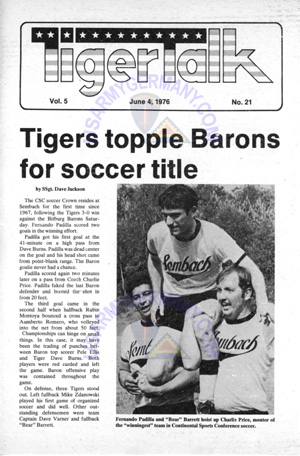
Tiger Talk, June 4 1976
|
| |
631st TCF
Würzburg
|
|
|
|
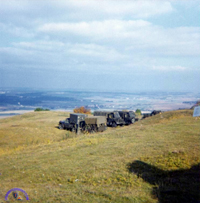
1. Würzburg site |
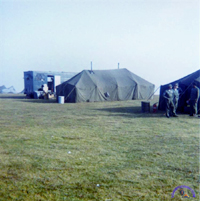
2. Würzburg site
|
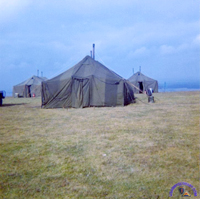
3. Würzburg site
|
|
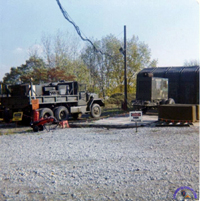
4. Würzburg site |
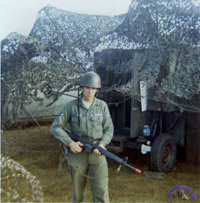
5. Würzburg site
|
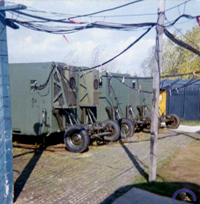
6. Würzburg site
|
|
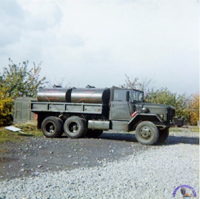
7. Würzburg site |
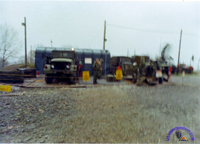
8. Würzburg site
|
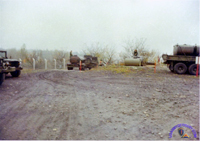
9. Würzburg site
|
|
|
|
| |
| 1983 |
| (Source: Email from Bill Parrish, 602nd TCS, Türkheim) |
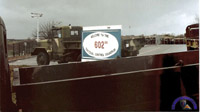 Main gate, Türkheim Radar Site
 |
|
Found some old shots of the 602 TCS site at Türkheim from around 1983-84.
Here’s a shot of the sign at the front gate. Nice site, by the way! |
|
|
|
| |
| (Source: TRAINING TIMES, September 1983) |
Air Force tactical radar unit can 'see' across threat border
by Bob Shipp
From the top of the hill near the Grafenwoehr Army Airfield you can "see" into Czechoslovakia. The U.S. Air Force 632nd Tactical Control Flight does it every day with their radar.
The unit's primary mission is providing the 602nd Tactical Control Squadron, a Control and Reporting Post based at Neu Ulm, with an extension of its radar coverage into the forward battle area.
"That mission can deal with both slow mover or fast mover aircraft," says Capt. Pat M. Armstrong, 632nd operations officer. "It can be in a defensive, offensive or surveillance role, looking into Czechoslovakia for possible hostile aircraft in NATO airspace."
The unit's 65 personnel also get missions from Sector Operations Center III (SOC III), an air defense agency for the 4th Allied Tactical Air Force Region which runs from Fulda to the Karlsruhe area.
"SOC III is responsible for the air defense of southern West Germany," explains Armstrong. "They may ask us to help track, say, some F-15s or F-16s that are scrambling from Bitburg Air Base.
"They will tell us, `We have a critical track coming into NATO airspace and we need you to control them on an intercept.'
"We haven't spotted anything unusual since I've been here, but I was told when I arrived that a MiG-25 flew over the ranges a few years back. I don't know that for a fact, but there are so many low flying fastmovers that come over the area..."
The primary day-to-day peacetime mission here is close air support on the GTA ranges, tracking A-10s on training flights.
"The desired scenario with A-10s is to pick them up on radar about 45 miles away," says Armstrong. "We then give them weather, traffic advisories and any pertinent command and control information they may need.
"When we pick them up we give them bearing and range to Capt. Tasker, the contact point at Bleidorn Tower. We hand them off to Capt. Tasker and he brings them in on target.
"It's pretty routine but the close air support scenario varies even though it is fluid. You must be flexible because it varies from pilot to pilot."
Armstrong says the site's location on the hill has advantages and disadvantages. "We have a great panoramic view of the entire area," he states. "We've seen a lot of 'air shows' so to speak. The C-130s and C-141s come in and put on air shows with air drops or something.
"You get a good sense of being in the woods here, but you know that five miles away you have a nice comfortable place to live.
"We enjoy it up here, but it does get awfully cold in the winter time," he continues. "It even snows here when it's raining in Graf.
"We occasionally have hearing problems and sometimes get jumpy when the firing starts because there are firing points on all sides of us. But we're used to that," he adds.
Armstrong says being on an Army post is different until you get used to it. "Then it's just like being on any other base. A lot of things are the same, but at Graf it is even different for permanent party Army personnel because of the training aspect."
Armstrong believes air attack is the biggest threat. His unit deploys about four times per year for training.
"We don't function during wartime unless we get off this hill quickly," he says. "You have to stay in tune. The more practice you get doing your wartime job the more effective you will be and the greater your chances of surviving. That's true for the Air Force as well as the Army.
"We are so close to the border that, when hostilities begin, you better have your stuff ready. We're going to have to roll out of here and do it quickly to survive." |
|
|
| |
| (Source: FRONTLINE, Jan 27 1984) |
Air Force unit controls the skies
by Gary Lindsley
The people of Leighton Barracks refer to it as the "eyes and ears of Wuerzburg." To U.S. Air Force pilots, it is known as "the third wingman."
The 631st Tactical Control Flight, provides radar support to the Army, Air Force, and other NATO forces.
"Our mission is to provide radar support for aircraft intercepts;" says 2nd Lt. Paul A. Schwanitz, an air weapons controller for the 631st. |
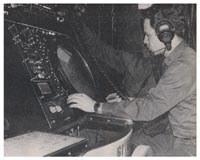 Lt Paul A. Schwanitz
 |
|
"We tell the pilot what he can't see. We provide him with a bigger picture than what he has on his screen," says Schwanitz.
According to Schwanitz, in wartime the unit would be redeployed to fill any gaps in the European command and control's radar picture. "We would go to the forward edge of the battle area. If we were needed to provide additional coverage, we would move elsewhere. We're a highly mobile unit," he says.
"I am the communications link between the controller and the outside world," says SSgt. Ronald Francis, a weapons controller technician.
"My job is to assist and coordinate with Lt. Schwanitz. In essence, I am another set of eyes for the scope. We're always on the lookout for violations," he says. |
|
|
Another part of Francis's job is to test and evaluate the controller's and technician's proficiency in their jobs on a monthly basis.
"My job with the 631st has provided me with a lot of challenges. We have to know all of the war plans of all of the NATO countries. I like challenges that are new to me since they provide me with new knowledge.
"That knowledge is essential and instrumental in the pilots being able to carry out their missions. The pilots really need us. In fact, a lot of pilots refer to us as their third wingman," Francis explains.
"It's a lot of responsibility," says 2nd Lt. Gary M. Perdew, another air weapons controller and the unit's security officer.
"If we don't give pilots enough information, they'll be casualties. That's why we're constantly training and running intercept flights," says Perdew.
"In deploying to the forward area, we provide surveillance, close air support for the Army, and send out fighter aircraft to intercept or destroy targets the Army can't eliminate," explains Capt. Dale L. Goodell, commander of the 631st.
Goodell says his unit's mission is very diversified. Besides running air to air intercepts, his unit runs refueling tacks for aircrafts. |
|
|
|
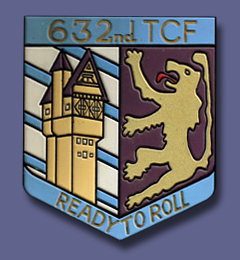 632nd TCF Insignia 632nd TCF Insignia |
| |
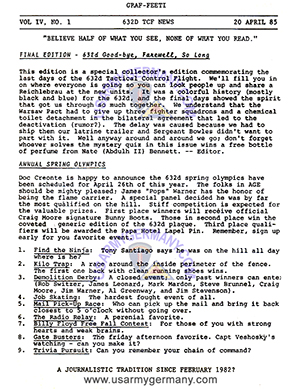
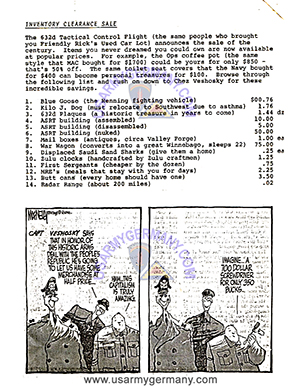
632nd TCF unit newsletter, Final Issue (Steve Brown)
|
| |
| 1985 |
| (Source: Email from Steve Brown) |
I thought you might be interested in these images.
I was there at Graf when the (632nd TCF) site was closed, then was sent to Sembach to the 603rd.
I was a 276xx at that time. |
|
|
|
| |
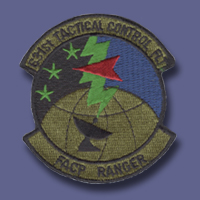 631st Tactical Control Flight Patch 631st Tactical Control Flight Patch |
| 1987 |
| (Source: Email from Paul Costinett, 631st TCF, 1987-91) |
I am currently a SMSgt in the Air Force. At one time, I was stationed at the 631 TCF in Wurzburg, W. Germany. I was there from 1987 until the unit closed in 1991. I was an Aerospace Ground Equipment (AGE) mechanic, responsible for ground power to the radar systems as well as air conditioning, fuels and heating. I have some pictures you may be interested in of some of the equipment we had.
I had read Bill Onderlinde's email posted on your site as well as the article from "Frontline", also posted. I recall that article and picture framed up in the hallway of the Ops building. Onderlinde is correct in that the power for the site was commercial, running off of two converters. The spiffy new fuel dike was worn by the time I go there. We had diesel, JP-4 and MOGAS tanks on site, as well as many M-49 fuel trucks for hauling fuel. As an 18 year old who never drove a stick shift, the M-49s were pretty awesome!
The unit, specifically AGE, continued the tradition of gassing up any Air Force vehicles which happened to pass through the area. I can still here the "ka-chunk" of the Serv-O-Plate tool ringing up another "sale" of MOGAS. We had EMU-30 generators dual mounted on a pallet and mobilizer. Collectively it was called a -8 (Dash 8) Pallet. The -30s could be paralleled together or with another pallet to share the load created by the radar system it powered. We also had two Dash 12 generators for Wideband.
That hard left turn needed to get into the site by Bill is no joke. The site was at the top of the hill, built on top of a former WWII German bunker. I found the entrance once, but it was filled in up to the keystone. Also a marker stone etched with either "1941" or "1944". Anyhow, the turn he talked about was severe. Drivers of 5-tons and M-35s with XM-720/530 shelter mobilizers behind them had to master this critical turn, or else you had the dubious ass-pain of having to back up your load. I think backing was worse than simply hitting a building in order to make the turn!
Since the site was on the highest point on Leighton Barracks, the AFN radio station was right next door. The facilities were fixed, no tents. The exception was a semi-permanent shelter down at the lower end of the site. This was our mobility area and location of our M-50 water truck. This water truck was burned by an arson in 1990 and is one of the photos I have. Everything else: AGE, VM, Comm ops, Ops, Radar maintenance, Supply, QA and Ground radio/Wideband/SATCOM were all fixed shelters. The last old building was this red metal shack thing at the main gate to the site. It was demolished prior to a major inspection. I believe the commander, Maj Whiterhurst, painted the galvanized steel gate grey. Many tree leaves weren't green enough for him, so they got a coat of paint as well.
The First Sergeant for most of my tour was MSgt Bill Harriff. A real SOB who smoked Marlboro Reds and broke off the filter. The second Shirt was a SMSgt, whom I can't recall. During my tour, we had our own dormitory which turned out to be a converted morgue. Nice. The second floor had many Army administrative offices, but we had the run of the first floor. Bill mentioned something about clearing out some area downstairs for a pool table during his tour. During my time, that downstairs had a fully functional kitchen with TV and VCR. Our washers and dryers were down there as well as a game room with foosball, pool and darts. Also a sorta storage/transient room we called "The Mole Hole". The Hole was for undistinguished visitors and newbies who didn't have a room on the first floor yet.
We did not use the Army chowhall, being paid a separate allowance. The legend goes a 601 TCW wing king came down for a visit, ate at the Army chow hall, puked, and then said something to the effect of "F$*& that, put them all on separate rats."
|
|
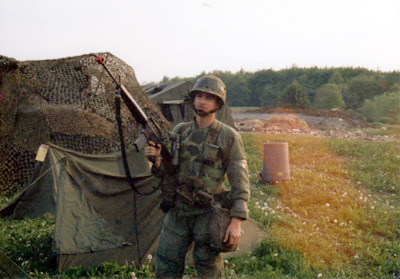 Paul Costinett - On my first deployment with the 631TCF. The red object on the end of my M-16 is a blank firing adapter (BFA). I am wearing the standard crappy chemical warfare ensemble with a bullet-proof vest. Standard-issue WWII steel pot on my head (Kevlar hadn't been issued yet, or even known really). Circa 1987, probably October.
 |
|
| I participated in several exercises including two Allied Air Forces Central Europe (AAFCE) Tac Evaluations These were the Operational Readiness Inspection for the FACPs back in the day and involved two phases. Phase 1 was a "crash-out" in which we would be recalled at 3 am, directed to pack everything up and bug the hell out as fast as possible. We'd then go hide in the woods for a while, then return to garrison and put it all away. Phase 2 was a full on deployment, packing it all up again and convoying out. Upon arrival, we'd sweep the area, refuel the trucks, set up the radar and establish ground power. AGE had the distinction of getting power up within the first hour on site and we never failed. Back in garrison we provided support to the radar ACs and were standby to fire up a -8 should the converters every drop out. By the time we closed, the -8s had a concrete pad and an overhang to work under. |
|
|
When we closed the site, everything left..everything. Every truck, tool box and sandbag was claimed by someone. I ended up stationed at the 606th by 1993. While on deployment in Italy with a sister unit, I came upon a familiar toolbox. I opened it up and discovered this was a CTK (composite tool kit) that had sat in our AGE shop. Not only had it sat there, it was the main tool box. I proved it by studying the etching on the side of a crescent wrench. Every tool had to be etched or re-etched if the tool moved to a different unit. Whoever did the re-etching on this tool did a poor job, because "631 TCF CTK-1" was visible to me. This was indeed my old toolbox. So I stole the crescent wrench and have it to this day. But I digress.
Once we closed up, that was it. People just drifted off on assignments. I was one of the last ten people after closing, eventually moving to England. The ROMADs/ALOs took over our site once we left. My understanding is it is abandoned now, or simply not used by Air Force anymore. There's a whole bunch of stories I'm sure. Stories about the bitter cold on mountainous deployments, the snow and rain. Tales of pulling out 300 yards of 3-phase power cable, only to realize I had the wrong end and having to reel this stuff back in and pull it back out AGAIN. Stories about painting the 3rd ID "Marne Dog"'s nutsack day-glo orange, upsetting the entire installation. One time a radar tech named Randy fell off the TPS-43 sail and busted his back pretty bad. Incidentally, the 631 was the first FACP to ops check and deploy the TPS-75 radar system which replaced our 43. I think that old sail is probably on an Iranian border somewhere now. Oh, and if Bill Onderlinde ever reads this here's a message, "You're right, Bill. Those -12s sucked."
Anyway, I have a complete list of 631 TCF commanders, a photograph of the last cadre, a copy of the Inactivation Ceremony program (which includes the commander's list and an extensive unit history), several photos and a unit patch. The patch, unfortunately, has a story of its own. When a unit patch was developed for the 631 TCF, sometime in the early 90s, there was an error in manufacture. The motto of the unit was to be "FACP Rangers". The stitching error resulted in "FACP Bangers" instead. No kidding. It is this patch I have, and not the authorized FACP Rangers. Eventually that Shirt I can't recall figured it out and made us all take off the "Bangers" so they could replace them with "Rangers". I sure wish I had a "Rangers" patch.
ADDITIONAL INFORMATION
Here is the list of commanders:
 Capt John H. Roseboom Feb 65 - 11 Apr 66 Capt John H. Roseboom Feb 65 - 11 Apr 66
Capt Jesse D. Jordan 12 Apr 66 - 15 Oct 66
Maj Ronald E. Gustafson 16 Oct 66 - 15 Jul 67
Capt Franz D. VonRabenau 16 Jul 67 - 6 Jan 69
Capt Charles W. Rush 7 Jan 69 - 21 Oct 71
Maj Charles M. Linville 22 Oct 71 - 3 Aug 75
Maj Richard E. Flannagan 4 Aug 75 - 25 Apr 77
Maj William D. McClintock 26 Apr 77 - 15 Apr 80
Maj Donald J. Tomaschko 16 Apr 80 - 14 Jul 82
Capt Dale L. Goodell 15 Jul 82 - 4 Jun 84
Capt John L. Motyl, Jr. 5 Jun 84 - 16 Jun 86
Capt Edd W. Richardson 17 Jun 86 - 19 Jun 88
Maj Charles M. Whitehurst 20 Jun 88 - 31 Jul 90
Maj David Burleson 1 Aug 90 - 30 Sep 91
Unit closed in Sep 1991. |
|
| |
631st TCF
Würzburg
|
|
|
|
1. Würzburg site |
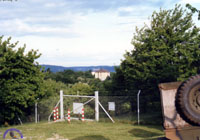
2. "Back 40"
|
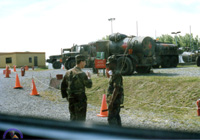
3. Fuel yard at Würzburg
|
|
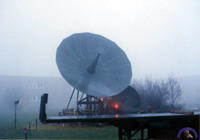
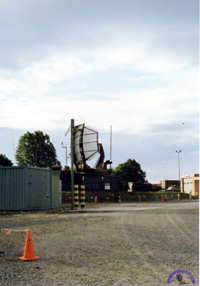
4. SATCOM dish |
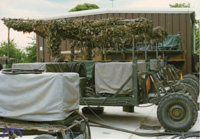
5. Generator pallets
|
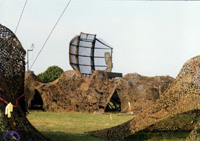
6. AN/TPS-43E radar in the field
|
|
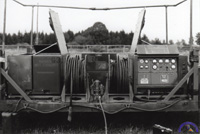
7. - 8 pallet |
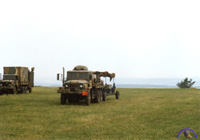
8. M-49 fueld truck
|
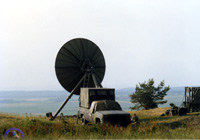
9. TRAC shot
|
|
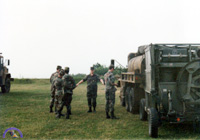
10. Getting ready to leave field site |
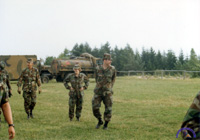
11. 631TCF personnel
|
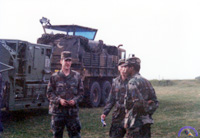
12. Makeshift entry control point shelter
|
|
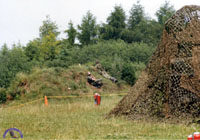
13. Fuel area in the field |
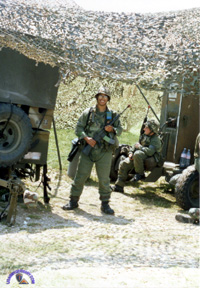
14. Security in the field
|
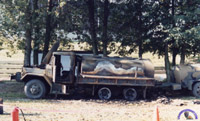
15. Torched M-50
|
|
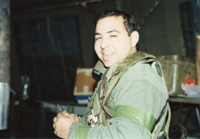
16. Guido |
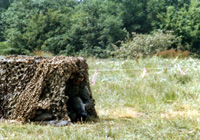
17. "Bunker"
|
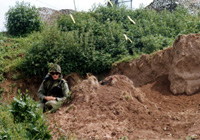
18. Wilhoit
|
|
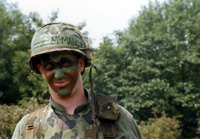
19. McMahon |
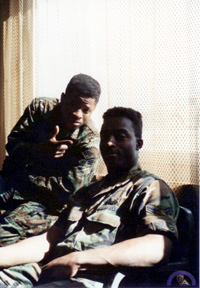
20. Brown and Oda, AGE Shop
|
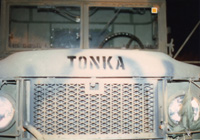
21. TONKA
|
|
|
|
|
|
| 603rd Tactical Control Squadron |
| |
| (Source: Rodrigo Genhard, Germany) |
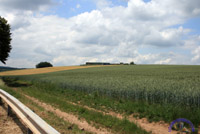 Former MUTATE 407L site
|
|
Picture of the former FACP of the 611th TCF, callsign MUTATE, near Alzey/Rheinhessen. There are several private German firms that use the facility today. |
|
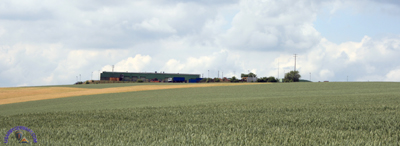 Close up of MUTATE, 2007
 |
|
|
| 1991 |
| (Source: MESSENGER, Aug 16, 1991) |
611th TCF deactivates, replaced by 601st TCS
By Bob Baldi
The 611th Tactical Control Flight was officially disbanded and its personnel and equipment transferred to the 601st Tactical Control Squadron during a small ceremony held at Orbis Remote Site, Aug. 2.
The ceremony also marked the change of command between Flight Commander, Major Terrence J. Maher and Squadron Commander, Lt. Col. Dan Kienker.
The only Air Force remote site in the Mannheim Military Community, Orbis can trace its roots back to shortly after the close of World War II.
Located on a hill known by Germans as Koppelberg, the first United States presence on the site was that of an Army signal and communications post.
|
|
|
|
In the late 1960's the site was taken over by an Air Force Forward Air Control Party and a Radio Relay section. In 1973 the detachment was formally designated the 611th Tactical Control Flight. Since that time, the mission of the 611th has been to operate and maintain a highly mobile Forward Air Control Post unit in support of United States Air Force Europe and NATO tactical operations.
The flight's on-site facilities underwent a complete renovation in 1985 and currently provide work and billet space for approximately 100 airmen.
Although isolated and small, the 611th TCF became well known in Air Force circles for its competent and professional performance. The unit reached the pinnacle of success in 1990 by winning the Commander-in-Chief trophy for the best support unit in USAFE.
The change to a new organization will increase the unit's personnel and equipment strength said Maher, the departing commander. The site's mission will be altered somewhat as well to reflect its growth in responsibilities. |
|
|
|
| |
| (Source: Email from Rodrigo Gebhard, Germany) |
622nd TCF
Rheingrafenstein
|
|
|
|
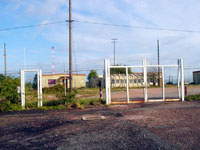
1. Main gate, 2004 |
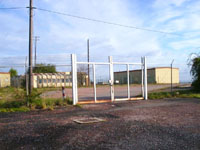
2. Site is abandoned
|
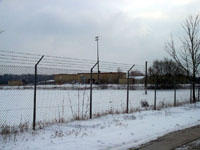
3. Winter 2005 view
|
|
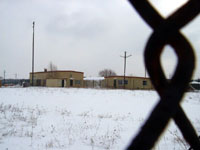
4. Rear view of site buildings |
|
|
|
|
|
|
|
| 606th Tactical Control Squadron |
| |
| (Source: Port Reporter, April 1987) |
606th TCS celebrates twice
By Wayland Jessup
BASDAHL, West Germany - The 606th Tactical Control Squadron celebrates two anniversaries this spring. March marks the 10th year the 606th has been operating in the Norddeutschland Military Community. In April, members of the 606th celebrate the fifth year of their move to their present location at Basdahl.
In those 10 years, the 606th has been performing a rather unique mission. Being a tactical unit, it is one of the few Air Force squadrons that has the capability to move to locations that need their services.
"About 90 percent of the Air Force is fixed installation units," said Col. Robert Zielinski, commander of the 606th Tactical Control Squadron. "We area mobile unit and practice that capability regularly."
Of course, making sure they move to whatever location they are needed at is the responsibility of the Logistics Section. |
|
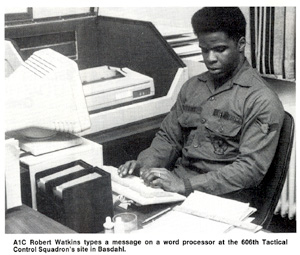 A1C Robert Watkins types a message on a word processor
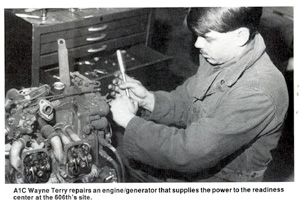
A1C Wayne Terry repairs an engine/generator |
|
"It is our responsibility to coordinate plans for deployment. We make sure there is fuel, food and whatever else is needed," said SSgt. Jerome Galaway, logistics plans technician.
"We can mobilize more than 100 trucks in a short time," Gallaway said. "If we need to, we can helo-lift equipment into a site. The main objective is to be able to convoy to a site and deploy for contingencies.
"We get a lot of support from the U.S. Army to accomplish our mission," he said. "Especially 69th Transportation Company, who does the maintenance on our trucks that we don't have the capability to perform.
"Once the members of the 606th get to their designated site, their mission is to support NATO and U.S. forces.
As Zielinski says, "We control fighter aircraft to intercept intruding aircraft. It's lust the opposite of what an air traffic controller does in the civilian world - they try to keep aircraft apart, we bring them together."
This is done through the Control and Reporting Post (CRP). Within the CRP is a radar system that tracks the movement aircraft.
To inform NATO and U.S. forces about these tracks, there is a Message Processing Center (MPC) also within the CRP. The MPC can receive information in one mode and translate it into another mode to be used by NATO and U.S. forces.
For the past 10 years the 606th has been an active part of NDL. The barracks for the squadron is located on Carl Schurz Kaserne. The members are active volunteers and field teams for every unit level sporting event in NDL.
"We enjoy contributing to the community," Zielinski said. "We want to continue enjoying the same vein of contributing to the community as well as enjoying what it has to offer." |
|
|
|
| |
| (Source: Port Reporter, Sept 26, 1986) |
"Air Force's Army" detects trouble and takes appropriate action
By Wayland Jessup
WANNA, West Germany - Norddeutschland is generally considered the U.S. Army's area of responsibility along with NATO forces from Belgium, England and the Netherlands. However, to protect these ground forces from possible air attack, the U.S. Air Force keeps units in NDL ready to deploy.
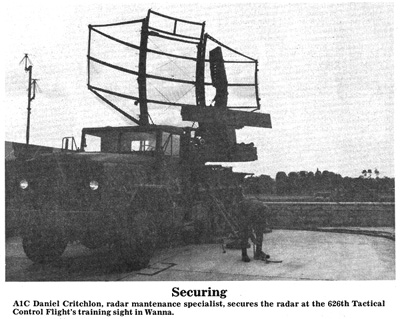
The 626th Tactical Control Flight, with barracks located on Carl Schurz Kaserne and its training site here, is one of those units.
The mission of this Forward Air Control Post (FACP) is to track and identify air traffic within a designated area.
|
|
 FACP radar
 |
|
"What an FACP does is detect, intercept, identify and take appropriate action against aircraft during a time of tensions," said Capt. David Boozer, commander 626 TCF.
"We also guide our aircraft to areas where they may be needed," Boozer said. "Germany has the most dense air traffic in the world, so we have to make sure our aircraft are in the right sector and at the right altitude."
"We train on the radar, which is the heart and soul of our unit. It is good up to 97,000 feet and has a range of 200 miles," he said.
Sgt. Phillip Weeks, radar technician, also said the radar is the heart of the unit. "If there's no radar, there's no controlling. We have to keep the radar ready."
"We have a full array of radar equipment and soon we will have satellite equipment. With this equipment we can give our commander the whole picture," Boozer said.
|
|
|
"Even though we are Air Force, we have to train to defend ourselves against ground attack because we are a mobile unit and have to move to wherever we are needed in a matter of hours. We call ourselves the `Air Force's Army' because just like the Army, we go to the field four, to six times a year," Boozer said.
"It's tough," Weeks said. "Donning the mask, rolling in the mud; it tests your limits."
"We are a self-contained unit and take all of our support people with us. We can go to our operations by land, sea, or air," Boozer said.
As part of the NDL community, the 626th receives support from the NDL community staff.
"The Army's support for us has been outstanding," Boozer said." Col. Hahn (deputy community commander) is responsive for our needs. Most of our people live in the housing areas and are full partners in the community."
Sgt. Thomas Bellon, an engine mechanic, agreed, "We get real good support from the Army. They do the maintenance on our vehicles that we are not equipped to do."
There are onl 78 persons in the 626th. It is a small unit compare to other FAPCs.
"Because we're such a small unit and have to do the same work as a much larger unit, we have the opportunity to get much more experience than we would in another unit," said 2nd Lt. Paul Hershey, weapons director.
As SSgt. Gary Cook, radar technician, said, "The hours can be long, but the job is rewarding." |
|
|
| |
| (Source: Port Reporter, March 1988) |
"Inspector of the Skies" is no stranger to the field
By Alex Gray
Soldiers can tell you what field training is like; long hours spent out in some field or patch of woods, yearning for a regular meal, a hot shower and a chance to relax.
Soldiers in Norddeutschland can tell you that rain, snow, cold and mud, or any combination thereof are usually a feature of field training.
The Army, however, has no monopoly on discomfort. In NDL, the United States Air Force's mission calls for ground units that are ready and able to take to the mud or snow, defend themselves, and accomplish their mission.
One such unit is the 606th Tactical Control Squadron, with facilities at Carl Schurz Kaserne and Basdahl. The squadron's mission is ground-based surveillance, communication and coordination with NATO air defense units and fighter squadrons. If war comes, the 606th TCS will deploy and become part of the NATO air defence network, making sure NDL's skies remain safe and in allied hands. |
|
| |
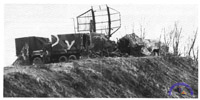 Radar site during field training
 |
|
To do this, the 606th TCS must keep up a training schedule that would make some Army units jealous. The squadron performs as many as 10 field problems a year to keep in top shape for its wartime mission.
Recently, the 606th TCS conducted a field training and evaluation exercise near the town of Stade. The exercise was in prepararation for an Allied Air Forces Europe tactical evaluation. The evaluations are run periodically by NATO to ensure units are prepared to perform their jobs in wartime conditions and stay alive while doing so. |
|
|
| |
The exercise was a combination of mission performance -- fullfilling the squadron's monitoring mission -- and tactical training. The squadron arrived at the site, set up its operations and communication equipment, prepared defensive positions and took on a rigorous training schedule.
U.S. Air Force evaluators stood by and observed the squadron in action. While operations and communications personnel performed their tasks as "Inspectors of the Skies," tactical exercises kept others equally busy.
Frequent attacks by aggressors kept perimeter guards and tactically trained personnel on their toes. Blanks, smoke grenades and artillery simulators gave reality to the attacks.
The 606th's commander, Lt. Col. Timothy Davis had positive things to say about his unit's performance. "The evaluation and exercise went very well," Davis said. "As always, we found a few areas where we can improve. We'll take those home, work on them, practice more and be ready to do our mission."
Commenting on the exercise, Airman 1st Class Julianne Laborczy said, "It's good training. It's not the same as simulating in garrison. We get to come out here and play it for real." |
|
|
| |
| (Source: Port Reporter, March 1990) |
NDL airmen work with Red Baron's squadron
by Leslie Harold
The U.S. Air Force's 606th Tactical Control Squadron deployed to Witmundhaven recently, setting up operations right outside the German military airbase there.
With its huge, mobile radar antenna and accompanying air-surveillance and combat air control capabilities, the 606th plays a vital role in NATO's ability to defend against hostile air attacks. A tactical squadron, it can deploy as many as 100 fully-loaded vehicles in as few as 24 hours if necessary. Everything - radar equipment, scopes, plotting boards, mobility gear, weapons, tent stoves and sleeping bags go to the field. Once they're moved out, the 606th's base site in Basdahl looks like an empty lot. |
|
| |
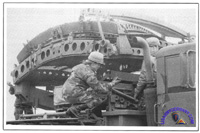 Mobile radar
 |
|
"The 606th is part of the whole NATO scheme," said Maj. Jeffrey Harwood, commander of the 606th TCS. "We supply the radar and radar picture and feed it into the larger fixed sites within the NATO scheme to provide a local air picture of the Norddeutschland region."
While the 606th is accustomed to deployment, spending as much time as most Army soldiers in the cold, wet and mud, the deployment to Witmundhaven was unique in several ways.
The German airbase located there is the home of the original squadron of the "Red Baron," World War One's most famous flying ace. Known for his bloodred Albatros and Fokker fighters, pilot Manfred von Richthofen shot down 80 enemy aircraft before being shot down himself. Von Richthofen's highly successful "dogfight" tactics opened a new era in aviation. |
|
|
|
| |
Face-to-face talks with the pilots involved in air intercept missions were another factor that made the Witmundhaven deployment unique. The 606th's weapons directors, who provide radar target information to fighter pilots through radio links, usually debrief missions over the telephone. Face-to-face briefings and debriefings provide excellent training for all personnel involved in the missions.
Training was the major purpose of the Witmundhaven deployment. While the 606th provides a radar air picture of Northern Germany to the fixed NATO sites, it cannot perform its mission if it is taken out by enemy attack. To avoid that, the squadron maintains its mobile and tactical wartime readiness. "We handle our own site security," said 21Lt. Kimberly Smith, a weapons director. "We also do our own battle damage assessments and deal with unexploded ordnance." In addition, all of the 606th's airmen are trained to handle medical casualties and how to survive chemical attacks. They spend a great deal of time in chem suits or behind sandbags with M16's defending the site against simulated aggressor attacks. |
|
|
| |
| (Source: Port Reporter, March 1991) |
Deactivation ceremonies for the US Air Force's 626th Tactical Control Flight took place Feb. 1 (1991) at Wanna, Germany. Unit commander, Maj. Lester C. Ferguson, and Col. Kenneth Reynolds, 601st Tactical Control Wing commander took part in the casing of the unit's colors. |
|
|
| |
| (Source: Port Reporter, November 1992) |
606th ACS sings 'Bye-Bye Blues'
By Leslie Harold
After 15 years of helping NATO to defend the skies over northern Germany, the 606th Air Control Squadron recently announced that it is moving south to Bitburg Air Base.
The mission of the small Air Force squadron, located at a complex in Basdahl, a town about 30 kilometers from Bremerhaven, has been to provide radar control to allied aircraft, radar surveillance of the skies over northern Germany, and to collect, evaluate and distribute air radar defense information and data to other command and control systems in behalf of NATO.
An integral part of the squadron's mission has been its ability to move its radar, command and control, and communications equipment rapidly to other locations in the event of a conflict. The airmen of the 606th spent a great deal of their time deployed to various locations in Germany, Denmark and the Netherlands, practicing and training their wartime mission. Many of the 606th ACS's people and some of its equipment also deployed to Southwest Asia in support of the Gulf War.
"The move to Bitburg is a result of the changing missions of NATO and the U.S. Air Forces in Europe," said Col. Rudnaldo "Butch" Hodges during a recent telephone interview. Hodges said that the Air Force's senior leadership feels that the 606th ACS should be located along with fighter units as part of the Air Force's new Composite Wing Concept. And, its ability to be airlifted has improved with new, recently acquired command and control equipment. "It makes sense to be located near an airfield so we can be moved quickly to other areas in the theater," Hodges said. "In addition, our training would be enhanced, being able to work directly with the fighters. The move will also help the squadron support-wise, reducing the logistics problems caused by distance from Air Force support centers.
Hodges said the 606th has enjoyed its time in northern Germany. "The support we've received from the Army in Bremerhaven for our airmen and their families has been superb," he said. In the past, the squadron has had as many as 270 airmen and their families assigned to northern Germany, the vast majority living in Bremerhaven and commuting to the Basdahl radar complex each day. But the end of the Cold War, the drawdown of U.S. Forces in Europe, the changing shape of NATO, and the manning requirements for the new command and control equipment have greatly reduced the number of people assigned to the squadron.
The 606th ACS will hold a formal site closure ceremony on November 6 acknowledging the support of local NATO forces and the military and civilian communities in Bremerhaven and Basdahl. After the airmen and their families move south, a small contingent of airmen from the 601 st Support Group OL-A will remain at Carl Schurz Kaserne for a short time to take care of any administrative tasks that arise. |
|
|
|
|
| 609th Tactical Control Squadron |
| |
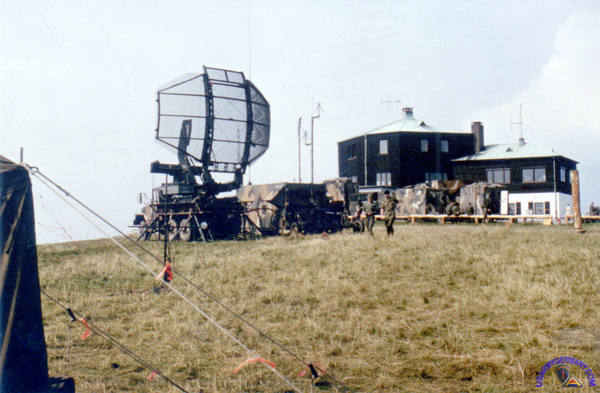
The AN/TPS-43E of the 619th TCF during a deployment |
| |
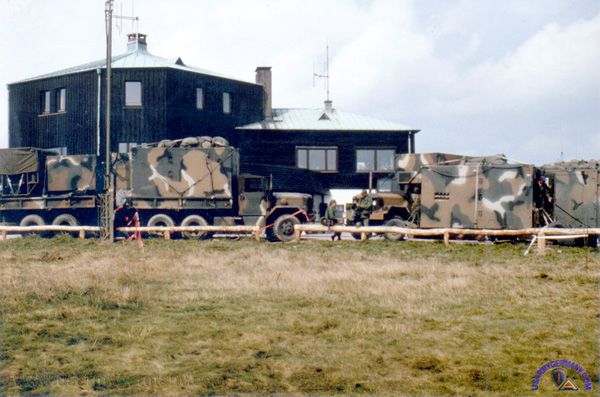
Support vans and equipment crowded in the parking lot on a mountain top |
| |
| (Source: 609th Tactical Control Squadron Unit History, Air Force Order of Battle, usafunithistory.com accessed 04/30/2021) |
| 609th Tactical Control Squadron |
The 609th TCS and 619th TCF were activated at Bad Muender and Schwellentrup respectively on 1 April 1976.
A month later, on 1 May 1976, the 629th TCF was also activated at Schwellentrup.
The 609th TCS was assigned to the 601st Tactical Control Wing. The 609th provided a control and reporting post element in the TACS organization to improve airspace management and surveillance activities in northern Germany.
Equipment for the 609th TCS came from Cannon AFB, New Mexico, and that for its two flights arrived from the 103rd TCF, Orange County, Connecticut, and the 101st TCF, Worchester, Massachusetts.
Shortly after, on 21 May 1976, Hessisch-Oldendorf Air Station was officially opened under Project Creek Control and, on 20 September 1976, the 600th TCG and 600th Combat Support Squadron (CSS) were activated to provide control and support for 2 ATAF radar units.
This left three new units yet to be activated. Almost a year later under Project Creek Brahman, on 15 March 1977, the 606th TCS, 626th TCF, and 636th TCF were activated at Carl Schurz Kaserne near Bremerhaven.
This marked the completion of mobile radar expansion into Northern Germany. But, unknown to wing officials at that time, the final bed-down of these latter two flights would become a monumental headache.
Going into 1977, the 609th TCS and its two subordinate flights were declared operationally ready on 1 February.
Also, yet another TAGS milestone was reached on 22 March 1977, when the 603rd TCS received the first two "E" model TPS-43 radars.
After initial checkout at the 603rd TCS, one of the TPS-43Es was sent to the 601st TCS on 22 April 1977. Four days later a TPS-43E radar was used for the first time in an exercise as the 601st TCS participated in Certain Fighter.
Eventually, all wing mobile radar units would receive the TPS-43E radar seta |
|
|
| 1977 |
| (Source: Email from John M. Hopkins, a.k.a. "Captain Crash") |
I was stationed with the 629th Tactical Control Flight (Schwellentrup… support base Hessisch-Oldendorf Air Station… “The HOG”), from 1977 – 80.
The 619th was our sister unit, co-located on Schwellentrup hill. Nearby was also a US Army microwave relay tower.
I was an AFSC (similar to MOS) “276X0” “Aerospace Control & Warning Systems Operator” (AC&W… “Scope dope”).
I also acted as a (self-trained) Command Post HF/SSB radio operator (the CP always had heat and coffee).
The correct callsign for the 629th is BRAHMA. |
|
| |
| 1979 |
| (Source: Email from Michael Gordon) |
I was assigned to the 619th Tactical Control Flight from July 1979- Feb 1982 as a A1C. I was a supply type my whole 28 year career in the Air Force before I retired as a Chief (E-9). This was my second of 11 assignments with less than three years in the service.
My first after tech school was at Andrews AFB MD with AF One so it was a slight shock. I flew to Germany in a C-141 configured for passengers because this was right after the bad DC-10 crash in Chicago and charter flights to Germany were still disrupted. I arrived at Hessisch-Oldendorf (HOG) were I was diverted from 609th TCS to 619th TCF as part of the plus up in manpower for a new mission coming on board. Supply went from 2 to 3 people and I was the new guy.
We Lived on HOG with 3 to a dorm room and traveled by bus to and from the radar site at Schwellentrup 5 days a week. All SSgt's had the additional duty of driving the bus on a rotating basis, if they were not suspended because of a crash. The Bus left from our Dormitory at 0600 and got to the site about 0700 and left at 1600 arriving back about 1700 weather and traffic co-operating of course.
We had about 65 folks assigned to the 619th and about 50 to the 629th which shared the radar site with us along with the second floor of the dorm, 619th having the first floor.
We were above the SKI slopes and during the winter it was an interesting drive. The good part was we shut down in winter if it got to -40 or worse so we had a quite a few early release days. If it was bad with red road conditions we would muster at 0600 at the Dorm, have roll call and then the rest of the day off as we could not get to the radar site.
While in the 619th I made SRA below the zone and SSgt on the first try. I got a two-man dorm room because of my new rank. We were all on separate rations as there was no food on site and chow hall hours were hard to catch on bad days. |
|
| |
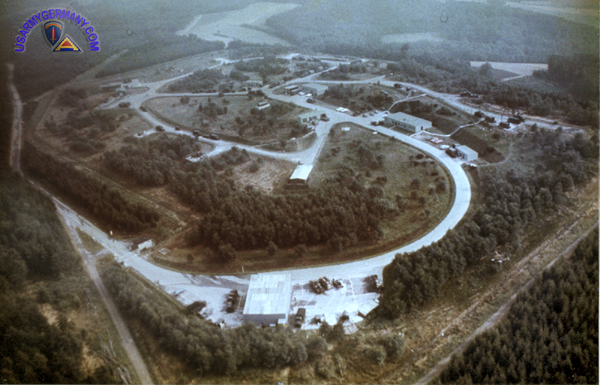
Schwellentrup, 619th TCF deployment site |
| |
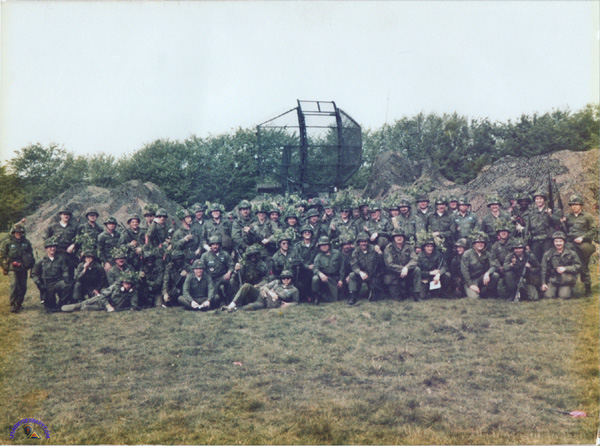
619th TCF group photo during NATO TAC EVAL May 1981 |
| |
The 619th made over 20 deployments while I was assigned including 90 days in Saudi Arabia as part of ELF ONE Jun-Aug 1981. We were very good at recalls, deployments and doing what we had to do. As Supply I was tasked with weapons transport as we did not store most at the site but at HOG with only enough for Charge of Quarters (CQ) on site to always be armed just in case of what we did not know. CQ was another rotating duty you had from 1600-0700 for week days and 12 hour shifts on weekends making sure the site did not wander off anywhere. We did hourly phone checks with HOG so they knew we were still there. We did all our own security on site and while deployed as security forces were too stretched to support in garrison or while deployed. Gate guard duty in the gate shack was a good place to read a book on between unlocking the gate for traffic going in and out.
Supply was located with job control and the only place you could smoke on site because we had above ground Fuel tanks and the no smoking zones were bigger than the radar site was. That helped me get to know lots of people on their Smoke, warm up or bathroom breaks as we had one of the few indoor plumbing facilities on site.
I enjoyed my time in 619th and my following assignments, RED HORSE being my next because of my experience from my time in Germany. |
|
| |
619th TCF
Schwelentrup
|
|
|
|
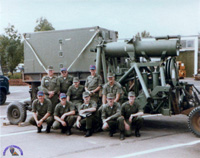
1. "Plus-up" team |
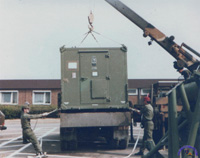
2. ASRT arrives
|
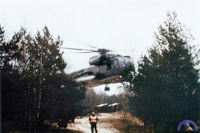
3. Airmobile deployment with CH-53
|
|
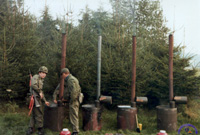
4. Lunch outdoors |
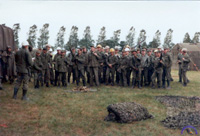
5. Safety briefing
|
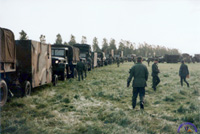
6. Arriving at site
|
|
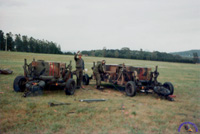
7. Setting up |
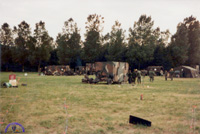
8. Setting up
|
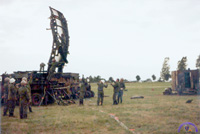
9. Setting up
|
|
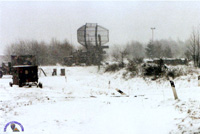
10. Schwellentrup radar site in the winter |
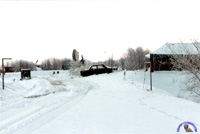
11. Schwellentrup radar site in the winter
|
|
|
|
| |
|
|
Related Links:
Hog Mania - a website for former members of the 609th Tactical Control Squadron at Hessisch Oldendorf.
606th TCS - Jerry Harrell
603 TCS/Sembach Alumni  - Mike Malloy's website - Mike Malloy's website
|
| |
|