| If you do NOT see the Table of Contents frame to the left of this page, then Click here to open 'USArmyGermany' frameset |
||||||||||||||||||||||||||||||||||||||||||||||||||||||||
|
Army Security Agency, Europe |
||||||||||||||||||||||||||||||||||||||||||||||||||||||||
|
|
||||||||||||||||||||||||||||||||||||||||||||||||||||||||
|
||||||||||||||||||||||||||||||||||||||||||||||||||||||||
|
|
||||||||||||||||||||||||||||||||||||||||||||||||||||||||
| New Center of Military History Book Project | ||||||||||||||||||||||||||||||||||||||||||||||||||||||||
|
||||||||||||||||||||||||||||||||||||||||||||||||||||||||
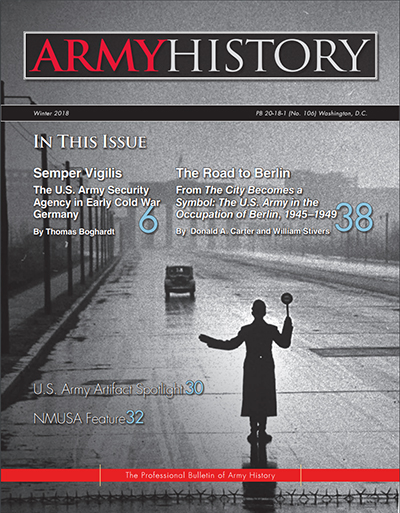 ARMY HISTORY MAGAZINE, Winter 2018 issue (U.S. Army Center of Military History, Ft. McNair, Washington, D.C.) |
||||||||||||||||||||||||||||||||||||||||||||||||||||||||
| The Winter 2018 issue of the ARMY HISTORY MAGAZINE contains a great article by Dr. Thomas Boghardt (see book project notice above) on the early days of the ASA in Germany after the end of WWII. The ARMY HISTORY MAGAZINE issue is available online on the US Army Center of Military History website at https://history.army.mil/ |
||||||||||||||||||||||||||||||||||||||||||||||||||||||||
| ASA-Europe History | ||||||||||||||||||||||||||||||||||||||||||||||||||||||||
| (Source: various sources, Walter Elkins) | ||||||||||||||||||||||||||||||||||||||||||||||||||||||||
|
Signal
Security Detachment D,
Signal Intelligence Div, HQ ETOUSA was attached to the 12th Army
Group and operated under the control of G-2 Division, 12th AG. The
unit furnished signal intelligence support at the army group level.
Immediately after the war, the Detachment was located in Rüsselsheim and became a major unit of USFET (and probably under direct control of that HQ) in mid Sept 1945. The Det has its own teletype circuit (DANA) to HQ USFET (DAAA). The Army Security Agency, Europe (ASAE) was established in Rüsselsheim, Germany, on November 27, 1945 as the European theater headquarters for the Army Security Agency. Its mission was to provide signal intelligence and communications security support to U.S. Forces, Europe and its subordinate commands. (I am assuming that ASAE took over the mission and resources of Sig Scty Det D.) Upon activation, ASAE assumed command of all signal intelligence units in Europe. This included any signal intelligence assets (probably "Detachment 6" or a predecessor) belonging to the former Signal Security Agency and its collection arm, the 2nd Signal Service Battalion, as well as all signal intelligence units previously subordinated to theater and Army commanders (mobile signal service units). ASAE thus exercised control over air and ground SIGINT and COMSEC units such as (field stations), signal service (radio intelligence) companies, signal service (security) detachments, and AAF mobile radio squadrons. In late 1946, the following units were attached to ASAE: |
||||||||||||||||||||||||||||||||||||||||||||||||||||||||
|
||||||||||||||||||||||||||||||||||||||||||||||||||||||||
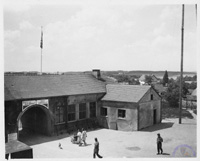
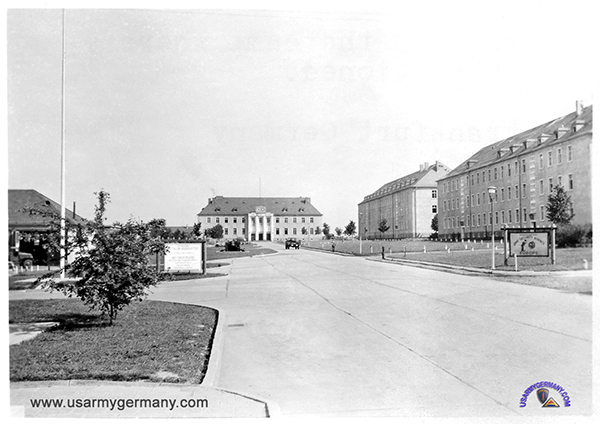 Gibbs Kaserne, Frankfurt, 1948 (Webmaster's collection) (Unit sign on right reads: "Headquarters Army Securty Agency Europe") |
||||||||||||||||||||||||||||||||||||||||||||||||||||||||
|
In
March 1946, HQ ASAE was moved to Gutleut Kaserne in Frankfurt for
billeting purposes. Operations were conducted in the IG Farben Hochhaus
in Frankfurt.
At some point, probably early 1950, HQ ASAE was redesignated as the ASA Europe, Hq Co, 8620th DU. Sometime before 1970, ASAE left Gutleut Kaserne and moved into Kennedy Kaserne, which was closer to the IG Farben Building. HQ USASAE moved to Flak Kaserne, Augsburg in June 1971. This move was a preamble to the consolidation of assets required for establishing Field Station, Augsburg. By June 1972, FSA was in full swing; the three supplanted stations, one large border site, three smaller sites, and HQ USASA Europe had been closed. |
||||||||||||||||||||||||||||||||||||||||||||||||||||||||
| 1946 | ||||||||||||||||||||||||||||||||||||||||||||||||||||||||
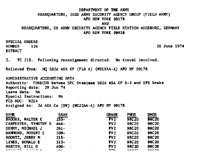
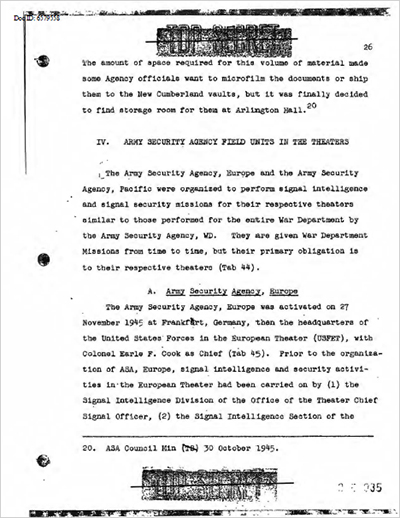 Summary Annual Report of the Army Security Agency, FY 1946 (1 July 1945-30 June 1946) (PDF file) (Only the section relating to ASA-Europe is reproduced here) |
||||||||||||||||||||||||||||||||||||||||||||||||||||||||
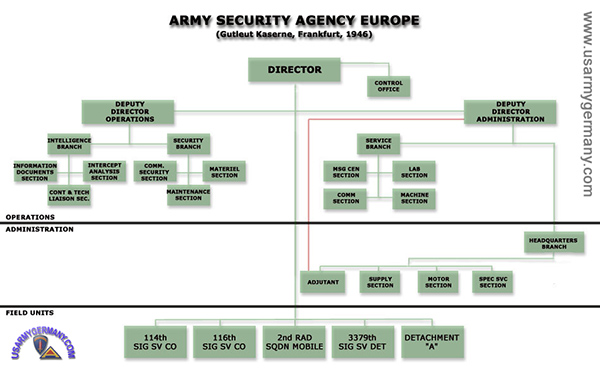 Wire diagram, ASA-Europe, 1946 |
||||||||||||||||||||||||||||||||||||||||||||||||||||||||
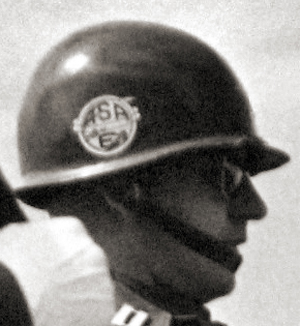
 ASA Europe insignia (decal) - need confirmation that this is accurate ASA Europe insignia (decal) - need confirmation that this is accurate |
||||||||||||||||||||||||||||||||||||||||||||||||||||||||
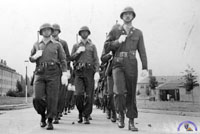
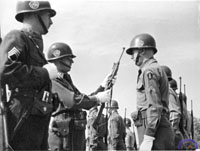
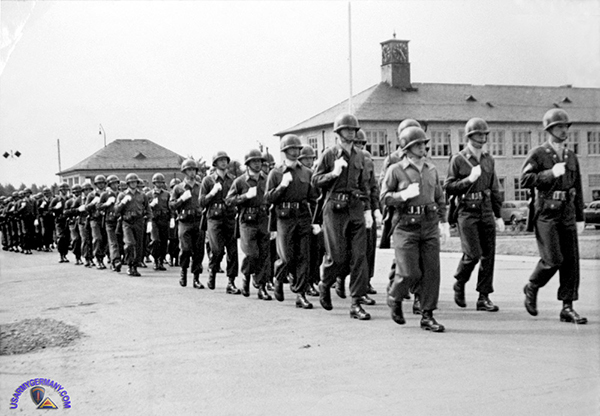 ASA-Europe parade at Gibbs Barracks, late 1940s |
||||||||||||||||||||||||||||||||||||||||||||||||||||||||
| Late 1940s | ||||||||||||||||||||||||||||||||||||||||||||||||||||||||
| CORRECTIONS & ADDITIONS (Source: Email from Bill Wagner, April 1949 to May 1952) Headquarters and Headquarters Company, ASAE, was billeted at Marbach Kaserne (Gibbs Barracks, Block#1 until August, 1951, when it moved to Block#3).
In December, 1951, Hq and Hq Co, ASAE moved to the Gutleut Kaserne, West Block.
The actual Headquarters of ASAE was on the 7th floor, West Block, of the I.G. Farben Building. HQ ASAE was redesignated as the Headquarters, Army Security Agency Europe, 8620th Administrative Area Unit (AAU) sometime before 31 August, 1950. |
||||||||||||||||||||||||||||||||||||||||||||||||||||||||
| (Source: Email from Dwayne Barber, son of the late Herschel C. Barber, Hqs ASA-Europe) | ||||||||||||||||||||||||||||||||||||||||||||||||||||||||
|
||||||||||||||||||||||||||||||||||||||||||||||||||||||||
|
||||||||||||||||||||||||||||||||||||||||||||||||||||||||
| 1951 | ||||||||||||||||||||||||||||||||||||||||||||||||||||||||
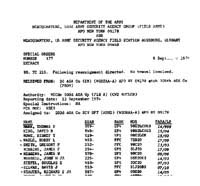
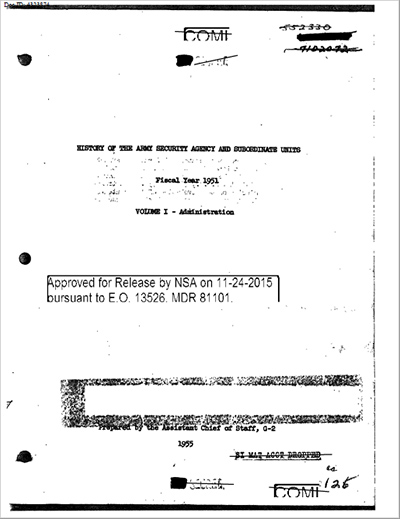 Summary Annual Report of the Army Security Agency, FY 1951(1 July 1950-30 June 1951) (PDF file) (Only the section relating to ASA-Europe is reproduced here) |
||||||||||||||||||||||||||||||||||||||||||||||||||||||||
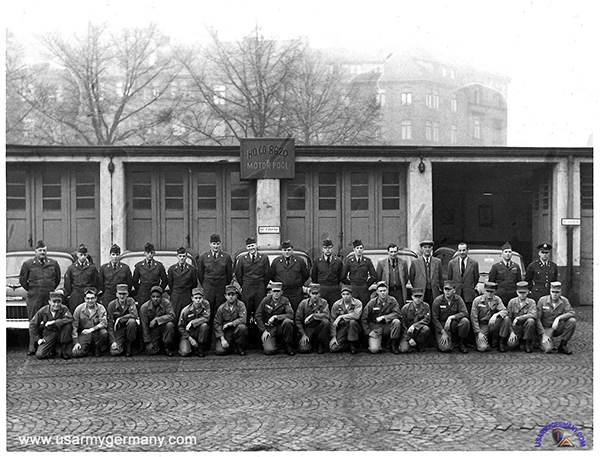 HQ 8620 DU, ASA-Europe motor pool on Gutleut Kaserne, 1950s (Benno Knorr) |
||||||||||||||||||||||||||||||||||||||||||||||||||||||||
| 1952 | ||||||||||||||||||||||||||||||||||||||||||||||||||||||||
| (Source: Email from Brock Carr, HQ ASE-Europe, 1952-54) | ||||||||||||||||||||||||||||||||||||||||||||||||||||||||
| I was with ASA, first at Vint Hill Farms, then Arlington Hall and ultimately in Gutleut Kaserne (behind the Frankfurt Hauptbahnhof (train station). I spent 28 months in Frankfurt and returned to the US in September 1954. Naturally I have a few memories that I could share. It would be remarkable if some of my old chums from ASA were still around. I haven't had a chance to read all of the material on the net, yet. I was telling my wife about the story about the pilot that was supposedly court martialed because of the I.G. Farben Building. As the story went, the pilots were told to level Frankfurt, except for this particular building, because it was planned to be the new European Command Headquarters (EUCOM). They were told that it would be a Court Martial Offense if they damaged it. Sure enough, one poor pilot's bombs "SKIP BOMBED" and took out a small corner of the building -- and he was Court Martialled, or so the story goes.
When I arrived there in early 1952, the Germans were working 7 days a week to rebuild Frankfurt, and it was almost complete. The exception was the "OPERA HOUSE" -- I believe all of the exterior walls were still standing, but it was only a shell, with nothing left standing inside. I believe you could see it, looking up the main street (strasse) from the Bahnhof. I spent a fair amount of my leisure time in a Bavarian Gasthaus at the Bahnhof, called Maiergustls'. It was quite popular for all GI's. As I recall there were four divisions located in and around Frankfurt, they were the 2d Armored (Hell on Wheels) Division, the 43rd Infantry, and two other's - maybe the 28th and 1st Infantry (but I am not certain). Some of the nicer post war activities ASAE performed: In my off duty time I was responsible for the company dark room (I was an amateur photographer (Oh yes, I have some nice shots inside the compound of Gutleut Kaserne, showing the deuce and a halfs in the motor pool all lined up, and some with the troops in formation) and I used to spend time in a small town that (understandably so) didn't like or accept American GI's.) but having a camera, rather than weapon, was accepted. To make a long story short (which I very rarely do), after all the bombings during WWII, there were about 100 or more orphans left in the area to be cared for. There was no orphange in the area to house and care for them, so the townspeople took the children into their homes. When I learned of this, and I saw how beautiful these young children were, I thought it would be nice if the town had a picnic for all of them and I acted as the official town photographer, taking a 8x10 photo of each child, taking it back to our company darkroom, developing and enlarging all pictures, and then going back to this (anti-GI town) and delivering each portrait to each home (I had two buddies, one was an ASA German linguist) , who helped me with the darkroom work and especially with the delivery to each home -- my knowledge of German was lacking, to say the least). The town had a beautiful young girl (named Hanalorre Schwanke) who also acted as my interpreter. The Company Comander (Captain Dugen) approved the use of materials expended (Photo Enlarging Paper and chemicals). We did all of this on our off duty time. The children loved the portraits, and their adoptive families really warmed up to the three of us. They still didn't want Soldiers visiting or dating their young daughters, but we were the privledged few that were invited to their weekly town dance at the townhall.
About ASAE: I was assigned to the Chief of ASAE for my 28 month tour. My memory is a little spotty, we're talking about 52-54 years ago. I never thought I would see info about ASA open for all to see. I remember signing that document swearing not to tell anyone about my service for 10 years. It appears from what I see on the net, that every so many years, they change their name. We were told to wear any patch and brass that we wanted. "Tell people that you are in the infantry, signal corps, etc. " Then, when we arrived in Frankfurt, we were shown a wall with about 500 passport sized photos, and told, "these are all the Soviet agents and sub-agents in the Frankfurt area. Before you got off the ship in Bremerhaven, their people were showing these agents a wall, just like this, and your picture is on it!. They are looking for you! Bartenders, Prostitutes, straight people, all types. When our people have accidents, like falling off trains, or are killed in a so-called drunken brawl in a gasthaus (bar), don't you believe that it was an accident. If you talk in your sleep, don't go with a prostitute, she may be an agent, or working for one. Then we walked out of the meeting, walked out into the motor pool area (middle of Gutleut Kaserne) and saw beautiful ASAE decals on all of our vehicles, telling the whole world that that 'TOP SECRET" ASA was stationed in Frankfurt. Wow!. We couldn't believe it. They even had small decals that you could put on your wallet, how about that. In any case, about 6 months later, all the decals were removed, and we just showed the 8606 AAU signs. We even caught one of our own Com Center officers selling our code rotors to the Russians. When we joined ASA, you wouldn't be accepted if you had a relative or connections with Russia or any countries behind the "Iron Curtain". The Captain who was caught had relatives in a communist country, but he got into ASA before they had that ruling about relatives. Oh well, that's how the cookie crumbles. Oh, info re ASAE: The Chief was Lt. Col. Richard C. Gales, he also had a WAC Major Martha Schuhart assigned to him. There was also a Major Fisher (he was a really nice, down to earth guy-and a good officer). All of us (the Secuity Division and the Operations Division) spent most of our time in the I.G. Farben Building. The company commander, was Captain Dugan, and the First Sgt was Willams (lovingly referred to as "Willie) by those who loved him. I am sorry to see that ASA has evolved to being assigned to different regular Infantry (and other groups). I would have to believe that a lot of secuity could be lost because ASA not being an independent intellegence group, reporting only to Washington. I'll tell you why. A team made up of several of us from HQ went out to see how good the secuity was -- One of our infantry divisions was going on maneuvers in the middle of the winter, with the French Army. Just as the enemy would do, we wore the patches and insignia of that division, went down to France, found the division's main signal battalion, cut into their wire and recorded everything that went through the heart of the division. Not only did we learn the grid coordinates of every outfit in the Division, we even recorded one Battalion Commander talking to another Battalion Commander, reviewing the location (grids) of their outfits. At one point, one officer said to the other, "Hey Joe, we really shouldn't be discussing the locations of our outfits over the wire, security regs and all that." To which the other officer responded, "what are you worried about, those Security people don't know what the hell they are doing." We didn't realize what we had on tape until we got back to Frankfurt. I forget how many days we listened to the tapes, had them all typed up and sent off to Washingtion. Some time later, 1-3 months, the General in charge of the Infantry Division came to see the Chief, and reamed his ass. He screamed "The next time you send your people out against my outfit, you give me advance notice." (As if the enemy would warn him that they were coming!). In any case, as the story goes, this incident was reported back to the Pentagon and a higher ranking General came down on the Infantry Division Gerneral and made it clear that in the future, he would not be warned, and that if he and his people did not comply with security requlations in the future, he may want to kiss his Army career good bye. You see my point. ASA needs to maintain its independance. Another nice story comes to mind. On one of our "The Russians are coming" trips into the hinterlands, we were all set for the night in our pup tents, when we were rousted out, and told that it was discovered that we had been hammering our tent pegs into what once was a WWII mine field that had not completely been cleared of the mines. You can immagine how fast we got out of that area. Let the good times roll. Ho, Ho.
One other fact about ASAE has been bothering me. During my 28 months -- I know Lt. Col. Richard C. Gales was the Chief, ASAE - but my memory is foggy. I'm not sure if there had been Two (2) Chiefs, one when I first was assigned and perhaps he shippen out several months later and was replaced by a new Chief? I don't recall exactly, I"ll have to look at some of the old papers (Orders and that kind of stuff) and in my photo album. In any case, yes, be my guest about any facts I give you. the more I think about it, I believe the first Chief ASAE either retired or rotated back to the United States, several months before I did. |
||||||||||||||||||||||||||||||||||||||||||||||||||||||||
| ADDITIONAL INFORMATION I just went through some old promotion orders and a reference letter given to me by the Chief, and I can now say for sure, that the new Chief, Lt. Col. Richard C. Gales arrived in Frankfurt in 1954, before I left in September. I remember that he wanted me sign up (re-enlist) for another three years and offered me an immediate promotion to Sgt. First Class (I was an E-5 Sgt) (and quaranteed me Master Sgt Stripes before the end of my second enlistment. He knew I had been thinking of staying in the Army, but I was so homesick (not being allowed to go home for 28 months, I refused. We (he and I) got along well and he just didn't want to break in a stranger in my place. So I went home, thinking that I still could re-enlist, if I wanted to, after going home. More ASAE facts: I have some names from my old documents. The Adjutant in January of 1953 was Captain Ralph G. Irish. Some of my buddies that I would love to hear from (if they are still kicking): Dale E. McGuire (Sgt) -- came from the mid-west. I remember that he was allowed to rotate back to the US before his scheduled date in order to "bring the crop in" -- obviously, he was a farmer. One of my favorite buddies and mentor was Roger Schleuter. I believe he had been a teacher of English (& perhaps, German?) He was constantly on my back about my NEW YAWK accent! He would constantly correct me, saying IT HAS AN "R" IN YORK, and po-ta-toes are not pronounced pitatis, etc. etc. etc. His constant harping and correcting were largely responsible for my decision to attend college when I returned to the US. I owe him a lot. And to top it off, not only was he a good teacher, he was a good friend and had a good sense of humor. Then there was Jesse L. Inman Jr. from Georgia (Atlanta or Savanah? We were going to buy a shrimp boat when we got out (and have it paid for within 2 years!) Jesse played football for Georgia Tech and was rather large and quite strong. Before leaving the states, he, I and Les Holmes (Maryland) spent some time at Fort Knox. Jesse was so strong, that one time we were kiddingly playing Judo in the barracks, he picked me up over his head, threw me at a wall (sheetrock) and I went right threw it, into the hallway. There I was, stunned, laying against the far wall in the hallway, and big Jesse stuck his head through the hole in the wall that I maded (or he made, depending on how your look at it) saying with his Southern accent, "Brock, Are you all right?" We had some great times. Les Holmes had just married, weeks before we shipped overseas. He was assigned to one of the outstations in Germany for his 28 months. He said the weather was so bad most of the year (lots of mud and rain) that they virtually never wore their Class A uniforms -- just fatigues, all year round. |
||||||||||||||||||||||||||||||||||||||||||||||||||||||||
| (Source: Email from Ray Grafflin, 534th AFA Bn and 7734th Sig Svc Pltn) | ||||||||||||||||||||||||||||||||||||||||||||||||||||||||
| I browsed the site and noticed that under Signal, another unit I was assigned to isn't listed - the 7734th Signal Service Platoon. This unit was tasked with monitoring Red Army electonic emissions over the Czech border. Base unit was located at various places in Frankfurt - Gutleut Kaserne, next to the Hauptbahnhof, Heddernheim in what normally would have been Dependent Quarters, and at Gibbs Barracks. The forward unit was located up on Mount Meissner with a whole lot of expensive electronics equiptment. We were 32 EM and 3 Officers. No one ever said so, but I suspect we were "owned" by one of the spook agencies. I do know that if we wanted anything for the operational side, a phone call to Washington triggered a next day delivery via air from the States. We had a high proportion of degree level troops, who had a neat lab and really odd senses of humor |
||||||||||||||||||||||||||||||||||||||||||||||||||||||||
| 1955 | ||||||||||||||||||||||||||||||||||||||||||||||||||||||||
| (Source: Email from Myron Goff) | ||||||||||||||||||||||||||||||||||||||||||||||||||||||||
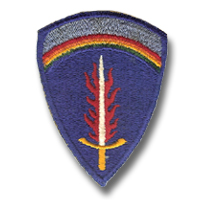
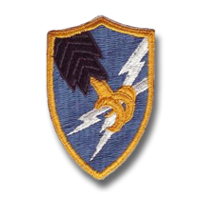
| I was with HQ 8620 DU from February 1955 to April 1956, and worked at the I.G.Farben Building and was billeted at the Gutleut Kaserne. I worked the dark room in the photo lab. I remember seeing bullet holes in the building from the pilot who straffed it. The paternosters were a real trip, having to jump on and off at your floor. Our floor was always gated with two MP's on guard at all times. If you have any info on this period, I would appreciate hearing from you. We had badges we wore on our shoulders which were of a dragon, in green and gold. We also wore the flaming sword patch. I have a large aerial blow-up of the I.G. Farben building and a couple of smaller ones. I remember riding in duece & 1/2's to get to work. I also have some pics of Gutleut Kaserne, with big black letters painted on the motor pool wall, "IHTFA". |
||||||||||||||||||||||||||||||||||||||||||||||||||||||||
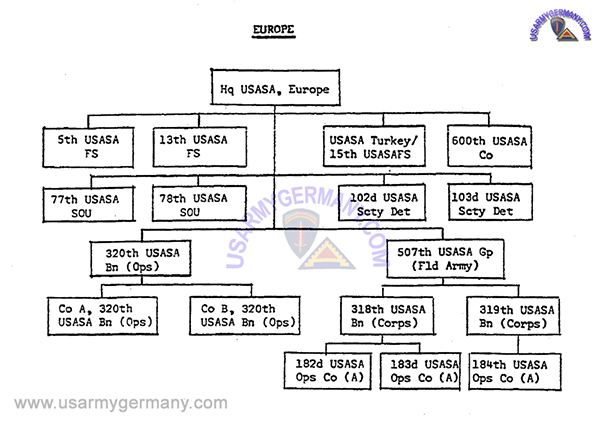 Organization of USASA, Europe in June 1962 |
||||||||||||||||||||||||||||||||||||||||||||||||||||||||
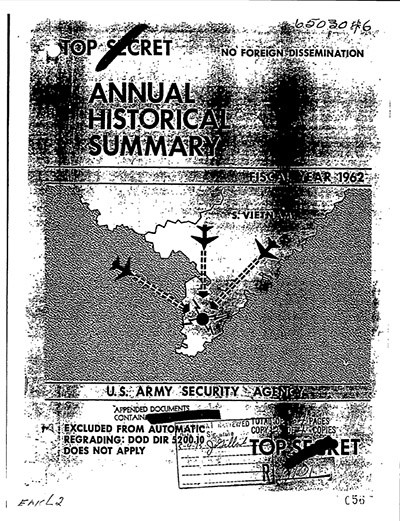 USASA Annual Historical Summary, FY1962 (Only the section - heavily redacted - concerning USASA, Europe is presented here) |
||||||||||||||||||||||||||||||||||||||||||||||||||||||||
| 1962 | ||||||||||||||||||||||||||||||||||||||||||||||||||||||||
| (Source: USASA Annual Historical Summary, Fiscal Year 1962 - reporting period 1 July 1961 - 30 June 1962) | ||||||||||||||||||||||||||||||||||||||||||||||||||||||||
| Colonel Robert E. Schukraft, SigC, 018744, was Chief, USASA, Europe from 1 July 61 to 30 Nov 61. Colonel James H. Keller, Inf, 021871, assumed command, 1 Dec 61, and remained as Chief, USASA, Eruope through the end of the fiscal year. | ||||||||||||||||||||||||||||||||||||||||||||||||||||||||
| 1964 | ||||||||||||||||||||||||||||||||||||||||||||||||||||||||
| (Source: Email from Sid Metcalf, July 1964 - December 1965) | ||||||||||||||||||||||||||||||||||||||||||||||||||||||||
| I was stationed at HQ USASAE in Frankfort from July 1964 until December 1965. When I first arrived we were housed at a place across the street from the I G Farben building called The White House. It had been an office building or school before the Army got it. My first job was duty or dispatch driver which I worked at for 2 or 3 months. Then the deputy chief needed a driver so I moved up. He was a bird Col. Lamee. Nice man. Soon the chief's driver had his third accident so I moved up again. At that time the chief was Col. Price. Also a very nice man. About 2 months later Col Price became Gen. Price and I stayed with him the rest of my time. We only lived at the White House for a short time, and they moved us to Gutleut Kaserne. Wasn't as nice but nobody bothered us. I wasn't due to rotate until Jan. but they let a few of us go mome before Christmas 1965. Since then I have lived and farmed in NW Kansas. |
||||||||||||||||||||||||||||||||||||||||||||||||||||||||
| (Source: Email from Jim Bair, Hq & Svc Co, 1964-68) | ||||||||||||||||||||||||||||||||||||||||||||||||||||||||
|
I served in the Personnel and Finance Office from Sept 1964 – sometime in 1966 when I was sent TDY to the 18th F&AO in Frankfurt to help set up a new computerized payroll system that the Army was instituting. |
||||||||||||||||||||||||||||||||||||||||||||||||||||||||
| 1968 | ||||||||||||||||||||||||||||||||||||||||||||||||||||||||
| (Source: Email from Francis Hamit) | ||||||||||||||||||||||||||||||||||||||||||||||||||||||||
| A couple of things about HQ USASA Europe. HQ was located on the 4th, 5th, 6th and 7th floors of that end of the building. Travel between floors was a unique elevator system called "paternosters." These were wood cabinets that moved continuously. The building is now the Humanities Building for the University of Frankfurt and these relics have been preserved. HQ for V Corps was on the bottom floors of the building. Kennedy Kaserne was home to HQ & Service Co and Com Unit before 1968, when I arrived there. It was a former girls' school and had an authorized EM club in the basement that served alcoholic beverages. It was called "The Spookeasy". There was also an Arms Room. Armed drills were held about once every three months. The HQ had an award winning unit newspaper, "The Frankfurter Forum," which won both Best in ASA and Best in Army for the multilith category. Copies of this newspaper are now in the Army Intelligence Museum at Fort Huachuca. You'll have to look at a map for exact directions, but my memory is that Kennedy Kaserne was across the street and to the left of the front of the Farben Bldg. It occupied most of the block at the corner of that street and Eschersheimer Landstrasse. The Officer's Club was directly behind the Farben Bldg. You could, if so inclined, walk down the street in front of the Farben Bldg all the way the Hauptbahnhof (main train station). That took you through the Kaiserstrasse area, where all the strip clubs and like amusements were located. Walking the other way took you to the Hauptwache, which was this great shopping area that had movie theaters that showed films in English and German on alternative showing. Took one of my German girlfriends to see "Easy Rider" there. She was shocked at the violence. The quickest way there was the U-Bahn (subway). Also there was our favorite bar, the Mausefalle (Mouse Trap), which had beautiful Chichi bar maids and one of our CI guys always lurking around. Walking the other way (North?) on Eschersheimer Landstrasse took you to the PX and the Topper Club, which was for E-5's and above and where you could buy a Heineken for 20 cents and a shot of Jack Daniels for two bits. The street between that corner that ran parallel led to the mess hall and the medical dispensary. There was a married housing and an American dependents school beyond the PX. Below the Hauptwache was the Staatsbühne (State Theatre) and the Opera. Next to the train station is the Messe Halle where they have the International Book Fair every October and where touring rock group would also perform. |
||||||||||||||||||||||||||||||||||||||||||||||||||||||||
 |
||||||||||||||||||||||||||||||||||||||||||||||||||||||||
|
|
||||||||||||||||||||||||||||||||||||||||||||||||||||||||
| The Early Years | ||||||||||||||||||||||||||||||||||||||||||||||||||||||||
| 8620 AU, Hq & Hq Company, Army Security Agency, Europe | ||||||||||||||||||||||||||||||||||||||||||||||||||||||||
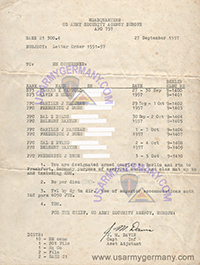
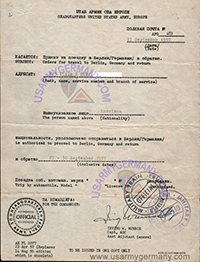
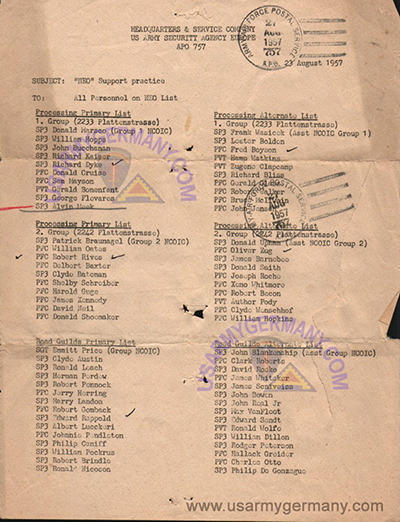 ASA-Europe Hqs NEO List, 1957 (Alvin Meek) |
||||||||||||||||||||||||||||||||||||||||||||||||||||||||
| 1956 | ||||||||||||||||||||||||||||||||||||||||||||||||||||||||
| (Source: Email from Alvin E. Meek) | ||||||||||||||||||||||||||||||||||||||||||||||||||||||||
| I served with 8620 ASA Bn from Oct 1956 to Feb 1958 in Frankfurt as a clerk in the Personnel Office. I also was trained as a truck driver for NEO (Non-combatant Evacuation Orders) and made armed courier runs to Berlin with classified material. 8620 ASA BN Frankfurt was Hq ASA Europe. NEO was the plan to evacuate civilian dependents to the coast of France (destination unknown) in a convoy with a deuce and a half truck between every six dependent vehicles. No maids and no pets allowed. |
||||||||||||||||||||||||||||||||||||||||||||||||||||||||
|
||||||||||||||||||||||||||||||||||||||||||||||||||||||||
| 1945 - 1951 | ||||||||||||||||||||||||||||||||||||||||||||||||||||||||
| 114th Signal Service Company | ||||||||||||||||||||||||||||||||||||||||||||||||||||||||
 114th Signal
Company DUI
114th Signal
Company DUI |
||||||||||||||||||||||||||||||||||||||||||||||||||||||||
During World
War II, the 114th Signal Radio Intercept Company was one of several
radio intelligence units allocated in support of 12th US Army Group.
SRICs were attached to the various US Armies, the 114th being in support
of First US Army. The primary mission of a Signal Radio Intelligence
unit was to intercept and record enemy radio transmissions and to
determine their locations by means of radio direction finders. The
SRI Co typically consisted of the following elements: Intercept PlatoonIntelligence and
Analysis PlatoonDirection Finding
PlatoonWire Platoon Intercept PlatoonIntelligence and
Analysis PlatoonDirection Finding
PlatoonWire PlatoonIn the immediate post-war period, the 114th was assigned to Signal Service Det D, Special Troops, 12th Army Group in Rüsselsheim, Germany. Det D served as the central command-and-control element for all signal intelligence operations conducted by the 12th Army Group and would eventually become ASA-Europe (Nov 1945). On Jan 10 1946, the 114th SRI Company was reorganized and redesignated as 114th Signal Service Company. The 114th Sig Svc Company was located in Sontra, Germany until May 1947. On 14 May 1947, the Sontra site was closed - the Company with its support personnel were sent to Herzo Base, the radio operators were reassigned to the 116th Sig. Svc. Co. which was located in Scheyern, Germany. In 1949, a detachment of the 114th (Det "A") was located at the old German Fliegerhorst in Rothwesten. With the growing fear of Soviet aggression in Europe after the war in Korea started in the summer of 1950, the 114th and its sister unit, the 116th, were ordered to remount (on 2½-ton trucks) their WWII-vintage intercept and communications equipment (TC-9's and SCR-399's?) and assume a tactical role as support units for 7th Army. (As the SRI's had settled in to occupational duty after the end of WWII, their truck-mounted equipment had been dismounted and operations were performed in a fixed-site mode.) In May 1951, the 114th Sig Svc Co was relocated to Kinglsey Barracks, Hof to be closer to the border. On 25 Oct 1951, the 114th Sig Svc Co was reorganized and re-designated as the 331st Communications Reconnaissance Company and allotted to Regular Army. |
||||||||||||||||||||||||||||||||||||||||||||||||||||||||
| Visit Dean Slagle's wonderful page dedicated to the 331st C.R. Co. in Germany. Includes great photos of the 114th's home stations at Herzo and Hof (331st Communication Reconnaissance Company). | ||||||||||||||||||||||||||||||||||||||||||||||||||||||||
|
|
||||||||||||||||||||||||||||||||||||||||||||||||||||||||
| Looking for 114th SRI members who stayed at Avon Tyrrell, England | ||||||||||||||||||||||||||||||||||||||||||||||||||||||||
| We're
looking for anyone who was in the US Army 114th Signal Radio Intelligence
unit around D-day and in Germany afterwards. The unit was based at
our house (Avon Tyrrell) in the New Forest,
England before D-day. A couple of vets have visited and have given
us some great memories and photos, and we'd like to see if we can
get more. Avon Tyrrell is now a listed historic building and used
as a childrens activity centre - the US Army being based here, and
massing before D-day, is an important part of its history - we'd like
to keep a record of this and put up some displays for the visitors
that come here. Richard Louis Bonney Centre Director Avon Tyrrell Activity and Residential Centre UK Youth, Bransgore, Hampshire BH23 8EE Email: director@avontyrrell.org.uk Web Site: www.avontyrrell.org.uk |
||||||||||||||||||||||||||||||||||||||||||||||||||||||||
|
||||||||||||||||||||||||||||||||||||||||||||||||||||||||
|
|
||||||||||||||||||||||||||||||||||||||||||||||||||||||||
| 1945 - 1951 | ||||||||||||||||||||||||||||||||||||||||||||||||||||||||
| 116th Signal Service Company | ||||||||||||||||||||||||||||||||||||||||||||||||||||||||
| (Source: Various ASA related websites, including a unit history posted on the ASA Alpiners website) | ||||||||||||||||||||||||||||||||||||||||||||||||||||||||
| The 116th Signal
Radio Intelligence Company, activated on 18 May 1942 at Camp Crowder,
Missouri, participated in several campaigns in the ETO, in support
of the 12th Army Group. The company was one of two Army radio intelligence companies left in Germany after redeployment. Both were located in the First Military District (Land Bavaria) area. On May 17 1945, the 116th had established its command post at Scheyern, Germany, about 35 miles from Munich, and soon began performing its intercept mission from there. The site was located on a former German Luftwaffe air base with family housing in the town of Pfaffenhofen. The operations center was located in the attic of a large German barracks which also contained the enlisted quarters, orderly room, dayroom, mess hall and arms room on the lower floors. A new two-story barracks was completed in 1948 to house new personnel arriving in the unit. The antenna field was located on farmland across from the Kaserne and contained 80-120 foot towers fitted with long-wire and rhombic antennas. On June 30 1945, the 116th was assigned to Det D of Special Troops, 12th Army Group. On July 30 1945, the company was relieved from 12th Army Group and assigned to the Third US Army. On 15 January 1946, the 116th Signal Radio Intelligence Company was redesignated as the 116th Signal Service Company with an effective strength of nine officers and 248 enlisted men. Effective 1 February 1946, the company was relieved from assignment to Third US Army (which was being inactivated at the time) and assigned to Headquarters, ASA Europe. Prior to the outbreak of the Korean Conflict (June 1950), the ASA units in Germany had become largely incapable of mobile operations due to the shortages of personnel and equipment. With tension's rising, the unit's operational shelters were again truck mounted and the unit was prepared for tactical ops. On 10 March 1951, a large contingent of the troops departed Scheyern and moved to Herzogenaurach, Germany, and from there to Coburg (on 16 April 1951), where it assumed full mobile operation. The troops remaining at Scheyern were re-designated as Field Station 8608 and operated as a fixed station. The 116th moved from Coburg, Germany, on 9 July 1951 to Baumholder, Germany, and then to Heilbronn, Germany on 22 August 1951. The unit was reorganized and redesignated on 25 October 1951 as the 332d Communications Reconnaissance Company, and concurrently allotted to the Regular Army. |
||||||||||||||||||||||||||||||||||||||||||||||||||||||||
| Visit Wade Temple's wonderful page dedicated to the 332nd C.R. Co. in Germany. Includes great photos of the 116th's home station at Scheyern (332nd Communication Reconnaissance Company). | ||||||||||||||||||||||||||||||||||||||||||||||||||||||||
| (Source: Email from Patrick Garrison, grandson of Roy Garrison, of the 116th Sig Svc Co) | ||||||||||||||||||||||||||||||||||||||||||||||||||||||||
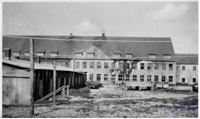
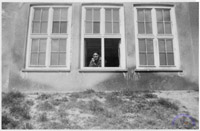
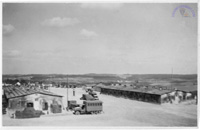
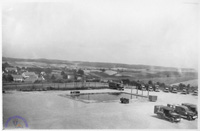
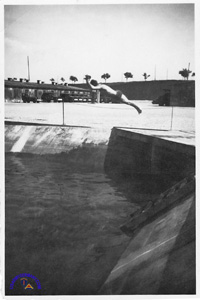
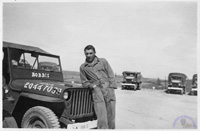
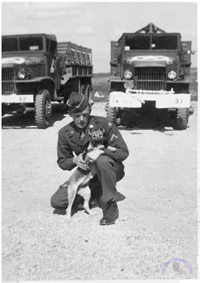
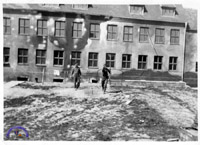
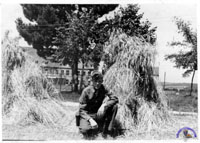
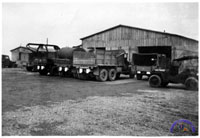
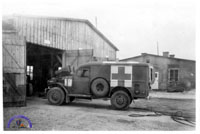
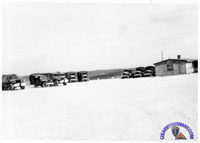
| Roy Garrison served with the 116th Sig Sv Co in Germany at the end of WWII and during the early occupation period. At least that is what Patrick has been able to gather. Roy did not talk much about his unit or specifics of his assignments, but often talked of the people he met and the beautiful German countryside. After Roy passed away recently, Patrick found a cigar box full of photos from Roy's time in Germany. The following photos are a small sampling of these memories. Patrick hopes that someone viewing these images might recognize details or persons and be able to help fill in some of the gaps in his knowledge of his grandfather's unit and activities in Germany in the early days of the Occupation. |
||||||||||||||||||||||||||||||||||||||||||||||||||||||||
|
||||||||||||||||||||||||||||||||||||||||||||||||||||||||
| Related Links | ||||||||||||||||||||||||||||||||||||||||||||||||||||||||
|
||||||||||||||||||||||||||||||||||||||||||||||||||||||||
|
||||||||||||||||||||||||||||||||||||||||||||||||||||||||
| 1945 - 1951 | ||||||||||||||||||||||||||||||||||||||||||||||||||||||||
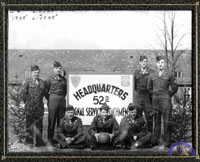
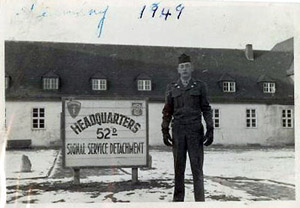
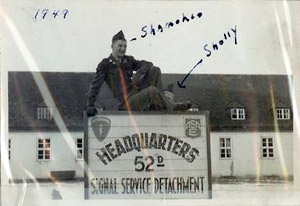
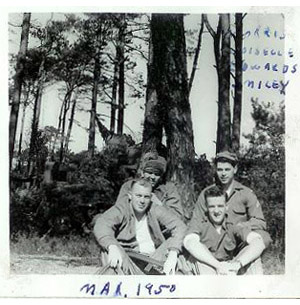
| 52nd Signal Service Detachment | ||||||||||||||||||||||||||||||||||||||||||||||||||||||||
| (Source: Email from Ronald R. Rehrer, 52nd Sig Svc Det, 1947-50) | ||||||||||||||||||||||||||||||||||||||||||||||||||||||||
| I was suprised to find such a wonderful website with all the units of ASA Europe included. But I never found my unit which was from 1947 to 1950 at Herzo Base, two years of which I served with the 52nd Signal Service Detachment. Our mission at the time was monitering all United States Army field communications in Germany. Also on base at the time were the 114th and 116th Signal Service Companies who were billeted aside of us. We spent much time in the field monitering US Army communications for violations of procedures. Our MOS at the time was 799 for high speed radio ops. Am enclosing several pictures of our unit between 1947 and 1950 at Herzo Base. Thanks for the visit to your great web site. |
||||||||||||||||||||||||||||||||||||||||||||||||||||||||
|
||||||||||||||||||||||||||||||||||||||||||||||||||||||||
|
||||||||||||||||||||||||||||||||||||||||||||||||||||||||
|
||||||||||||||||||||||||||||||||||||||||||||||||||||||||
|
|
||||||||||||||||||||||||||||||||||||||||||||||||||||||||
| 502nd Communications Reconnaissance Group | ||||||||||||||||||||||||||||||||||||||||||||||||||||||||
| 1951 - 1957 | ||||||||||||||||||||||||||||||||||||||||||||||||||||||||
| (Source: Various ASA sites including the ASA Vets site) | ||||||||||||||||||||||||||||||||||||||||||||||||||||||||
| In
May 1951, HHC, 502nd Communications Reconnaissance
(Comm Rcn) Group was activated
at Ft. Devens, MA. The unit received orders to move to Germany in
June 1952.
Upon arrival in Europe, the Group was assigned
to HQ ASA, Europe and ordered to Badenerhof Kaserne in Heilbronn.
The 502nd was probably further attached to the Seventh Army and assigned
the mission of providing signal intelligence and security support
to the field army and its subordinate units. At this time, the 502d
Group also assumed control of the 302d and 307th Communications Reconnaissance
Battalions which were already in country. In 1952, the 502nd Comm Rcn Gp comprised the following units: |
||||||||||||||||||||||||||||||||||||||||||||||||||||||||
|
||||||||||||||||||||||||||||||||||||||||||||||||||||||||
| In the mid-50's,
Comm Rcn Bns were involved in the listening role, using TRD-4 DFs
to track movements of equipment such as nuclear weapons systems. During
this period, the 502nd operated detachments at Rothwesten, Tülau
(DF site), Bährdorf (DF site), Söllingen (DF site?) and
several other sites. In late 1956, the Rothwesten and Söllingen dets
were later redeployed to Lüchow and Schöningen. On 1 July 1956, HHC, 502nd CR Gp was redesignated as HHC, 502nd ASA Group as part of a worldwide reorganization of ASA units. (The CR battalions were redesignated as ASA battalions at the same time.) In April 1957, the 502nd ASA Gp comprised the following units: |
||||||||||||||||||||||||||||||||||||||||||||||||||||||||
|
||||||||||||||||||||||||||||||||||||||||||||||||||||||||
| On 15 October
1957, the 502nd ASA Gp was redesignated as 507th
USASA Gp. Webmaster Note: The 502nd ASA Group had been a TOE (Table of Organization and Equipment) unit while the 507th USASA Group was a TDA (Table of Distribution and Allowance) unit. The underlying reason for the redesignation was in the ASA having been forced to downsize in 1957 after a DoD decision that year to cut the Army's strength by 50,000 personnel. The ASA found itself unable to sustain the manning of its tactical TOE units. In order retain a support structure in the tactical commands, the TOE units were inactivated and replaced by units which were tailored specifically to the needs of their supported command (i.e. mission tailored). These new mission structured units were TDA (Table of Distribution and Allowance) units. The designations of these TDA units also differed from the TOE units they replaced. TOE units were designated as "ASA" whereas TDA units were titled "USASA." |
||||||||||||||||||||||||||||||||||||||||||||||||||||||||
| 1955 | ||||||||||||||||||||||||||||||||||||||||||||||||||||||||
| (Source: Email from Jack Lee) | ||||||||||||||||||||||||||||||||||||||||||||||||||||||||
| The website, your initiative and research in maintaining it are all both admirable and impressive. It is a pleasure to be in touch with you. Herewith my very small contribution, as well as I can recall, after more than a few years. After an unsuccessful first year in college, I enlisted in the Army in 1953 and chose ASA for my assignment. This was contingent upon passing a background investigation, the first of what turned out to be a great many over the years. After basic training at (then) Camp Pickett in VA, I went to Ft.Devens, MA, for ASA testing and assignment. I demonstrated a high aptitude for languages and was told I could, if I wished, attend the (then) Army Language School at the Presidio of Monterey in CA. They then told me I could choose, right then, from among Czech, Serbo-Croatian, Russian and Albanian. In the belief that Russian would offer the best post Army possibilities, I chose that and, for the next forty-six weeks spent six hours a day in class learning to speak, write and read Russian. I had the advantages of liking language study, being fairly fresh from an academic environment, and I did well. Throughout my post Army career, I have studied and used three other languages and Russian remains by far my best second language. Then to Arlington Hall Station for a several week course in Russian language radio intercept and transcription. I arrived in Frankfurt in late Spring or early Summer 1955 and spent a short time in, and I have always remembered the name, Gutleut Kaserne, for ongoing assignment. The scuttlebutt was that there were three possibilities: someplace in Bavaria, nfi, Lubeck in the north where the guys wore civvies and lived in houses, and something called Bahrdorf, where the accommodations consisted of canvas Army squad tents. My number came up for Bahrdorf and off I went to Kassel. You have mentioned Rothwesten, I believe. This Is unknown to me and we referred to only Kassel. Some of my language school classmates were still with me, and one morning we were joined by some strangers and loaded into several deuce and a halfs for a long day of travel. We arrived after dark at what seemed at the time to be deep woods and were told to disembark and carry our bunks, which we had with us, into waiting tents. I chose to spend the night on my bunk in the bed of the 2 and 1/2 and no one complained. The next morning I saw that my new home consisted of a small collection of those tents with some 3/4 ton and 2 1/2s with what I came to know as "huts" affixed to their beds. It was possible to stand up straight in a deuce hut, but not in a 3/4, and my six foot plus frame found both of them cramped, at least initially. The topography was generally flat and we were on the only hill, really only a slight rise above our surroundings. Farm land surrounded on three sides, while on our east was low scrub gradually developing into larger and deeper woods. We were in the then British Zone, about ten km. from the east-west border and we were proscribed ever from straying east of our location. It was not a rule that was difficult to follow. The camp, officially it had to be called a Detachment and I have no recollection of any designation, was still very much under construction. The commanding officer was a first lieutenant and the first sergeant a huge bear of a man. Both worked daily on the continuing construction, along with a fairly large contingent of motor pool guys who, in addition to vehicle maintenance and driving, erected and climbed poles for the antenna array that was also growing. My linguist and other technical buddies were excused from the construction and went immediately to shift work in the huts. When we were off shift we were not expected to do any of the manual labor, but most of us pitched in doing some of the lighter stuff. When we arrived, the latrine consisted of a single wood box with a seat hole placed over a hole in the ground. The women working in the nearby fields found this most amusing and the c/o quickly responded to many complaints and a proper four-holer with sides, roof and door was quickly put together. Each tent had an oil stove that worked fairly well. There was no pecking order in the tents and everyone did his share and I recall no problem of slacking or personal animosity. I suppose we realized we were all in the same situation and that everyone had to pull an oar. Everyone did. I do not remember precisely to what outfit I belonged to. My DD 214 lists Company A, 507th ASA BN (sic), (Webmaster note: could this have been the 307th ASA Bn?). I know that ASA was never used and that the battalion to which I belonged, and it well may have been 507, was called a ComRecon battalion. Same thing, to be sure, but it surely did not say ASA. All R&R, for just about everyone, took place at the Gasthaus zur Eisenbahn, about a kilometer north and down the hill and then one click back east and just across the tracks. The gasthaus was there, but the eisenbahn had not operated since the east-west border was closed. An elderly German couple ran the place. The woman, of course, immediately became "Mutti," and she seemed to appreciate the name. The husband was known as and answered to "Rudy" and, whether was his name or not, I know that Mutti and Rudy are fondly remembered by a lot of now old soldiers from their Bahrdorf days. They served the usual schnitzels, wursts, and brotchen and never, ever ran out of beer. They had quickly adapted to shift work, and I do not recall ever having seen the place closed. There was a mess tent and an adjoining dining tent and there was always something to eat at the end of shift. It was generally OK Army chow, and every week we had a meal of WWII C-rations. Despite our involuntary efforts to reduce the inventory, I suspect there are still plenty of them around. Water for all uses was delivered by tanker and each tent had jerry cans for its own use. Once a week, each shift went by truck to Wolfsburg, home of the VW, to a bathhouse, and that is really what it was and what we really wanted. Several of our group had POVs and we would occasionally go back to Wolfsburg for a truly elegant meal in a fine restaurant. There was also a large public swimming pool in Wolfsburg which we also visited. Sometime in October, we closed the site and returned to Kassel for the winter. We were kept half busy with make work and, as long as we stayed out of trouble, no one seemed to care what we did. I did have the opportunity to go on two separate "patrols." On the first, a small group of us traveled by jeeps and an ops 3/4 to a town I simply do not recall, but it was in the American zone and, no surprise, close to the border. We bunked with a small group of fellow ASAers who lived in a house and very comfortably. They were not happy to see us in our fatigues and boots. There were two German women, in their twenties, who came in every day to clean, do laundry and cook. We went out every morning and drove east to yet another hill, where we set up a small, portable antenna, turned on our radios and searched. We did this every day for about a week and it was a completely dry hole. In the meantime, some of us had become friends with the housekeepers, no doubt further alienating us from our reluctant host who were, I am certain, not at all sorry to see us leave. On yet another "patrol," and my memory is quite vague on this, a small group of us were back in the British zone, staying on a British Army base. We had our own rooms for bunking, ate with the Brits and drank with them in the evenings. Many of us, me included, learned for the first time what it means to be two peoples divided by a common language. I have no idea what we did about ops on that patrol. With most of winter behind us, we returned to Bahrdorf in late Spring 1956. By then, we were old hands and fell right back into the swing of things. Mutti and Rudi were still running the gasthaus and were delighted to see us return. I had been accepted to return to college and the Army gave me an "early out." I left Bahrdorf in early August and was separated from active duty at Ft. Dix later that month. Fast forward to 1992. I was serving at the embassy in Budapest and my wife and I took a driving vacation that included Germany. We went way out of our way to visit Bahrdorf. Our first stop was the gasthaus; it was there, but not open,for the first time in my experience. We drove to the bottom of our hill and noticed large antennas on top. A young German man in civvies stood in the road. We stopped and I explained in my kitchen German who I was and when I had been there before. He was polite and courteous, asked no questions and simply wished a pleasant remainder of our travels. And that, Walter, is the story of my experience in USAREUR Germany. |
||||||||||||||||||||||||||||||||||||||||||||||||||||||||
Visit the bennettpics Online Photos  website for several photo albums with pictures of Badenerhof Kaserne and the 507th (502nd) ASA Group! website for several photo albums with pictures of Badenerhof Kaserne and the 507th (502nd) ASA Group! |
||||||||||||||||||||||||||||||||||||||||||||||||||||||||
| 334th Communications Reconnaissance / 339th ASA Company | ||||||||||||||||||||||||||||||||||||||||||||||||||||||||
| (Source: From some historical information compiled by Ralph R. Thadeus on his ASA Alpiner website) | ||||||||||||||||||||||||||||||||||||||||||||||||||||||||
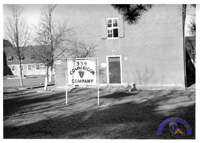
 On 1 July 1954 the 334th Communications Reconnaissance Company (CRC) relocated from Mannheim to Herzo Base. On 25 June 1955 the personnel and equipment were assumed by the 339th CRC which was activated concurrently at Herzo. (1) On 1 July 1956 the 339th CRC was re-designated as the 339th ASA Company and remained at Herzo until September 1957 when it relocated to Rothwesten. On 1 July 1954 the 334th Communications Reconnaissance Company (CRC) relocated from Mannheim to Herzo Base. On 25 June 1955 the personnel and equipment were assumed by the 339th CRC which was activated concurrently at Herzo. (1) On 1 July 1956 the 339th CRC was re-designated as the 339th ASA Company and remained at Herzo until September 1957 when it relocated to Rothwesten.(1) Could it be that the 334th was a National Guard or Army Reserve unit that was "returned" to the States and replaced by a Regular Army unit (in this case the 339th CR Co) under the program described on the Seventh Army Page (Release of RC Units)? |
||||||||||||||||||||||||||||||||||||||||||||||||||||||||
| (Source: Email from Roman P Weber, 334th CR Company and 328th CR Company) | ||||||||||||||||||||||||||||||||||||||||||||||||||||||||
| August 1951 I was discharged from the USN, Radioman (RM3), morse radio operator aboard ships almost 4 years and last 6 months in Korea. In November I enlisted in the Army. While at Ft Riley for basic I was interviewed by ASA/CIC officers, I believe from Vint Hills Farm Station, Warrenton, VA. Following the "classified interview", I volunteered for ASA. Sent to Vint Hills. TS/Crypto indorsed Clearance approved and went to TSESS, Ft Gordon. Completed the 6 month morse High Speed Operator (MOS 1766) in a few days. Graduated and sent to Ft Devens, MS and assigned to the "newly forming" 334th Comm Recon Co. Trained with an 11-man DF Team for several months. About February 1952, the 334th was stationed at Funari Barracks, Käfertal (Mannheim), Germany. Our shoulder patch was the "Flaming Sword;" brass, "Unassigned (eagle)", although we were permitted to wear any army branch brass we wanted to just so long as our overseas hat braid was the color of the branch. Otherwise hat bread for "unassigned" branch was green. "Green" was the only one issued. If you wanted to wear other branch (Armd, Arty, Inf, etc) brass and hat braid, you had to buy them yourself. Most did that. The 334th, I think, came under the 502nd CR Group. Never heard of the 302nd, 307th, 312th CR Battalions. The only ASA companies I knew of through the earlier 1950s, were the 328th, 332nd and 334th CR Companies. I probably never became familiar with the chain of ASA command, since I was almost always gone from my ASA company with my 11-man DF Team. Maj Kenny, MP, was Company Commander when we first got to Mannheim from Ft Devens, MA. Replaced by Maj Carnine, MP. Neither one could enter "operations", since they did not have, nor need to have, TS/Crypto clearance. My DF Team comprised a SSG, NCOIC (in 1952, E7 was the highest EM grade, 1st Sgts) and 10 Corporals -- five were High Speed Ops (1766) and the other five Intercept Ops. We worked 24/7, two-man shifts, one of each MOS. ALL were cross-trained to the other MOS, although, I think for security reasons, never recorded in Personnel Files. For the first few months in Germany (Mannheim), the DF Teams went TDY to DF Sites of the 332nd CR Co that had already been performing ASA/NSA missions. After HOT with the 332nd a few months, my DF Team was qualified to perform "missions." Our Team moved "all over" W. Germany testing antennas and reception quality/quanity of soviets of their Republics and satellite nations they occupied since the end of WW2. After some months "testing", our Team was more permanently stationed at Sinzig am Rhein und Ahr, a few miles south of Remagen and about 10 miles south of Bonn. After several months at Sinzig, our Team moved back to the Company at Eschwege, near Kassel, where it had moved to from Mannheim. From the back of our van, we could see the E. Zone communist border towers, just a couple kms distant. I was transferred to the 328th CR Co, Bad Aibling, at the foot of the Alps in southern Germany, near Munich and not far from Salzburg, Austria. I was promoted to SP5 (SP2 back then). Sent to a 328th 11-man DF Site at Graz, Austria, near the border of Hungary/Yugoslavia, at a small British Army Intell Kaserne. (International occupation of Austria, Britain, USSR & US, not permitted same as when we were in French Zone, Germay). When packing my suitcase at Aibling before leaving for Graz, the CO personally check each item packed and assured that I carried nothing that could ID me as being an American soldier. Was given a civilian clothing allowance and $77 per month per diem while in Austria (or wherever..) while at Graz. $77 almost matched base pay of an E5 w/8 yrs back then and was tax free. Also, cost to eat 4 meals a day in British mess was only $9 a month. And about all it was worth! Most times we ate "out" in gasthauses. At a "selected location" in the forests of the Alps after leaving Salzburg, the last American Zone camp in the West, we stopped the truck. Changed from fatiques into civilian clothing. From then on, and only if really necessary, used the Black/White w/photo, ID Card, not the regular army ID Card (had but hidden). A 3/4T that followed us took my army clothes back to Aibling for storage. We masked all vehicle US Army, numbers, Star, etc and painted OD over it all. Placed British issued army license plates to the truck (Brit army, at least then, used plates rather than bumper numbers etc as we do). Before leaving for Graz, I was briefed. It included instructions as to what to do in event the Russians attacked while the few of us Americans were hundreds of miles from the US Army in Germany, at Graz. Instructions were that if had to retreat we were not to attempt return to Germany. We were to make our way, "anyway we could, on our own, vehicle or afoot, etc", to the Brenner Pass, in N. Italy Alps. Under no circumstances were we as individuals to permit ourselves to become a POW (won't get into that any deeper..) Went down farther on your ASA Page and read some of he things other ASAE vets wrote. I recall much of what the others have written from the ASA companies I was in (1952-1956). ASA didn't have it's own shoulder patch 1952-56 when I was in it. We wore the "US Forces Europe" "Flaming Sword" shoulder patch. In the 334th CR Company at Mannheim we never were permitted to indicate or say we were "Army Security Agency", nor "Communications Recon." When some guys requested songs on AFN they might say they were calling from 334th "Combat Ranger" CR Company etc. NEVER once did I ever hear those that worked in "operations" (High Speed Morse, RDO Intercept, TFC Analysts, etc) say a word about "on duty" jobs etc. Never. Not even when out drinking, which was most of the off duty time! Someone wrote they had ASA decals etc on vehicles. Guarantee that such was never even dreamed of doing in the 334th nor the 328th CR Companies when I was in both at different times. When we left our trick at operations, the Special Police (MP sort of) gate guards spot-checked that you didn't accidentally carry some little piece of paper that you may have scribbled down some call sign of soviets or satellite countries they occupied. Always, 100%, checked the black and white ASA ID card when entering or leaving operations. Not everyone in ASA had TS/Crypto Clearance. Motor mechanics, cooks, etc didn't need such a clearance any more than any others in the army with those MOS's that didn't work in operations. In the 334 we had an MP major for Co. Cmdr. He couldn't enter operations, since he as most officers don't have, nor need, TS/Crypto clearance. The ASA units I was in, or TDY to, did everything possible not to disclose that we were some sort of Mil Intell army unit. We never 'talked shop" even in our barracks rooms even though operations soldiers had rooms separate from cooks, motor pool, etc unit members. We weren't permitted to write home what our MOS jobs were. Some MOS's were not listed in army MOS job description Pamphlets etc. Once ASA came out with an "ASA" Shoulder patch, the security I knew earlier ASA years, went out the window. The patch says, "I'm a member of ASA/Army Intell"...myself, I think it was a stupid move to "tell the world" whom a soldier of ASA is. We were told that the soviets had the name, rank and serial number of every ASA soldier in Europe. Before going to Graz, at a briefing, they said never to permit yourself to become a POW. In event that the soviets attacked while we few were at Graz, we were not to attempt getting back to Germany, 100s of miles distant, but to make our way, on our own, any way we could to the Brenner Pass, N. Italy and if we made it, to report to the first American commander we met. DF Operations How many DF Teams were in the 334th? Several (I think 334 had 4) in different locations in West Germany - and other places I won't mention. To get a "fix" of where "they" (Threat forces) were at the time, requires you to get at least three "good bearings" (using AN/PDR-1?). "Good" meaning DF bearing accurate within a couple of degrees. Sometimes the bearing swing might be plus or minus 10+ plus degrees. Used if none better from other DF sites, but noted on report not dependably accurate etc. DF Team sites were fairly well fixed. At least for weeks or some months. But not always. My team for example, moved all over West Germany testing reception quantity/quality of signals. Probably our reception reports were filed away by ASAE for possible use in the future. Don't know. Some places were good, others lousy. Sinzig obviously was a "good" reception/DFing site. They kept us there a long time. Months. The site was a few miles out of Sinzig on top of a hill that had been an Italian airfield during WW2, we heard, or so the local Germans told us. (I heard, but don't know for sure, that after our team left, Sinzig became a more permanent ASAE location with more people etc. They built a mess hall and bldgs to house troops, and a bigger detachment of ASA soldiers was assigned. Probably true.) In the French Zone of Germany, although international occupation ageements (France, England, USSR & USA) prohibited soldiers of one nation to be stationed in the zone of another nation. Therefore, we wore civilian clothes (civilian clothes were not allowed in the Army in those days. Get caught and charge might be "intent to go AWOL"). At Sinzig we usually wore fatigues only to work. ASA inspectors almost never came around Sinzig. I don't remember any at all. The WOIC of all 334th DF Teams visited once a month to "inspect" and pay us. (Besides, WO, Mr Whipple, had a fraulein in Sinzig to visit! Heard some years later he died of heart attack in hallway at the Pentagon). Received per diem for board and 2-man rooms at Steineman's Gasthaus in Sinzig. Later we moved to Rheinischer Hof, another Hotel in Sinzing. Although liquor-rations were not authorized other than ranking NCO, each of us Cpls were issued a liquor-ration card. NCOIC, Ralph Newquist (years later heard he became an ASA 1st/Sgt, CA?), monthly dispatched his jeep to the embassy liquor store in Bonn to pick up our liquor rations (in a jeep trailer!). We were paid in cash, mostly D-marks, since no American kaserne, PX etc anywhere nearby. What did a DF Site look like? As I remember, vehicles of a DF Team: a 2½-ton with a hut that contained DF equipment, TS/Crypto documents, our personal M1 rifles w/ammo, basic load of emergency C-Rations, limited spare radio tubes and parts an operator could replace; another 2½-ton troop and equipment carrier; one jeep; one ¾-ton "run around vehicle". Usually we used the ¾-ton to and from the DF site if we lived in a hotel or on a kaserne which was always distant from the DF site and antenna field etc. (As we became friends with some of the German civilians in Sinzig, it was not unusual to use the ¾-ton as a "free" taxi cab to take Germans home from the gasthaus and other not-authorized usage). The ¾-ton was permitted to be used for "recreational purposes", since at Sinzig we didn't have access to kaserne clubs, bowling alleys, army movies, etc. I think our DF site had a 500 gallon gas allowance monthly. But never enforced if more than that needed. We didn't buy German gas, but it came to us in 5-gallon cans. We had a 10kw generator in the trailer that was towed by the DF van. I think the trailoe had 10 gas cans strapped across the back end of it. Plus 5-gallon can on side of trucks or back of the jeep. We had a short, I think, 15' power cable from the DF van to the 10kw in the towed trailer which permitted operating while mobile. I don't remember operating mobile in ASA (did in Signal units later), but we could have if ever would have been needed. Had a long (50' power cable?) from DF van to the 10kw, so when we were set up the noisy generator wasn't near our DF hut. I think the nomenclature of the 10kw was, PE-95, but not certain. I know the 10kw had the same engine as a ¼-ton jeep. Inside the DF hut, some equipment I remember: DF set/rcvr with 360 degree bearing taking scope (AN/PRD-1?). Our DF hut also had a BC-610, 500 watt xmtr. We never used "max" power. One reason for not using "max" was that as you key the big xmtr, a power meter pointer swings up to peak of power tuned. If you used 500 max, the needle pointer would peg the meter every time you keyed. Would risk ruining the meter, plus no need for that much RF power output. Never tuned over 300-350 watts output RF. Often we used "Low" power (a switch). Why permit someone in Moscow hear and DF your xmtr when only communicating shorter distance to Mannheim, for example? Our several DF sites sometimes were very long distances apart, so then you would have to use "High Power" when "tracking/Dfing" some station to the east. The DF site had rather complex antenna systems for intercepting receiver. Long coax connecting to antennas. Sig officers, ASA officers often, too, didn't know much about antennas, coax etc. Once we had an inspecting officer at a DF site. He didn't like the way our long coax didn't have the excess length neatly coiled up, instead of staggered along the ground (always on short wooden stakes at Df sites to keep coax from touching ground/earth). He insisted that the excess coax cable be neatly coiled up and attached to side of the truck. What he didn't realize is that when a coil has RF passing through it, it creates a counter-electromotive force within the coiled cable and reduces reception of signals received. We did what he wanted, but as soon as he left we got rid of he coil. Did we stay at gasthaus or sleep in tents? Never slept in tents. Didn't have any along or that were TO&E to DF teams. Lots of times we stayed in barracks if DF site near to a US kaserne. If so, and they had MPs or CID, we stayed in their barracks. Even then, as most always, DF teams drew per diem. Could eat out or in the army mess hall. Lowest per diem I remember was $77 a month. Most, $110. Good deal back in the days when a Cpl E4 base pay wasn't much more than that. Per diem was tax free and never had to pay that much for food and rooms where ever we were. Small incident when staying in an Armored barracks at Bindlach Kaserne, near to the DF site at Bayreuth. Armored unit gave us one big room to house us 11. DF you always have some just coming off duty, some getting ready to go, and the others on their 3 day break (We worked 6 on and 3 off most times). So the room will be kind of messy. The Armd Col and some senior NCO were inspecting troop rooms. (At the time when 334 first got to Germany, 1952, all promotions in the Army were frozen. No promotions. 334 operations had all Cpls with some being made "acting" buck sgts. Wore sgt bands on arm. In 334, by the way, we had only one Pfc. When the Col came in our room he was shocked. Pissed off at the "mess". People in bed, some in underwear, clothes not hung up in lockers, etc. I remember, just now, the "acting" Sgt of our DF Team wasJoe Greeney, Darnellen, NJ and our NCOIC for a while, including that day. The Col wanted to talk to, and did, to whoever was in charge of this bunch of seemingly to him, "misfits.' He asked Joe what in the hell were the jobs of these soldiers, why they weren't on duty but still in bed, etc. Joe told him that for security reasons he wasn't permitted to answer the Col's questions The Col really go pissed off and had Joe give him the phone numbr of CO, 334. No doubt the Col made a phone call. Don't know what he was TOLD, but he nor anyone else ever came around to our room again. Another thing that happened when at Bindlach/Bayreuth site. In 1952 the Army had mid-night curfew. You could be on 30 days leave, but still had to be off the streets at mid-night. At Bindlach when off duty, including NCOIC Greeney, we'd go out drinking or/and chasing frauliens. Almost never made it through the gate by mid-night and written up, DR Report, by MPs or gate guards. MP station sent DRs to senior person in charge of the DF troops, so Joe Greeney would get them from the Armd Orderly Room. Supposed to send all the DRs (lots of them. Most every night, some) back to the company at Mannheim. Didn't. Shit-canned them all when he got them. Got away with it apparently, because we never heard anything about DRs at the company later. I said DF site operators were not interested in msg texts. Only call-signs. Soviet radio morse call-signs were always number/letter three digits. During several hours on duty, we might intercept many many call signs, but most were not of those assigned to your unit's mission. I'm sure other ASA units all had differing missions and call-signs/soviet commands of interest. (Xmtrs aren't issued to Pfcs. More powerful a xmtr sounds, probably indicated the higher the command. Not necessarily though). I think I wrote that my primary MOS was 1766 High Speed Morse Opr. Original MOS was 052, which changed later to 1766. Both included RTT, but never used RTT much. When mobile, or even mobile-at-halt, reception usually not good enough to copy RTT signals). We mostly all learned the other operator's MOS, Intercept Opr. Always two, one of each MOS, worked DFing. The intercept opr would get a good "mission assigned" call sign, then the 1766 would code with a rapid code means the call sign etc and send it to all other unit DF sites. Within minutes, hopefuly, each site would have sent the site's bearing back to "operations" (Mannheim, Bad Aibling, etc) and there it would be plotted and the "fix" of the soviet xmtr location reported. Each unit was assigned "books" of soviets of interest. At the main unit station many Intercept Oprs were always on duty, "listening" for a book assigned mission call sign. Soviets changed call signs fairly often. We never learned, nor were ever told, the soviet command a call sign belonged to. Intercept was not an easy job, since soviets sent and received on different freqs vs US sending and rcving on same freq. So Intercepts might get only one-end of the "to" and "from" message. Without both ends, intell info not much good. Usually, I think, we got both ends. On a trick were many Intercept Oprs. Each had two receivers and operated split-phone. One receiver in one earphone that stayed on a "special" frequency, just in case that important unit of interest came on the air, which wasn't often. The other earphone used while searching the band for 3-digit call signs. When an operator had a mission assigned call sign picked up, he buzzed the WO trick supervisor. The WO, or maybe an NCO sometimes in place of, would alert intercept operators to look for the other end of the intercepted station. During all this time, the DF sites would also be notified the freq of the other end and get a "fix" on it. Then it would be known exactly where both stations (commands) were located. All DF sites intercepted and tracked the same way, so when I moved from 334 to 328, I could get to work immediately. The only difference being call-sign mission of 328 being other than at 334. Identical equipment, same make up of DF Teams, etc, just in some other location in Europe someplace. I found it very exciting. Especially when getting a call sign "book" not having been heard for a long time. |
||||||||||||||||||||||||||||||||||||||||||||||||||||||||
| (Source: Email from Cleve Tarvin, 339th CR Co, 1955-57) | ||||||||||||||||||||||||||||||||||||||||||||||||||||||||
| I arrived in Germany in April of 1955 and was sent directly to the 339th CR Co as an 058.0 (old mos 1717). We remained there until early 1957 (I think) when the outfit was moved to Kassel where we stayed until October when we were disbanded and shipped back to Herzo as part of the 319th ASA Battalion.
I was shipped home in December of 1957. As I remember it, our company was fairly small. We had a Lt. for a CO, a W/O for ops, two men in the armory (who we each paid $2 a month to clean our weapons) and a large motor pool staff. Operations had four tricks of about twenty men each. We all worked days, swings and mids, 6-3 6-2 6-3 (6 days, 3 off; then 6 swings, 2 off; then 6 mids and 3 off), so we had a lot of three day passes ! We each had to pay $5 a month to cover paying the people who did KP and the tailor and the guys that cleaned our rooms and showers etc. At Herzo Base we were in a large building on the first floor about 200 yards from the chow hall. Our mission was the Czech border guards and secret police and, of course, general search. At Kassel we were about 50 yards from the snack bar on the main road. Operations was right across the street in a two story building. |
||||||||||||||||||||||||||||||||||||||||||||||||||||||||
|
||||||||||||||||||||||||||||||||||||||||||||||||||||||||
|
||||||||||||||||||||||||||||||||||||||||||||||||||||||||
|
|
||||||||||||||||||||||||||||||||||||||||||||||||||||||||
| 507th USASA Group | ||||||||||||||||||||||||||||||||||||||||||||||||||||||||
| 1957 - 1971 | ||||||||||||||||||||||||||||||||||||||||||||||||||||||||
| (Source: Various ASA sites including the ASA Vets and OV-1 Mohawk Association sites) | ||||||||||||||||||||||||||||||||||||||||||||||||||||||||
| The 507th USASA
Group was activated in Oct? 1957. The subordinate elements of the
Group expanded their operational sites to 17
spread throughout Germany. Some of the sites were at Lübeck,
Mount Meissner, Gartow, Gusborn, Schneeberg, St. Andreasberg, Wobeck,
Grünstadt (GuardRail) and many other border sites and locations. An Aviation Section was added (probably to HHC) at this time and equipped with two L-19 and one L-20 fixed-wing aircraft and manned by four pilots and five mechanics. The air section operated out of Heilbronn airfield (Mutlangen?). In March 1959, the 251st USASA Processing Co was added to the Group. During the summer of 1960, HQ 507th USASA Gp and the Processing Co were moved to Baumholder where they occupied the facilities previously used by the 11th USASA Field Station (Faulenberg Kaserne?). (Webmaster Note: The field station at Baumholder did not work out, so the ASA established a field station at Harrogate in England and moved the personnel of the 11th FS to Harrogate between April-May, 1960. Then they moved the 502nd Gp to the old 11th FS facility in Baumholder.) In contrast to Vietnam where airborne COMINT was playing a significant role in the 1960s, there was no need for airborne COMINT assets in Europe where the ASA collected COMINT via a well-established network of fixed Field Stations. However, there was a real need for airborne ELINT. The OV-1A model entered US Army service in 1961 and was deployed with the 7th Army (possibly assigned to SRU 2 in Zweibrücken) in Germany in the summer of 1961. By 1962, the 507th ASA Group was collecting ELINT using the OV-1Mohawk (variously called BATTLEAXE, HOT PIPE and SILVER LANCE) and CV-2A Caribou (called SURE THING or GOFER DELTA). G-2 Air, HQ 7th Army, Stuttgart, coordinated all MOHAWK surveillance missions along the border at that time. In April 1962, the 507th USASA Gp comprised the following units: |
||||||||||||||||||||||||||||||||||||||||||||||||||||||||
|
||||||||||||||||||||||||||||||||||||||||||||||||||||||||
| In May 1965,
the Signal Research Unit 2 at Zweibrücken was assigned to the 507th.
(Webmaster Note: I believe this is the unit that operated the
OV-1A/C Mohawk (BATTLEAXE) and CV-2A Caribou (SURE THING) ELINT aircraft
that had arrived in theater in 1961/62.) The Group's mission changed in the summer of 1966, with the national-level missions being reassigned to other ASA units in Germany. The Group was to provide field army level support to Seventh Army. This change in mission also resulted in a reduction in strength within the Group. The Air Section was discontinued due to personnel shortages (prob. a result of the heavy demand for pilots in VN). In 1968, the Group was moved from Baumholder to Flak Kaserne in Augsburg. On May 3 1971, the 507th USASA Group was redesignated as 502nd ASA Group. |
||||||||||||||||||||||||||||||||||||||||||||||||||||||||
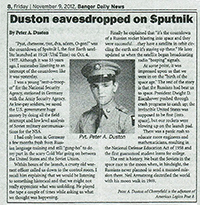
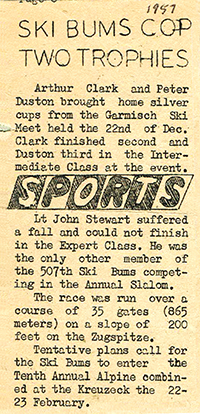
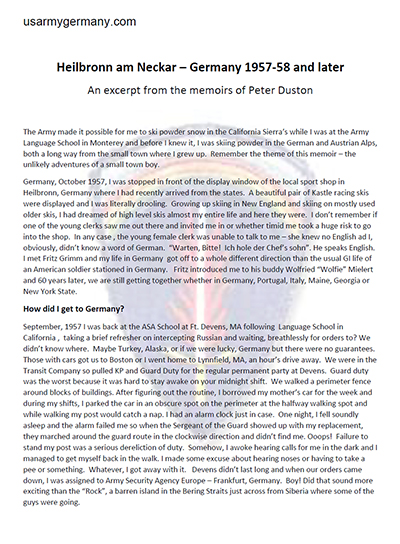 Excerpt from the memoirs of Peter Duston, 507th USASA Group, Badenerhof Kaserne, Heilbronn, late 1950s |
||||||||||||||||||||||||||||||||||||||||||||||||||||||||
| (Source: Email from Peter Duston) | ||||||||||||||||||||||||||||||||||||||||||||||||||||||||
| I can add narrative for the 1956-59 time span for HQ, 507th USASA at Badenerhof Kaserne in Heilbronn. I remember Heilbronn Station. Once in a while, those "spooks" showed up in Tillie's and were always surprised at what the conversations were between some of our guys. Philosophy, History, Politics, Chess. They would want us to repeat and they leaned in - we presumed we were being recorded. More than once, we reported to our HQ or maybe CIC about obvious efforts to compromise us. "My brother always wanted a US Gas Mask. Could you get me one. I'd be willing to pay 50 or a 100 Marks for one. He's just a collector of military stuff." was one I remembered. Do you remember the "Soviet Mission in West Germany"? Russian Officers driving cars with an official plate "snooping" near US Bases? We were suppose to report if we saw them and they weren't allowed to come close to Badenerhof. I remember one day I had courier duty to the airfield on Jaeger Hill with one of our new LT's. He wanted to drive the "deuce" I was driving although wasn't allowed because I was signed with the truck. We're coming down that steep Jaeger Strasse hill and the SMLM Ruski's are on the side of the road, out of their car with a telephoto camera pointed down into the Kaserne. The LT swerves across the road and gets the Russians jumping into the bushes almost hitting a German driving up the hill. I remember the look on the poor German's face as he was almost wiped out by our huge truck. The LT got in trouble over that. The Russians apparently filed a complaint. I apparently got off because I had been ordered by an officer to let him drive. Later in 1961-63, when Martha and I lived in Munich, I worked with CIC/FBI/CIA people. Many of them got their start in Army Intelligence and had Reserve commissions - were in my Reserve unit there and when I worked for Radio Liberty, we communicated since RL was financed by the CIA and "other" federal agencies. While at Heilbronn, we had a teenage social club of Germans and a few Americans - the Donnerstag Abend Klub (Thursday Evening Club). We met in the Passagen Cafe, chatted, went on hikes, picnics, dances, etc. We are meeting this year in NY State although one German couple may not make it. We also have had a reunion group of German friends and GI's from back then that has been meeting for 60 years. My wife and I have been back to Heilbronn multiple times. Badenerhof is gone - it was prime real estate and is a nice eco-friendly development now. |
||||||||||||||||||||||||||||||||||||||||||||||||||||||||
|
||||||||||||||||||||||||||||||||||||||||||||||||||||||||
| Lübeck Convoy – 1958 TDY at the “best” duty in the whole ASA – Co. B, 319th ASAs In late summer 1958, things were quiet at Badenerhof Kaserne where I was stationed with the 507th ASA in Heilbronn. It must've been a lull in the Cold War. A notice went up on the board calling for volunteers to drive some trucks to northern Germany to help set up a new intercept site. The ASA in Europe was tasked with intercepting Russian and East Bloc communications to determine if the Soviet Union was preparing for their invasion of Western Europe, Being somewhat bored, I volunteered. Problem was, you needed a military truck license which I did not have, but no problem, the motor sergeant just signed me off. He said you can learn on the way. Believe me, driving a huge truck through narrow German village streets was nerve wracking but I learned under fire. We were assigned three brand-new deuce and a half trucks. That's a 2 1/2 ton truck, standard with the U.S. Army. We loaded a few cases of C rations in the back since they were unable to give us any advanced travel pay for food on the way. It was unsure how long we would be gone as it wasn't really clear about what our mission was other than to get these trucks up to northern Germany. We got some last-minute orders that directed us to a military base outside of Frankfurt Germany where they loaded our trucks with perforated steel planking (PSP - aka Marston Mats) 1.) , a kind of big metal sheets that clipped together you could lay on a muddy ground and provide a stable foundation for either of landing strip or in this case intercept huts. One of us got a generator trailer to tow as well. There were six of us with one of us being a sergeant in charge, two soldiers assigned to each truck. We had a night in Frankfurt so went on the town. We ended up in a nightclub that offered a strip show on the stage and I experienced my first cross-dressed male playing a woman's role. I was young and kind of naïve about those things so was really shocked when the stripper whipped off her clothes to reveal a male underneath. We continued on into northern Germany which at that time was considered the British Zone, no American army up there. At one location, we were stopped at a Gasthaus and sitting outside eating and having a beer when a British convoy rolled by with hoots: “Bloody Yanks” – taking over everywhere. I don't know whose idea it was, probably our sergeant with a little more experience than the rest of us and wanted to make it a joke but he drove us through Hamburg and down the famous "Reeperbahn" where all the worker prostitutes in the brothels were hanging out the windows waving. We honked our horns and waved as three huge Army trucks drove down through that red light district past the big signs warning allied troops that the area was “Off Limits.” We eventually made it to Lübeck which was our initial destination We had directions to the U.S. Army Station Luebeck but as we're driving down a wide boulevard with mansions on one side and lawns reaching down to the bay, I remarked this couldn't be where there's a U.S. Army station This looks like the high rent district. But then, there they were - a couple of U.S. Army jeeps and several little Austin Healey Sprite sports cars parked in front of a large mansion with a big iron fence gate. We were tired and smelly from several days on the road and trucks and glad to be there and even more amazed as I walked up the walkway and the French windows on the front were open and a young woman sitting in the window welcoming us with "come on in guys, you're just in time for happy hour". I'm thinking, what kind of Army station is this? Well, it turns out that Jürgen-Wullenwever Strasse was leased by the US Army and run like a college fraternity. “Jerk Haus,” as they called it, had their own house mother who cleaned and cooked for them. They had a bar and even a sailboat on the bay down at the end of the lawn. They kept telling us don't tell anybody back in southern Germany what the station is like because we have got the sweetest deal in the whole U.S. Army Europe. Officially, they were a detachment of Company B, 319th ASA Battalion, located in Rothwesten on an old Fliegerhorst (WWII German Air Base). By the way there were several attractive young women at happy hour including the young woman in the window who happened to be the city police chief's daughter. They put us up for the night and I think the next day took us down to the bay where their favorite club was named "Der Kahn" (the Riverboat). It had been a substantial passenger vessel now permanently moored at the dock. The middle decks had been cut out of it so around the periphery were like balconies looking down on the middle dance floor in the bottom of the vessel with the band was. Great jazz and dance music and we had a great time. We stayed a couple of days to get destination orders on where we were hauling the cargo. We got back on the road and headed north to the North Sea coast where we met up with a ferryboat, loaded our trucks for the transport across to Fehmarn Island (GOOGLE Maps) not far off the coast and very close to the East German border. Fehmarn was a summer resort island with beautiful beaches and very popular with Germans and nearby Danes and Swedes. We rendezvoused at George's Gasthaus on the remote end of the island. Here we were to stay for several days while waiting for additional troops who would be setting up an intercept site to monitor Russian communications, especially targeting Rostock which was a huge Russian Navy base. Since we had several days to kill, we stalked the beaches especially ogling the multiple Scandinavian blondes. Too many of them however, had mothers with them who were giving us the evil eye. We had a black sergeant with us from Luebeck who attracted an enormous attention because none of these people had ever seen a black person before. When we walked the beaches, little kids especially, followed Sgt. Clark and he was really great with them. Way down at the end of one beach there was a nude beach which of course we had to crash but with Roy Clark with us it was obvious we were strangers. |
||||||||||||||||||||||||||||||||||||||||||||||||||||||||
 Aerial of Lübeck, located on the German Baltic coast in the state of Schleswig-Holstein. |
||||||||||||||||||||||||||||||||||||||||||||||||||||||||
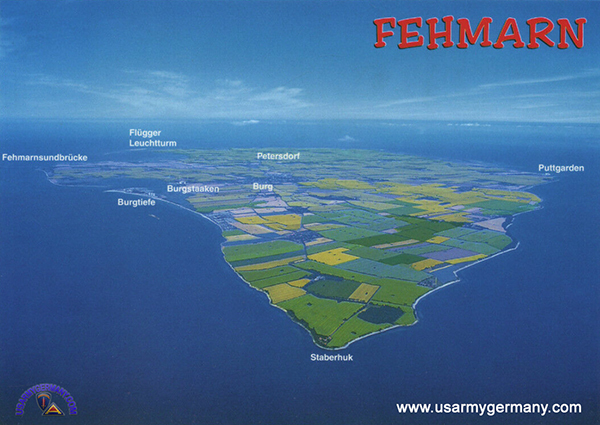 Fehmarn Island, Baltic Sea (German postcard) |
||||||||||||||||||||||||||||||||||||||||||||||||||||||||
| Eventually, the intercept team showed up with a communications shelter that fit on the back of a deuce and a half. So we were relieved and headed back south with our three trucks after an overnight stop back in Luebeck. We pretty much drove straight through to Rothwestern in central Germany where we had an intercept base for the central region of the border and was the Headquarters for the Lübeck Detachment. We had some trouble turning our trucks over to the motor Sgt. there. The days we were driving, up and back, we had very little money for food so we were forced to eat the Army C rations that we had with us. Because the cans were cold I had the bright idea of resting them on the manifold of the truck allowing the heat to heat them up. However, I left a couple of cans of beans on too long. They exploded and made an awful mess of that brand-new engine. Somewhere else we had caught the canvas on the truck on a tree branch or tree limb and ripped half of it off and there were a few other issues as well. Eventually, they were satisfied and signed off the paperwork but when they backed one of the trucks into a garage building which had been a hanger of the German Luftwaffe during World War II, there was an explosive mine still in the wall and it blew the back end of the truck off. Luckily no one was hurt. They issued us train tickets and drove us to the train station where we found that we had first-class tickets which was a good thing because in our smelly uniforms we didn't have to sit in second class with other passengers who would've been offended by our presence. Problem was we still had no money for food on this train. We did, however, still had a few C rations so there we were while the steward was going down the corridor with his little gong calling everyone to dinner in the dining car, we were sitting in our first-class compartment opening cans of beans. We got a lot of very disapproving looks but we had had quite the adventure. By the way, while we're on the ferryboat, the other passengers did not believe that we were even Americans. They had not seen any if any since the war so they were convinced that we must be from the Danish Army which was right across the bay. 1.) Primarily used for the rapid construction of temporary runways and landing strips. |
||||||||||||||||||||||||||||||||||||||||||||||||||||||||
| Early 1960s | ||||||||||||||||||||||||||||||||||||||||||||||||||||||||
|
||||||||||||||||||||||||||||||||||||||||||||||||||||||||
| 1960 | ||||||||||||||||||||||||||||||||||||||||||||||||||||||||
| (Source: Email from John O'Neil) | ||||||||||||||||||||||||||||||||||||||||||||||||||||||||
| My next duty station (after Vint Hill Farms) was with the 507th USASA Group (Field Army) at Heilbronn am Neckar. We had 4 -2½ ton trucks with expandable sides that held all our IBM equipment that ran off portable diesel generators (one per truck). The vans were housed in a big garage and it was a fairly comfortable, if sometimes very cold, arrangement. Being 6 foot 6 and working is a space with a 6 foot roof became a real pain in the neck. Heilbronn was a good duty town because there were so few US military around. I was there from Feb 1960 to May 1961 when we hitched the generators to our trucks and moved to Baumholder. I’ve managed to blot out almost everything about the 5 ½ months we spent there – but I do recall that there was a Sgt Elvis P reported to be driving a tank around in the neighborhood. I have a copy of an order sending me from Heilbronn to Rothwesten for a 4 day TDY on 24 Feb 1961. I have no memory of it, or why I would have gone – unless it was trouble shooting the equipment. I do recall going down to Bad Aibling to deliver a part they needed. They stopped me at the gate, took the part, and sent me home again. Not even a coffee or beer! While working in Heilbronn I received a phone call from a 206 at one of our other Processing Companies saying that an IG Inspection team had just been through his unit, and looked under the covers of one of the machines. When the IG found a rather big mess of old oil and card dust he demanded to know why it wasn’t nice and clean. The 206 quickly explained that it was IBM’s policy ‘not to disturb the dirt’. As much as he would have liked to clean it up, he had to follow IBM’s maintenance orders. He suggested that if my machines were clean, I’d better get them dirty before the IG arrived. Another rather odd practice that we had was called ‘blanket sorting’. Our CO needed sets of random numbers, and one thing that was difficult to do on a card sorter was to produce something random. So we punched up 4,000 cards in sequence, dumped them out on a blanket and them tossed them up in the air several times to get them well mixed up. Needles to say, the cards went every where in the garage; they were ‘sorted’ with gusto. I never knew if it was a true coincidence or if our CO had set us up, but the base commander, a bird colonel as I recall, knocked on the door just after the last big toss. It was rather difficult to explain why the cards were all over the floor. I have no knowledge of any fixed wing aircraft in Heilbronn during my time there. However, being the ASA, I didn’t have any particular need to know! In Nov 1961 I was sent to the 251st USASA Processing Company, Frankfurt (yes - the IG Farben Building) only we were on the 1st floor as I recall. I was still working as a 206 and some how had become a SP-6 (E6). I was in Frankfurt until August 1962 when my second tour was over and I was ready to get out. While I was with the 251st they received an IBM 1401 computer (could have been 1410 but I don’t think so). It was the first computer I’d seen outside the IBM plant in Endicott NY. It had been shipped from the US without ever having been mated on the floor (the RAM came from California and the rest from NY). It took several weeks for the trained IBM techs to figure out why it turned itself OFF every time the power was turned ON. That was my introduction to computers. Jim Campbell in his email said “(When I was in, no 206 had ever re-enlisted - IBM had a job ready for them when they got out.)” When I got out I went to the IBM office in San Francisco, showed them my diploma with TJ Watson’s signature and asked for a job, they asked me what I knew about computers, so I told them I’d seen one in Germany. I got the hint when they said ‘Goodbye, thanks for stopping in”. Late in 1962 was not the time to look for a job repairing the soon to be obsolete IBM punched card machines! It all turned out for the best. I worked as a tab operator while I taught myself computer programming and all that stuff and lived happily ever after. My wife, our three children and I moved to Australia 40 years ago. I’ve enjoyed looking through the web pages. It brings back the old memories of a different era. |
||||||||||||||||||||||||||||||||||||||||||||||||||||||||
| (Source: Email from James "Bull" Durham) | ||||||||||||||||||||||||||||||||||||||||||||||||||||||||
| I was stationed at Heilbronn from about April/May of 1960 in the 507th USASA GP. I worked in the com.center as a teletype operator among other duties!! After a few months we moved to Baumholder (sorry to say). When I found out we were moving to Baumholder I asked where is that, someone said it was the “toilet” of Germany. They weren’t far from right. After 2 years there (it felt like 10) I left for home. You know what? if I could go back there and be 22 or 23 years old again I would do it all over again!!! I sure would like to hear from some of the guys in my unit. If any one wanted to contact me I am James Durham (aka) BULL. |
||||||||||||||||||||||||||||||||||||||||||||||||||||||||
| 1967 | ||||||||||||||||||||||||||||||||||||||||||||||||||||||||
| (Source: Email from Bill Shade) | ||||||||||||||||||||||||||||||||||||||||||||||||||||||||
Looking at your website about the 507th ASA Group, you have a note about SRU 2 and the belief that it was the parent unit of the ELINT aircraft.
SRU #2 was a an acoustint (sp) unit used to monitor nuclear events. There were several around the world. SRU 2 did not have any connection to the Aircraft. The aviation units under the group were in the 507th Special Projects Detachment, a TDA organization under Group Headquarters. The SURETHING aircraft was the last of its type to be turned over to the USAF when that decision was made. I was a member of the Group Staff from 1967 through 1970 when I moved to the 318th USASA Battalion in Support of 7th Corps. Bill Shade
|
||||||||||||||||||||||||||||||||||||||||||||||||||||||||
| Visit the bennettpics Online Photos website for several photo albums with pictures of Badenerhof Kaserne and the 507th (502nd) ASA Group! |
||||||||||||||||||||||||||||||||||||||||||||||||||||||||
|
||||||||||||||||||||||||||||||||||||||||||||||||||||||||
|
|
||||||||||||||||||||||||||||||||||||||||||||||||||||||||
| 502nd ASA Group | ||||||||||||||||||||||||||||||||||||||||||||||||||||||||
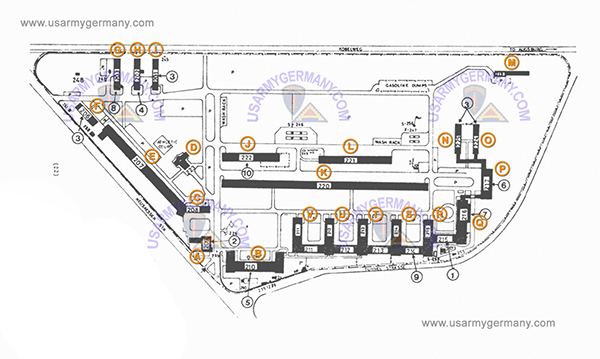 Annotated map for Flak Kaserne (502nd ASA Gp), Augsburg late 1970s |
||||||||||||||||||||||||||||||||||||||||||||||||||||||||
 502nd ASA Group
DUI
502nd ASA Group
DUI |
||||||||||||||||||||||||||||||||||||||||||||||||||||||||
| 1971 - 1977 | ||||||||||||||||||||||||||||||||||||||||||||||||||||||||
| On May 3 1971,
the 502nd ASA Group was activated in
Augsburg. At this time, the 502nd ASA Gp comprised the following units: |
||||||||||||||||||||||||||||||||||||||||||||||||||||||||
|
||||||||||||||||||||||||||||||||||||||||||||||||||||||||
| Between
1971 and 1974, the Group grew in size as additional units were added
to its span of control:202d ASA Co (Direct
Support), activated 1 July 1974 at Ansbach, supported 1st Armored
Division851st ASA Company
(Direct Support), activated 1 July 1974 at Kitzingen, supported 3rd
Infantry Division856th ASA Co (Direct
Support), supported 3rd Armored Division326th ASA Co (Operations
Forward) 409th ASA Co (Operations
Rear) 328th ASA Co (Control
& Processing) 307th ASA Battalion,
activated on July 1 1974 and tasked with supporting VII Corps |
||||||||||||||||||||||||||||||||||||||||||||||||||||||||
| In 1974, the
2nd EW Co was split into two units: 335th
ASA Co (Prov) 374th
ASA Co (Prov) On 1 July 1974, the 851st ASA Co (DS) was activated in Germany and assigned the mission of supporting the 3rd Inf Div. That same year, the 374th ASA Co was redesignated 856th ASA Co (Michael Bks, Frankfurt-Höchst) and assigned to the 3rd Armd Div. (Webmaster Note: Another source states that the 2nd EW Co, Flak Ksn, Augsburg became the 202nd ASA Co and moved to Katterbach (1st Armd Div) sometime around 1974-1975. Can anybody provide information on this? - see response from Larry Mellgren) In 1975, the 302d ASA Bn and the 415th ASA Co (Direct Support) (supported 8th Inf Div) joined the Group. The 302nd ASA Bn (Corps) was react at Frankfurt, effective 21 Dec 1975, and assigned to the 502nd ASA Gp in support of V Corps. The 415th ASA Co had been activated in July 1974 at Augbsurg (Flak Ksn) and was later moved to Idar Oberstein which was closer to the 8th Inf Div, the unit that the 415th supported. By December 1976, the Group had also assumed control over the 330th ASA Co (Avn). The 330th ASA Co (EW) had been activated on 30 Sep 1973 to operate the GUARDRAIL system as a theater level asset. Detachment 1 of the 330th ASA Co was deployed to Kitzingen AAF (Sept 1973 - 1975) and later at Stuttgart AAF (1975). The detachment flew the RV-1C's (QUICKLOOK I). (Webmaster Note: COMINT aircraft were first used in Europe in the 1971 REFORGER I exercise. The RU-21G GUARDRAIL I was equipped only for intercept missions. The GUARDRAIL II (RU-21E) was deployed the following year and added a DF capability.) In January 1977, the 502d ASA Group was reassigned to HQ US Army, Europe. This was a result of the deactivation of the Army Security Agency, Europe. The Group downsized shortly thereafter as the 302d (on 1 Jan 1977) and 307th Battalions were reassigned to V and VII Corps and the direct support companies reverted to divisional control. The Group was reorganized and redesignated on 1 Oct 1981 as Headquarters and Headquarters Company, 502nd Army Security Agency Battalion. |
||||||||||||||||||||||||||||||||||||||||||||||||||||||||
| CORRECTION: (Source: Email from Mark L. Streeter) I was assigned to the 502 ASA Group Augsburg in 1976. I noticed in your web page, which is absolutely wonderful, the 415th ASA Co. as being re-assigned in 1975. I may have found an error. I was assigned to the 415th ASA Co., 502 ASA Group which was not re-assigned to the 8th Infantry Division until 1976. I was part of the move north with our new home in Idar Oberstein, Germany. Webmaster Note: Could it be that the 415th was assigned or attached to the 502nd in 1975 (with the mission of providing DS support to the 8th ID), but then reassigned directly to the 8th ID in 1976? (Source: Email from Donald Nesheim (MOS 983A USASA 1957-77) From the part of the Web page on 502nd -- "By December 1976, the Group had also assumed control over the 330th ASA Co (Avn). The 330th ASA Co (EW) had been activated on 30 Sep 1973 to operate the GUARDRAIL system as a theater level asset. Detachment 1 of the 330th ASA Co was deployed to Kitzingen AAF (Sept 1973 - 1975) and later at Stuttgart AAF (1975). The detachment flew the RV-1C's (QUICKLOOK I). (Webmaster Note: COMINT aircraft were first used in Europe in the 1971 REFORGER I exercise. The RU-21G GUARDRAIL I was equipped only for intercept missions. The GUARDRAIL II (RU-21E) was deployed the following year and added a DF capability.)" Detachment 1 of the 330th ASA Co (AVN) was deployed to Kitzingen AAF in June 1974 and moved to Stuttgart in June 1975. The 330th was a 502nd Group unit as soon as it came in country. I was the OIC of Det at Kitzingen and arrived in late June 1974. There was a small advanced party there under SSG Kiser when I arrived. The RV-1C's (tail numbers 68-15964 & 68-15965) had been flown from the US to Germany but the unit pilots were not in country yet. Capt Lawrence arrived a few weeks after I did and assumed command upon his arrival. He was a Mohawk IP pilot and trained the other pilots on border flight procedures when they arrived. CW4 Donald Nesheim, USA Ret MOS 983A (USASA 1957-1977) (Source: Email from James Kiser, Det 1, 330th ASA Co (Avn)) The dates of Det 1 330th ASA Co are a little off. We actually deployed to Kitzingen AAF in Jun/Jul of 1974. The activation order was dated sometime in Jun 74. The personnel and equipment arrived piecemeal and I don't think we were declared operational until late Aug 74. We moved to Stuttgart AAF in June of 75. Det 1 became part of the 73rd MICAS in Sep 1977. Quick Look I was replaced by Quick Look II in Sep/Oct 1978. I was NCOIC and OPSNCO for Det 1. Click on the following linkis to see more on the 330th ASA Co (EW) Aerial Surveillance along the Border2nd Military Intelligence Battalion (AE) |
||||||||||||||||||||||||||||||||||||||||||||||||||||||||
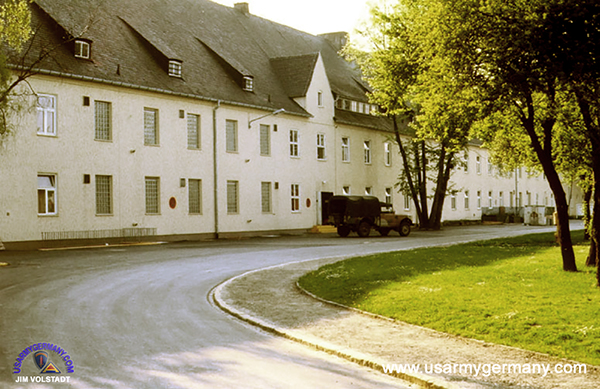 502nd ASA Group HQ, Bldg #207, Flak Kaserne, mid-1970s (Jim Volstad) |
||||||||||||||||||||||||||||||||||||||||||||||||||||||||
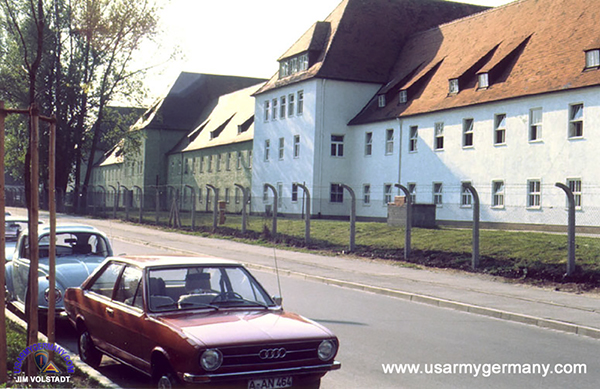 Barracks buildings on the south side of Flak Ksn, seen from Tunnel Strasse (Jim Volstad) |
||||||||||||||||||||||||||||||||||||||||||||||||||||||||
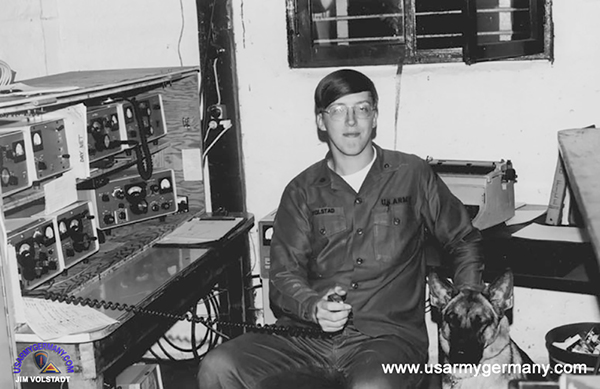 Jim Volstadt working at the MARS Station on Flak Kaserne (Jim Volstadt) |
||||||||||||||||||||||||||||||||||||||||||||||||||||||||
| 1973 | ||||||||||||||||||||||||||||||||||||||||||||||||||||||||
| (Source: Email from Jim Volstadt) | ||||||||||||||||||||||||||||||||||||||||||||||||||||||||
| Jim Volstadt served with HHC, 502nd ASA Group in Augsburg from April 1973 until 1975 when he pcs'ed to Field Station San Antonio. Initially, he was billeted in Bldg #124 (near the Post Chapel) at Sheridan Kaserne. Jim provided the ID for Building M at Flak Kaserne (see map) as the former MARS station. He was one of the operators in the mid-1970s. |
||||||||||||||||||||||||||||||||||||||||||||||||||||||||
| (Source: Email from Larry Hudacek) | ||||||||||||||||||||||||||||||||||||||||||||||||||||||||
| I was browsing the web when I happened upon your listing of Flak Kaserne, my old stomping grounds. I was a Military Policeman assigned to HHC 502d ASA GP in 1973-1974. I spent 2 years in Augsburg before being reassigned to Garmisch. As a military policeman assigned to an ASA (Army Security Agency) unit, our main duties were manning the gate at the kaserne entrance, patrolling the kaserne and guarding the S-3 (Plans, Operations and Training) office 7 X 24. We also responded to incidents at the Flak EM Club, in an unofficial and first response manner. Our main function was to provide physical security to the ASA mission. The “real” law enforcement functions were handled by the 21st MP Det and Co C, 385th MP BN located on Reese Barracks. Many of the MP’s on Flak kaserne knew many of the MP’s on Reese Barracks. We often compared notes. We fared much better (nicer living areas, a lower profile kaserne and a better work schedule. ASA just wasn’t the “Real Army”. The mission was more technical and less soldier oriented. I remember the 409th ASA Co being formed, but prior to that, the subordinate units were:  HHC, 502nd ASA Group 201st ASA Co (Scty) which was billeted in bldg. 211 326th ASA Co, billeted in bldg. 212 2nd EW Co, billeted in bldg. 213 HHC, 502nd ASA Group 201st ASA Co (Scty) which was billeted in bldg. 211 326th ASA Co, billeted in bldg. 212 2nd EW Co, billeted in bldg. 213 This all probably changed after the 502d ASA Group reorganization was complete. I believe that the 30th Gen. Hosp. medics and other enlisted personnel were billeted in Bldg. 214. The APO (as I remember it) was located in the basement of the main hospital bldg. Located in the rightmost area of bldg. 210 was the “Lifer’s Lounge” with a Thor Brau beer sign hanging above the door. Hasen Brau beer was served in the EM Club. Might the 236th Medical Detachment (Medevac) been located in bldg.. 225? Might the MARS Station been located in bldg. 219? Was the library Located in bldg. 217? Just thought I would pass on some recollections of my “Flak Experience”. The other ASA unit in Augsburg was “Field Station Augsburg”. Their military police staffed their headquarters office on Flak Kaserne and provided security at the large antenna site at Gablingen kaserne. ADDITIONAL INFORMATION I contacted an Army buddy of mine who spent a number of years at Reese Kaserne. From his reply I gather that my knowledge of that area is better than his! What I do remember is that Bldg. #2 (on the northern part of the Reese map, along Langemarkstr.) was occupied by Co C 385th MP BN, which later became the 218th MP CO. The 8094th CLG (Civilian Labor Group) was located in the same building. The 229th S & S Co was located in Bldg. #1 (due east of Bldg. #2). The 1/36 FA and HQ VII Corps Artillery were also located at Reese, exact locations unknown. I also lived for 1 year as a civilian in Munich – Giesing, which was close to McGraw Kaserne. The impressive Reichszeugmeisterei building "Reichszeugmeisterei" is currently in use by the German Police. I passed by the front of the kaserne several years ago and observed shadows on a building that spelled “University of Maryland”. The raised letters had long been removed, but the vestiges still remained. A website with which you may already be familiar (link) contains many details about the former McGraw Kaserne. |
||||||||||||||||||||||||||||||||||||||||||||||||||||||||
|
||||||||||||||||||||||||||||||||||||||||||||||||||||||||
|
|
||||||||||||||||||||||||||||||||||||||||||||||||||||||||
| USASA Communications Unit, Europe | ||||||||||||||||||||||||||||||||||||||||||||||||||||||||
| 1970 | ||||||||||||||||||||||||||||||||||||||||||||||||||||||||
| (Source: Email from Paul McKennon, USASA Comm Unit, Eur in Frankfurt, 1970-72) | ||||||||||||||||||||||||||||||||||||||||||||||||||||||||
| I was just reading your history of the ASA in Europe and thought I would drop in my two cents. I was a 31J TTY Repariman assigned to USASA Comm Unit Europe from November of 1970 to November 1972. The unit was housed at Kennedy Kaserne (The White House) (It is on the corner of Escherheimer Landstrasse and Bremer Strasse. It is only about a quarter mile from the IG Farben building. I was there in 1977 and it was just an abandoned building.) Our Communications Center was located on the edge of Gruenerberg Park beyond the IG Farben building from the Kaserne. It was referred to as Dachsbau. It was a single story structure surrounded by a double chain link fence topped with razor wire. Next door was an area where the germans would walk their dogs. I believe it was early in 1972 when this building caught fire and burned to the ground. I was in the baracks getting ready for a midnight shift when someone came in as said dachsbau is on fire. We ran to park and upon our arrival found the building burning and the German Fire department standing in the street in front of it held at bay by our digilent ASA MPs. As we stood and watched the roof collapsed and pieces of teletype tape and paper began to rain from the sky and blow into the park. I picked up a half burned piece of paper and there big as life was a message with words Top Secret in the header. I showed it to a Warrant Officer standy nearby who had just come to the same realization. His reaction was immediated. He yelled to the forty or fifty of us standing around to find all this stuff and pick it up. So we ran through the park and found all we could. We weren't the only ones picking it up. I even saw a couple of guys from the SMLF (Soviet Military Liason Force) out there on "Police Call" It was a mess. During the next 60 days we rebuilt the comm center on the fourth floor of the Farben building where the Air Force Security Service was kind enough to share their facility with us. We shared this facility with them until I left in November of 1972. When I enlisted in the Agency in 1969 it was a four year enlistment. In the summer of 1972 the enlistment was reduced to three years and everyone on their first enlistment got a one year early out. Almost half of our unit went home on the same day. It was crazy. When I went home in November we were so short handed we could barely function. During my tour there we hung out at the Furstenberger Eck and a little bar called Der Stube. The Penthouse Bar was another favorite hang out since they had a dance floor and one could occasionally pick up a chick there. In the beginning we ate midnight chow at the mess hall when we were on mids. Unfortunaly one night almost a whole trick got food poisoning and the CO put the entire unit on separate rations. What a deal 68 bucks of additional beer money. Also that year, the Bader Meinhoff bunch put a bomb in the lobby of the Farben building and as I recall one in front of the O Club behind it. Some of my pals and I were in the park when they went off. I had to pull CQ at the White House that night and It was really scary sitting behind that desk in a glass lobby. It was a great tour and a great Job I loved it. |
||||||||||||||||||||||||||||||||||||||||||||||||||||||||
| 502nd ASA Battalion | ||||||||||||||||||||||||||||||||||||||||||||||||||||||||
(Source: Excerpt from the Special Historical Series pub, "INSCOM And Its Heritage," published in 1985) |
||||||||||||||||||||||||||||||||||||||||||||||||||||||||
 Click on image to view the 502nd ASA Bn unit history |
||||||||||||||||||||||||||||||||||||||||||||||||||||||||
|
||||||||||||||||||||||||||||||||||||||||||||||||||||||||
| 2nd EW Company | ||||||||||||||||||||||||||||||||||||||||||||||||||||||||
| (Source: Email from Jim Howeth, 2nd ASA Co (EW) --> 202nd ASA Co)) | ||||||||||||||||||||||||||||||||||||||||||||||||||||||||
| I arrived at Flak Kaserne, Augsburg, in Sept 1974 and was assigned as an MP with the 2nd EW Co. We moved to Katterbach Kaserne in Ansbach soon after my arrival. I do not remember exactly (if the entire company made the move to Ansbach) but I think all went because we had maint, mp's, and ops also. An extremely large company, almost a small battalion. We changed our unit designation to the 202nd ASA Co. I believe our co was Maj Alexander who was replaced with captains after the move. We were a great group of persons that produced some good memories. I think it would be nice to try to communicate with some of the persons I was stationed with. |
||||||||||||||||||||||||||||||||||||||||||||||||||||||||
| (Source: Email from Larry Mellgren) | ||||||||||||||||||||||||||||||||||||||||||||||||||||||||
| The 2nd EW did in fact move to Katterbach Army Heliport, Ansbach, Germany and became the 202nd ASA Company. I arrived in 1977. The company then changed to A Co. 501st MI Bn (CEWI). | ||||||||||||||||||||||||||||||||||||||||||||||||||||||||
| (Source: Email from Ray Ridings) | ||||||||||||||||||||||||||||||||||||||||||||||||||||||||
| You asked whether the 2nd EW Co became the 202nd ASA Co and a few people have comfirmed that. Just to give you a little documented proof, I am attaching parts of orders that assigned personal to the 2nd EW Co and then a couple of months later to the 202nd. | ||||||||||||||||||||||||||||||||||||||||||||||||||||||||
|
||||||||||||||||||||||||||||||||||||||||||||||||||||||||
|
||||||||||||||||||||||||||||||||||||||||||||||||||||||||
| 102nd ASA Detachment (Security) | ||||||||||||||||||||||||||||||||||||||||||||||||||||||||
| 1956 | ||||||||||||||||||||||||||||||||||||||||||||||||||||||||
| (Source: Email from John L. Kelley) | ||||||||||||||||||||||||||||||||||||||||||||||||||||||||
| Dave Peper recently made me aware of your website pertaining to ASA units. My hat's off to you for the obvious effort you have made in collecting, compiling and creating such a website. I have read most of the info and will go back and re-read everything. (It didn't take long to read about the 102nd but I hope that is about to change). Dave is generous with his estimate of how much information I have but then, Dave is a generous fellow. I do have some info but at the moment most of it comes from memory and you know what they say about old fellows and memory. Sometimes its not too reliable. However, I will pass on to you what I do have. I am attempting today to contact Frank Bunn who I believe was the First Sgt. of the 853 Comm. Recon when it was activated stateside in 1953 and moved with the group to the Heidelberg Area, perhaps Mannheim, where they were billeted with a Signal Corps outfit until they moved to Patton Barracks in Heidelberg. I came along in mid 1956 and thus know little about the history prior to my arrival. Once we get on your site, maybe others who were there can fill the blank spaces in. ADDITIONAL INFORMATION I just talked via phone with Frank J. Bunn, the original First Sergeant of the 853rd Comm Recon. Frank confirmed that Cpt. John Andrews was the original C.O. The 853rd was formed in 1953 at Ft. Devens, not Maryland, as I've previously stated. The unit moved to Mannheim, Germany and was billeted with the 334th ASA Company at Funari Barracks. Some time later but prior to May of 1956, the name of the unit was changed to 17th ASA Detachment and moved billets to Patton Barracks, top floor of MP Building and work location to Campbell Barracks which was USAREUR, United States Army Europe Headquarters. It is possible that the work location was not changed from the Funari Barracks Site as it was only a few miles from Mannheim to Heidelberg. Frank states he left the outfit in May, 1956. I arrived in May of 1956. At that time we were the 17th ASA Det, 8620DU, detached from ASA Headquarters in Frankfurt. (We were not associated with the 17th Field Station at Rothwesten. Our mission was communications monitoring and intercept.). Hopefully, this will prove that we were not a "ghost outfit" and provide a starting point for the members of the 102nd, as it was to become, to tell their stories and be a part of the historyof the unit. |
||||||||||||||||||||||||||||||||||||||||||||||||||||||||
| 1960 | ||||||||||||||||||||||||||||||||||||||||||||||||||||||||
| (Source: Email from Dave Peper) | ||||||||||||||||||||||||||||||||||||||||||||||||||||||||
| I was formerly with the 102nd ASA Det. Heidelberg, Germany 1960-1962. In looking at your website, I didn't see our group listed. We were pretty small (only a Detachment) but we were there at USAREUR Hq. Patton Barracks, Heidelberg from about 1957 on until about 1965............ Please forgive me if my dates are incorrect. You can acquire a lot more history and information from John Kelley. I have talked with John just a few minutes ago and asked him to contact you. John was there earlier than myself. He was there around 1957. Hope this info will enlighten you to add to your website. We have reunions every year at different locations around the US. This year (2007) will be in Frankenmuth, Michigan (our 14th reunion). |
||||||||||||||||||||||||||||||||||||||||||||||||||||||||
| (Source: Email from John G. Jungkeit) | ||||||||||||||||||||||||||||||||||||||||||||||||||||||||
| I arrived in Frankfurt in June of 1961 and was sent to Gutleut Kaserne for one week, awaiting final orders to the 102nd. During WW2 this Kaserne housed captured US pilots in the basement, one floor below ground level. My job there was to paint the halls on the first floor. Finally, I was sent by train to Heidelberg Bahnhof where I was met by a jeep with acouple of guys who drove me to the Autobahn Kaserne, the private base of the 102nd Security Detachment. I was shown my bay and introduced to Captain Reichard, the CO. Initial assignments were in Frankfurt at the IG Farben building, in the attic, monitoring friendly telephone conversations and analysing there significance in terms of security. When back at the Kaserne, I was broken into monitoring radio traffic in Morse Code. ME6 de RV6 K (MOS 055). Though our detachment was very small (I believe less than 100), we had our own private Kaserne, conviently located to Heidelberg, our own motor pool, and because we were the spooks, no one knew who we were. This gave us some freedom other units do not get. With no mess hall, we had our choice of where to eat, CENTAG (UGH) or go into Heidelber and eat at the WAC shack (YEA). We all feasted well at the WAC shack, especially when it was a holiday. The best thing was TDY. We got to go all over Germany in groups of three to eight, stay at a post for two to six weeks and analyse the amount of information our communications were leaking to the Eastern Block. I was fortunate enought to have two TDY assignments in Berlin, the first in October 1961 and again for three months in spring 1963. Both visits were highlighted by the crisis of 1961 when the wall was built, and the American and Soviet tanks faced each other at Check Point Charlie. That is a long an interesting story by its self. The second time, in 1963, John F. Kennedy made his visit to Berlin. The most conservative estimates were that 2 million people lined the streets to get a glimpse of him (population of West Berlin 2.2 million). I was lucky enough to be about 40 feet away when he said "ich bin ein Berliner". As an E-5, when the Berlin assignment was over, I had to give an oral briefing to field grade officers advising them about how much information was beeing leaked to the East and what measures should be taken to stop those leaks. In my entire experience there, I had my hands on a weapon twice. While in Berlin in 1961, we carried M-1 carbines. This created a stir because the entire Berlin garrison was equiped with the new M14 Rifle. No one was to have any other type rifle. We kept our carbines because we had not yet had M14 training. There were three real war alerts during that time, ammunition was issued in the field for the first time since the end of WW2 (in Europe), tanks, mortar implacements were all armed and ready to go. Thankfully, the third alert in one week was called off and tensions settled some what. The whole story was much more dangerous than anything you may read today. Heidelberg, a tourist town, was a wonderful place to be stationed. We all had a great time there. I had my first beer there (schlosquelle-cost-12.5 cents), took me a couple hours to get used to it, but, that all changed very quickly. Even though we had a curfew of 12 midnight and 1AM on Saturday, we were able to meet ladies from all over the world during the summer. Winter time was more lonely. We did lose one guy to an auto accident, E4 Chuck Tullos, a painful loss. Some of the guys careers went on to the CIA, NSA, and military careers, I came home and finished my tour of duty as a Police Officer. |
||||||||||||||||||||||||||||||||||||||||||||||||||||||||
| Related Links 102nd Softball - A photo page put together by Bog Higgins; 102nd ASA Det softball team at Heidelberg, 1958-60. Great pics! |
||||||||||||||||||||||||||||||||||||||||||||||||||||||||
|
||||||||||||||||||||||||||||||||||||||||||||||||||||||||
| 103rd ASA Detachment (Security) | ||||||||||||||||||||||||||||||||||||||||||||||||||||||||
| The 103rd (ASA) Det served in Orleans, France, in the early 1960s. Probably attached to HQ Com Z. | ||||||||||||||||||||||||||||||||||||||||||||||||||||||||
| 1961 | ||||||||||||||||||||||||||||||||||||||||||||||||||||||||
| (Source: Email from Charles Edwards, 102nd and 103rd ASA Det) | ||||||||||||||||||||||||||||||||||||||||||||||||||||||||
| I was just going over your website, and congratulate you on a fine piece of work. I was in Germany with the 102nd Detachment at USAREUR from May-December 1960, at which time I transferred to Orleans, France. This was not a separate unit at the time, but a mobile unit detached from the 102nd, providing full-time COMSEC support to COMZ headquarters at Orleans, and it seemed to be policy to rotate French linguists to Orleans as long as proper MOS slot were open. Somewhere about this time USASAE decided to transform the mobile team into a separate detachment, and in February 1961 I and a number of others returned to Heidelberg to pick up vehicles and equipment to assist the transformation. I stayed with the 103rd until I returned to CONUS in May 1962. During this time the commanding officer was LTC Eugene T. Bratton, who also wore the hat of USASAE’s liaison officer to COMZ. The XO was 1LT David G. Hubby, and the 1SG was SSG Ronald Antoine. I was in charge of the analysis section, but I can’t recall who was in charge of the monitoring section…too many years gone by. We were stationed at the Caserne Coligny, a French Army barracks dating back to the late 19th century. Interestingly, while virtually all personnel in the Orleans area wore the COMZ patch, we wore the USAREUR patch, probably because our actually assignment was to USASAE and not to COMZ. Sometime in the fall of 1961 (November, I think) a semi-permanent monitoring team was established at EUCOM headquarters outside of Paris. I was in charge of this team, which was billeted in barracks at EUCOM—six men as I recall. Being married to a French national at the time, I had an ideal situation: I lived in Paris with the family. Each morning I walked to the Metro and took the train to the Etoile, where I caught the SHAPE bus. When I got to EUCOM I woke the team, changed into uniform, and went to the mess for breakfast. We had a normal workday in our monitoring trailer parked outside the Comm Center, and in the evening I just reversed the procedure and went home to our place in Paris. Sort of unreal, but very, very pleasant. ADDITIONAL INFORMATION
|
||||||||||||||||||||||||||||||||||||||||||||||||||||||||
|
||||||||||||||||||||||||||||||||||||||||||||||||||||||||
| 251st ASA Processing Company | ||||||||||||||||||||||||||||||||||||||||||||||||||||||||
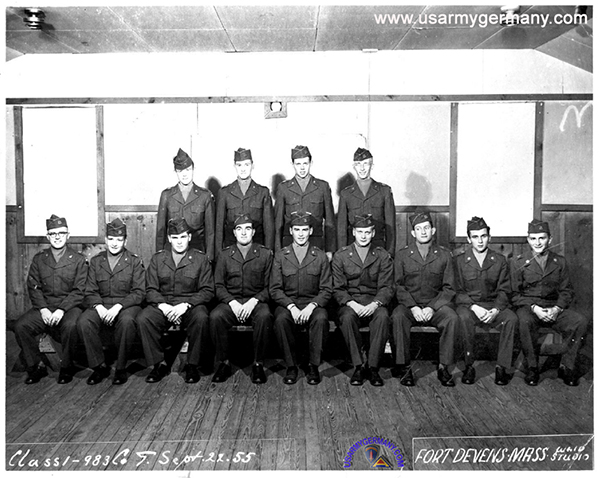 Class photo of the Army Computer course at Fort Devens, MA in 1955 |
||||||||||||||||||||||||||||||||||||||||||||||||||||||||
| 1955 | ||||||||||||||||||||||||||||||||||||||||||||||||||||||||
| (Source: Email from Gregory M. Hoffman) | ||||||||||||||||||||||||||||||||||||||||||||||||||||||||
| Attached please find my father's (Walter T. Hoffman) Army Computer Course (IBMs and Punch cards) Class photo taken September 22nd, 1955 at Ft. Devens, MA. After his graduation, he was assigned to one of the ASA Companies (I don't know which one), V Corps, Frankfurt, Germany and worked out of the I.G. Farben (Hochhaus) building from 1955 to 1957. (Webmaster note: Could this have been the 251st ASA Processing Company or maybe a predecessor unit? If anyone has details about the personnel shown in the class photo or has information about ASA units with operations at the IG Farben Building in the mid 1950s, please contact the webmaster (email address at top of page).) I'm assuming a number of his fellow graduates may also have been assigned to various ASA companies as well; perhaps there will be some success in finding a few who may be interested in this photo. On the back of the photo is a partial list of the names and hometowns of some of the men in the picture but I can't provide a match of a name to anyone else in the photo, except my father of course, who is in the back row, first one on the right. I did a scan of the back of the photo but it turned out mostly unreadable, so I am providing the list here as best I can; the names were all scribed by the individual in question and some of the handwriting is tough to read.  EDWARD G. LATTILA / SOUTHRANGE, MI JAMES D. ANDERSON / SUMMERFIELD, KS BRUCE A. BEHAN / BROCKTON, MA EVERETT W. CASE / LOS ANGELES, CA JEROLD NELSON / SUMMERFIELD, KS HAROLD E. MICKELS / OLNEY, IL HOWARD NORTON / UNION CITY, TN ALBERT SPALL / INDIANA ROYCE V. WATTS / RINGGOLD, LA JOHN R. BARR / READING, PA RICHARD A. STROHL, PHILADELPHIA, PA WALTER T. HOFFMAN / ST. JOSEPH, MI EDWARD G. LATTILA / SOUTHRANGE, MI JAMES D. ANDERSON / SUMMERFIELD, KS BRUCE A. BEHAN / BROCKTON, MA EVERETT W. CASE / LOS ANGELES, CA JEROLD NELSON / SUMMERFIELD, KS HAROLD E. MICKELS / OLNEY, IL HOWARD NORTON / UNION CITY, TN ALBERT SPALL / INDIANA ROYCE V. WATTS / RINGGOLD, LA JOHN R. BARR / READING, PA RICHARD A. STROHL, PHILADELPHIA, PA WALTER T. HOFFMAN / ST. JOSEPH, MIThe only additional background that I can provide, based on what my father told me years ago, is that this was one of the first Army computer programming courses. |
||||||||||||||||||||||||||||||||||||||||||||||||||||||||
| 1958 | ||||||||||||||||||||||||||||||||||||||||||||||||||||||||
| (Source: Email from Jim Campbell) | ||||||||||||||||||||||||||||||||||||||||||||||||||||||||
| I was a Ham Radio Operator before enlisting in the ASA in the Summer of 1957. While being processed at Ft. Devens I was assured by all and
sundry that I was destined for a career as an 058 (ditty bopper).
Instead, I was tapped for a job of teaching electronics in the Bird Cage
at Devens. Not long after starting that job I got the opportunity to
become an IBM CE for the ASA. After a stint at IBM school in Endicott
and Poughkeepsie, NY I was assigned to USASA HQ Europe in Frankfurt. I worked for a year there in the data processing center on the top floor of the IG Farben Building. Our data processing unit was transferred to Rothwesten in the Summer of 1959 and I worked there outside the Operations Building in some shelters mounted on trucks. I believe that my MOS was 206.10, Cryptanalytic Equipment Repair. I left the army in the Summer of 1960. (When I was in, no 206 had ever re-enlisted - IBM had a job ready for them when they got out. The ASA ran a new group through the IBM school every year or so.) At least one ditty bopper strike happened while I was at Rothwesten. We got a new company commander who had just come off the line on the border as an infantry company commander. He decided that he was going to shape up this outfit of slackers. There was reveille at 6:00 AM even though some of the troops were off-shift sleeping. No more buses to the ops building; the troops marched. Soon there was no "take" from ops either. NSA called to see what was wrong. Needless to say, the new CO got the word. Our shelters were heated by gasoline heaters that malfunctioned regularly. As I had the only set of tools in the place, repairing those heaters was added to my duties. Seems that the people at Mt. Meissner also had shelters with heaters that didn't work. I was sent up there to repair them. I went to the mess hall to get some chow. While eating, I heard something like chanting nearby. I asked someone at my table what the chanting was all about. He explained that they got one movie a week. There was virtually nothing to do while off duty, so the movie played continuously. Soon, everyone on post knew the dialog of the movie, so they were repeating the dialog along with the actors on screen. I became somewhat notorious while at Rothwesten. Our keypunch operators transcribed the "take" to IBM cards for processing for the analysts. Another group transcribed the "take" to teletype tape for transmission back to Ft. Meade. It so happened that we had an IBM machine that read IBM cards and punched teletype tape. I was tasked with getting the machine programmed to punch the tape. The day we went live, the cards were transferred to teletype tape and given to the comm center to send to Ft. Meade. A phone call was soon received from the White House comm center asking why we were sending them all this raw data. Seems that I transcribed the automatic routing information punched into the first card incorrectly and an entire days "take" was dumped raw into the White House comm center. |
||||||||||||||||||||||||||||||||||||||||||||||||||||||||
| 1961 | ||||||||||||||||||||||||||||||||||||||||||||||||||||||||
| (Source: Email from Wilson Gray, Processing Co, 1961; 78th USASA SOU, Berlin, 1961-63) | ||||||||||||||||||||||||||||||||||||||||||||||||||||||||
| In Jan-Aug 1961, I served with the Processing Company of the 507th USASA Gp in Heilbronn (Badnerhof Kaserne) and in Baumholder (Faulenberg Kaserne), before foolishly volunteering to go to Berlin, then learning that Processing Co. was being redesignated the 251st and being transferred to Frankfurt, my favorite city in Germany. Berlin, where I arrived one week after The Wall, then only a strand of barbed wire, went up, was the site of the 78th USASA Special Operations Unit, billeted at Andrews Barracks, Berlin-Lichterfelde West, near the once-famous Teltower Canal, and working out of Tempelhof AFB. Anyway, USASAE personnel wore the 7th Army "Seven Steps to Hell" patch, the 7th Corps "VII" patch. and the Berlin Brigade patch, at least, in addition to the USAREUR patch. Around this time, Agency EM stopped wearing name tags. Very cool. Non-Agency NCO's looking for warm bodies could be ignored. If you heard the dread shout, "Hey, soldier!" you just kept on stepping. Since the NCO couldn't call you by name, how would you know that he was talking to you? This was a real blessing, since corporals loved to put random SP5's to work at some shit job, like unloading a shipment of ball ammo. The 507th did have its own "Air Force" in Heilbronn, but, as far as I know, it was used mainly to ferry people to TDY at remote sites. Of course, in those days, at least, "need-to-know" was taken very seriously and I had no need to know more than that. Processing Co. was divided into three "sections:" Silver Section, Blue Section, and Orange Section. A good buddy of mine transferred from Silver to Blue. He refused to tell me what Blue did, despite the fact that we had been asshole buddies since our days at the Army Language School. I had no need to know. Silver Section reworked and corrected the carbon copies of rough translations of Russian COMINT done in real time by Special Operations Units and other remote and airborne sites. It was a nice, civilian-style, 9-5, 40-hour-a-week job. By comparison, the 'round-the-clock, seven-days-a-week work in Berlin truly SUCKED!!! Processing Co. personnel flew COMINT missions in USAF B-29's. A member of Mary Co. (so-called by HHC, "Animal Co." of the 507th because it was made up of 99.44% Army Language School grads, "Monterey Marys"), McNabb - I can't recall his first name - was killed in 1961 when his B-29 crashed returning from such a mission. If there's a memorial to Agency personnel - uh, "human resources" - killed in the line of duty, McNabb's name ought to be on it. I never laid eyes on the ASA patch until I saw one in an Army-surplus store in 1981. I once saw a ROTC officer wearing the ASA brass - the new version that looks like some kind of weird sunflower, not the old crossed-keys-split-by-a-lightning-bolt version - in 1972. ADDITIONAL INFORMATION I served in Processing Company from Dec, 1960 - ca. Mar, 1961, in Heilbronn, Germany, at Badnerhof Kaserne. In the spring of 1961, the unit and H&HQ Co, 507th ASA Gp (Field Army), were moved to Faulenberg Kaserne - former site of the 11th FS, which was moved to Harrogate, England - at Baumholder, Germany. In August of 1961, about the time that The Wall went up, Proc Co, which, as far as I know, had no enumeration, became the 251st Proc Co and was transferred from Baumholder to the I.G. Farben building. I was PCS'ed to the 78th Special Operations Unit in West Berlin. I have *no* idea whether the Proc Co with no number that later became the 251st in 1961 was the same as the original 251st Proc Co from the '50's. |
||||||||||||||||||||||||||||||||||||||||||||||||||||||||
| (Source: Email from John Meekins, 251st ASA Co, 1962-64) | ||||||||||||||||||||||||||||||||||||||||||||||||||||||||
| I went to Germany
in the summer of 1962 and was assigned to a detachment of the 251st
ASA Processing Company that was at Rothwesten. We moved a few months
later (before the end of the summer) to Gutleut Kaserne in Frankfurt.
We first operated out of the back of a two-and-a-half ton near the
IG Farben Building. Then we moved to one of the floors in the Farben
Building, I forget which one. The section remained there until after I left in the early summer of 1964. One thing I recall: I wasn't there, but I remember hearing about one of the ASA planes being shot down somewhere along the East/West German border. I remember people talking about processing the data collected from the crash site, blood on it etc. The company commander for most of my time in the 251st was a Capt. Caton. We wore the 7th Army patch until near the end of my tour, when it seems like we wore an ASA patch. We got a major for company commander before I left, but I do not recall his name. I once heard he said he got a battle field commission during World War II. He said it happened when he and a bunch of other guys were laying around exhausted near a battlefield in Italy. Someone came up and asked a question, and the major said he stood up. No one else could. He was promoted. As to the 251st, we were called a processing company. We had linguists who "scanned" tapes from the field. In fact, I suspect that most of what we did was to receive data from the field, do some preliminary work with it and then ship it back to Ft. Meade and the NSA. In our particular section, we were all radio teletype people, I think that was 057. We would get tapes with bits and pieces of teletype on them, print the teletype portions off and then send that and the tapes on back to NSA. We got those tapes from probably half a dozen field stations. A couple of funny stories about Rothwesten: It happened before I arrived, but I heard that the 058s there (ditty boppers) actually went on strike once because of 12-hour days, plus additional duties back at the company. There were reports that they, enmass, suddenly stopped taking code one night. When the trick sergeants came around to ask what was happening, they all said, "I can't hear a thing, sarge. I can't hear a thing." The word was that after NSA missed several days of data from the ditty boppers, someone in civilian clothes showed up, talked to the company commander and bingo! No more extra duty, and the ditty boppers suddenly started hearing again. There also were reports that the field station at Rothwesten was buzzed a couple of times by MIGs, and that the grunts working there were actually given permission the carry their rifles and to shoot at it. I heard they actually did shoot at one once. I also remember the biggest coffee pot I ever saw at that field station in Rothwesten. Finally, one night late (maybe the midnight trick), I suddenly saw a pile of boxes beside by station start to move. Strange? Yes. I'm trying to figure out what is going on, earthquake, what? Then a GI crawls out from under the cardboard boxes. He'd been taking a well-hidden nap. Looked like he was familiar with the process. Later, after we moved to Frankfurt, we used to use the mail room to wrap packages for us, particularly at Christmas. It was also the place where they wrapped up tapes etc. to send back to NSA. The story is that the mixed up packages once and NSA got some beer steins and some family somewhere got some stuff intended for NSA with Top Secret stamped all over it! |
||||||||||||||||||||||||||||||||||||||||||||||||||||||||
| 1964 | ||||||||||||||||||||||||||||||||||||||||||||||||||||||||
| (Source: Email from Albert Easley, 251st ASA Co) | ||||||||||||||||||||||||||||||||||||||||||||||||||||||||
| After graduating from tech school 72b, comm. ctr operations specialists, took leave and then reported to McGuire to catch a flight across the Atlantic. There were 3 72B's -- one went to Bad Aibling and two of us were assigned to the 251st Processing Company. We were billeted at the Gutleut Kaserne in Frankfurt. A big change for a southern boy. We had to wait for our clearance to catch up with us.
We were finally briefed four days later and could start work. 7th floor of the IG Farben Bldg. They did a whole lot of things up there that were really interesting. I enjoyed it very much, knowing just what the bad guys were doing. I guess we spent about 6 to 7 months at the 251st, then we were sent to Communications Unit, Europe. Boy, was that a big change! I remember the first day we were allowed to enter the building, there was one guy on the top of the receive aisle and one on the transmit, one barking like a dog and the other like a cat. We were billeted at the White House or Kennedy on the fifth floor. At the time we got to comm unit they were undermaned by about 50%. They had just had a mutiny or work slow down because they were working the guys 12 on and 12 off. You could only get so many men in this building so they had us picking up around the building. Evidently someone wrote the headquarters Arlington Station and one day we received a visit from a whole bunch of high ranking officers. General, cols, by the droves and maj down to E-8. They did interviews of the personel. We had a big change after that. Some of us had been waiting for promotion for some time. We finally got it, and also got a new CO. The captain we had was a big jerk. About 1966 we started getting replacements -- Vietnam. When they got a taste of what we were going through they wanted to 1049 back to Vietnam. The old man finally put a stop on that by refusing to forward and 1049. Our OIC at the comm center bacame our CO -- Capt Sower. Great guy. Well respected and very understanding. Finally made E-5 with 8 months left in my tour. (arrival date to Germany Jan 5, 1964), departed Dec 23, 1966. A little over 6 months to go. Did those 6 months at Ft Meade, NSA. Now that was the cat's meow. I got a chance to meet a lot of very good people over the four years i spent in the Agency and I will never forget. The names excape me but the years don't. |
||||||||||||||||||||||||||||||||||||||||||||||||||||||||
|
||||||||||||||||||||||||||||||||||||||||||||||||||||||||
|
|
||||||||||||||||||||||||||||||||||||||||||||||||||||||||
| 328th ASA Company | ||||||||||||||||||||||||||||||||||||||||||||||||||||||||
| (Source: ASALIVES.org) | ||||||||||||||||||||||||||||||||||||||||||||||||||||||||
| 1952: 328th Communications Reconnaissance Company activated in
Bad Aibling, FRG 1956: Redesignated as 328th ASA Company 1957: Inactivated 196? - 1972: Served in South Vietnam 1972: Inactivated 1975: Reactivated as 328th ASA Company in Augsburg, FRG |
||||||||||||||||||||||||||||||||||||||||||||||||||||||||
| 328th Communications Reconnaissance Company | ||||||||||||||||||||||||||||||||||||||||||||||||||||||||
| 1954 | ||||||||||||||||||||||||||||||||||||||||||||||||||||||||
| (Source: Email from Allen T. Poland, Jr.) | ||||||||||||||||||||||||||||||||||||||||||||||||||||||||
| I’ve spent some time surfing your very interesting site. Thanks for the memories and memory refreshment. I was assigned to the 328th Communications Reconnaissance Company at Bad Aibling from 1954 to 1956. THe company became the 328th ASA Co. in 1956. In 1954 and early 1955 the 328th was the only ASA company at Bad Aibling. I arrived at the Bad Aibling Kaserne in the fall of 1954. This would be approximately 2 years after the post was established as an ASA site. The first day was orientation. We were told:  There would be NO formations There would be NO inspections There would be NO KP, guard duty or latrine duty We would be given permanent passes which would be kept in the orderly room. When not working our time was ours to do as we pleased. We could buy and operate any mode of transportation we could afford including motorcycles. (We had 96 motorcycles on post when I left in Dec. 1956.) There would be NO formations There would be NO inspections There would be NO KP, guard duty or latrine duty We would be given permanent passes which would be kept in the orderly room. When not working our time was ours to do as we pleased. We could buy and operate any mode of transportation we could afford including motorcycles. (We had 96 motorcycles on post when I left in Dec. 1956.)What WAS required: We had to keep up-to-date on all notices, and changes by reading the bulletin board daily. We would “voluntarily” contribute to a fund to pay German civilian kitchen workers and cleaning ladies salaries. We were responsible for keeping our rooms and wall lockers clean and reasonably orderly. We must report for work on time without fail. We must sign out in the log book when picking up our gate passes. They wanted to know if we were off post and the “approximate” destination. We would have periodic “alerts” at which time we were expected to form up at predetermined areas with our full field gear and weapons, which was to always be maintained in perfect condition. (We were a C/R company. This happened maybe 4 times in two years.) We would have a yearly IG inspection and would be given a two week notice of when it would take place. We would have weapons qualifications once a year.If we obeyed these basic rules we would be left alone and be under the immediate command and control of appointed cadre which usually was members of our Trick, a Specialist Rating. We had the usual CO, XO, First Sgt., etc. but they usually left us alone. The buildings on post were better than anything I had ever seen on a military post. The post was a former Luftwaffe training post. (Me-109 - Copy officers) The buildings were substantial; thick concrete walls….no WWII wood that I was used to. Marble floors in the halls and tile in the latrine. The rooms were mostly 3-man rooms with one 5-man room per platoon. The walls were painted and the floors were polished hardwood. Each room had one or two large windows. Every major building on post was connected with tunnels. Most didn’t know they existed. The kaserne had a library manned by a German civilian who spoke fluent English and was always able to help with American/German problems. The kaserne also had a PX, a great EES snack bar manned by a German civilian chef, a sports shop where one could buy sporting equipment including guns. There was also a religious facility for services for Catholic and Protestant denominations. The grounds sported beautifully manicured lawns and trees all maintained by German civilians. The same with the boiler and maintenance. All buildings were heated with steam and never cold in the harsh German winters. The kaserne looked more like a college campus than a military post. We also had several ham radio stations located in various unoccupied buildings around the post. Post security during 1954 and 1955 was supplied by SPs (Special Police) and German military for the perimeter area. The SPs became MPs in 1956. After reading everything I was able to find about ASA life world-wide, I have concluded that being posted at Bad Aibling was THE plum ASA assignment! They started construction on buildings 310 and 311 (dependent housing), as I recall, in 1955 and populated them with officers/NCOs families in 1956. Other dependent housing was constructed after 1956. It’s been a long time since I’ve actively exchanged information about the BAK and thoughts keep popping up. For example, adding to the duties with the 328th, we were required to wear Class A uniforms when going to town for the first 30 days we were there. Why? I haven’t a clue! I still have a photo of me setting at a table in my favorite gasthaus in Class A’s with the expression on my face that asks the question, “What the hell have I got myself into?” |
||||||||||||||||||||||||||||||||||||||||||||||||||||||||
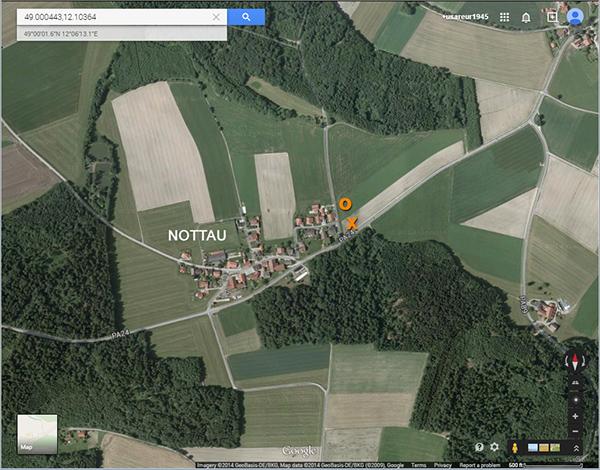 Nottau, Germany, former site of Det L (GOOGLE Maps): o = location of antenna; x = location of tents |
||||||||||||||||||||||||||||||||||||||||||||||||||||||||
| 1955 | ||||||||||||||||||||||||||||||||||||||||||||||||||||||||
| (Source: Email from Jack Welch, Det K, Vienna & Det L, Nottau) | ||||||||||||||||||||||||||||||||||||||||||||||||||||||||
I was originally with the 328 C/R Co, in Bad Aibling from February 1955 to July 1956. |
||||||||||||||||||||||||||||||||||||||||||||||||||||||||
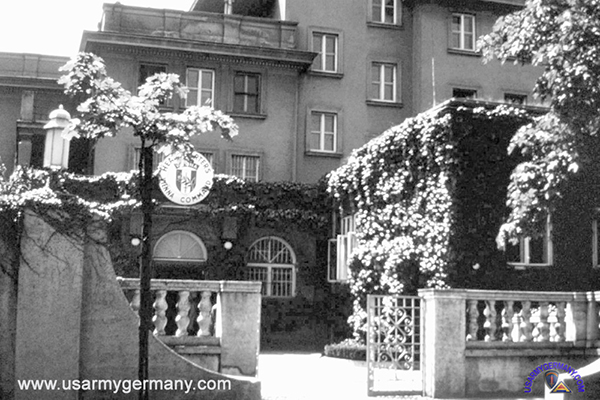 Headquarters, Vienna Command (Jack Welch) Det K was also located in this building |
||||||||||||||||||||||||||||||||||||||||||||||||||||||||
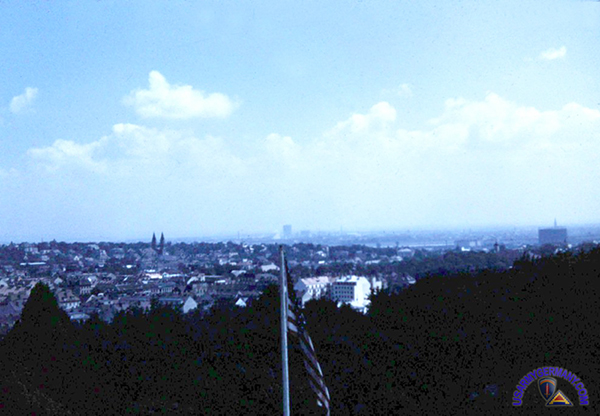 A last look at Vienna from the office window of Det K prior to vacating the building in 1955. |
||||||||||||||||||||||||||||||||||||||||||||||||||||||||
| Detachment L (Nottau) Det. L was about 20 Ks east of Passau in a little town called Nottau. We have a web site that I am able to hear from some of the guys. I'm about the oldest one left (82). I know most of the others have gone to the Great Beyond. The intercept site at Nottau was only about 40 or 50 feet wide and ran toward the woods at the top (of the GOOGLE Maps image above) for 75 yards or so and the antenna was beyond that. We initially lived in big squad tents but in the winter of 1954/55 they closed up and returned to BA. When spring came they reopened. The ASA engineers from Frankfurt came and put in a new antenna and we had great reception. So good that the Army asked us to move into German households which we did for the winter. When Austria shut down we received about 20 guys from (the ASA site at) Wels, Austria sometime after July 1955. We used to eat in a squad tent and by that time we lived in 3 of the neighbors houses. Great Duty -- Stay out of trouble, do your job, drink a lot of beer, and keep your mouth shut. When I left in July of 1956 the detachment had grown to about 35 guys. Later on they built a mess hall and I think sleeping quarters for the guys. We used to get about $34 a month for quarters and $75 for food. There was a Doctor in Passau, a Provost Marshal, gasoline pump, a PX, snack bar, movies, an MI outfit, and an engineer company whose mission was to blow the bridges in Passau in case the balloon went up. For dentistry and food shopping we went to Straubing about 60 miles away where there was a tank battalion. I understand that the group (Det L) was there until 1962 or so. I have since stopped by there with my old buddy Paul Brennan about 4 times. Also I had reunions with another group, the Alpiners, which had a few of the guys I knew in it. I hope this helps. |
||||||||||||||||||||||||||||||||||||||||||||||||||||||||
|
||||||||||||||||||||||||||||||||||||||||||||||||||||||||
| 279th ASA Company | ||||||||||||||||||||||||||||||||||||||||||||||||||||||||
| (Source: Email from William A. Christen II) | ||||||||||||||||||||||||||||||||||||||||||||||||||||||||
| An Unofficial History has been prepared for the 279th USASA Detachment (Field) and following units – the USASA Theatre Exploitation Company and the 77th USASA Special Operations Unit. The 279th USASA Detachment was formed from 3rd platoon of the 279th ASA Company, which is identified on your web site. Attached are two files that are part of this unofficial history – Chapter 1 (The Heredity) and Appendix One (The Lineage). You are welcome to include all or part of the information in your website as you deem necessary. Please be advised that a CDROM with the entire history as well as photographs and the 77th’s Annual Historical Reports is available free of charge to members of these units.  77th OSU DI (courtesy of William Christen) 77th OSU DI (courtesy of William Christen) The third file is the unofficial Distinguished Unit Insignia identifying the 77th USASASOU. The insignia was on a cigarette lighter given to members of the 77th in 1962-63 by the CO. I believe your web site does a great service to members of the ASA who served in Europe. If not for your website, much of the information would have been lost over time. It has become a valuable resource for many of us. Thank you! |
||||||||||||||||||||||||||||||||||||||||||||||||||||||||
|
||||||||||||||||||||||||||||||||||||||||||||||||||||||||
| 409th ASA Company | ||||||||||||||||||||||||||||||||||||||||||||||||||||||||
| 1975 | ||||||||||||||||||||||||||||||||||||||||||||||||||||||||
| (Source: Email from Dean Sartain) | ||||||||||||||||||||||||||||||||||||||||||||||||||||||||
| Enjoyed your site. I was reading LeCarre's "The Spy Who Came In From The Cold" today when it got me to recalling my days in Germany. I was a 98C2LGM with the 409th ASA Company at Flak Kaserne, Augsburg, GE from Dec 1975 to Nov 1978. We were part of the 502nd ASA Gp - commanded by Col Teal (Teal did go on to get a star). The CSM was Bernie Rector who had a heart attack and died at his next assignment. Cpt Ronnie Cates was our CO. Harry Miller was 1SG. Glenn Shaffer was Ops Officer. Vernon Allison was my platoon leader - the Control & Analysis Plt. Allison went on to make colonel. Mike Taylor was platoon sgt. We wore the 7th Army patch - "Seven Steps To Hell" we all called it. Not sure why. Probably something left over from WWII. Sometime in early 1978 we were resubordinated to the 302nd ASA Bn under V Corps and we wore the V Corps patch. Ltc Charles Simmerly was the battalion cdr. I understand he passed away several years back at a fairly young age. The 409th was a high frequency manual morse and radio printer intercept and DF operation... The Soviets still used a lot of manual morse in the 70's. We conducted several long-term collection operations during my time. One was a 4-month long deployment from Flak to Gruenstadt (photo below). We collocated with another ASA unit that had their downlink site there. I think it was the 330th ASA... an aviation unit. Our operation was totally separate from theirs. We just used their mountain. Two of our other long-term ops were local to Augsburg. One was on Flak itself and the other was in Dillingen (I think). While on Flak someone attempted to firebomb one of our 100kw generators. Those were big and noisy diesel generators and we had one running 24x7 for months. The local towns people of Neusass got tired of it. We also discovered a wire tap on our WD1comms wire running from the ops to the DF transmitter. Shortly after my arrival we began fielding the MSA-34 system. It was made up of 7 specially-configured low-boy trailers each carrying three shelters, all of which could be interconnected via removable wall sides or doors. It was an impressive set-up and quite comfortable to work in. We had racks of the R390 receivers. I recall we could field 10-15 HF intercept positions. We had big MRA-17 antenna systems. It had a telescoping mast with a "curtain" of antennas each cut to different frequency lengths. We would orient the antennas in the direction of interest. At night, we'd get morse traffic from the other side of the globe. We primarily copied the morse traffic of the Group of Soviet Forces Germany (GFSG), East German units and some Czech Air Defense printer and morse. I recall the "case notations" of RMB's...Russian Military Morse. And the RMD's for printer. We copied all the GSFG army-level units down to division and at times down to regiment. One of our more interesting cases were the RMQ's... the Red Army's own SIGINT units. We monitored them intercepting US units. They knew who we were too! They would sometimes get on our morse DF flash net freq and send greetings to the 409! All the Soviet radio messages were encoded. We did however have their callsign generation system...called the Juliet Arbitrary Basic System or JABS. Each day around midnight their higher HQs would broadcast a string of "keys" to subordinate units which would then generate the day's new callsigns. We often knew their new callsigns before they did. As analysts we would do STRUM reports back to DIRNSA. We also had TEXTA...technical extracts of traffic analysis. Would get to issue the occassional Klieglight Report and even a SPOT report or two. One of our more noteworthy accomplishments was the discovery of the GFSG 34th Pipeline Brigade. We provided copy that help determine that this unit had the mission of supplying fuel to front line combat units. As such, this unit's activities were an early warning indicator of possible hostilities. We got commended by DIRNSA. Another time we were placed on alert to look for Czech and GSFG reaction to an SR71 flyover of East Germany. We had the flight path traced on our illuminated map board with time tics at intervals. The path was from south to north. On the day of the flight there was zero response. If the bad guys saw it they sure didn't say anything about it on their radio nets. I recall that based on time tics that airplane was moving incredibly fast! We had good leaders. We had good troops. We were lucky that we got to have a real world mission; unlike some of the DS units. Augsburg was a nice town. In 1993 I got a chance to escort a group of Italian Army colonels to observe a V Corps exercise in Germany. We took time off to visit the former East Germany. I took them to several towns where I recall GSFG units we held case notations on being garrisoned. We even found some of the abandoned Soviet garrisons. Quite interesting to get to visit where the "bad guys" used to live. |
||||||||||||||||||||||||||||||||||||||||||||||||||||||||
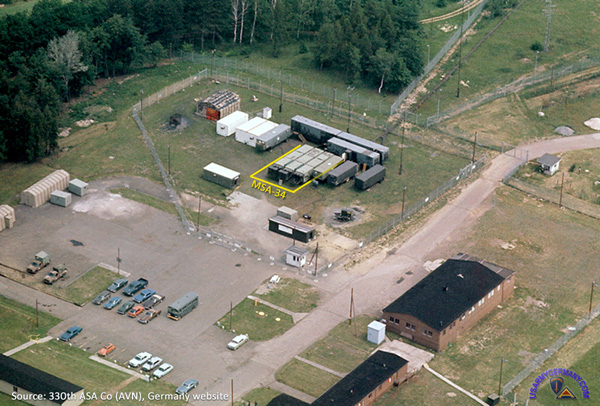 Three MSA-34 trailers at Gruenstadt, c. 1976 (330th ASA Co (AVN) website) |
||||||||||||||||||||||||||||||||||||||||||||||||||||||||
| Gruenstadt Site Operation Gruenstadt was a good op. We deployed there from Augsburg in Jan 1976. We only took three of our new MSA trailers. It was cold! We lived in tents for months up on the hill. We operated from our trailers. Several days a week a Luftwaffe F104 would come screaming up the east side of the hill in a low level pass. It would make our tents billow. Cool to watch. Our operation was separate from the Guardrail mission at Gruenstadt. If I recall correctly the OV1s carried the SLAR. I think the Guardrail was on the RU21 or earlier model... a Beechcraft QueenAir and later KingAir. The first Guardrails had ops in the back. Over time the acft receivers were all remotely controlled from the ground. 409th ASA Company Organization The 409th had the commander, XO/Ops Officer, 1SG and a clerk who had the only IBM Selectric typewriter in the company. We had no photo copiers. We had a mimeograph machine! We also had ... a Control & Analysis (C&A) Plt -- all 98Cs. an Intercept Plt -- made up of 05Hs and 05Ks (printer intercept). a Direction Finding (DF) Plt -- made up of 05Ds. a Maintenance Plt -- had 33S as well as vehicle and generator mechanics... all TSSCI cleared.And we had two warrant officers. TA warrant. DF warrant. Tom Finney was the TA. Walt Baer replaced him. Speaking of limited typewriters, we only had one phone line to the company! I'm trying to remember the name of the DoD telephone system back then. To place an official call to the States you had to go through an operator who would schedule the call and then call you back when the connection was made...how high speed was that? NSA at FS Augsburg had the gray phone. Direct lines back to Meade. That was amazing. I did some time at the FS (Field Station) as part of Mud Pack. Mud Pack was a program between the 502nd and the FS that allowed group ops and analysts to exercise their skills out at the FS. I got to work as a floor analyst in the new La Fair Vitte (LFV) op. That was employing new remoting technology from the border sites back to the FS. Since I was a GM I'd often get to sit the German position and copy border guards and missile units both on single channel voice and four channel multichannel. LFV was state of the art stuff! Harris Corp was the contractor. I believe Teal went to work for Harris when he retired. SSG Ron Hintz was my trick "chop". Ron's wife Maria (I think) was the regular GM op. To this day I don't know if we (the US intel community) could read the Soviet message traffic we copied at the 409th. I suspect most of the morse messages were encoded on one-time pads. Pretty secure stuff, even to this day. Our goal as TAs was to establish the "norm". The Soviets were highly regimented and anything that deviated from that norm was intelligence. Since we could not read the messages the so called "message externals" were critical... frequency use, call signs, procedure charts, networks, network procedures, and physical location, etc. I had a 21 yr career. I was commissioned in 1983 and stayed in MI/SIGINT. I retired in 1995. |
||||||||||||||||||||||||||||||||||||||||||||||||||||||||
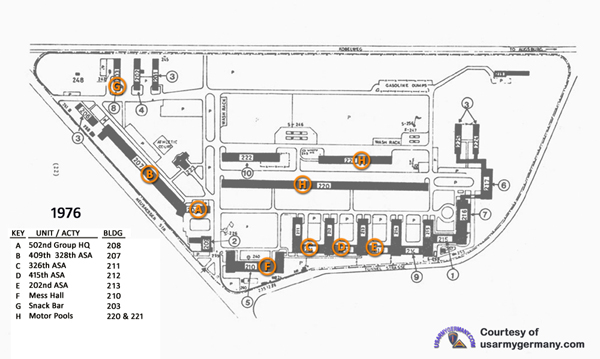 |
||||||||||||||||||||||||||||||||||||||||||||||||||||||||
| ASA Units at Flak Kaserne, 1976 Group HQ was in Bldg. 208. All floors. The 409th and the 328th were in #207. The 328th was known as the PCAC - primary control and analysis center. I'm not exactly sure of the buildings but the 326th, the 415th, the 202nd were in the 211, 212, and 213 buildings when I got there. When the 415th moved out the 409th moved into its building while 207 was being remodeled. Building 210 was the Bernie Rector Memorial Mess Hall. #203 was the snack bar. We spent a lot of time there. I don't recall a barbershop in 203. When I was there it was in the EM club building. #220 and 221 were all motor pool. (Webmaster note: if you have additional information on the exact location of units on Flak in this time period or other activities at the same installation (Army Hospital, Vet Services, Dental Services, etc.) please contact me.) |
||||||||||||||||||||||||||||||||||||||||||||||||||||||||
|
||||||||||||||||||||||||||||||||||||||||||||||||||||||||
| 415th ASA Company | ||||||||||||||||||||||||||||||||||||||||||||||||||||||||
| (Source: Email from Mark L. Streeter) | ||||||||||||||||||||||||||||||||||||||||||||||||||||||||
| See Mark's corrective comments above. | ||||||||||||||||||||||||||||||||||||||||||||||||||||||||
| 1975 | ||||||||||||||||||||||||||||||||||||||||||||||||||||||||
| (Source: Email from Jerry Paulsrud) | ||||||||||||||||||||||||||||||||||||||||||||||||||||||||
| I was assigned as a 98G2LGM to the 415th ASA Co. in late March or April 1975. The 415th was OPCON to the 502nd ASA Gp. I was also later transferred to the 326th ASA Co. before the 415th departed to Idar-Oberstein. What a blessing. The 415th was one messed up unit. The worst I ever saw in my 20 years in the service. We had no real mission and did paint a lot of rocks as Peart stated. All or most of our hi-tech equipment was just for show and really did not work at all or at least very well, especially the DF vans. Pure dog and pony shows for the brass. One guy, Richardson (I believe) even wrote an article to Playboy Magazine about the problems and it was put in the magazine. The 326th ASA Co. was like night and day. Although the soldiers were very good, the command structure in the 415th ASA Co. was very lacking. They did not care at all about the soldiers. Since we did not belong to the 502nd ASA GP, I guess we just fell through the cracks. Peart's comments were right on target. I did like being stationed in Augsburg and I had some very good times on Flak Kaserne. The unit structure in 1975 was Cpt Scarangela, CO (maybe misspelled) and 1SGT Steelman, Steelman was a rifted major and a very good 1SGT. Back then there was the Army way and the ASA way and the ASA way trumped the Army way. Most Army regulations were superseded by ASA regulations and then no one read the ASA regulations, at least in our unit. They spent 2 days arguing once on how to lay out your bunks for field equipment inspection and that really killed morale. They (command) simply made it up as they went along. What a disaster! The 502nd ASA Gp command structure was CSM Bernie Rector and Col. Teal. The 415th ASA Co. was of course an tactical intel company, one of the first we were told. This was a new game for ASA and we literally wrote the book on how to use the equipment (i.e. TLQ-17) in a shoot and move operation. We were told that we had gotten the 17s from the Marines who could not get it to work. The TLQ-17 was very good when it worked (it had some antenna problems), and the GLQ-3 was better for voice intercept than jamming. The TLQ-17 was better for that job. The DF equipment did not work and was a joke. There were 2 platoons of intel folks and we also had so many vehicles that we were often short of drivers. Back then, the intel platoon leaders were first in combat arms and then moved to intel slots. That left a lot of problems since many of the E-4s back then were smarter than the LTs as Jonathan Peart eluded to. The recession was on back then and the all volunteer Army and a lot of 4 year grads came into the linguist field as E-4s to get a job. The LTs just wanted their instructions followed and did not know about the concept of commanders intent. They would always give too many details on how to do a simple job, whereas we would always ask them what they wanted done and we would figure out how to do it fast and efficiently. They did not care about efficiency since they were just trying to fill up our days. The LTs really hated those comments because they were used to the infantry folks jumping at every direction and not asking questions and they liked it that way. We had very poor platoon leaders in the beginning. We also had no platoon sergeants in the early day of 1975, so they finally made a few of us (E-4s or E-5s) acting platoon sergeants. Low morale is hard to overcome and was nearly impossible while in Augsburg since all the other ASA Co.s had a real job for linguists. I am glad it got better in Idar-Oberstein. The linguists were not happy since we wanted a real linguist job, not just field duty and painting rocks. They would offer us huge re-up bonuses to paint rocks with no follow-up training or a chance to use our language skills. The German linguists had it much better in that regard. The 326th had some border sites and we were fully part of the 502nd ASA GP unlike the 415th. They were well run and a fairly good unit for the times. The dirtiest words that could be spoken in all units back then was to call someone a "lifer". The military did not have high appreciation in the civilian or military world back then on the heels of Vietnam and the young soldiers in our unit mostly wanted to do their time and get out. |
||||||||||||||||||||||||||||||||||||||||||||||||||||||||
| (Source: Email from Robert Davis) | ||||||||||||||||||||||||||||||||||||||||||||||||||||||||
| Concerning the 415th ASA Company and the 502nd Group: The 415th ASA Company was reactivated in 1975 at Flak Kaserne in Augsburg. It occuppied the barracks next to the 326th ASA Company. At the time of its activation, the ASA/Army dual chain of command and control still existed so it was theorectically under the control of the group. The 415th stayed in Augsburg while it was filled and equipped and certified ready, and while space was found for it with the division it was to support, the 8th ID. I believe it participated in the last 502nd Group field exercise, Deep Freeze, in 1976. I was in the 326th ASA Company (Operations Forward), serving in the 2nd EW Platoon and working Project Mudpack with the FS Augsburg's 1st Operations Battalion from March 1975 until Feb 1978. |
||||||||||||||||||||||||||||||||||||||||||||||||||||||||
| (Source: Email from Jonathan Peart) | ||||||||||||||||||||||||||||||||||||||||||||||||||||||||
I was assigned to the 415th ASA Company on Flak Kaserne, Augsburg, Germany in April 1975. As I recall the unit was being reestablished after being disbanded in Viet Nam some years earlier. When I arrived at the 415th, with many of the guys I had been to language school with in Monterey, it was a fairly laid back unit. We had a wonderful First Sergeant, no equipment and lots of time to do nothing or paint rocks as we liked to joke. All that changed rapidly when our First Sergeant, whose name escapes me, was rotated back to the states and we got a new First Sergeant, CO and new platoon leaders. Never have so few, risen so far above their capabilities.
From 1975 through early 1977 when I was transferred, along with others, to the 326th ASA Company next door (prior to the 415th's move to Idar Oberstein), the 415th was an out of control, poorly led unit. Morale was awful. We went to language school to work at the Field Stations, not go out in the woods to listen to English. Even when a new 1LT the previous one as platoon leader, things did not improve. Simply put, the enlisted guys were a lot smarter than the officers and NCOs. Anyway, we suffered through Reforger 1975 and 1976 and then again in 1977, while serving in the 326th. While the unit and the leadership left much to be desired, I served along side some of the best soldiers around - Charlie Black, Steve Bird, Steve Teaff, Jim Saylor, Frank Anderson, Faron Lovvorn, Joe Johnson and others. Great men who I love and respect to this day. The challenges of being in that company with such poor leadership forced all of us to dig deeply within ourselves to perform and survive. Looking back it was a great experience and we learned a lot. And the GI Bill paid for a great education after the service. Hope this helps with your website about the 502 ASA Group led by Col. Teal. I think the whole concept of the 502nd was poorly conceived and executed.(I wonder if Col. Teal ever got his star.) You don't take intelligent men who expect to be using their intellect in a positive way and send them to the woods to play soldier with their trucks. Hell, we got criticized because we didn't name our trucks like the guys in the motor pool did. We didn't sign up to be grunts but that's how we got assigned. No wonder morale was so bad!
|
||||||||||||||||||||||||||||||||||||||||||||||||||||||||
| (Source: Email from David Demeter) | ||||||||||||||||||||||||||||||||||||||||||||||||||||||||
| As a brand-new 2LT, my first duty assignment was with the 415th ASA Company. I arrived in Augsburg in March, 1975…assigned as the Communications-Electronics Platoon Leader. I think there were only about 8 people on the company roster at the time….CPT Scarangella was the CO…..We had an E7 named McCully, who was the acting “top.” The Supply Sgt was an E6 named Hodovan. As the men and equipment trickled in, the unit began to form. McCully left and was replaced by a former Captain…now E8 named Steel. CPT Scarangella held daily staff meetings at 1630 hrs. and each person took a turn giving a brief report on the day’s events. Most of us just kept track of how many times Sgt Steel repeated his favorite clichés. “So to speak….;” “It goes without saying…..;” “A real goat-fxxx.” These are some of the ones I remember. Steel was later replaced by E8 Daniels, who seemed most frustrated that he was unable to persuade me to trim my mustache. While CPT Scarangella was a good man. The Operations Officer, (unnamed), on the other hand was ill-suited and inept as a military officer. I’ll never forget the night during a REFORGER when one of the EM’s stopped him from pouring a can of gas on a generator fire. Enough said. Fellow LT comrades were Acosta and Noteboom. 1LT Machany later joined the team. I did not consider him a friend…but he was entertaining….in a weird way. One of my favorites was SFC Beagle. I wonder what ever happened to him. In answer to Jonathan Peart’s question…yes, Teal got his star while at Ft. Huachuca….which is where I went after Germany. As a Signal Officer, I enjoyed my time in the ASA and at the Intel Center & School. The MI branch folks were good people. However, I got out after six years of active duty and went into the business world. It’s hard to believe that it’s been almost 30 years now since I left Germany. There were some zany times in the early days of the 415th in Augsburg. |
||||||||||||||||||||||||||||||||||||||||||||||||||||||||
| 1976 | ||||||||||||||||||||||||||||||||||||||||||||||||||||||||
| (Source: Email from Ed Smith, 1976-79) | ||||||||||||||||||||||||||||||||||||||||||||||||||||||||
| I was an Sp-5, MOS 33S in the 415 ASA Co, Sept 1976 to June 1979. The 415th ASA Company was assigned to 502nd Group, then was DS for 8th Infantry Division in 1976. In early 1977 they relocated from Augsburg to Idar-Oberstein and pretty much lost any affliation with the 502nd. We had about 30 people in the company when I reported in September 1976. |
||||||||||||||||||||||||||||||||||||||||||||||||||||||||
| 1977 | ||||||||||||||||||||||||||||||||||||||||||||||||||||||||
| (Source: Email from Wayne R. Foote, 1977-79) | ||||||||||||||||||||||||||||||||||||||||||||||||||||||||
| I was an E-6 98G4LRUK3 assigned to 415th at Idar-Oberstein from Nov 1977 to Nov 1979. Intercept squad leader. We spent a lot of time at Our platoon, 2nd Pltn, was one of two voice intercept and jamming platoons. There was also an EW platoon, a HQ platoon and a support platoon. The company was probably the largest company in the Army. Our CO was Capt (the promoted to Major) Leslie Butler until the summer of 1979 at which time Major Blake, the former XO, became CO. The Ops Officer was a Capt Topalian. |
||||||||||||||||||||||||||||||||||||||||||||||||||||||||
| 1978 | ||||||||||||||||||||||||||||||||||||||||||||||||||||||||
| (Source: Email from Pat Moyna, 1978-81) | ||||||||||||||||||||||||||||||||||||||||||||||||||||||||
| I saw your request for info about the 415th. I was assigned for three years and three months from 1978 to 1981. I don't recall all the details, but the 415th had been in Northern Italy supporting the Airborne Brigade there before going north to take up the 8th Inf Div mission. I was in ASA and INSCOM from 1963 to 1991. I was an enlisted 988/98G (Russian & German) Voice interceptor and carried several secondary/other MOSs like Traffic Analyst, Cryptanalyst, Combat Intell NCO. As a SFC I took a Warrant as a Voice and Traffic Analytic Technician, serving a total of 28 years. Most of my career was in SIGINT/EW Direct Support at the Division and Corps. I was assigned to the 415th ASA (Co) at Idar-Oberstein from the 371st ASA, 1st Cav Div at Fort Hood in 1978. As you are aware there were many reorgs and resubordinations of ASA units during the 1966 to 76 period, ending with the deactivation of ASA and creation of INSCOM? It was hard to follow them and unfortunately I have not been very successful in tracing the lineage and honors of the 415th. I have found bits and fragments about the unit in RVN as an RRCo. I remember while at Fort Meade in about 1973 or 74, seeing something in an ASA Pub about the 415th being posted to Italy, but I'm not sure where (maybe Camp Darby). Without being able to get at the archives of either the Army or INSCOM it is pretty tough to track info. INSCOM has a history site but it is weak and with all the privacy BS they don't want to tell you much. The old archives at Arlington Hall had a ton of info on every ASA unit and it's predecessors but I'm not sure where those archives went. I did meet one NCO who told me a little about the unit but he died in 1978. The main problem seems to be that so many changes were taking place at the same time that some got lost in the shuffle. Sorry I can't be of more help. The 415th was a fine unit until it was morphed into a CEWI Battalion in 1980. I couldn't wait to leave after that and did in 1981. I can tell you however that the 415th ASA Co. was instrumental in developing and testing the SIGINT/EW equipment and doctrine for the post-VietNam era. Between 1975 and 1980, the unit tested and fielded the first generation Trailblazer System and planned and executed the first-ever integration of the Guardrail Airborne Platform with that ground-based intercept, DF and countermeasures system, using the Guardrail-provided Tactical Commander's Terminal (TCT), employing those assets against real-world, live targets in the GDR. Those results continued to influence R&D of equipment and doctrine for the next 15 to 20 years. |
||||||||||||||||||||||||||||||||||||||||||||||||||||||||
| 1979 | ||||||||||||||||||||||||||||||||||||||||||||||||||||||||
| (Source: Email from Gary L. Jackson, 1979-1980) | ||||||||||||||||||||||||||||||||||||||||||||||||||||||||
| As a Military Intelligence Branch officer, rank of Captain, I was Ops Officer from June 1979 to February 1980. Paul Topalion was a previous Ops Officer, who I got to know when he was a student at the MI Officers Advanced Course at Fort Huachuca, I think around 1977. CPT Dale Noteboom, a classmate in the Advanced Course Oct 1977-May 1979, had also served with the 415th. I came from my previous position as S-2, 2nd Bn, 20th Field Arty (155mm Self-Propelled) in the 4th Brigade, 8th Inf Div (a.k.a. "Brigade 76") at Wiesbaden Air Base. [BDE 76 was a uniquely task-organized formation from Ft Carson, CO that was assigned to the 8th ID - very similar to the Brigade Combat Teams we have in today's Army.] In February 1980 I was transferred to Bad Kreuznach to be S-2 of the DISCOM (Division Support Command). The 415th had about 175 soldiers and about 150 vehicles -- nearly everybody was a driver! As Ops Officer of the 415th, I was also Platoon Leader of the Ops Platoon - consisting of about 5 people including me, SGT DiMarco (who Succeeded SSG Billy Hollis as the Ops NCO), Spec Marianne Strope, Spec Dom Salvatore, and one other I can't remember his name. Later, SFC Plehn (spelling?) came on board as Ops NCO. Our small platoon had an M-151 jeep with trailer, two M-880 pickup trucks with trailers, and a 2 1/2 ton turbo-diesel truck called "Thumper" with a TYQ-5 shelter chock-full of FM radios and spooky side-lit plexiglas map plotting board (like you see on Navy ships in the movies) and pulling a VERY LOUD PU-519 gasoline generator. We used to heat up our C-ration cans on the exhaust manifold of the generator. DiMarco and I loved Thumper. I recall he and I spending hours together in the motor pool scraping off rust and spot painting to get ready for an inspection -- it was my TOC (tactical operations center) vehicle, so even tho an officer, I still had some responsibility for maintenance like any soldier would - especially because we were very short-handed in the Platoon). Plus I had to help pull maintenance on my jeep, too. I remember Captain Blake pulling the usual stunts to avoid trouble for that inspection - loading up a truck with gear we weren't supposed to have, and putting that vehicle "on dispatch" for the day - until the inspectors left the area of course. 2LT Gene Kaye was the Signal Platoon officer - who it turns out is related to my best friend, Major Glen Sharp, MI, (Retired). Gene got in trouble because he trusted an NCO who declared that certain classified material had been destroyed, and Gene signed the destruction certificate. Unfortunately, a surprise inspection found the undestroyed documents still in the bag. Ooops! 2LT Irwin (can't remember first name) and 1LT Steve Schiacatanno were the other platoon leaders. Don Blake was our company commander. MSG Wayne Stogsdill (a grumpy, crusty old school soldier) was our 1st Sgt. Pat Moyna was one of our warrant officer techs, along with Wayne Lowe. Pat and Rosie Moyna lived in the same stairwell as I in quarters at Strassburg Kaserne in Idar Oberstein. CW2 Eddie Washington (the skinniest man in the Army - always eating but never gained a pound, I swear) was a great ELINT tech working with the Trailblazer system. I had great pleasure to serve with him again at the TACSIM computer simulation program (models of SIGINT and imagery collection systems) at Ft Hood, TX, 1982-84. I just remembered, in Fall 1979, we got a Lt Wasson in Ops. And CPT Jim Brown later came on board - a feisty, dedicated hardworking professional - He and I stayed back in January 1980 to write an important OPLAN for an exercise, while CPT Blake took practically the ENTIRE COMPANY out on a ski vacation in the mountains of Bavaria - whew!!! We had GLQ-3B high frequency jammers mounted on M-548 artillery tractors and TLQ-17 jammers mounted on M-577 command APC's. These tracked vehicles were added to our MTOE (modified table of organization and equipment - just for our company) from other units in the Division - but we were not authorized any track mechanics! Naturally, our PLL (prescribed load listing - number and type of spare parts we were supposed to keep on hand) was huge. We had another warrant officer for maintenance - named Walker I think. Somehow he had the luck to live in a Government Quarters detached house off post. SGT DiMarco and I had an interesting (unconventional and daring - never heard of any other officers doing something like it ) field outing to reconnoiter the upcoming exercise area for CONSTANT ENFORCER 79. We spent several days and nights scouting in our jeep, camping at night in the woods in my Montgomery Ward nylon tent, and getting goosebumps from the hair-raising grunts of the wild boars roaming the woods looking for food and people to gore! In CONSTANT ENFORCER, just as we moved into our pre-exercise administrative bivouac site, an M-16 was "lost" by Specialist White, one of our wiremen. CPT Blake made a BIG MISTAKE by not notifying DIV HQ about the lost weapon for over 24 hours. When they found out, the 415th was punished. Our whole company was surrounded by MPs, troops were rousted out of their tents all hours of day and night to do shoulder-to-shoulder sweeps of the area. The MPs tossed everybody's gear out onto the grass in middle of the night, which got rained on and soaked wet. This went on for about 3 days - until just after dawn, about an hour before STARTEX, the weapon mysteriously appeared leaning against Blake's M-880 right front fender. We all were pretty sure it was PVT Jesse Lightning, who recently had his driving license revoked by Blake, who was the perpetrator - but no proof. We went on to do great during the exercise. The TLQ-17A jammers were instrumental in breaking up an 11th ACR (I believe) attack that had broken thru a weak spot and was headed for the DIV TOC. Ah - the "windmill" sound was sweet - along with the ACR commander complaining in the clear on his FM command net about his comm's problems - if only he knew! Our jammer crews were a "Kelly's Heroes" lot - complete with leather flight helmets - they would load up with C-rats and we would not see them for days and days. Another curious bit was that a Canadian SIGINT-EW battalion was placed OPCON to our company. I also recall another platoon OPCON to us from another BN - with a female PLT LDR. In the after-exercise review at HQ, USAREUR in Heidelberg, we were commended because the other side tried hard but just could not locate (DF) any of our highly mobile jammers. I recall a married couple - SGT Hunt and SGT Hunt. She was pregnant, and even with the basketball evident in her stomach, she cold still hop in and out of a track, packing her pistol belt and LBE (load-bearing equipment) suspenders and pack, and her M-16 rifle, with great dexterity - I really admired her bounce, spirit and soldierly virtues. At the time, we probably were operating outside the official rules for women in the frontline units/area - but we were a Division-level tactical unit darn-it, and our FM equipment had to operate radio line of sight -- you can't shoot FM jamming signals or intercept FM through tall hills and through heavy woods. So you had to be on the forward slope not too far into the treeline out in the Covering Force Area or near the FEBA as the battle progressed. Pat Moyna is correct -- we were part of the initial fielding of the Trailblazer -- when I was there. There are more stories, but this can't go on too long! The 415th was under-manned, facing many extraordinarily demanding material, operational and technical challenges, but we all stood up and did our jobs -- and we're all proud of our service in the 415th !! PS - I recall the 415th has a Presidential Unit citation for Vietnam - every man killed heroically defending a hilltop radio detachment listening post. |
||||||||||||||||||||||||||||||||||||||||||||||||||||||||
|
||||||||||||||||||||||||||||||||||||||||||||||||||||||||
| 9487th Technical Service Unit | ||||||||||||||||||||||||||||||||||||||||||||||||||||||||
| 1954 | ||||||||||||||||||||||||||||||||||||||||||||||||||||||||
| (Source: Email from Conrad Welch) | ||||||||||||||||||||||||||||||||||||||||||||||||||||||||
| I was a Lieutenant assigned to Signal Division of USAREUR as Operations officer prior to Electronic Reconnaisance being transferred to ASA. My organization was the 9487th Technical Service Unit operating out of the attic of the SIGDIV Headquarters in Campbell Barracks in Heidelberg. At that time there was a hint -- which came to pass -- to be transferred to ASA out of the IG Farben building in Frankfurt. Later I came back as a Civilian 3 additional times supporting ASA and NSA Europe. I could fill in a few pages of those times between 1953 and 1967 if that would be of value to you. Those were critical times for us in the Cold War. Also for a period I was a field officer in the USMLM, a liaison officer to the Soviet Group of Forces in East Germany. ADDITIONAL INFORMATION The 9487th TSU was established in SigDiv because the HQ needed someplace to put a highly classified control and analysis center. I will refer to that as Electronic Reconnaisance (ELINT) and ASA as Communications Reconnaisance (COMINT). They had a title of Electronic Information Center. We got all kinds of calls for information. We performed analysis of electronic intercepts via classified teletype and later logs and magnetic tape. We had 2 Border sites reporting to us one at Mt. Meissner, near Kassel and another at Schneeberg, near Bayreuth.: The troops at both sites were billeted on site. Officers lived generally in Kassel and Bayreuth. For the 9487th we reported the 7734th Technical Detachment commanded by then Major Harry Sieber and the 9487th commanded by a Major Reed Dehorsey. Deputy at the 9487th was a Lt. Edward Pienkowski. I was the operations officer of the Analysis center of the 9487th in Electronic Reconnaisance. While I was there in 1954-1956 there was a rumor that we would might be integrated into the ASA. When I received my comission out of Kansas State, I was called to officers basic course in Ft. Monmouth. I had worked for Boeing in airborne reconnasance and got orders to report to Mt. Meissner even before finishing officers basic. Major Dehorsey reported to Major Sieber in the 7734th Technical Detachment? (I have forgotten the official name). Our troops were billeted in Seckenheim; officers lived on the economy and I shared with 21 other junior officers, the Reichpost Hotel Annex in downtown Heidelberg. Major Sieber had an office in Seckenheim Kaserne. The mission of the 7734 was classified. One Lt. there I believe was liaison with the Bundesnachtendienst and SigDiv perhaps back to Washington. Our operations at the 9487th was controlled from the Pentagon. We had our own liaison (office) at Campbell Barracks over the Ordnance (Division) and the USMLM. We had questions that we asked of the USMLM and liaison with the Soviet Group of Forces in East Germany. I was tapped to work with the USMLM in East Germany for a period of time for signal matters. SigDiv thought that I probably didn't have a Dossier with the Soviets and could get a pass from the Soviet Group of Forces without any disagreements. QUESTION: Do you remember in which building the USAREUR Signal Division was located on Campbell Barracks at the time? Well, I can't remember the building number, as you go into the Campbell Barracks (HQ USAREUR) turn left and follow around the parade ground, first building on the left. We were on the top floor opposite end of the SIGDIV building. QUESTION: When the unit moved to Frankfurt, where were the unit's billets located - Gutleut Kaserne or in the IG Farben complex? I lived on the German economy in Frankfurt and the troops billeted in Gutleut. When I left USAREUR in 1956 the 9487th TSU had not yet joined ASA. I went back to the CONUS and went to work for a company that had a contract for technical support to ASA field stations. I returned to Germany in 1959 and was assigned to the same operation but in ASAEUR HQ in the I.G Farben building in Frankfurt. I was assigned to ASAEUR in the S4 Engineering. Whenever the Electronic Reconnaissance operations encountered problems I was called upon to work those problems. I had the capability to travel immediately and make purchases directly on the economy, or wherever necessary, to get the sites back in operation or work difficult analysis problems. I worked with all of ASA's Electronic Reconnaissance sites such as Schneeberg, Mt. Meissner, Berlin Jagan 87, Tempelhof and Rudow. Rudow was yet to suffer the Tunnel discovery from the Rudow site across the border and tap the the Soviet telephone lines between the Schoenefeld Airport and Soviet Headquarters in East Berlin. QUESTION: After the reassignment to ASA-Europe was the unit redesignated? No, it was merged directly into the ASA technical analyis center on the 7th Floor of the I. G. Farben Building. My office was in Engineering, three floors below. There was an ASA Supply and Maintenance building on the west side of the Farben building that I also worked with. There were other organizations we worked with down the hall from ASA. |
||||||||||||||||||||||||||||||||||||||||||||||||||||||||
|
||||||||||||||||||||||||||||||||||||||||||||||||||||||||
| Related
Links Field Station Berlin - FSB veterans Reunion Group with lots of information and photos. (Broken LINK) |
||||||||||||||||||||||||||||||||||||||||||||||||||||||||
|
||||||||||||||||||||||||||||||||||||||||||||||||||||||||
| Wurmberg - nice page on the ASA site at Wurmberg. Page is hosted on the German website - LostPlaces.de Gatow and Wobeck - nice page on the ASA sites at Gatow and Wobeck. Great photos of the Torii Towers!! Page is hosted on the German website - LostPlaces.de Nottau - Image Page by Joseph P. Strock bennettpics Online Photos - several photo albums with pictures of Badenerhof Kaserne and the 507th (502nd) ASA Group - if anyone has a current email address for Preston Bennett, the owner of the albums, please contact me  . . ASA Veterans Reunions - a guestbook that specializes in organized ASA reunions. |
||||||||||||||||||||||||||||||||||||||||||||||||||||||||