| If you do
NOT see the Table of Contents frame to the left of this page, then
Click here to open 'USArmyGermany' frameset |
||||||||||||||||||||||||
|
Army Aviation in the European Theater |
||||||||||||||||||||||||
|
|
||||||||||||||||||||||||
|
||||||||||||||||||||||||
|
|
||||||||||||||||||||||||
| The 1970s | ||||||||||||||||||||||||
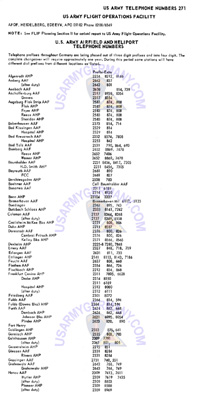
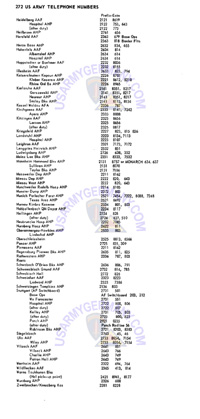
| Army Airfields and Heliports in USAREUR - 1970 | ||||||||||||||||||||||||
| (Source: DOD Flight Information Publication - Enroute Supplement, 5 Nov 1970) | ||||||||||||||||||||||||
|
||||||||||||||||||||||||
| (Source: STARS & STRIPES, April 9, 1976) | ||||||||||||||||||||||||
| There are currently 19 Army-run control towers at Army Airfields in USAREUR. One of the towers is at Schwaebisch Hall - it is 80- feet tall. Some of the towers are free-standing structures, some are located over a wooden building. |
||||||||||||||||||||||||
 |
||||||||||||||||||||||||
|
|
||||||||||||||||||||||||
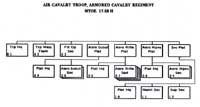
| Air Cavalry Concept in USAREUR | ||||||||||||||||||||||||
| 1973 | ||||||||||||||||||||||||
| (Source: USAREUR Air Cavalry Troop Reference Handbook, June 1973) | ||||||||||||||||||||||||
|
||||||||||||||||||||||||
|
||||||||||||||||||||||||
|
||||||||||||||||||||||||
|
|
||||||||||||||||||||||||
| Border Aerial Surveillance | ||||||||||||||||||||||||
| 1970s | ||||||||||||||||||||||||
| (Source: US ARMY BORDER OPERATIONS IN GERMANY, 1945-1983, by William E. Stacy) | ||||||||||||||||||||||||
| Chapter 6,
Modern Border Operations Aerial Surveillance Along the Border At the beginning of the 1970s, US Army aerial surveillance efforts along the border were conducted by the armored cavalry regiments, as they flew their daily border trace patrols with helicopters, and by the 122d Aviation Company, which flew OV-1 Mohawks. As was mentioned previously, the aerial surveillance activities in this area being conducted by the US Air Force and national collection agencies were not addressed in this study. They were occasionally tasked by USAREUR units to collect specific information, and any intelligence of importance they gathered with their normal aerial surveillance missions was fed into US Army intelligence information networks. The aerial surveillance activities of the ACRs were limited primarily to visual observation and photography. The 122d Aviation Company employed photography, the SLAR system, and infrared sensors on its daily missions over most of the USAREUR border sector. In addition to these daily missions, the corps could each request two special flight per month when increased or unusual sightings were noted or expected. In 1971 the 122d Aviation Company continued to refine its ability to use the SLAR's data-link capability, which was added to the SLAR system in the latter part of the 1960s -- a capability that allowed almost instantaneous access to the information gathered by the SLAR rather than waiting for the aircraft to land and have the film processed before the analysts could have access to the photographs of the radar picture. (For more information see article on 1960s.) Initially, SLAR was utilized to provide the corps with an early warning capability to detect enemy build ups. During 1971 the 122d Aviation Company began testing the feasibility of having SLAR monitor peacetime surveillance missions or, to put it differently, as a method for checking the operations security (OPSEC) of the border units. Apparently, it was a success, because by 1983 the majority of the peacetime SLAR and infrared missions of the aircraft were directed at USAREUR units for OPSEC purposes, although with their coverage of approximately 60 kilometers across the border, they did retain their early warning mission. A potentially significant upgrade of USAREUR's aerial surveillance capabilities along the border was tested between February and December 1971, when the QUICK LOOK sensor and data-link transmitting equipment were evaluated in the European environment. A 14-man test team brought over two OV-1C Mohawks with the QUICK LOOK electronic intelligence (ELINT) system installed and tested it against both East Bloc and USAREUR electronic emitters (primarily radar). The QUICK LOOK system was a prototype airborne detector designed to locate and identify ground-based radars. Generally, the equipment successfully detected both hostile and friendly emissions in near-real-time, but problems with the aircraft's navigational system would not allow the system to pinpoint locations of hostile emitters precisely enough for target acquisition purposes. Testing revealed that it was very good at detecting radar emitters in the frequency range from 550 to 10,300 megahertz (MHz), but that it could not detect narrow band emitters such as the ground surveillance radars. USAREUR recommended further testing to increase the accuracy of the QUICK LOOK system itself, as well as the aircraft's navigational system, and the expansion of its frequency range detection capability to at least 18,000 MHz so that it could pick up Soviet antiaircraft fire control radars. When these improvements were incorporated, USAREUR thought it would be a valuable addition to the command's intelligence gathering capabilities. The QUICK LOOK equipment, aircraft, and personnel returned to the United States in early 1972 for further testing. In response to a USCINCEUR requirement for a signals intelligence (SIGINT) system that could provide near-real-time tactical intelligence information directly to combat units, the National Security Agency (NSA) developed an experimental system known as GUARDRAIL I. Basically, GUARDRAIL was a communications intelligence (COMINT) system that monitored communications systems such as radio and teletype equipment. (Technically, both ELINT and COMINT were considered SIGINT.) Composed of already existing hardware that was interconnected to meet the specific needs of tactical SIGINT, GUARDRAIL I was tested in Europe from September to November 1971. The lessons learned during this 1971 testing were to be applied to the follow-on, operational system known as GUARDRAIL II . In 1971 CINCUSAREUR had requested that his command be provided 13 of the new OV-1D Mohawk aircraft, which were equipped with more modern and sophisticated sensor equipment and included all three operational aerial surveillance systems (photo, SLAR, and infrared) on one airframe. The new aircraft began arriving in early August 1972 and were deployed to the 122d Aviation Company at Hanau Army Airfield. As of 25 September 1972, all SLAR missions were being flown by OV-1Ds; and by the end of the year, all 13 OV-1Ds were operational (12 for operational use and 1 for maintenance float) and USAREUR's 13 OV-1B aircraft were being prepared for shipment to the United States. A significant problem was that the data-link system used with the SLAR system on the OV-1B (AN/APS 94) was not compatible with the SLAR system on the OV-1D (AN/APS 94D). USAREUR told Department of the Army that the equipment's use in providing early warning of imminence of hostilities and target acquisition once hostilities began, precluded waiting until FY 1977 for the expected deployment of compatible datalink equipment. Department of the Army said that it was working on an interim solution to the problem. |
||||||||||||||||||||||||
|
||||||||||||||||||||||||
| Meanwhile, the
73d's SLAR OV-1Ds were soon to be joined by the two newer aerial surveillance
systems. The new GUARDRAIL II
system had been tested in Europe from September to December 1972,
and USAREUR was so impressed with the upgraded system that it had
recommended retaining it in Europe. The GUARDRAIL II's system encompassed
signal-intercept and direction-finding equipment mounted on RU-21
aircraft, which through air and ground relays was capable of providing
near-real-time tactical intelligence information to combat commanders.
After extensive surveys and negotiations throughout 1973 to find a
home for the aircraft and its unit, the 330th Army
Security Agency (ASA) Company,
it was decided to station flight operations and maintenance elements
at Ramstein Air Base, with administrative support and other elements
at Sembach and Gruenstadt. The equipment and aircraft arrived by ship
in the spring of 1974 and were ready for operational test and evaluation
(OTE) on 26 August 1974. The GUARDRAIL II-system successfully completed
its OTE in March 1975 and started its intelligence mission in support
of theater requirements in April 1975. The combination of its mission
tracks being outside of the JCS-defined "sensitive airspace" (20 miles
next to the border) and the passive nature of its detection equipment
significantly lowered the political sensitivity of GUARDRAIL II's
operations. To further complicate matters for the 330th ASA .Company in 1974 -- when it was receiving its GUARDRAIL II aircraft and attempting to achieve OTE for the new system -- the company also had to field its two new QUICK LOOK aircraft in mid-July. Like the GUARDRAIL deployment, there had been a great deal of discussion about where to put these two aircraft in a theater where airfields were critically overcrowded. Although it would have been desirable to, collocate them at Ramstein Air Base with the rest of the 330th's assets, there just was not enough room. Hanau was the next best choice because the 73d MI Company was located there with its OV-1Ds and OV-1Cs, and since QUICK LOOK was mounted on RV-1Cs -- a modified OV-1C -- there were obvious maintenance advantages and the incoming QUICK LOOK pilots could train on the 73d's OV-1Cs. However, Hanau had runway limitations for the QUICK LOOK aircraft and it too was overcrowded, so the two QUICK LOOK aircraft and Detachment 1, 330th ASA Company, which consisted of 25 personnel, were stationed at Kitzingen Army Air Field. Since the QUICK LOOK's flight tracks would be in the "sensitive air-space," it was imperative the pilots be thoroughly trained before assuming their operational mission and, as a consequence, they were trained by the border-experienced pilots of the 73d in their OV-1Cs. The QUICK LOOK system was approved for reconnaissance missions in the 'sensitive airspace" in March 1975. In June 1975 the QUICK LOOK aircraft moved to Echterdingen Army Air Field near Stuttgart, which resulted in all of USAREUR's Mohawks being collocated on the same field, since the 73d had moved there recently with its OV-1Ds. (The 73d's OV-1Cs had been returned to the United States in October 1974, except for one, which had been transferred to the 330th for training purposes.) 1975 was a significant year in another respect for the aerial surveillance mission. The data-link compatibility problem of the new SLAR equipment installed on the OV-1D was finally solved in the latter part of the year. This followed a rather tortuous period between the OV-ID's fielding in 1972 and 1975, which saw the command try several interim solutions to the problem. In 1973 the command had tried to use KY-8 and KY-28 secure voice communications devices between the ground stations and the aircraft with only marginal results and decided to further test the concept in 1974. However, the testing was delayed due to a lengthy grounding of the OV-1s from January through April 1974 because two of them had crashed during a short period of time. When testing of the devices was resumed, it was discovered that they were not reliable for air-to-ground transmissions in this configuration. Next, the command tried issuing acetate overlay maps of the border area to system operators on the aircraft and in the ground stations. When the SLAR equipment detected activity, the aircraft crew indicated this to the ground station personnel by giving references to a sector identified by a letter-number combination on the acetate maps. Tests in November 1974 indicated the system was usable. In the meantime, however, discussions with the manufacturer of the data-link system used with the older SLAR equipment (AN/UPD-2) revealed that it would be relatively easy to modify it to be compatible with the new SLAR equipment on the OV-1Ds. The contract was let in February 1975 and the upgraded data-link system (AN/TQ-2A) was delivered and operational in both corps by 5 November 1975. The new equipment worked very well during its test period, and timely inflight reporting from the SLAR missions (code named LARD CAN) was again available to the border units. In the latter part of 1978 both the QUICK LOOK and GUARDRAIL II systems were upgraded in USAREUR. The QUICK LOOK II system replaced the developmental QUICK LOOK system, becoming operational on 7 October 1978. The new system was mounted on six RV-1Ds and was operated by the 73d MI Company (AS) instead of the 330th ASA Company. It had a day-and-night, all-weather capability and was effective for approximately 150 kilometers (line-of-sight) against pulsed and continuous wave emitters. Missions were flown at 10 000 feet on JCS-approved flight tracks in the "sensitive airspace." It averaged 20 missions a month; in comparison, the QUICK LOOK I system had averaged 12 missions per month. The code name for its missions was CARAT ROCK. The new GUARDRAIL V system (its mission code name was CARD WHALE) replaced the aging GUARDRAIL II system and was declared operational on 28 November 1978. Operated by the 330th ASA Company, the system was mounted on 6 RU-2H aircraft (plus a seventh aircraft for maintenance float) and flew approximately 25 missions per month. The 2-aircraft missions were normally flown at around 18,000 feet on JCS-approved nonsensitive tracks. It also had a day-and-night, all-weather capability and was effective to a depth of 300 kilometers against ground-based emitters and 450 kilometers against aerial emitters. Both upgraded systems improved the command's aerial surveillance capabilities, and USAREUR was scheduled to receive additional sets of QUICK LOOK II and GUARDRAIL V in 1979. Stationing problems for the aircraft precluded this, however, and the deployments were rescheduled for 1980. Eventually, only the QUICK LOOK II set of six additional RV-1D aircraft was fielded by the 73d in the summer of 1982, with the additional set of GUARDRAIL V aircraft scheduled to be deployed in 1984. Organizationally, things had been fairly straightforward for the aerial surveillance units up through 1978; however, at that point they became involved in an Army-wide reorganization of intelligence and electronic warfare assets. Many of these assets were controlled by higher headquarters, such as USAREUR headquarters, or were part of INSCOM units in a stovepipe arrangement. The new doctrine called for placing the "combat electronic warfare intelligence" (CEWI) assets in companies, battalions, and groups that would be directly attached to the tactical units they supported. In 1978, CEWI planning called for each USAREUR corps to have one CEWI group, part of which would be composed of a CEWI aerial exploitation battalion. However, the command only had enough aircraft and equipment to form one aerial exploitation battalion. As a consequence, most of the 2d MI Battalion, including the two aerial surveillance units, was reorganized as the 2d MI Battalion (Aerial Exploitation - AE) on 16 May 1979. It continued to be assigned to the 502d ASA Group, an INSCOM unit, until 16 January 1981, when it was reassigned to USAREUR. It was subsequently reassigned to VII Corps on 16 June 1983, and finally to its CEWI group, the 207th MI Group, when the latter was activated and assigned to VII Corps on 16 October 1983 (the 207th had been in carrier status since 16 April 1983).56 |
||||||||||||||||||||||||
|
||||||||||||||||||||||||
| As was noted earlier, there were not enough assets to create a CEWI group or aerial exploitation battalion for V Corps, but throughout this period bits and pieces of its CEWI group (205th MI Group and battalion (1st MI Battalion (AE)) were being accumulated. A key element of the 1st MI Battalion had been present since 16 June 1982, when the 144th ASA Company was activated at Echterdingen and initially attached to the 2d MI Battalion. Although it had some personnel, when its set of six QUICK LOOK II aircraft and equipment arrived in the summer of 1982 (see above) it was still under-strength, and the 73d initially fielded the equipment and maintained it until 1983, when it handed it over to the 144th. Also in 1983 the 144th ASA Company was renamed the 144th ASA Aviation Company (Forward) and assigned to its parent unit, the 1st MI Battalion (AE), on 16 August 1983, which at that time was in carrier status under its parent, V Corps. It, like the other two aerial surveillance companies, also picked up a letter designation in 1983 and became Company B of the 1st MI Battalion. It remained at Echterdingen, however, and was still attached to the 2d MI Battalion. By the end of 1983, the 144th had moved to Wiesbaden Air Base, where plans called for it to be collocated with the 1st MI Battalion, which was scheduled to be activated on 16 January 1984. The 1st MI Battalion was scheduled to activate another aerial surveillance company in the FY 1985-86 timeframe and, sometime in FY 1985, accept delivery of the second set of six Improved GUARDRAIL V aircraft and equipment. In 1984 the 330th EW Aviation Company (FWD) would move from Ramstein Air Base to Echterdingen, thus collocating all of the 2d MI Battalion's aerial surveillance assets at one location. When all of these activations, equipment and aircraft accessions, and unit movements were completed, the command would have a significantly improved aerial surveillance posture that would allow even better peacetime aerial surveillance coverage of the border area. | ||||||||||||||||||||||||
|
||||||||||||||||||||||||
|
|
||||||||||||||||||||||||
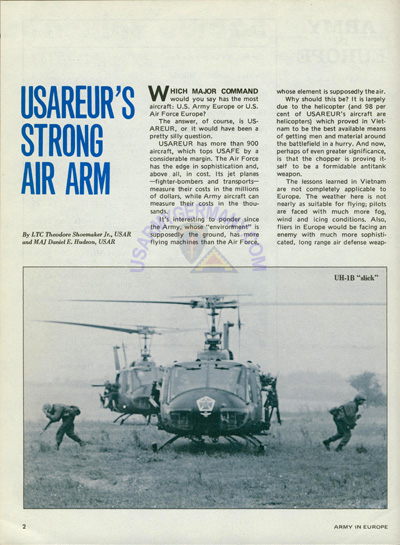
| Army Aviation in USAREUR in the Mid 1970s | ||||||||||||||||||||||||
| (Source: ARMY IN EUROPE Magazine, Aug 1975) | ||||||||||||||||||||||||
 |
||||||||||||||||||||||||
|
||||||||||||||||||||||||
| Divisional Aviation Units (1970s) | ||||||||||||||||||||||||
| 1970s | ||||||||||||||||||||||||
| LINEAGE OF US ARMY DIVISION AVIATION BATTALIONS IN GERMANY (ONGOING PROJECT) |
||||||||||||||||||||||||
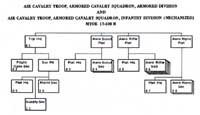
| One of my current USAREUR website projects includes researching the lineage of the four divisional aviation battalions that were stationed in Germany during the 1970s and early 1980s - 3rd, 8th, 501st and 503rd Cbt Avn Bns. One of the objectives of this project is to create for each of the battalions a timeline schematic that will (I hope) show the evolution of each of the organic divisional aviation units as Army Aviation doctrine changed and new equipment was fielded in the post-Vietnam era. |
||||||||||||||||||||||||
|
||||||||||||||||||||||||
| 2. When was Troop D (Air Cav) of the 1-1 Cav formed/activated? Does anyone have details on how that unit was reorganized to form Co B, 501st Avn Bn? (Same question goes for the other divisional air cav troops - Trp D of the 3-12 Cav, 3-7 Cav and 3-8 Cav.) 3. When did the 175th Attack Helicopter Company arrive in Germany (exact date or at least month and year)? I understand that the 175th might have been located initially at Kitzingen AAF before moving to Illesheim. True? If so, does anyone have a date for the move? (Other Attack Helicopter Companies that arrived in USAREUR in the same timeframe and eventually became the Co C of the other div avn bn's were the 334th, 235th and ??? Avn Co's. Does anyone have information on these units? RESPONSE No 1: Jim Sprinkle - I served with both the 235th Aerial Weapons Company and 334th Attack Helicopter Company in Vietnam. The 235th returned from Vietnam to Ft. Knox as the 235th Aviation Company; and, as you know, in June 1976 was deployed to Giebelstadt, West Germany. They were, as far as I can determine at this time, the second unit to deploy the AH-1Q in Europe (the 2nd ACR being the first). In late August ’76 they were re-designated B Company, 3rd CAB. The 334th, similarly, returned to Ft Knox. The 334th had a direct lineage (although the US Army does not recognize it officially) to the first aviation unit to deploy helicopter gunships in Vietnam in 1963, the Utility Tactical Transport (UTT) Helicopter Company. The 334th was only at Ft Knox about 8 months when they were deployed to Hanau AAF, West Germany, in mid-November 1972. On September 1978 they were re-designated C Company, 503rd Aviation Battalion. In January 1977, they were re-equipped with the new AH-1S (modified). RESPONSE No 2: Robert Quillen - The 175th Attack Company arrived in Illesheim, Germany Jan 1973 – (check AH-1Q Tow Cobra section) – the 175th was never stationed in Kitzingen at any time during the 70s. The 175th Attack Company / C Company 501st ABC and B Company 501st ABC , never had the AH-1Q model helicopter, instead they received the AH-1S (Mod). 4. When was Co F of the 123rd Maint Bn formed and how was it organized? Also interested in Co F, 122nd Maint Bn; Co F, 703rd Maint Bn; and Co F, 708th Maint Bn. I am sure I will have more questions as I get deeper into this topic. Any and all information and feedback (suggestions or comments about this project) are always greatly appreciated!!! RESPONSE: Robert Quillen - F Company 123rd Maintenance Battalion was the 1st Armored Division’s direct support for aircraft maintenance during the 70’s. Prior to this time fame B Company 126th Maintenance Battalion was the 4th Armored Division’s Direct Support for aircraft maintenance. 4th Armored Division was replaced by the 1st Armored Division early 1970. B Company 126th Maintenance Battalion 4th AD - 1960 – becomes – F Company 123rd Maintenance Battalion 1st AD - 1970. |
||||||||||||||||||||||||
|
||||||||||||||||||||||||
| AH-1Q TOW Cobras | ||||||||||||||||||||||||
| 1976 | ||||||||||||||||||||||||
| (Source: STARS & STRIPES, June 6, 1976) | ||||||||||||||||||||||||
| The 235th Attack Helicopter Company arrived in Germany on June 6, 1976. Equipped with the AH-1Q TOW-Cobra, the unit will be assigned to the provisional 3rd CAB of 3rd Inf Div and be stationed at Giebelstadt AAF. At some point in the future, the company will be redesignated as "B" Company, 3rd CAB. The first unit in USAREUR to receive the new model of attack helicopter was the Air Cav Troop of 2nd Armd Cav Regt, Feucht AAF. Air Cav Troop, 11th Armd Cav Regt in Fulda received its complement of AH-1Q's in May, 1976. Attack helicopter units that were previously attached to 11th Avn Gp in Schwaebisch Hall are being reassigned to divisional aviation battalions:  334th Attack Helicopter Company, Hanau (arrived in Nov 1972; equipped with 18 AH-1G Cobra & two Hueys) 175th Attack Helicopter Company, Illesheim (arrived on Jan 25 1973; equipped with 22 AH-1G Cobra & 2 Hueys) 334th Attack Helicopter Company, Hanau (arrived in Nov 1972; equipped with 18 AH-1G Cobra & two Hueys) 175th Attack Helicopter Company, Illesheim (arrived on Jan 25 1973; equipped with 22 AH-1G Cobra & 2 Hueys) The 71st Aviation Company, Wertheim, is scheduled to assign a platoon of Cobras to an armored cavalry regiment. |
||||||||||||||||||||||||
|
||||||||||||||||||||||||
|
||||||||||||||||||||||||
|
||||||||||||||||||||||||
| Army Aviation Maintenance Units (1970s) | ||||||||||||||||||||||||
| 1970s | ||||||||||||||||||||||||
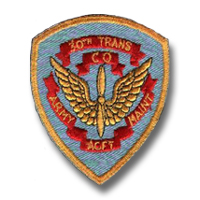
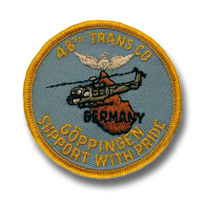
| In Dec 1974,
the VII Corps AVIM Bn (Prov) was formed
using personnel and equipment from the 29th and 48th Trans Cos. In Apr 1975, the V Corps AVIM Bn (Prov) was formed using personnel and equipment from the 30th and 245th Trans Cos. In Jul 1975, the 1st Spt Bde AVIM Bn (Prov) was formed. |
||||||||||||||||||||||||
| General Support | ||||||||||||||||||||||||
 48th
TC Co (GS) 48th
TC Co (GS) |
||||||||||||||||||||||||
| 245th
TC Co (GS) |
||||||||||||||||||||||||
| 661st
TC Co (GS) |
||||||||||||||||||||||||
| Direct Support | ||||||||||||||||||||||||
| 29th
TC Co (DS) |
||||||||||||||||||||||||
| 30th
TC Co (DS) |
||||||||||||||||||||||||
| RESPONSE: Robert Quillen - Under Army Aviation Maintenance Units 1970 – 591st Transportation Company (DS). Unit was located in Illesheim APO 09140, from 1970 to Jun 1972. The unit supported non-divisional units in Bavaria to include the 2nd ACR. Unit’s parent unit was the 71st Maintenance Battalion APO 09070. |
||||||||||||||||||||||||
|
|
||||||||||||||||||||||||
|
||||||||||||||||||||||||
|
||||||||||||||||||||||||
|
|
||||||||||||||||||||||||
| Army Aviation in USAREUR in the Late 1970s | ||||||||||||||||||||||||
| 1979 | ||||||||||||||||||||||||
| (Source: An unpublished
article compiled by Gordon Wimmer, October 1979 and submitted by Alfons
Kraus, Germany) Webmaster Note: The webmaster has only made some minor editing changes to correct spelling and grammar. Any necessary corrections to unit organizations, missions, or other details will be added to the end of the article in a separate section. |
||||||||||||||||||||||||
| Very little information
has been published to date on the organization of U.S Army Aviation
units Europe, a gap which this article hopes to fill by introducing
the interested enthusiast to the chain of command between the various
units, along with their respective locations and unit strenghts. It
will concentrate on the West German scene as only about 20 aircraft
are assigned to small units in Belgium, Greece, Italy and Turkey.
A recent reorganisation within USAREUR has resulted in fewer but stronger combat units, and this process is being continued back in the USA and in the Far East. The following notes should therefore help towards a better understanding of the Army structure in these areas as well. USAREUR has about 50 airfields in West Germany, of which 40 are operational and permanently staffed, although only 19 of these can be considered to be major bases. The recent changes have led to closure of (several airfields???) and it is expected that further minor locations will be closed in the future. Some 70 percent of USAREUR aircraft today are assigned to only nine major aviation units, including several Combat Aviation Battalions (assigned at Division level) and the Air and Support troops of two Armored Cavalry Regiments. The remaining 30 percent are spread over a large number of small units. Approximately 1,100 aircraft/helicopter are currently assigned in the following numbers: |
||||||||||||||||||||||||
|
||||||||||||||||||||||||
| All army units in West Germany come under the control of the USAREUR & 7th Army, whose HQ is at Heidelberg. The major commands under it will each be dealt with in turn, and are as follows: | ||||||||||||||||||||||||
|
||||||||||||||||||||||||
| US Army Europe & Seventh Army | ||||||||||||||||||||||||
| The only aviation
unit which reports directly to USAREUR/7th Army headquarters at
Heidelberg is the 11th
Combat Aviation Group. The Group forms a part of NATO's Allied Command Europe Mobile Force (AMF) which is deployable at short notice to any area within NATO, and the 11th CAG is frequently called upon for exercises in this role. In 1979, 11th CAG consisted of the following five aviation companies: |
||||||||||||||||||||||||
|
||||||||||||||||||||||||
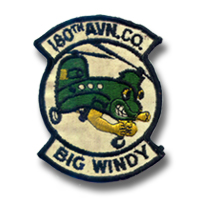
| The 180th Aviation
Company is believed to have only 18 CH-47C's at present, although
it is thought that it will soon be up full strenght of 20. The two U-21A's remaining with the 207th Aviation Company will probably be replaced by C-12C's this year. Another U-21 is based at Schwäbisch-Hall and used by the commander of the 11th CAG. |
||||||||||||||||||||||||
|
||||||||||||||||||||||||
|
||||||||||||||||||||||||
|
|
||||||||||||||||||||||||
| VII Corps | ||||||||||||||||||||||||
| The major subordinate
units of VII Corps at Stuttgart are
the 1st Armored Division, the 3rd Infantry Division (Mech), the 2nd
Armoured Cavalry Regiment, the 2nd Support Command (Corps) and one
Brigade (Forward) of the 1st Infantry Division. As with V Corps, these
will be dealt with in turn after a couple of other units that report
directly to the Corps level. The Aviation Sections of all the smaller units under VII Corps, including the 72nd and 210th Field Artillery Groups, the 34th Signal Battalion (Corps) and the 7th Engineer Brigade, have been disbanded and the aircraft are now assigned to two Companies of the 223rd Aviation Battalion at Stuttgart: |
||||||||||||||||||||||||
|
||||||||||||||||||||||||
| The 25th Aviation Company keeps one or two detachments, including one at Gablingen (Augsburg). One C-12 is based at Stuttgart-Echterdingen for use of the VII Corps Commander. | ||||||||||||||||||||||||
|
||||||||||||||||||||||||
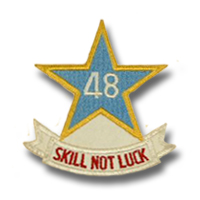
| (1)
I am not certain that this is the right version of the 48th Aviation
Co pocket patch used during this period.
(Source: Email from Rick) Yes, the Blue Star patch that you show above is the correct version used at Katterbach airfield starting in 1972. |
||||||||||||||||||||||||
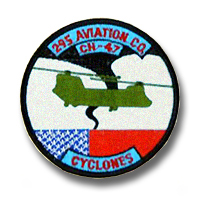
| The 295th Aviation Company (Assault Support) is a separate unit and is directly attached at Corps level: | ||||||||||||||||||||||||
|
||||||||||||||||||||||||
| The unit used to be located at Mainz-Finthen, and was equipped with nine CH-54A's until September 1976. (Webmaster note: the CH-54's of the 295th were phased out and replaced by CH-47's. With the transition to CHINOOKs, the 295th was redesignated as a "Medium Lift Helicopter" company.) | ||||||||||||||||||||||||
|
||||||||||||||||||||||||
| The Divisional
Aviation units under VII Corps are as follows: 501st Aviation Battalion, 1st Armd Div, Katterbach AAF, Ansbach |
||||||||||||||||||||||||
|
||||||||||||||||||||||||
| A Company keeps a detachment of one or two OH-58A's at Bamberg, while another detacdhment which used to be at Erlangen is no longer there. Directly attached to the 1st Armored Division is the 2nd SOTAS Detachment formed on January 1, 1979 with two EH-1H's at Ansbach. | ||||||||||||||||||||||||
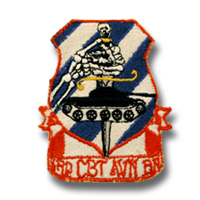
| 3rd Aviation Battalion, 3rd Inf Div (Mech), Kitzingen | ||||||||||||||||||||||||
|
||||||||||||||||||||||||
| A Company keeps one detachment of one or two OH-58A's at Aschaffenburg. | ||||||||||||||||||||||||
| 3rd Brigade (Fwd) of the 1st Infantry Division at Fort Riley, Kansas, is located at Göpppingen, where its four OH-58A'S are also based. (The other two Brigades of the Division left Germany in 1968, and in theory return to Germany each year for the REFORGER exercises. In fact, the two Brigades flown across the Atlantic are drawn from every active Division in the USA and change each year.) | ||||||||||||||||||||||||
|
||||||||||||||||||||||||
| As under V Corps, VII Corps has its own Armored Cavalry Regiment, the 2nd ACR, which operates from Feucht Army Airfield near Nürnberg. | ||||||||||||||||||||||||
|
||||||||||||||||||||||||
| The two Troops are controlled by the Regiment's Command and Control Squadron. The Support Troop keeps detachments of two OH-58A's each at Bayreuth (Detachment 1) and at Bamberg (Detachment 2, not recently confirmed). | ||||||||||||||||||||||||
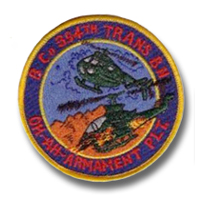
| 2nd Support Command controls the 394th Transportation Battalion (AVIM) at Nellingen, where its two UH-1H's are based. As Nellingen only has a helipad, the unit's U-21A is resident at Stuttgart. Apart from its two Hueys and and of the Corps helicopters which it may have undergoing maintenance, the 394th AVIM Bn usally has a small number of UH-1H's, OH-58A's and AH-1's in stock as float (attrition replacements). | ||||||||||||||||||||||||
|
||||||||||||||||||||||||
|
||||||||||||||||||||||||
|
|
||||||||||||||||||||||||
| 21st Support Command | ||||||||||||||||||||||||
| The 21st Support
Command at Kaiserslautern is USAREUR's primary logistical organisation,
and also handles the storage and maintenace of combat-ready equipment
for issue to troops that would be brought in from the USA in the event
of war. Of its many subordinate units, only three have relevance to
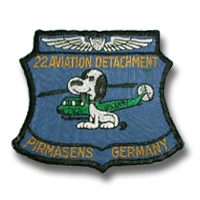
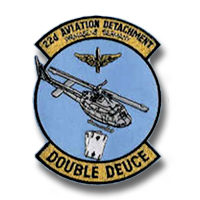
this article. The 22nd Aviation Detachment in Pirmasens is equipped with 10x UH-1H's. The 56th Aviation Company at Coleman Barracks, Sandhofen, is equipped with 7x UH-1H helicopters and 6x U-21 and 1x C-12 fixed-wing aircraft. The 56th also has one OH-58A which is detached to Bremerhaven for most of its time. The third unit is the 70th Transportation Battalion (AVIM) at Coleman Barracks. This unit is responsible for higher level maintenance of all European based U-21's plus those helicopters which do not belong to V Corps or VII Corps. It has no aircraft of its own, but does usually keep a small stock of attrition replacements. In addition, its 'Closed Loop' detachment at Ramstein AB is responsible for the transfer of all aircraft and helicopters from and to the USA. Those which cannot be repaired in Germany or are in need of complete overhaul are shipped back to Corpus Chtisti Army Depot, TX, from where 'new' machines are delivered, usually on a one-for-one basis. Typical sets on the C-141 flights are 3 UH-1's, 3 AH-1's or 6 OH-58's, with up to 3 CH-47's on a C-5 flight. Newly arrived aircraft are assembled and test-flown at Ramstein prior to delivery to their new home units. |
||||||||||||||||||||||||
|
||||||||||||||||||||||||
| (1) Have not found the unit patch yet, so the decal will have to do until then.. | ||||||||||||||||||||||||
|
||||||||||||||||||||||||
|
|
||||||||||||||||||||||||
| Berlin Brigade | ||||||||||||||||||||||||
| The Aviation
Detachment of the Berlin Brigade at Tempelhof is equipped
with five UH-1H's, two UV-20A's and one U-21A. The two O-2A's and
two U-6A's were shipped back to the States in late 1979. (Avn Det pocket patch courtesy of Joe King, Aviation Detachment, Berlin Brigade) |
||||||||||||||||||||||||
|
||||||||||||||||||||||||
|
||||||||||||||||||||||||
|
|
||||||||||||||||||||||||
| 32nd Army Air Defense Command | ||||||||||||||||||||||||
| The 32nd AADCOM at Darmstadt has its many Nike Hercules and Hawk batteries spread throughout central and southern Germany. Only a few of its Air Defence Artillery Groups are supported by small Aviation Sections, however, and the following is known: | ||||||||||||||||||||||||
|
||||||||||||||||||||||||
|
||||||||||||||||||||||||
|
|
||||||||||||||||||||||||
| 7th Medical Command | ||||||||||||||||||||||||
| Rescue and ambulance work is carried out by 7th Medical Command's subordinate units, which are well distributed over the area used by US Forces. The main aviation unit is the 421st Medical Air Ambulance Company with its four Platoons: | ||||||||||||||||||||||||
|
||||||||||||||||||||||||
| Also under the command of 7th MEDCOM are four independent detachments, known as Medical Detachment Helicopter Ambulances, details of which follow: | ||||||||||||||||||||||||
|
||||||||||||||||||||||||
|
|
||||||||||||||||||||||||
|
||||||||||||||||||||||||
|
|
||||||||||||||||||||||||
| Miscellaneous Units | ||||||||||||||||||||||||
| There are still a large number of small independent units in USAREUR in addition to those already listed under various Commands. In some cases the information at hand is incomplete, and there may even be one or two more units beyond those we are about to list. All unconfirmed items are marked with an asterix (*), and the given unit strengths should be regarded as a minimum. | ||||||||||||||||||||||||
|
||||||||||||||||||||||||
| 502nd ASA Group, USAREUR, Flak Kaserne, Augsburg | ||||||||||||||||||||||||
|
||||||||||||||||||||||||
| Final strength
of the 320th ASA Co will probably be 14RV-1D's. (Webmaster Note:
The 320th might be a typo by the author. I have never heard of a 320th
ASA Company in Germany. There was a 320th ASA Battalion stationed
in Bad Aibling, but that outfit had been inactivated in 1966.) The 330th ASA Co was activated on 30 Sep 1973 in Germany to operate the GUARDRAIL IIA (upgraded GRII) system as a theater level (airborne COMINT) system. In 1978, GUARDRAIL IIA was replaced in the 330th ASA Co by the RU-21H GUARDRAIL V system. |
||||||||||||||||||||||||
| (Webmaster Note: for some interesting details on the QUICKLOOK system and its use in Europe check out the Det 1, 330th ASA Co (AVN) web site.) | ||||||||||||||||||||||||
| Two new combat brigades were formed under USAREUR in the mid to late seventies. Brigade 75 was formed in 1975 at Grafenwöhr, Brigade 76 in 1976 at Wiesbaden. (Brigade 75 would later be moved to Garlstedt - the first US Army Brigade to be based in northern Germany - and be redesignated as 3rd Brigade (Fwd) of the 2nd Armd Div; Bde 76 would later be redesignated as 4th Bde (Fwd), 4th Inf Div (Mech).) | ||||||||||||||||||||||||
|
||||||||||||||||||||||||
| Various other units operated Aviation sections as follows: | ||||||||||||||||||||||||
|
||||||||||||||||||||||||
| Another well known unit was the 2nd MIBARS (Military Intelligence Battalion Air Reconnaisance Support) based at Zweibrücken with five U-21's. The battalion was disbanded there during the Summer of 1979. | ||||||||||||||||||||||||
|
||||||||||||||||||||||||
|
||||||||||||||||||||||||
|
|
||||||||||||||||||||||||
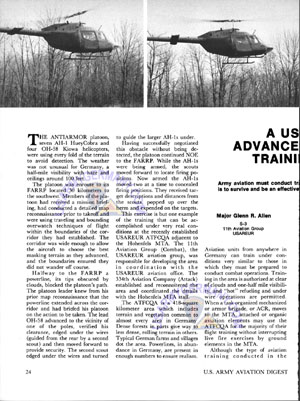
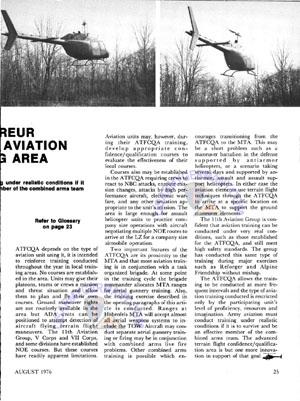
| Advanced Terrain Flight Confidence/Qualification Area (ATFCQA) | ||||||||||||||||||||||||
| (Source: US ARMY AVIATION DIGEST, Aug 1976) | ||||||||||||||||||||||||
|
||||||||||||||||||||||||
|
||||||||||||||||||||||||
| The 1980s | ||||||||||||||||||||||||
| Divisional Combat Aviation Brigades | ||||||||||||||||||||||||
| 3rd Infantry Division (Mech) | ||||||||||||||||||||||||
|
||||||||||||||||||||||||
| [1] Elements of C Co 3 AB(C) moved from Schweinfurt to Giebelstadt and were redesignated the 13th AHB. B Co was already at Giebelstadt and redesignated in name only. The remainder of C Co 3 AB(C) remained at Schweinfurt and became the nucleus of 2 Air Cav troops for the 3/7 Cav. (Source: Mark Evetts) | ||||||||||||||||||||||||
| The 3rd Avn Bn (Cbt) was reorganized as 4th Brigade (Combat Aviation)(Provisional) on Nov 16, 1984. 4th Bde, 3rd Inf Div (M) was the first combat aviation brigade to be organized under the "Army of Excellence" concept in USAREUR and was organized with assets already existing within the Division without an increase in soldiers or equipment. | ||||||||||||||||||||||||
| In 1987, a new unit was organized to provide command and control of the separate aviation companies within the brigade: Task Force 23 | ||||||||||||||||||||||||
|
||||||||||||||||||||||||
| [1] it is possible that the 63rd TAMC was actually assigned to the division's DISCOM and was not really a subordinate element of TF23. OR, the unit was originally part of TF23 and then reassigned to DISCOM. Can anybody provide details? | ||||||||||||||||||||||||
| Also in 1987 (on Aug 16), the aviation units within the division were redesignated under the new regimental system. | ||||||||||||||||||||||||
|
||||||||||||||||||||||||
|
|
||||||||||||||||||||||||
| 8th Infantry Division (Mech) | ||||||||||||||||||||||||
| On April 11 1986, 8th Infantry Division's 4th Brigade was activated in ceremonies at Finthen Army Airfield. | ||||||||||||||||||||||||
|
||||||||||||||||||||||||
| In 1987, the aviation units within the division were redesignated under the new regimental system. | ||||||||||||||||||||||||
|
||||||||||||||||||||||||
| In August 1988, a new unit was organized to provide command and control of the separate aviation companies within the brigade: Task Force Skyhawk | ||||||||||||||||||||||||
|
||||||||||||||||||||||||
| [1] it is possible that Co I, 4th Avn was actually assigned to the division's DISCOM and was not really a subordinate element of TFS. OR, the unit was originally part of TFS and then reassigned to DISCOM. Can anybody provide details? | ||||||||||||||||||||||||
| The mission of TFS and its three subordinate aviation units includes aerial fire support, reconnaissance and surveillance, troop and supply movement, electronic warfare, aviation maintenance and air traffic control. | ||||||||||||||||||||||||
|
|
||||||||||||||||||||||||
| 1st Armored Division | ||||||||||||||||||||||||
|
||||||||||||||||||||||||
| In 1987?, a new unit was organized to provide command and control of the separate aviation companies within the brigade: Task Force Phoenix | ||||||||||||||||||||||||
|
||||||||||||||||||||||||
| [1] it is possible that the 61st TAMC was actually assigned to the division's DISCOM and was not really a subordinate element of TFP. OR, the unit was originally part of TFP and then reassigned to DISCOM. Can anybody provide details? | ||||||||||||||||||||||||
| In November 1987, the aviation units within the division were redesignated under the new regimental system. | ||||||||||||||||||||||||
|
||||||||||||||||||||||||
| [1] The battalion was inactivated on April 21, 1988 and the unit's colors were transferred to Fort Hood, Texas, where it was to be reactivated as an AH-64 unit. After being re-equipped and trained on the new APACHE helicopters, the battalion was scheduled to return to Germany in 1989 and rejoin the 1st Armd Division. | ||||||||||||||||||||||||
|
|
||||||||||||||||||||||||
| 3rd Armored Division | ||||||||||||||||||||||||
|
||||||||||||||||||||||||
| In April 1987, a new unit was organized to provide command and control of the separate aviation companies within the brigade: Task Force Viper | ||||||||||||||||||||||||
|
||||||||||||||||||||||||
| [1] it is possible that the 58th TAMC was actually assigned to the division's DISCOM and was not really a subordinate element of TFV. OR, the unit was originally part of TFV and then reassigned to DISCOM. Can anybody provide details? | ||||||||||||||||||||||||
| Missions
of the new Task Force:air assault and
aerial resupply (UH-60A)VIP mission (UH-1H,
OH-58A)electronic warfare
(EH-1H)aeroscouts (OF-58D) |
||||||||||||||||||||||||
| In August 1987, the aviation units within the division were redesignated under the new regimental system. | ||||||||||||||||||||||||
|
||||||||||||||||||||||||
| [1] The battalion was inactivated in August, 1988 and the unit's colors were transferred to Fort Hood, Texas, where it was to be reactivated as an AH-64 unit. After being re-equipped and trained on the new APACHE helicopters, the battalion was scheduled to return to Germany and rejoin the 3rd Armd Division. | ||||||||||||||||||||||||
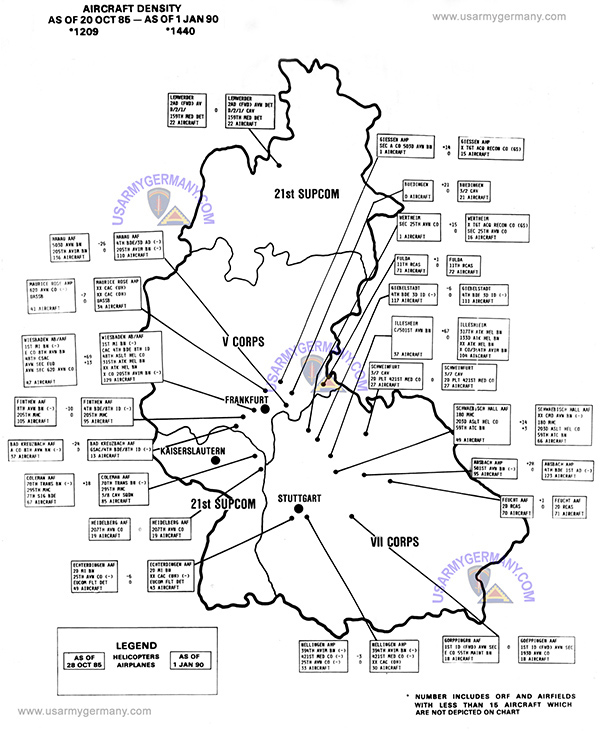
| Army Aviation in USAREUR - Aircraft Density 1985 & 1990 | ||||||||||||||||||||||||
 |
||||||||||||||||||||||||
|
||||||||||||||||||||||||
|
|
||||||||||||||||||||||||
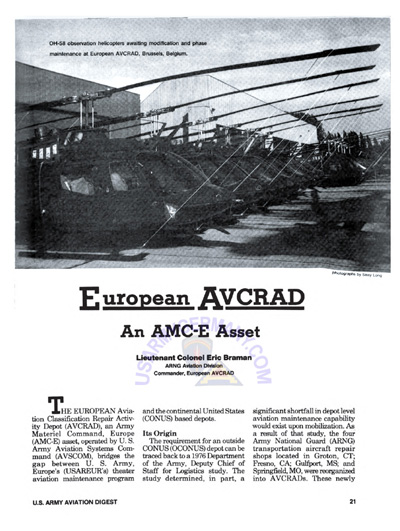
| European Aviation Classification Repair Activity Depot | ||||||||||||||||||||||||
| (Source: ARMY AVIATON DIGEST, Jul-Aug 1989) | ||||||||||||||||||||||||
 |
||||||||||||||||||||||||
|
||||||||||||||||||||||||
| Aviation Safety and Standardization | ||||||||||||||||||||||||
| The mission of the Safety and Standardization detachments is to plan, coordinate, monitor, and implement the Army Aviation Standardization Program in Europe, including watching over aviation safety programs and managing flight simulation assets. | ||||||||||||||||||||||||
|
||||||||||||||||||||||||
|
||||||||||||||||||||||||
|
|
||||||||||||||||||||||||
| Related Links: 73rd Military Intelligence Company (Dead Link) - site dedicated to the 73rd MI Co in Germany. Check out the Photo Albums! QUICK LOOK - an interesting website for former members of Detachment 1, 330th Avn Co C Company, 6th Bn, 159th Avn (203rd Avn Co) - Paul Scott's very nice web site featuring Co C, 6/159th Avn (prior to Nov 1987 designated as 203rd Avn Co) based at Dolan Barracks, Schwäbisch Hall. 205th Aviation Co "Geronimos" - 205th Aviation in Germany, 1973 - 1988. 295th Aviation Co (HH) - Another very good Army Aviation web site - the 295th served at Mainz-Finthen AAF and flew the CH-54A Sikorsky Skycrane Helicopter (TARHE) in the early 1970s. Chuck Robers is the webmaster. Aviation Detachment, Berlin Brigade - A Historical Overflight of Berlin with a UH-1H pilot of the Avn Det, Joe King US Army Otters - a page on the De Havilland DHC-3 Otter web site authored by Ian Butter |
||||||||||||||||||||||||
 .
.

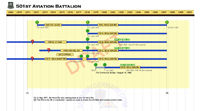
 Example of one of the schematics I am working on (501st Avn Bn (C).