| If you do
NOT see the Table of Contents frame to the left of this page, then
Click here to open 'USArmyGermany' frameset |
|||
|
7th Medical Command |
|||
|
|
|||
|
|||
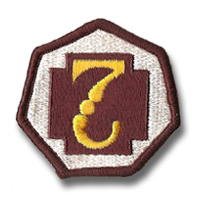
| A maroon, silver and gold patch, 2½-inches in height, consisting of a seven-pointed star, one point up, nearing the shape of the number seven which is interwoven through a maroon Greek cross. The colors maroon and white are traditional to the Medical Corps. The fleam is a heraldic symbol for a surgical lancet and its form simulates the unit's numerical designation. The star alludes to the command position of the unit. As a symbol of aid and assistance, the maroon Greek cross is used to designate the medical activity. |
|||
|
|
|||
| US Army Medical Command Europe | |||
 USAMEDCOMEUR Facilities in 1978 (Webmaster's collection) |
|||
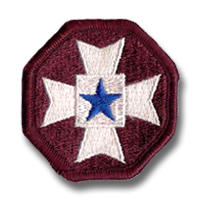 US Army Medical Command Europe patch (worn 1970 - 1978) US Army Medical Command Europe patch (worn 1970 - 1978) |
|||
| 1970 | |||
| (Source: USAREUR Medical Bulletin, May 1970) | |||
| Birth and Development of the US Army Medical Command, Europe (*) by COL Leigh F. Wheeler, Sr., MSC (**) The United States Army Medical Command, Europe (USAMEDCOMEUR), is the result of an idea prompted by the removal of American forces from French soil in 1997. The geographical and organizational changes which occurred during 1967 caused the Surgeon, US Army, Europe tUSAREUR), along with other staff officers and Department of the Army personnel, to study the entire command structure within the US Army, Europe, and make it more responsive to the existing situation. A study was made to see how the medical structure we had at that time could possibly be realigned to make better use of our reduced capability within the Field Army and to accomodate the shorter lines of communications within our fixed facilities. It was decided that the hospital center which had moved from France to Worms, Germany as a part of the US Army Communications Zone, Europe (later redesignated the Theater Army Support Command, Europe) was no longer needed within the geographical area in which we had to work. It was also felt that better use could be made of the resources available by having the Surgeon command the medical resources and also provide staff advice to the USAREUR Commander in Chief. After this concept had been approved by the Surgeon and the Commander in Chief, work began to develop a headquarters organization and to recommend the subordinate elements which it would control. The result was that the Surgeon's office, as such, was eliminated as a separate entity from the US Army, Europe, and Seventh Army Headquarters. The Communications Zone Surgeon's office was reduced in size and certain alterations were made in the mission of the 9th Hospital Center. Most of the personnel spaces and the personnel made available were formed into the headquarters for the new Army Medical Command, Europe. Organization and mission far the Medical Command briefly stated is to command all medical units assigned and to provide staff advice to the Commander in Chief, US Army, Europe. Its organization is shown in Figure 1. |
|||
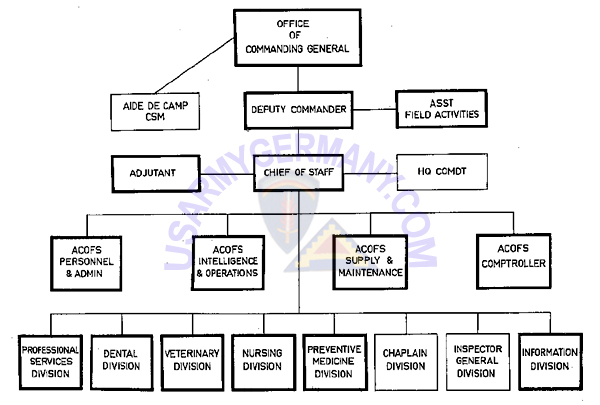 Figure 1: Organization of Headquarters, Medical Command and USAREUR Office of the Surgeon. (Positions represented with thin borders have responsibilities only within Hqs, MEDCOM; all others have dual responsibilities.) |
|||
| You will note on the chart that the Commanding General has two hats. There are a number of other staff officers who also have a dual responsibility. They support not only the Medical Command but also the Office of the Surgeon, Headquarters, US Army, Europe, and Seventh Army. The Command concept was approved, and activation orders specified July 1, 1968. Rather than jump into the water too deeply, only certain medical elements were initially assigned to the Medical Command. These were the 9th Hospital Center and its hospitals, dispensaries, and activities; the US Army Veterinary Detachment, Europe; the 8th Finance Dubursing Section; the 10th Medical Laboratory; the 26th Medical Detachment (Illustration); the US Army Nuclear Research and Development Detachment; the Medical Regulating Office; the 655th Medical Company (Blood Bank); the US Army, Europe, Preventive Medicine Detachment (Prov.); the 8000th Civilian Labor Group; and the Benelux Medical Service Area which includes the SHAPE Medical Center with a 60-bed capacity and dispensaries in Brunssum, Holland and in Brussels, Belgium. After we had shaken down a bit, the 7th Medical Brigade, the field army support element and its subordinate units, the 30th and the 31st Medical Groups, and the 421st Air Ambulance Company were assigned on October 1, 1968. On that same date, the Medical Depot at Einsiedlerhof, which included the 67th Medical Depot and the 8040th Civilian Labor Group and the medical section of the Supply and Maintenance Agency from the Communications Zone Surgeon, was formed into the US Army Medical Materiel Center, Europe, marking the first time in Europe that all medical supply functions were under the control of the USAREUR Surgeon. On January 1, 1969, the medical facilities in Berlin and those in the Southern European Task Force (Italy) were assigned to the Medical Command. As of that time, all medical facilities and medical units, except those which were organic to other major organizations in Europe, came under the command of the Commanding General, US Army Medical Command, Europe, who is at the same time the Surgeon, US Army, Europe, and Seventh Army. Advantages One of the intents of the reorganization was to allow greater flexibility in the use of medical resources and greater responsiveness to requirements. This has been proven in field exercises and natural disasters, during which support has been rapidly provided without the necessity of going through other major headquarters to provide personnel and services. A major area in which we feel there has been improvement is that of personnel assignment, especially enlisted specialists. We now control these assignments and can easily readjust enlisted strength within the overall Command. Previously the USAREUR Adjutant General performed this function, many times creating an imbalance in an organization. Medical Department officers are assigned to units outside the Command by the Officer Personnel Section of the Medical Command, which is also a part of the office of the Deputy Chief of Staff for Personnel, USAREUR. As mentioned earlier, the medical supply function is now completely controlled by the Surgeon. In the operational area we are now able to provide equal guidance to all hospitals in administration, and to assist and monitor construction projects on a theater-wide basis. Also, we have developed information which assures us of the readiness posture of all assigned units. One of the greater benefits received is the personalized interest in the operation which comes from being a part of the medical family. The Commanding General has directed that all of his staff tour all medical and dental facilities in any area visited. Also, as Surgeon, USAREUR and Seventh Army, he has directed that we will visit medical and dental facilities not assigned to the Medical Command whenever we are visiting an area. Medical Service Areas Mentioned earlier were a number of small units assigned to the Medical Command on July 1, 1968. The question asked many times is why are these units not assigned to the 9th Hospital Center or the 7th Medical Brigade? Why do they report direclly to the Medical Command Headquarters? The answer is that each one of these organizations has a mission which requires it to support the total geographic area within the European Command, and in some cases outside of that. They are not limited to the Benelux Medical Service Area, Berlin Medical Service Area, SETAF Medical Service Area, or the 9th Hospital Center. Here is a brief synopsis of the mission of each of these units. US Army Veterinary Detachment, Europe First is the US Army Veterinary Detachment, Europe. With its headquarters in Giessen, this unit provides veterinary and food inspection services within USAREUR and food inspection for off-shore procurement in Holland, Luxembourg, Belgium, Denmark, Norway, Sweden, Finland, Yugoslavia, the Federal Republic of Germany, and France, as well as other areas, when directed. They coordinate food inspection activities with various procurement activities. Their food inspections are not only for Army mess halls and commissaries but for numerous youth activities which purchase local foods, officers and enlisted men's clubs, some Air Force activities, and the European Exchange System. As you can see, this is certainly not a limited mission. 8th Finance Disbursing Section 10th Medical Laboratory The 26th Medical Illustration Detachment designs and produces non-standard illustrated media and audio-visual training devices to include scientific exhibits in support of authorized training, research, and publications programs. They prepare photographs and motion pictures for medical, surgical, and para-medical procedures. The Detachment maintains a library of non-standard medical films to be loaned to medical facilities in Europe. They provide other illustrative functions as directed, one of which is assistance in preparation of simulated patients for annual training tests, organizational readiness tests and mass casualty exercises. Although located in Landstuhl, these last services are available to any hospital or medical unit within Europe upon request and within the availability of personnel and funding. Nuclear Research and Development Detachment Medical Records Detachment Medical Regulating Office Blood Bank 8000th Civilian Labor Service Group SUMMARY |
|||
 |
|||
| 7th Medical Comd History | |||
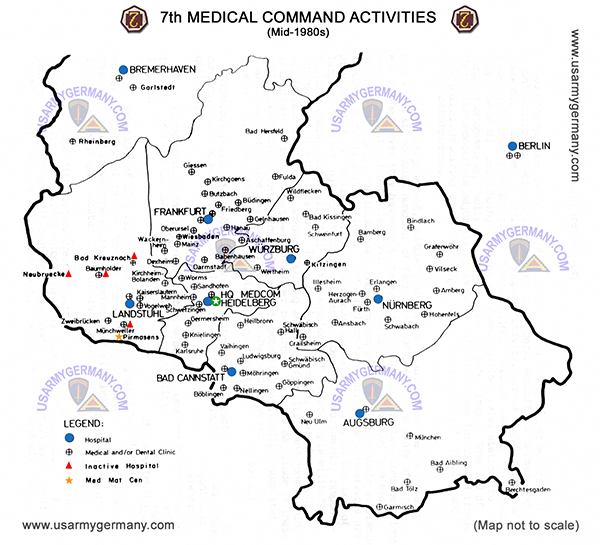 7th Medical Command Facilities, mid-1980s (Webmaster's collection) |
|||
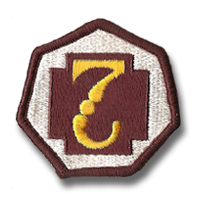 7th Medical Command Europe patch (worn after 1978) 7th Medical Command Europe patch (worn after 1978) |
|||
| 1978 | |||
| (Source: USAREUR Medical Bulletin, Aug-Sep 1978) | |||
| ACTIVATION OF 7TH MEDICAL COMMAND With its activation on 21 September, 1978, the 7th Medical Command became the first and only unit of its type in the US Army. The basic mission of the 7th Medical Command is to be prepared to provide medical support to US Army Forces in the European Theater in the event of war and to provide peacetime health care services within the theater. The significance of the 7th Medical Command designation is that this mission is now recognized as an on-going task, and the necessary equipment and personnel for a combat role are Identified. Thus, the reorganization under the 7th Medical Command banner has a direct effect on the unit's readiness for combat. The predecessor organization of the 7th Medical Command -- the US Army Medical Command, Europe (USAMEDCOMEUR) -- did not have the necessary equipment and personnel authorized for a combat mission, although many of the subordinate units and activities will remain the same. The USAMEDCOMEUR was activated in Heidelberg, Federal Republic of Germany, on 1 July 1968, as part of the Command, Control and Logistics System 1970. Initially assigned to USAMEDCOMEUR were the 9th Hospital Center, its hospitals, dispensaries and activities; the US Army Veterinary Detachment, Europe; the 8th Finance Disbursing Section; the 10th Medical Laboratory; the 26th Medical Detachment (Illustration); the Medical Regulating Office; the 655th Medical Company (Blood Bank); the USAREUR Preventive Medicine Detachment; the 8000th Civilian Labor Group; and the Benelux (SHAPE) Medical Service Area. On 1 October 1968, the 7th Medical Brigade with its major units -- the 30th and 31st Medical Groups and the 421st Medical Company (Air Ambulance) -- was added to the Command. On that same date, the Medical Depot at Einsiedlerhof and the medical section of the Supply and Maintenance Agency were formed into the US Army Medical Materiel Center, Europe, marking the first time in Europe that all medical logistics functions were under the control of the USAREUR Chief Surgeon. On 1 January 1969, the medical facilities in Berlin and those in Italy were assigned to USAMEDCOMEUR. The 9th Hospital Center was phased down in December 1970, and hospitals in that command became Medical Department Activities (MEDDAC) reporting directly to USAMEDCOMEUR. In March 1971, USAMEDCOMEUR became subordinate to the Theater Army Support Command (TASCOM), while the Office of the Chief Surgeon remained an integral part of Headquarters, USAREUR. On 21 July 1973. the 7th Medical Brigade was inactivated and the 30th and 31st Medical Groups, the 421st Medical Company and all other units subordinate to the 7th Medical Brigade were assigned directly to USAMEDCOMEUR. On 1 July 1973, USAMEDCOMEUR was relieved from assignment to TASCOM and became a major subordinate command of USAREUR. On 1 July 1974, the Teheran MEDDAC was activated and assumed responsibility for Army medical support in the Middle East area. On 1 April 1975, the 31st Medical Group was inactivated, placing all combat support hospitals and other field medical units under the 30th Medical Group. On 21 October 1978, in another major move to improve combat readiness, another medical group -- the 68th Medical Group -- will be reactivated and certain medical units previously assigned to USAMEDCOMEUR (such as ground ambulance companies and combat support hospitals) will come under the command & control of the V and VII Corps. The 68th Medical Group will command units of V Corps, and the 30th Medical Group will manaqe the field medical units VII Corps. The 421st Medical Company will remain under the control of the 7th Medical Command and continue to provide air ambulance service throughout the theater. After this upcoming action in October 1978, the 7th Medical Command will control all fixed medical and dental activities throughout the European Theater, providing medical care services to members of the US Forces and their dependents, while maintaining a readiness for combat. |
|||
| (Source: STARS & STRIPES, Sept 21, 1978) | |||
| The U.S. Army Medical Comd, Europe, will be redesignated as the 7th Medical Comd (7th MEDCOM) in ceremonies here Thursday, according to a
MEDCOM spokesman.
The redesignation recognizes the command's mission as a continuing one in times of war and peace, and documents the equipment and personnel needed for wartime, the spokesman said. In a related move to improve medical readiness, certain corps-level medical units, such as ground ambulance companies and combat support hospitals, will be reassigned from 7th MEDCOM to V and VII Corps on Oct. 21. A second medical group, the 68th (Medical Group), will be reactivated to command medical units of V Corps, while the 30th Medical Group will command the VII Corps units. The 421st Medical Co (Air Ambulance) will come under command of 7th MEDCOM, the spokesman said. |
|||
| 1983 | |||
| (Source: MEDCOM Examiner, Special Orientation Issue, Spring 1983) | |||
| 7th
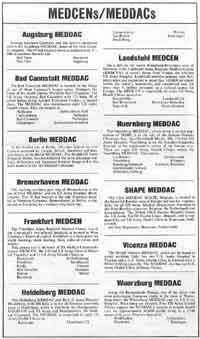
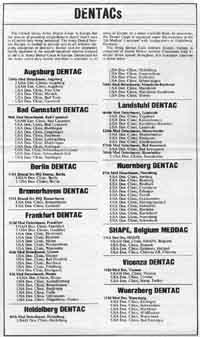
Medical Command - A brief look With its activation September 21, 1978, 7th Medical Command became the first unit of its type in the U.S. Army. The basic mission of 7th MEDCOM is to provide health support to U.S. forces during conflict and to provide peacetime health care for U.S. forces and their family members throughout Europe. There are currently more than 500,000 health care beneficiaries in Europe. Prior to the activation of 7th MEDCOM, health care services in Europe were controlled by the U.S. Army Medical Command, Europe (USAMEDCOMEUR), which was activated in Heidelberg, Germany, July 1, 1968. Health care has been provided to U.S. forces and family members in Europe since 1945. The USAMEDCOMEUR was established to enhance command control and logistical support of the medical units in Europe. From 1968 to 1978, both fixed and nondivisional field medical units were assigned to USAMEDCOMEUR. Currently, 7th MEDCOM provides command and control to all fixed medical, dental and veterinary units in Europe. Among the many health services provided to beneficiaries in Europe is the life-saving helicopter medical evacuation capability. The command also conducts both field and hospital-based health training and sponsors extensive professional training programs to support the mission of providing health care to U.S. forces while maintaining readiness for combat. |
|||
If you have more
information on the history or organization of the 7th Medical Command,
please contact me . . |
|||
|
|||
|
|
|||
| MEDCOM Orientation | |||
| (Source: MEDCOM Examiner, Special Orientation Issue, Spring 1983) | |||
|
|||
| Vital
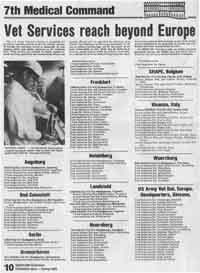
support activities The following organizations are most essential in the accomplishment of the 7th MEDCOM, USAREUR and EUCOM medical missions. They are briefly: the US Army Veterinary Detachment, Giessen, which provides veterinary and food inspection services within USAREUR; the 8th Finance Disbursement Section provides finance control and accounting services for the command; the 10th Medical Laboratory watches over health and disease conditions where USAREUR personnel are stationed and provides laboratory reference and consultant services to hospital labs; the 10th Medical Laboratory (lllustration) designs and produces nonstandard illustrated media and audio-visual training devices. The USA Biostatistical Activity Europe is a coordinating agency for all medical records and biostatistical reports for all Army medical treatment facilities USAREUR-wide and elsewhere as directed; 2nd Med Detachment, a dental service headquarters, providies guidance for field dental operations readiness; the USAREUR Blood Bank, 655th Med Company, assists hospitals in establishing and maintaining blood banks; the USA Testing Laboratory is a facility for urine drug testing for all US Forces in Europe and Middle East and supports the Alcohol and Drug Abuse Prevention and Control Program (ADAPCP); the Data Processing Installation at Karlsruhe operates the Automatic Data Processing (ADP) Service Center in Karlsruhe for support of 7th MEDCOM and the Karlsruhe community; the 8000th Civilian Labor Group operates dispensaries for labor service units working for USAREUR. Nellingen, Germany, is the headquarters for the 421st Medical Company (Air Ambulance). Air ambulance companies are responsible for emergency patient flights to hospitals in 7th Medical Command and for transfer of patients from hospital to the Frankfurt MEDCEN for aero-medical evacuation to the United States. The 421st supports training areas and exercises, with units located in Schweinfurt, Darmstadt, Fuerth, Gablingen, Grafenwoehr and Landstuhl. Stretching from northern Germany to Italy, the size of 7th MEDCOM necessitates good supply operations. The US Army Medical Materiel Center in Pirmasens, has the responsibility for providing all medical supplies and equipment used by the US Army in Europe. This includes the functions of inventory and stock control, distribution and storage and issue of medical items. All the varied activities of the 7th Medical Command exist to bring the best possible care to the soldier and his family and to prepare for health care support of USAREUR in time of war. From the headquarters of the command in Heidelberg, to every medical treatment facility, the patient comes first and that's what 7th Medical Command is all about. |
|||
|
|||
|
|||
|
|
|||
| Related Links: CHAPTER XI: Redeployment and Occupation - Official historical manuscript that describes in some detail the U.S. Army medical supply system as it existed during World War II. Chapter XI covers the early Occupation period in Europe. |
|||