| If you do
NOT see the Table of Contents frame to the left of this page, then Click here to open 'USArmyGermany' frameset |
|||||||||||||||||||||
505th Signal Battalion |
|||||||||||||||||||||
|
|
|||||||||||||||||||||
|
|||||||||||||||||||||
|
|
|||||||||||||||||||||
| Group History | |||||||||||||||||||||
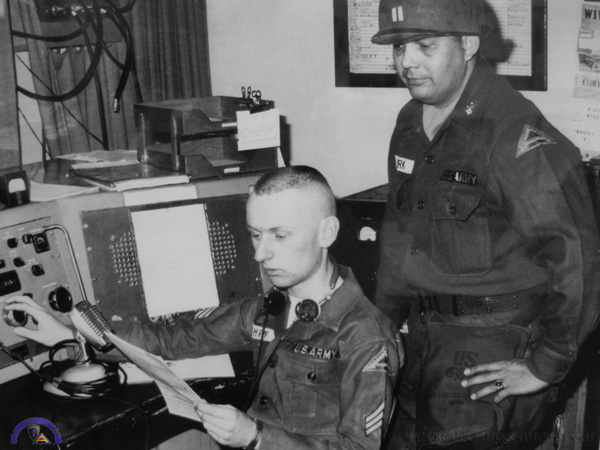 Sgt David Ohrn and Capt York, 505th Signal Gp, 1962 (David Russell Ohrn) (Who can provide details on the communications console in the photo?) |
|||||||||||||||||||||
| (Source: 93rd Signal Bn History, 1962; Army Information Digest, May 1963) | |||||||||||||||||||||
|
The
160th Signal Group was inactivated in (1961?) and reorganized/redesignated
as the 505th Signal Group.
The 505th Sig Gp was organized as part of the requirements of the Army Area Signal System to support the modern field army developed by the Signal Corps in the late 1950s. The system is composed of an area communications system for each division, a system for each subordinate corps, and an army area communications system, and facilities for other assigned or attached units. Throughout the overall system, radio relay and multi-channel cable communications support is considered the work horse of a field army. In addition, messenger, wire and numerous low, medium and high power voice and radio-teletype radio links are provided for special purpose communications, contact during fluid situations, and to back-up the radio/cable networks. The 505th served as a command and control headquarters for the Combat Area Signal Battalions that supported the AACS. These battalions installed, operated and maintained the Army Area Signal Centers and the interconnecting trunk circuits all the way down to division level. On 15 August 1961, the 26th Signal Bn moved to Germany and joined the 505th Sig Gp. The 16th Signal Bn moved to Schloss Kaserne located in Butzbach, Federal Republic of Germany, in September 1961. Upon closure in Germany, the battalion became a subordinate unit of the 505th Signal Group The 1st Signal Bn was activated on 1 October 1961 in Europe and assigned to the 505th. The 440th Signal Aviation Construction Battalion was redesignated on 29 September 1961 as the 440th Signal Battalion and allotted to the Regular Army. It activated on 1 October 1961 in Kaiserslautern, Germany. In September or October 1961, the 93rd Signal Bn was moved to Germany and assigned to the 505th Group. Sometime late 1963, HHD, 505th Signal Group moved to Kleber Kaserne in Kaiserslautern. In August 1964, the 505th comprised the following attached units: |
|||||||||||||||||||||
|
|||||||||||||||||||||
| [1] per STATION LIST, 15 Dec 1965 | |||||||||||||||||||||
|
|||||||||||||||||||||
| (Source: Department of the Army - Lineage and Honors: 505th Signal Brigade) | |||||||||||||||||||||
| The 505th Signal Group, 7th Army, located at Kleber Kaserne, Kaiserslautern, was inactivated on 10 September 1965. | |||||||||||||||||||||
If you have more
information on the history or organization of the 505th Sig Gp, please
contact me . . |
|||||||||||||||||||||
| (Source: Email from David Russell Ohrn) | |||||||||||||||||||||
| A very brief history of my tour:
I was the Group Guide on Bearer at the retirement of the 160th and the activation of the 505th. I worked under both Col. Van Harlingen and Col. Clark; however Capt. Harry M. York, the Group S-3 was my immediate boss at Group. The photo (above) is in the basement of Group Headquarters at Panzer Kaserne at Boeblingen. I had just been assigned as the Chief Operator of the MARS station for 7th Army (AE1USA). I rotated to CONUS and was assigned to the Signal Unit at the Combat Developments Command at Ft. Ord California and subsequently Honorably Discharged in 1965. That's it in a nutshell. |
|||||||||||||||||||||
 |
|||||||||||||||||||||
|
|
|||||||||||||||||||||
| 7th Army Report of Operations, 1963 | |||||||||||||||||||||
| (Source: Report of Operations, Army Area Communications System, Seventh Army, HQ Seventh Army, APO 46, 15 Oct 1963) | |||||||||||||||||||||
| (Page 1) | |||||||||||||||||||||
15 October 1963 |
|||||||||||||||||||||
Report of Operations, Army Area Communications System, Seventh Army (excerpt) |
|||||||||||||||||||||
I. PURPOSE:  The purpose of this report is to provide definitive information resulting from practical field experience in use of the Army Area Communications System under closely simulated tactical conditions. It is believed that this report will be of inestimable value to the US Army Combat Development Command, the US Army Materiel Command, USCONARC and other activities in execution of their missions.The following guidance has derived from experience of recent Seventh Army Command Post Exercises (CPX's) in Western Germany. The purpose of this report is to provide definitive information resulting from practical field experience in use of the Army Area Communications System under closely simulated tactical conditions. It is believed that this report will be of inestimable value to the US Army Combat Development Command, the US Army Materiel Command, USCONARC and other activities in execution of their missions.The following guidance has derived from experience of recent Seventh Army Command Post Exercises (CPX's) in Western Germany.II. DISCUSSION: A. Concept, Organization, and Equipment.1. The Army Area Communications System Concept - The concept, as interpreted and practiced by the Seventh Army within the past 18 months, has been considerably modified from the original theory. Following the arrival of the first increments of the equipment during the last quarter of 1961, Seventh Army began putting the system and the concept to realistic test for the first time in the field. After several preliminary exercises with the equipment, three major Command Post Exercises ensued, utilizing the Army Area Communications System. These CPX's were GRAND SLAM I in March 1962, FALLEX 62 in September of that year, and GRAND SLAM II in May 1963.The Army Area Communications System is a common-user, multi-axis, multi-channel, multi-means communications complex. It is designed to serve highly mobile military commands and units that are dispersed widely and that move freely throughout the Army's area of responsibility, reckoned in the thousands of square miles.The Army Area Communications System is designed to survive nuclear attack whereas the single-axis type of Army communications could be paralyzed by a major disruption, as by the obliteration of a major communications center along the axis. But the communication nets which the Army Area Communications System provides over the vast field army area, although portions may be wiped out by nuclear attack, will continue to function. The multiple axis paths radiating forward and laterally from surviving Area Communications Signal Centers, widely dispersed in the Army area, will continue to carry communications in support of Army and Corps headquarters, or of fragments of these headquarters, Division Support Commands and other Army units. At all times the Army Area Signal (Page 2) Centers (AASC's) will maintain numbers of circuits in a checkerboard or radial pattern, serving all Army elements, providing alternate routings which can substitute for other circuits or centers that may have been incapacitated.2. Organization - The original concept contemplated 24 AASC's dispersed through the Seventh Army Area, interlinked by carrier telephone and telegraph facilities utilizing primarily radio relay and, as back up, wire (Spiral-4 cable). Manpower, it was planned, would derive from six signal battalions organized under a Headquarters, Army Area Signal Group. Control over so complex a system, with its many centers, circuits and nets, was recognized by the planners to constitute a difficult and very crucial task. This control was established as follows: |
|||||||||||||||||||||
|
|||||||||||||||||||||
| In practice, the 505th Army Area Signal Group commands about 8,500 officers and men which provides the personnel to man the system in the Seventh Army Area. The Signal Battalions, Combat Area, numbered six: the 1st, the 16th, the 26th, the 53d, the 93d, and the 440th. The group commands also a maintenance battalion, the 504th, and a Cable Construction Battalion, the 25th, (also a German civilian labor force, the equivalent of a construction battalion, designated the 6980th). Command of the 505th Signal Group extends over still another battalion (for a total of ten battalions in all) - the 97th Signal Battalion (Army). Personnel of the 97th are responsible for garrison communications at Seventh Army Headquarters and for the Army communications centers at Army main, rear and forward, and they terminate (at those top command posts) the circuits which enter the Army Area Communications System. |
|||||||||||||||||||||
| (Page 3) | |||||||||||||||||||||
|
|||||||||||||||||||||
| The Army Signal Officer provides SYSCON with the requirements for all Army area communications. He notifies the Systems Control Section as to the moves and locations of Army Command Posts, and of major Seventh Army elements. SYSCON accomplishes the details of planning, engineering, and siting the stations, the radio relay paths, the choice of circuits and channels, and so on. SYSCON issues instructions to the S-3 of the battalions, instructing battalion elements in their moves and in the installation and operation of their equipment at all points over the 24,000 square mile area under Seventh Army. SYSCON must gather with utmost promptness all information on moves and troubles, especially on circuit changes and difficulties, in order to engineer and instruct circuit changes, and also in order to inform all Systems elements about all circuit operation and changes, up to the minute.SYSCON operates through four subsections: Administrative, Radio, Wire, and Signal Information. The Wire (and Carrier) Subsection plans circuitry for both spiral-4 and radio relay systems. It determines adequacy, prepares instructions to the battalions in the field to accomplish installations, and compiles circuit diagrams to meet the requirements established by the Army Signal Officer. This subsection supervises the wire portion of the installations everywhere in the field.The Radio Subsection plans networks, prepares terrain profiles (from contour maps) to determine if a proposed radio relay beam or "shot" is free of obstacles (making certain that the line-of-sight path is not blocked by hills), prepares instructions on radio systems, issues frequencies (obtaining them from the Army Frequency Board in the Signal Section of the Army Signal Officer), and checks continuously with system elements in the field as to how the many systems are performing (also this subsection processes field element requests for changes, etc.). (Page 4) The Signal Information Subsection compiles an up-to-the-minute directory as to circuit users and their addresses, as to which units are served by this or that AASC. Whenever a unit moves, this subsection must issue the information at once to all centers. This subsection prepares and issues telephone and teletype traffic diagrams, routing indicators, and directives implementing changes. It also prepares messenger schedules, both for the many motor car messengers, and for those who move by aircraft. An alternate systems control is designated in the Group operations order. This mission is assigned to one of the battalions of Army Signal Group. The battalion so designated must maintain complete system and circuit information, an up to date system diagram, a signal information map and a complete file of the Group SYSCON message traffic. Upon assumption of responsibilities, the battalion SYSCON notifies all battalions that responsibility has been assumed and will immediately establish the circuitry required to effectively control the systems.
In summary, SYSCON is the control point of the entire Army Area Communications System. It is the troubleshooter on the system. Whenever a circuit or system element deteriorates, it is SYSCON's job to direct and coordinate the correction. SYSCON maintains sole-user circuits to each battalion S-3, both teletype and voice (preferably over a single speech-plus circuit which provides both teletype and voice service). This control circuit should be the No. 1 priority sole-user circuit terminating in each battalion field element or station unit. The control circuit, at the outset of a CPX, is provided by an AN/GRC-26 radio, for use on the move if necessary, and for use until radio relay can be established. Each signal battalion, incidentally, has four line companies. Each company is capable of fielding a nominal AASC. If an AASC is about to phase out or move to another location, the battalion headquarters ("Jump Platoon") is capable of maintaining communications (using a minimum of circuits) until the entire company sets up for business in its new area.Obviously all such changes, while exemplifying the flexibility of the signal battalions and their equipment to provide sophisticated multi-channel communications of high quality even in field situations, nonetheless require detailed planning and tight control by SYSCON. At the battalion level, system control functions are performed by the operations and intelligence section, S-2/3, of the headquarters and headquarters company.(Page 5) See Tab A, appended to this report, for further details regarding the operations of SYSCON. See also SYSCON discussion, page 14. |
|||||||||||||||||||||
| 3. The AASC's (Army Area Signal Centers) and Their Equipment The concept contemplates 24 AASC's (4 centers provided by each of 6 battalions), each AASC to serve a local area of about 500 square miles - for an overall Army Area of some 12,000 miles.Actually, in Seventh Army exercises, the total Army area is twice as large, about 24,000 square miles. The number of AASC's have averaged less than the 24, actually fewer than 20 (18 in GRAND SLAM II). The reduced number of AASC's, despite the support of six signal battalions, has resulted from insufficient equipment, and especially from the drain imposed by the requirements of other missions. The battalions have had to provide men and equipment to support various special operations, for example, certain air defense missions.Yet the reduced number of AASC's has been able to provide the required communications support in Seventh Army CPX's. This was accomplished only by depleting all reserves in the area communications system, by using all the jump capability, and committing men and equipment that should be kept in reserve to implement sudden moves of AASC's. It was accomplished, further, by careful and very tight planning and siting of centers well ahead of the exercise (this would hardly be possible in actual combat, however).The capabilities of the Army Area Communications System in these carefully planned CPX's have met the needs, although the total Army area is twice that contemplated in the original concept, and although the actual range, or area of service to subscribers or Army elements in an AASC area, has proved out less than the concept figure of 500 square miles. It has been found that 10 road miles ought to be taken as the maximum separation between a local AASC and its subscribers. Roughly then, the AASC area, it has been determined from Seventh Army experience, ought not exceed a circle 10 miles in radius, for a total of about 300 square miles.Foremost among the reasons why Seventh Army Area Communications System has had to get along with fewer than 24 AASC's is that actually only five battalions, or their equivalent, have been available to support the CPX's. The 53d Signal Battalion, for example, has never been able to put all its strength into the field AASC's because of assignments of its personnel and equipment to other duties. It is a worrisome matter that only by means of advanced planning and heavy use of
(Page 6) pre-installed wire (not possible in combat), and that only by utmost utilization of every individual and every item of equipment, has an adequate Area System so far been provided to Seventh Army CPX's. Fortunately for the System, the CPX's to date have extended only three to five days over the many days the signal battalions had been in the field setting up and practicing their missions. It was noted that on the last day of FALLEX 62 the System showed signs of deterioration, because personnel were becoming exhausted, and because the AASC's had had to operate at reduced strength. These facts point up the need for some reserve in the Area Communications System, a reserve that would be desperately needed in any combat situation.Up to the present time the Army Area Communications System has relied heavily upon wire and cable lines for back-up and some primary systems. Maximum use is made of spiral-4 with carrier techniques applied at the terminals. A great deal of this field cable is placed prior to Seventh Army exercises by the 25th Signal Battalion (Const) and by the battalion-size German labor force (the 6980th CLG or Civilian Labor Group). For example, in preparation for GRAND SLAM I these two units began laying cable three months in advance, and all the while they conducted continuous cable maintenance. Also, much use continues to be made of German commercial wire facilities. Presently, however, this usage is somewhat curtailed because of the "gold flow" program. This circumstance places additional burdens upon the Area Communications System because its wire teams must take on cable tasks that would otherwise have been handled by the Deutsche Bundespost (the German Government Post Office, which operates the nation's tele-communications). Use of German facilities require detailed arrangements with local authorities so that the signal men may hook onto leads which the Bundespost makes available to the US Army at designated terminal boxes. These arrangements are made by the Communications Division of the Seventh Army Signal Section through the Signal Division, United States Army, Europe.However, at most locations in the Area Communications System, radio relay must be used, as it should be according to the concept, and as indeed it would have to be relied upon to provide the main mode of communications in actual combat and in highly mobile situations. The several equipment configurations add up to about 20 in number. They are in 6 or 12 foot shelters (S-144 and S-141) or in V-51 vans - all of which are truck mounted and accompanied by trailer mounted power units.These equipment configurations, except for the old Angry 26 (AN/GRC-26) mobile high frequency radio (used with certain modifications in the Korean War), are all new aggregates of equipment items employed for a variety of purposes, all providing multi-channel (12 channel) carrier, whether via radio or wire links. They include telephone repeaters, (Page 7) telegraph/telephone terminals, teletype central office sets, teletype operations centrals, radio repeaters, radio terminals, radio receiving centrals, radio transmitting centrals, communications operations centers, telegraph terminals, shelter mounted electronic shops, manual telephone offices, communications patch panels, and a variety of electric generator sets.
Some of the major equipment complexes comprise up to a dozen items, such configurations as the radio terminal set "Mark 73", (the AN/MRC-73) which provides 12 channels of carrier telephone or 11 channels of telephone and 8 channels of teletypewriter. A central item in this aggregate is radio relay set AN/TRC-24. Experience gained in the AASC's in Seventh Army exercises early demonstrated a need to add another AN/TRC-24 to the MRC-73. Battalions were issued the additional AN/TRC-24 by special authorization for use as a spare. Thus, the MRC-73 remains a 12 channel set, having only one TCC-7 carrier equipment. If a second TCC-7 carrier were also added to the MRC-73, then the spare TRC-24 could be employed to provide another 12 channels. This would enlarge the MRC-73 to a 24 channel assemblage which is much needed (this in actuality represents the MRC-69). Spare circuits in the system would continue to be held in reserves (good practices require that 20% of system circuits be kept as spares, or 2 to 3 circuits in each 12 channel complex). Another "Mark" configuration, the AN/MRC-54, is a radio repeater and terminal that includes three AN/TRC-24 sets. The MRC-54 is a basic element of the AASC's, 19 of them to a battalion for a total of 105 in six battalions. In GRAND SLAM I, 102 MRC-54's were used, not including those employed to support some aspects of the tactical garrison network and other operational missions. As these basic Army Area Communications System equipments are sidelined for repair or maintenance, or are drawn off to meet other communications missions and requirements, the area system suffers from a shortage of circuits. Even if more MRC-54's or 73's were made available (over and above present battalion TO&E's), there would remain a lack of sufficient personnel to operate such additional sets. But if the same equipment, with the 12 channel AN/TCC-7, were replaced by 24 channel carrier, then the same number of operators could handle twice as many circuits (using no more frequencies) as they now handle with the present equipment. The superior efficiency of 24 channel operation, doubling circuit capability with a marked conservation of personnel and frequencies, is obvious. Another important aggregate of equipment items is the telegraph terminal AN/MSC-29. The "Mix" 29 is used in the AASC' s to terminate teletype communications center circuits including crypto (on-line) (Page 8)
facilities. The demands upon the teletypewriter facilities of the MSC-29 are heavy, despite its capability of terminating four full duplex on-line circuits or eight half duplex on-line circuits. The MSC-29 becomes overloaded and the capacity of the van is exceeded (an enlarged or expandable van is needed). The Seventh Army Signal Section is presently studying also the feasibility of using teletype operations central AN/MGC-19 as on-line commcenter. The AN/MGC-23X, Teletype Relay Van, currently under development appears to offer more room, and additional teletype circuitry than the AN/MSC-29. This new van should be considered as a replacement for the AN/MSC-29 at the Corps and Army levels. All the carrier radio equipment operates in the upper VHF and lower UHF (line-of-sight) frequencies in bands C through J, ranging from 225 mc to about 1850 mc. Because the lower of these frequencies lie within the range of German commercial communications and television, there have been severe interference problems in the Seventh Army Area. Consequently, radio equipment that will operate on higher frequencies, as well as provide 24 channels, is greatly desired (such as the 24 channel version of AN/GRC-50, on 600 to 1850 mc, employed in the "J" band, with appropriate carrier equipment).Problems exist in regard to assemblages AN/MCC-3, a 12 channel telephone attended repeater (using a TCC-8), and terminal AN/MCC-6, which provides 24 channels of carrier voice, (using two TCC-7's). Each battalion is allotted 42 sets of the former, 8 of the latter. This is an excessive number of MCC-6's, some of which remain unused, but there are not enough MCC-3's. For example, whenever keying lines (spiral-4) between the radio terminal and the carrier equipment extend over a mile, total for each end, an MCC-3 (attended) is required on the line. Some keying lines run four or five miles, as when the carrier equipment is at the bottom or side of a hill and the radio equipment is on top. Hence, more MCC-3's or TCC-8's are needed.The reason for the separation of the equipment is that combat commanders vigorously object to large equipment on exposed hill tops or large complexes near Command Posts. The radio (and antenna) must be positioned on a high site. But the separation from the carrier and switchboard assemblages, so that the latter can be concealed, raises problems of inter-connection and loss of signal strength. The problem is especially severe if the TCC-7 is in the radio truck with the TRC-24, as it is in the MRC-73 and 69. The TCC-7 is usually connected to the switchboard by 26-pair cable, whose length must be kept to a minimum or the signal loss will exceed three decibels cutting signal strength below the limit of toleration. As an alternative the radio relay terminal of the MRC-73 can be extended with spiral-4 cable to the subscriber area,
(Page 9) terminating in MCC-6 carrier equipment. This results in a requirement for two teams, one for radio, and one for carrier. This configuration while more costly in personnel and equipment does provide better quality service to most extension facility subscribers. More efficient use could be made of the capabilities of the AN/MCC-6 if a second 600 volt power supply were incorporated into the equipment. At present two 200 volt power supplies are included for radio relay circuits, and only one 600 volt supply for one spiral-4 cable connection. Yet the present equipment is capable of handling an additional spiral-4 line, except that it lacks a second 600 volt power supply (component PP-826/(U), which a second cable connection would require). If the desired second 600 volt power supply were added, then the set could be demodulated and could be used in place of an attended repeater on spiral-4 lines. The Seventh Army Area Communications System could make good use of its excess MCC-6's if they were thus modified. Their application on keying lines would alleviate the present shortage of MCC-3's.In the matter of interconnecting AASC equipment assemblages, there is a pressing need for a better cable than the present 26 pair CX-4566. This cable is unsatisfactory for connecting the present sophisticated AASC equipment items. The cable permits too much noise and cross talk, especially if the connectors have been slightly damaged (this easily occurs). A better quality cable, better insulated and having improved connectors, is required to assure the greater reliability and the higher quality of operation that the Area System must provide its users. (End of excerpt - will add more at a later date.) |
|||||||||||||||||||||
| SUBORDINATE UNITS - 1960s | |||||||||||||||||||||
|
|||||||||||||||||||||
|
|||||||||||||||||||||
| Related Links: First Circus (1st Signal Battalion) - Wunderbar! A very nice website dedicated to the former members of the 1st Signal Battalion who served in Kaiserslautern 440th Signal Battalion, HQ Company, Kaiserslautern, Germany 1964-1967 - Patrick Mahoney's web site serves as a reunion place for members of HQ Company of the 440th Signal Battalion who served during the above mentioned years. (Netscape user should access the site from here!) |
|||||||||||||||||||||


 Arrived 1960 assigned to 58th Signal Company