| If you do
NOT see the Table of Contents frame to the left of this page, then
Click here to open 'USArmyGermany' frameset |
||||||||||||||||||||||||||||||||||||||||||||||||
|
97th
Signal Battalion |
||||||||||||||||||||||||||||||||||||||||||||||||
|
|
||||||||||||||||||||||||||||||||||||||||||||||||
|
||||||||||||||||||||||||||||||||||||||||||||||||
|
|
||||||||||||||||||||||||||||||||||||||||||||||||
| Battalion History | ||||||||||||||||||||||||||||||||||||||||||||||||
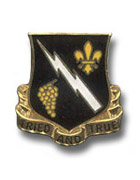 97th Signal
Bn DUI
97th Signal
Bn DUI |
||||||||||||||||||||||||||||||||||||||||||||||||
| 1945 - 1962 | ||||||||||||||||||||||||||||||||||||||||||||||||
| (Source: The History of the 97th Signal Battalion (Opn). No date, but published in the early 1960s.) | ||||||||||||||||||||||||||||||||||||||||||||||||
| Ruhr
Valley Campaign On 18 April 1945 the Ruhr task was completed and on 23 April the Battalion CP, Headquarters, and Able Companies moved to Beckum, Germany. Charlie Company moved to Horne, seven miles East of Beckum. Baker Company moved forward with XVI Corps Headquarters and furnished communications to the units engaged in "moping up operations" in the Ruhr Valley. On 9 May 1945 the war in Europe ended and the 97th Signal Battalion was reassigned to Ninth Army Headquarters. A week later the Battalion was assigned to Third U.S. Army Headquarters. On 13 June 1945 the Battalion, less Baker Company, moved 459 miles to Augsburg, Germany. The Battalion set up in a vacant field on the outskirts of Augsburg while Baker Company moved to Pilsen, Czechoslovakia. On 27 June 1945 the 97th moved to Bamberg, Germany where Baker Company rejoined the Battalion from Czechoslovakia. The entire Battalion set up in a former German Cavalry garrison called Lagards Kaserne. At Bamberg the unit furnished communications for the Third Army's XV Corps. The mission was installation of XV Corps command post communications and the rehabilitation of open wire and underground circuits. Very High Frequency radio communications was furnished to the 6th Armored Division and the 26th Infantry Division. On 20 July 1945 Able Company moved to Munich, Germany and took over the mission of picking up wire from the 28th Signal Heavy Construction Battalion. While at Bamberg the 97th established communications for the Stars and Stripes and other press services, put in 10 VHF circuits from Altenburg Castle in Bamberg, and furnished signal communications for the war crimes trails at Nurnberg. |
||||||||||||||||||||||||||||||||||||||||||||||||
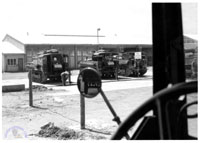
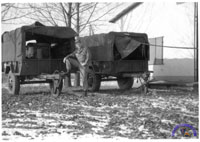
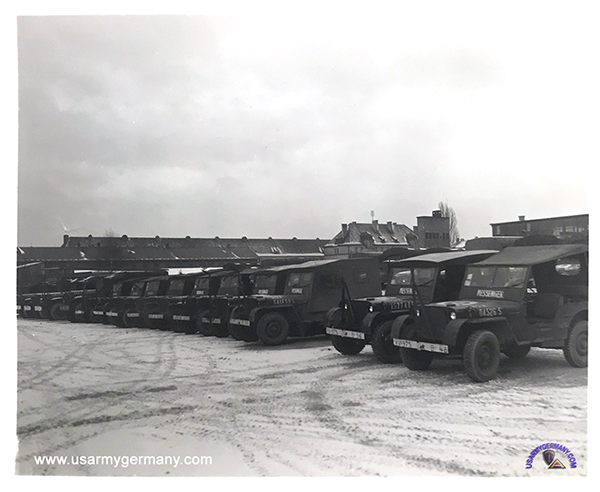 Jeeps of the 97th Sig Bn stand idle in the unit's motor pool in Bamberg as the acute gasoline shortage hits the ETO in early 1946 (Webmaster's collection) |
||||||||||||||||||||||||||||||||||||||||||||||||
|
U.S. Constabulary Assignment
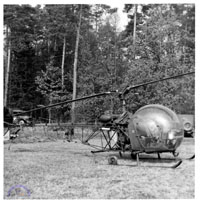
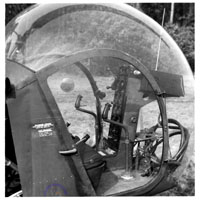
On 1 May 1946 the unit was reorganized and redesignated as the 97th Constabulary Signal Squadron and assigned to the U.S. Constabulary. Between 10 March and 1 April the 97th established land lines, VHF and HF radio, and a motor messenger service for Constabulary Headquarters at Heidelberg, Germany. The Squadron was also responsible for setting up a Constabulary Signal Center, installation of radios in Constabulary armored vehicles, and formation of radio repair teams. In May the Squadron set up 500 lines of dial telephone and installed radios in over 150 armored vehicles. On 1 July 1946 the Squadron moved from Bamberg to the Constabulary Headquarters in Heidelberg. The unit now consisted of Headquarters Detachment, Able Troop, Baker Troop, and Charlie Troop. The Medical Detachment and the Photo Platoon were reassigned to the United States. In January 1947 Constabulary Headquarters moved to Patton Barracks on the outskirts of Heidelberg. The communications "shift-over" by the 97th Signal was completed in less than 24 hours. The 301st Signal Battalion stayed in operation at Patton until the 97th had moved all its equipment and personnel to the new site. The VHF network was rearranged and tied info telephone lines furnished by the Heidelberg Deutsche Post. Patton Barracks did not have telephone equipment, therefore commercial switchboards were installed for Constabulary Headquarters. On 15 July 1947 Able Troop, the mobile unit, was inactivated but a short time later Charlie Troop was renamed as Able Troop. Move to Boeblingen Early in 1948 Constabulary Headquarters moved to Patch Barracks in Vaihingen, Germany. This time the Squadron did not establish headquarters with the Constabulary unit but moved to Panzer Kaserne, Boeblingen, Germany, five miles from Patch. The Squadron's signal equipment was set up of Patch, however. Within six days after the move, a multi-position manual switchboard and several VHF and HF radio nets were in operation. The Constabulary Command Post closed at Heidelberg and opened in Vaihingen at 1500 hours on 1 February 1948. Between 1 February and 1 March 1948 the 97th Signal Squadron installed a complete central telephone office, a cable distribution system, two complete radio stations at Patch Barracks, and mounted VHF and HF equipment in trucks and teletype and radio carrier equipment in tractor vans for operation out of Panzer Kaserne. In January 1949 the Squadron was issued a new AN/MSC-1 mobile com-center mounted on eight, five-ton vans. The units were tested in a field exercise near Ulm. In March the Squadron mounted all VHF and HF radio equipment on trucks and vans for "Operation April Showers" near Katterbach, Germany. These units were also used in July during "Exercise Grafenwoehr" and in September during "Exercise Harvest." In "Exercise Harvest" the Squadron supplied communications for the Aggressor Forces engaged in mock war against the 1st Infantry Division. On 4 November 1949 the approved unit insignia with the motto "Tried and True" was issued to all personnel in the Squadron. The insignia depicted a sable shield with bolt of lightning, bunch of grapes, and fleur-de-lis. Early in January 1950 Headquarters Detachment established a HF radio command net for the commanding general of the Constabulary. After the net was set up, Able Troop took over operation and maintenance of the net. In February 1950 the Squadron participated in "Exercise Shoepac" near Bretton, Germany. The next month the Squadron furnished communications for Constabulary Headquarters in "Exercise Shamrock" near Kaiserslautern in the French Zone of Germany. During this exercise particular emphasis was placed on radio communications tied with message center cryptographic processing of intelligence reports. The Squadron inaugurated a special VHF radio net for receiving and interpreting S-2 reports. J2-3 Task Force commanders from USAREUR Headquarters stated that communications by the 97th Signal in establishing the special net were by far the best they had witnessed. Redesignated as Operation Battalion The 97th was reorganized and redesignated on 5 July 1950 as the 97th Signal Operation Battalion and remained assigned to the U.S. Constabulary. The Battalion consisted of Headquarters and Headquarters Company (formerly Headquarters Detachment), Radio Operation Company (formerly Able Troop), Wire Operation Company (formerly Baker Troop), and a new company, Message Center Operation Company. After the renaming, the mission of Headquarters Company became solely that of furnishing personnel for Battalion Headquarters. Radio Company continued to furnish VHF voice and teletype communications to Constabulary Headquarters. The construction company, Wire Operation Company, continued to furnish field signal construction and teletype and telephone carrier operations. Message Center Company's mission was to operate the entire message center for the U.S. Constabulary and later for Headquarters, Seventh U.S. Army. Their job included installation and operation of cryptographic and message center facilities. In July the Battalion was scheduled to participate in a mounted review of Nurnberg, and then proceed to Vilseck for field exercises. However, shortly outer some elements of the Battalion departed for Nurnberg, verbal orders from the U.S. Constabulary commanding general returned the unit to Panzer Kaserne. The reason for the General's abrupt decision, published in a letter a short time later, was due to the mounting tension near the communist border. As tension increased along the Soviet front, a heavy interest was placed on security of information and equipment within the Battalion. Frequent unannounced security checks were made by Constabulary G-2. With the advent of the Korean conflict, the Battalion prepared an alert plan for evacuation of dependents to France and the United States if such an occasion arose. Dependents were briefed on the plan and several practice alerts for dependents were conducted including simulated loading into evacuation buses and distribution of emergency food and clothing. After the North Korean communists crossed the 38th Parallel, the Battalion initiated a vast training program with the purpose of improving combat readiness in case the unit was alerted for duty in Korea. By mid-October each company was given advanced training in the .30 and .50 caliber machine gun, 3.5 rocket launcher, and various other small weapons. A series of overnight training exercises were conducted in coordination with the small weapons training. Special courses were given in map reading, first aid, CBR defense, communist propaganda, communist brainwashing, and night warfare. During this time the Battalion S-3 Training office conducted two communications courses in connection with the Military Defense Assistance Program. Representatives from Norway, Netherlands, France, and Italy attended the classes at Battalion Headquarters. Assigned to Seventh U.S. Army On 24 November 1950 the Battalion was relieved from duty with the U.S. Constabulary and reassigned to the Seventh U.S. Army. In 1951 the 97th Signal Battalion's sole mission was to furnish radio, teletype, message center, and cryptographic communications for Seventh Army Headquarters in Vaihingen, Germany. On 16 February 1951 the 97th Signal Battalion was allotted to the Regular Army of the United States. By March 1951 a new note had been added. To cover the Seventh Army command post with a more complete communications net, the Battalion sent men and equipment to key points and sites in Germany and Northeastern France on a permanent basis. A communications "watchdog" system was set up with 24-hour operations in support of Seventh Army infantry, artillery, and armored units. This system served two purposes: It provided Seventh Army Headquarters with top-notch, on-the-spot communications and it served as good on-the-job training for the men in a unit which might have to go to Korea to participate in the United Nations' "police action." Also added to operation "watchdog" was an air section consisting of two L-19s and one helicopter. The Battalion participated in seven field problems in 1951 - "Lightfoot," "Hotfoot," "Blue Sky," and "Yule Tide" to name a few. On 7 April 1951 a vast motor messenger service was established by the Battalion's Message Center Operation Company. The motor messenger serviced 19 Signal, Ordnance, Armored, Engineer, Transportation, Infantry, Quartermaster, and Medical units from Frankfurt to Munich with a fleet of 24 jeeps. By mid-year Wire Operation Company was responsible for the installation of teletype and telephone circuits in Sandhofen, Heidelberg, Ulm, Sonnenberg, Degerloch, Vaihingen, and Boeblingen, Germany. In "Exercise Blue Sky," conducted near Mannheim in July, the Battalion pooled talents with the 12th U.S. Air Force. In this joint Army-Air Force exercise, the Battalion furnished communications to the 1st Infantry Division, 2nd Infantry Brigade, 4th Infantry Division, and the 555th Engineer Group, plus the 12th U.S. Air Force Group. In January 1952 the Signal Corps' newest "electronic brain child," the AN/GRC-26 radio-teletype van, was introduced to the Battalion in "Exercise Northwind." The Battalion operated only two of the AN/GRC-26 sets which were issued on a trial-loan basis from the V and VII Corps. Use of the set proved successful and now the Battalion operates over 50 AN/GRC-26 units. Facsimile Operation In June 1952 the Battalion operated a facsimile photo net from VII Corps Headquarters in Moerhingen, Germany. The facsimile process, adopted by the Signal Corps from American Newspaper Photo-Fac, was used to transmit photographs, maps, circuit diagrams, charts, and various typewritten material. The facsimile was first operated by Headquarters Company but later reverted to the control of Radio Operation Company. In 1952 the Battalion Headquarters operated three schools - a code refresher course, radio-teletype operator's course, and a teletype procedure course. In 1952 the 97th participated in four major field exercises - "North Wind" 4-18 June, "Spring Time" 14-18 April, "Grand Alliance" 16-18 July, and "Rosebush" 4-9 September. In December a photo detachment from the 479th Photographic Service Company was assigned to the Battalion. The Photo Detachment, later renamed the 97th Signal Battalion Photo Platoon, was made up of one officer and 20 enlisted men and furnished signal photo coverage for all Seventh Army activities. By the end of the year the Battalion Air Section increased to five L-19s but the helicopter was dropped from the TO&E. The section now consisted of five pilots and 13 enlisted personnel. |
||||||||||||||||||||||||||||||||||||||||||||||||
|
||||||||||||||||||||||||||||||||||||||||||||||||
|
||||||||||||||||||||||||||||||||||||||||||||||||
|
Reorganization
of Companies
On 5 November 1958 the Battalion started a reorganization program which was completed on 1 December. The reorganization consisted of consolidating all supply personnel to a Battalion Supply and Maintenance Section, transferring the Aviation Section from Company C to Headquarters Company, moving the teletypewriter operation platoon from Company A to Company C, assigning the JOC (excluding crypto personnel) from Companies A and C to Company B, assigning the radio relay platoon from Company B to Company A, and moving the power section from Headquarters Company to Company A. The overall mission of the 97th remained unchanged despite the reorganization. In 1958 the 97th participated in field exercises "Sabre Hawk," "Lion Bleu," "Full Play," and "Wig Wag." On 19 March 1959 Company A moved to Mannheim and set up in Sullivan Barracks. In 1959 the Battalion participated in five major field problems - "Free Play" 2-6 February, "Top Weight" 13-16 April, "Cross Flags" 27-31 July, "Side Track" 25-28 August, and "Side Step" 17-25 September. |
||||||||||||||||||||||||||||||||||||||||||||||||
|
||||||||||||||||||||||||||||||||||||||||||||||||
|
In
February 1960 a platoon of signalmen were formed called the "CYTAC
Platoon". The CYTAC Platoon was organized to give the Battalion
a small, quick moving, flexible, and high mobile signal unit capable
of providing communications where needed on extremely short notice.
The CYTAC Platoon, capable of establishing communications for a
tactical Army Headquarters, can be on the air and operating in 30
minutes after time of arrival at location. Personnel and equipment
for the CYTAC Platoon were taken from each company in the Battalion
and from companies of the 25th Signal Battalion (Construction).
The 97th participated in exercise "April Shower" from 22-29 April providing communications for Seventh Army Headquarters. The purpose of this exercise was to test mobile and tactical Signal Corps equipment and personnel in furnishing CP communications. Looking Ahead Other exercises are scheduled for the remainder of the year, including an Army Training Test which will be held in conjunction with a Signal Field Exercise. These frequent maneuvers, in addition to a rigorous training schedule and substantial commitments for garrison communications, help to keep the Battalion on its toes ready to operate around the clock at a moment's notice. Also in progress is a major reorganization of the Battalion. Based on extensive experience amassed over recent years, the reorganization has been proposed after exhaustive studies and thorough planning. The reorganization has been approved in concept, and the detailed structure of the new units are being finalized as this book goes to press. The new Battalion will consist of five companies: Headquarters Company, a Field Operations Company, and three Command Operations Companies. The purpose of such a reorganization is to provide a Battalion capable of fulfilling the communications requirements of a combat-ready command such as Seventh Army, under conditions of increased mobility and dispersion. Into this new organization, along with officers, men, and equipment, will go the loyalty and competence which have been hallmarks of the 97th Signal Battalion since its beginning. (see Note at end of article) The Army in combat is supported by three elements: firepower, mobility, and command control. While the Signal Corps supports all three vital characteristics, it is to the last - command control - to which its efforts are primarily directed. It is this modern concept which the 97th Signal Battalion strives to achieve. Note: The Battalion was reorganized 5 March 1962 per USAREUR GO #33, dated 2 January 1962, in accordnace with TO&E 11-95D. |
||||||||||||||||||||||||||||||||||||||||||||||||
If you have more
information on the history or organization of the 97th Signal Battalion,
please contact me . . |
||||||||||||||||||||||||||||||||||||||||||||||||
| U.S. Constabulary | ||||||||||||||||||||||||||||||||||||||||||||||||
| 1947 | ||||||||||||||||||||||||||||||||||||||||||||||||
| (Source: Lightning Bolt, Jan. 11, 1947) Webmaster Note: The Headquarters Pltn of the 91st Constabulary Sqdn was located at Bad Hersfeld (better known simply as "Hersfeld" in those days). |
||||||||||||||||||||||||||||||||||||||||||||||||
| New Radio Station Installed At 91st Sqdn. Headquarters 91st Squadron - The communication facilities of the 91st Squadron has been greatly increased lately with the addition of a new radio station. It is a V.H.F. (very high frequency) carrier station, and has been installed and will be operated by six men from the 97th Constabulary Signal Squadron. It is under the supervision of T-5 Say. The new station is situated in the top floor of the Headquarters Troops building. It is hooked up to the squadron switchboard and is in contact with the 1st Constabulary Regiment. Though still in its "testing" stage it will soon be used by the commanding officer and the various sections in communicating with higher headquarters. |
||||||||||||||||||||||||||||||||||||||||||||||||
| 1951 | ||||||||||||||||||||||||||||||||||||||||||||||||
| (Source: SIGNAL, July-August 1951) | ||||||||||||||||||||||||||||||||||||||||||||||||
| Spirit of the 97th Signal Operation Battalion I'm a 97th Signal man . . . I'm everyone who has been . . . is, . . . and will be in the 97th. I'm the spirit of the organization. A private, a non-commissioned officer, an officer. I have worked and played, sweated and laughed . . . and most important, I have done the job of furnishing communications when the chips were down. I have only been with the 97th Signal for nine years but I have 88 years of signal experience to draw upon. I guess nine years of service doesn't seem so much to some fellows in outfits with a hundred well-served years or so behind them, and maybe the unit's history isn't as glamorous as some of the signal units that have served the U. S. Army. The guys in the 97th are proud of it, though, and believe me the years were packed with plenty of good honest signal effort and work. I'm not saying we were the only or best signal outfit in Europe . . . no sir . . . not by a long shot. The fellows in other communications units did a swell job too, and deserve a lot of credit. So I have asked the editor of SIGNAL to let me tell my story in my own words about the 97th. I'll try not to bore you too much but I have something to say and want to get it off my chest. Most outfits are pretty much the same and I think if you do a little remembering with me, a lot of things will come back to you of the outfits you too may have belonged to. Activation On the 10th of April 1942, the unit saw its first day as the 97th Signal Battalion, at Fort Sam Houston, Texas. It wasn't very big then, only eight officers and twenty-four enlisted men. But the unit soon grew. From all over the States fellows came in, regulars, reserves and others who had been inducted. A whole new outfit had to be set up . . . and in a hurry because a war was going on and we felt quite certain that we would be in the middle of it. We started our "basic," some for the first time, some for the second or third times. Soon we were off to Louisiana for maneuvers. The unit was assigned to the Third Army and it was our first chance to show the kind of Signal men we were. Some real work began. I can remember the rain and the talks by the officers on "Work, work and more work." We did work, and began to feel as if something was being accomplished. There were three companies to begin with, Headquarters, "A" and "B" companies, and while the unit was at Louisiana, Company "C" was activated. In November 1942 we got into our vehicles and started over the roads to Camp Bowie, Texas. Some of the fellows were a little sorry to leave Louisiana ... those Louisiana gals were pretty nice. But there was no settling down in Texas like we thought, because it seemed that we weren't in camp more than a few minutes when all of us about faced and trucked on down to Louisiana again. We settled down for a little more training. Then darned if the outfit didn't head back for Camp Bowie, Texas. I do believe I still have callouses. All of us thought we had real training by then, but there was lots more to come. There came a period of shifting all around the south. We became provisional platoons and detachments. These are some of the camps and places that the unit hit between April 28 and September 8, 1943. I'll name a few you might remember too. There were Camp BuIlis, Texas; Camp Maxey, Texas; Camp Howze, Texas; Camp Claiborne, Louisiana; Camp Van Dorn, Mississippi; Camp Shelby, Mississippi; Fort Clark, Texas; Camp Barkley, Texas; and Camp Polk, Louisiana. The unit was separated, and moved a lot but still the communications were pretty darn good. Some of the guys said something about "Rat Race," but by this time we had climbed more poles than we thought ever existed, pounded more keys than an M-29 converter has, and said "number please" so many times that it was like a broken record. Rumors were flying around that we might be on our way to Europe or maybe to the Pacific . . . or else Texas again. Then . . in August 1944, the unit was alerted! I can remember the furloughs and kissing the gals goodbye! So Long, USA Along with showdown inspections we marked and remarked our clothes. The wild rumors sure were flying. I can remember the classes on malaria and tropical fever that made us sure we were going to the Pacific! There was that major who said we would be back in the States by Christmas, but lie didn't say which Christmas. We're still not back. Well, we waited, and packed and repacked until boarding the train on 6 October 1944 . . . for where . . . none of us knew. There sure was good chow on that train. We were traveling through the south and the porter finally told us we were going to Camp Shanks, New York. Then came more processing . . . they even looked at our teeth twice. Finally we went by foot, rail, and ferryboat to Brooklyn, New York, and took a trip up a gang plank to the HMT "Largs Bay" lugging a load of combat gear. Our morale was pretty good, even the wise-cracks! Red Cross gals gave us coffee and doughnuts. At last we were going somewhere . . . and just a little nervous about it. We finally said, "So long USA, Hello . . . who knows?" I'll never forget that trip over; and the smell of the kitchen coupled with the smell of latrines . . . Can you? What a trip we had . . . Seems like everybody was seasick . . . and some guy kept saying "it's blackout time" . . . the terrible chow . . . the short arm, ten days out . . . and the weird thoughts when we couldn't see the rest of the convoy . . . our first sight of that hunk of land somebody said was England. It was, and we landed in Plymouth, England. Later somebody told us that we were headed for Glasgow, Scotland but because of engine trouble our ship had to drop out of convoy two days out and proceed to the nearest port. I was sure glad to get off that boat. We had to walk a mile and a half to the train station, then an English train took us to New Alresford, England. I can remember our first look at England . . . the pubs with only warm beer . . . the afternoon tea . . . the lack of sunshine . . . Piccadilly Street at midnight . . . the uniform regulations . . . the difference of opinion concerning the English! Then we took off with one hundred and seventy-seven vehicles and seventy-seven trailers for Waymouth, England, and boarded LST's on the English Channel. The water in the channel was sure rough and the weather wasn't fit for a dog, but after a while it cleared up and there was nice weather crossing to the harbor of Le Havre, France. We spent the night in the harbor . . . lights were on all over that night. It seemed odd after the blackout in England! Right after lunch we started up the Seine River to Du Clair, France, then proceeded to Rouen where the battalion regrouped and spent the night. It was raining, snowing, and the French countryside was mighty muddy. At four o'clock in the morning we were in our vehicles and on our way to Tongres, Belgium. The first night was spent at Binche with good old "K" rations for supper. The Belgian people were swell. Most of the officers and men were invited into the homes of the people to sleep . . . this sure relieved the billeting problem. We were then assigned to the XVI Corps. Right nice place, we thought, but then a few buzz bombs started saying hello to us. All of us looked kind of funny when one of them landed near Battalion Headquarters The big German offensive had opened up on the night of 17 December 1944 and we could see continuous artillery action near us. The unit tasted its first direct enemy action when a Nazi plane poured down some lead near "A" and "C" companies A verbal order from the commanding general of the XVI Corps sent us pushing our vehicles towards Heerlen, Holland, where we set up our equipment in two school buildings and some prepared dugouts. It wasn't very long, though, before the outfit was on the move again, with two hours' notice to move to Flouse, Belgium. Except for two officers and a hundred men, who stayed behind to furnish communications for XVI Corps, we rolled down Belgian roads. We didn't stop at Flouse long and wound up instead in the woods near Awan, Belgium. There wasn't much sleep for us because lots of equipment had to be set up for operation. Tracers made the sky look like 4th of July all night long. When everything was almost set up . . . the situation changed! Headquarters, "B" Company and the medical detachment were ordered to return to Heerlen. Holland. The construction Companies "A" and "C" stayed on special duty with XVIII Airborne Corps to work with the 54th Signal Battalion. The battalion's assignment was with the First United States Army under British Field Marshall Montgomery as part of the Northern Group of Armies. The Battle of the Bulge was on . . . and we were in the same Corps with the 5th and 7th Armored Division, the 82nd Airborne and the 8th Infantry Divisions. The Sixth German Panzer Army had been on the move, in our direction, but the 82nd Airborne managed to plug a gap in the area. It was cold, and the roads were covered with ice and snow, but to "A" and "C" Companies, the only things that seemed to matter was getting up that slippery pole and rolling out more line. By the 3rd of January, the army's Northern Offensive began to take shape. The enemy's bolt was shot, and he began to move out his armor . . . what was left of it. We still had plenty of communications to furnish our troops engaged in stiff and deadly fighting, but the Battle of the Bulge was over . . . and Germany had thrown away its reserves. That's what we heard, anyhow, but it wasn't until February 1945 that "A" and "C" Companies were relieved from duty with the 54th Signal Battalion and XVIII Corps. The mission of the Ardennes offensive was successfully completed, so "A" Company got into their trucks near Montenau, Belgium and rejoined the rest of the battalion. Company "C" rolled on home from Francorchamps, Belgium. All of us got together again on the 8th of February. It sure felt good to get some good old 97th chow and see all the old gang . . . except that a couple of our pals from "C" Company weren't with us any more. We just sat around for a couple of hours and swapped stories. Then the unit was assigned to the Ninth U. S. Army . . and it wasn't long before the battalion broke up again. "B" Company, which was the operational company, left for Sittard, England and stood by for signal operations. The rest of us left for Leijenbroeck, Holland, where we settled down in a monastery conducted by the Sacred Heart Fathers. Conditions sure were crowded in the area. A lot of us were amazed at so many soldiers and so much equipment. We heard that this was because the American XVI Corps was taking over this front from the British XII Corps. The battalion received another verbal order. By infiltration of one company at a time, we moved to Kaldenkirchen, Germany. Company "B" moved forward with the XVI Corps and set up in Kaldenkirchen and in Venlo, Holland. Company "C" moved to Heinsburg, Germany where the company was set up for the operation which would start the drive of the Ninth U. S. Army across the Roer River. The Ninth Army was being held up by the Roer floods, but on February 23rd the attack was launched, throwing bridgehead after bridgehead over the rampaging Roer. The advance finally swept over the Cologne Plain towards Duesseldorf, plunging the German Fifteenth Army into wildest confusion. We played our part in this gruesome game, too . . . it was communications. Lots of it was needed. By infiltration we moved to Niedereyll, Germany . . . . then to Lintfort, Germany. Some of the "C" Company fellows had to stay behind in the Heinsburg sector to clean up wire. We felt pretty much like signalmen by then. There were some funny moments, too, especially the souvenirs that started to show up! Across the Rhine Well, anyway, the Ninth Army was firmly established on the Rhine River and preparations had to be made for the next step . . . the crossing of the Rhine. We heard about the First Army's big break when the Germans failed to destroy that Ludendorff Bridge that crossed the Rhine at Remagen. This gave the troops all along the line a break too, because we heard later that Hitler rushed his forces from the north to try to stop the First Army. He kinda failed. So . . . the Ninth Army crossed on March 24, 1945, using alligator tanks under smoke cover and established three bridgeheads north of Duisburg. These were busy days for the 97th. On the 29th, the Battalion CP along with Headquarters Company moved to the vicinity of Brueckhausen. Company "C" went ahead of the Battalion to Friedrichfeld, Germany, then on to Vennemannshaff. Company "B" moved forward with the XVI Corps and set up at Lohberg, Germany. Company "A" moved to a place near Letkampshut, Germany, then on to Recklinhausen, Germany. The 97th Signal Battallion was furnishing communications support on the move these days. Everything seemed to be moving fast. The First Army had taken a long end run around the Ruhr to Paderborn. Meanwhile the Ninth Army skirted the Ruhr and suddenly shooting its right flank southward, they linked up with the First Army Spearhead. The Ruhr was encircled . . . the greatest encirclement in history . . . with 300,000 Germans inside of it. We were furnishing communications for the XVI Corps whose mission was to help whittle down this Ruhr pocket. Our armies raced full speed ahead into the German Reich. It was the grand climax for the U. S. Forces and communications had to go in fast. The Ruhr task was completed on April 18th and by 28 April, the Battalion CP, Headquarters and "A" Companies found themselves at Beckum, Germany. Company "C" was located in Herne, seven miles away from the Battalion CP. Company "B" was moving with the XVI Corps forward. Everybody was a DP. Remember the original non-fraternization rule and the 65-dollar fine . . . if you were caught? We heard about the First Army linking up with the Russians near Torgau. That news sounded good ...they were our allies . . then! All of a sudden . . . THE WAR WAS OVER, at 0001, 9 May 1945. It gave us a funny kind of feeling inside. All of us began to think more about home and our folks, but our job wasn't over by any means - we never thought so much wire existed to be picked up. The XVI Corps was given the mission of military government which was turned over to the British on 7 June 1945. A week later the 97th was assigned to General Patton's Third Army, and was on the move again. After a tiresome 459 mile road march, Headquarters, "A" Company, "C" Company and the Medical Detachment arrived at Augsburg, Germany on 23 June 1945. We set up in a field on the outskirts of the city while Company "B" went to Pilsen, Czechoslovakia. The German people were finding that Hitler had said at least one truthful thing in his bloody career when he said "Sieg oder Chaos." Defeat for them did indeed bring chaos. The Germans met defeat . . . hungry, homeless, and hopeless . . . we also heard about the concentration camps. Remember the "Schnapps" that suddenly started to appear . . . and the effect it had? There wasn't much time to think and swap tales though, because on the 27th of June we left for Bamberg, Germany where Company "B" rejoined us from Czechoslovakia. The entire battalion set up in a former German cavalry garrison known as Lagarde Kaserne. Our mission was to furnish communications for the XV Corps Area. We were kept busy with the installation of XV Corps Command Post and the rehabilitation of open wire and underground circuits. Very High Frequency Radio was furnished to the 6th Armored Division and the 26th Infantry Division. Then they announced the point system and we all sat down and figured out our own! We join Constabulary Signal communications were quieting down to routine garrison installation to divisions being redeployed. Plenty of wire still had to be picked up and lines had to be put in shape again. We waved goodbye again to "A" Company who had to take over the mission of the 28th Signal Heavy Construction Battalion in Munich, Germany. A lot of our old buddies were going fast, because they were leaving for the Good Old United States. New men . . and plenty green . . . came in to take their places. We set up pole lines across the Regnitz River, maintained communications for Stars and Stripes, RCA and Press Wireless, put in ten VHF circuits from Altenburg Castle in Bamberg and furnished signal operation for the war crimes trial at Nurenberg. In spite of constant personnel changes our post war job was well on its way. It was just like starting all over again . . . new replacements had to learn and learn fast. We had heard rumors about an elite force of super troopers being formed in Germany called the United States Constabulary, and that the 97th would become a part of it. Quite an honor to he picked for what was going to be the Crack Troops of the United States Army. |
||||||||||||||||||||||||||||||||||||||||||||||||
|
||||||||||||||||||||||||||||||||||||||||||||||||
| Dressing Up On July 1st, 1946, the U. S. Constabulary became a reality. Our outward appearance changed. Jeeps were fancied up in bright yellow, blue, and red. So were we . . . shiny leather, yellow scarfs, and slick looking boots. It wasn't all fancy dress, though. Our training period had to be cut off and actual communications began for the main United States Occupation Force of Germany. The unit now consisted of Headquarters and Headquarters Detachment, "A" Troop, "B" Troop, and "C" Troop. Our Very High Frequency circuits were put to use and we found them far superior to the German land lines at that time. The high frequency radio sent its signal from antennas on the tallest trees near Bamberg. Our Constabulary commander, Major General Harmon, spent a lot of time making on spot inspections all over the U. S. Zone, so we gave him communications right from his special train wherever he went. I can remember how cold it got in Bamberg, and the ice we had to chip off the barracks floor. You won't believe it, but ashes had to be put on the floor to keep from slipping. I still get the shivers thinking about it. The task of occupying Germany required fast, organized communications. We began furnishing almost every electrical means of communications available to the Army, and the new men were learning how to be signal technicians in a hurry. The beginning of 1947 found all of our major signal projects finished and we were busy ironing out the rough spots. On 14 February 1947, Constabulary Headquarters moved to Patton Barracks, Heidelberg. This move was easier, though. We took over the Third Army Signal Center, lock, stock, and barrel. The change was made darn fast. The VHF network was rearranged and tied into telephone lines furnished by the Heidelberg Deutches Post. There wasn't any telephone equipment at Patton Barracks so we put in a PABX with attendance boards for use of Constabulary Headquarters. The 301st Signal Battalion helped us out a lot by staying in operation until we had our communications in operation from Heidelberg. On 15 July 1947, our mobile radio troop, "A" Troop, was deactivated. A lot of us were sorry to see "A" Troop drop away from us, but later "C" Troop was renamed "A" Troop. A new year 1948 came and with it . . . another move . . . this time it was towards Stuttgart, Germany. We billeted down in the Panzer Kaserne, Boeblingen, and readied ourselves for furnishing communications for U. S. Constabulary from the Vaihingen Kaserne. This move was entirely different from our previous move to Heidelberg. We had to start from scratch. The billets sure had a lot of floor space to scrub and walls to paint. All the signal means had to be installed at Vaihingen. It meant plenty of work because the general wanted to talk to his command . . . in a hurry. All of us chipped in and we soon had a six-position manual switchboard and VHF and HF frequency radio nets in operation. The Constabulary Command Post closed in Heidelberg and opened in Vaihingen at 1500 hours 1 February 1948. Before long we had a complete new signal section, installed a telephone central office, constructed a cable distribution system, built two complete radio stations and rehabilitated our new home in Boeblingen. It was a proud day when Major General Withers A. Burress, our Constabulary commander then, personally commended us for what we had accomplished. For the rest of the year we operated and trained, and our morale was high. The Inspector General even gave us a superior rating during his inspection. It was the first time any unit in the command was ever given the maximum rating for everything. The occupation of Germany was beginning to show success and our role in Germany began to change from purely occupation duties into a fast moving defense force. This called for mobility . . . and communications that were mobile. VHF was mounted on trucks and we were expected to move our communications fast. A lot more time was spent in the field. Let me tell you about the mottoes and signs that were placed around Panzer Kaserne. Headquarters had "Not the biggest but the Best" . . . "A" Troop had "The Able Troop" . . . and "B" Troop had "The Best Troop." And there was that sign that said, "V.D, not me, I'm a 97th Man," . . . and the aluminum swagger sticks most of the officers carried around . . . or a sexy picture that Mess Sgt. Snider had painted on the first three graders mess wall . . . the battalion commander, Colonel Clapper, had it changed to a bird scene. Something new was added when we received a brand new mobile communication center early in 1949. As soon as we received it a test was made in operation near Ulm . . . in very cold location . . . cold? . . . even the gasoline froze. Field Exercises The next big show was April Showers. That was a honey of a problem. Everything seemed to click from our command post near Katterbach, Germany. Well, we all felt pretty good after that maneuver. The problems got tougher, though, and a lot more was expected of us during Exercise Grafenwoehr in July and Exercise Harvest in September. We supplied communications for the Aggressor Forces against the First Infantry Division, during Exercise Harvest. Our job was to furnish communications to points all over the U. S. Zone, while the units of Constabulary shifted all over the place. Between field problems and command post exercises, operation continued twenty-four hours a day for the main occupation forces of Germany. Exercise Shoepac was the first field problem that faced us in 1950. Our commanding officer was Lieutenant Colonel Walter B. Bess. The U. S. Constabulary by this time was formed as a striking force with the task of guarding the United States interests in Europe. Then in March we took part in Exercise Shamrock. When it was over, the former Chief of the EUCOM Signal Division, Major General Matejka during a briefing said, "I personally think a very fine job has been done. Every man I saw in the communications business was working hard and intelligently at his job. I think these people deserve a great deal of credit for their fine performances." Our name was changed on 5 July 1950 from a Signal Squadron to the 97th Signal Operation Battalion, and we consisted of Headquarters and Headquarters Company, Radio Operation Company, Wire Operation Company. and a new company . . . Message Center Operation Company. This made us into a new outfit with new ways of operation . . . new responsibilities . . . and a new commander, Lieutenant Colonel Herbert R. Archibald. We had our first chance to try out our new unit in September, during Exercise Rainbow. The memory is still fresh in our minds, of the good and bad things we did in that field exercise. Now I have come to the point in my story where I can no longer speak of what is behind us, but instead, of what lies ahead. Everything seems to be growing in Germany. Now the unit furnishes communications for the Seventh Army and our tasks grow bigger with each day that passes. The threat of world domination by communistic elements hangs heavy over Europe. In combating this, the 97th has an important role. Everyone of us has . . . you . . . me . . . the guys over us, and the guys under us . . . and we've got to work together. We know all you fellows in and out of the Army are depending on us, and we will try to do our darndest to furnish the kind of Communications that you deserve. Sure we have guns and ammunition, but our big caliber ammunition is words. Just plain words, but when they are put together in a message during a tactical situation, they mean a lot. Every command that our commanding general puts out to his troops when in the field, using signal means, will start on its way over a signal facility of the 97th. The job of a front line unit is to shoot large caliber ammunition straight and true; ours is to shoot words along a path we provide from them . . . or to them, in the same accurate manner. So on our Ninth Anniversary, we want the members of the Armed Forces Communication Association, to know that we'll be with the units in Germany twenty-four hours a day, whether they're American, English, or French units. We'll be there . . . on top of that pole . . . slogging along those weary miles . . working through the lonely night. We'll be there because we're 97th Signal Men . . . and I'm the Spirit of the 97th. |
||||||||||||||||||||||||||||||||||||||||||||||||
| Seventh Army | ||||||||||||||||||||||||||||||||||||||||||||||||
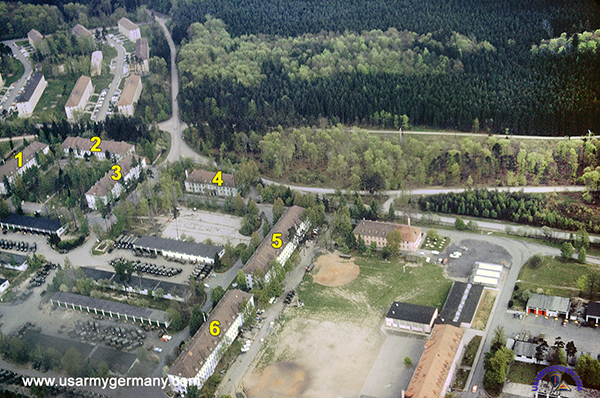 97th Sig Bn area, Panzer Kaserne, Böblingen, around 1962 (Andrew Dalzell) |
||||||||||||||||||||||||||||||||||||||||||||||||
| 1961 | ||||||||||||||||||||||||||||||||||||||||||||||||
| (Source: Email from Andy Dalzell) | ||||||||||||||||||||||||||||||||||||||||||||||||
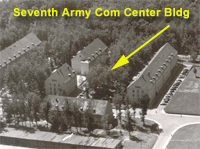
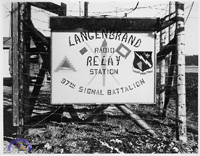
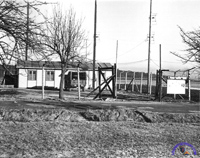
| I served in the 97th Signal Battalion from Jan 1961 to August 1963. I served in D Company at Langenbrandt and Bad Dürkheim hill sites. After the reorganization in 1962, I served in Boblingen as a member of B Company for the balance of my tour. While in B Co. I was in VHF & CXR Pltn and worked VHF TRC-24's at Montana Radio. I was known to those who knew me as Dizzy or Diz. ADDITIONAL INFORMATION In regards to the 1962 Reorganization. When I first arrived at Böblingen in January 1961, I was in D Company (formerly Field Operations Company or FOC). It was D Company which manned most if not all of the remote VHF radio sights and including at least some of the Garrison carrier sites. After serving as a floating substitute (sort of a vacation relief) at Frankfurt and Darmstadt I was sent to the Langenbrant VHF detachment (call sign Watertown Radio, I think). That became my regular duty station until later that year when I was promoted to Sp4 and transferred to the Bad Dürkheim VHF detachment along with my friend, Sgt. Roland Boutiette. I also remember the call sign for Bad Dürkheim (Yakima Radio) and Mannheim (South Dakota Radio). The relay sites were all named after US towns, the terminals after US states. While I was at Bad Durkheim I had a jeep accident in the Jeep. As a result, I was transferred back to D Company headquarters in Boblingen. At that time, our D company VHF and Carrier Platoon was still manning all of the remote garrison VHF and Carrier sites. It was about March of 1962 when the battalion reorganization took place. Most if not all the remote sites became the responsibility of A Company in Mannheim. So the guys who I knew at Langenbrant and Bad Durkheim were all transferred to A company. D Company VHF and Carrier personnel in Boblingen who were not currently serving on detachment to one of the many remote sites were transferred to B Company where most of us ended up in the VHF & Carrier Platoon also in Boblingen. The Platoon had two sections: VHF Section and Carrier Section. We maintained the usual fleet of both VHF and Carrier truck mounted rigs that were used when we went to the field on maneuvers. B Company also operated the garrison communication station in Boblingen known, I think, as Illinois Radio and Illinois Carrier. When I arrived in B Company it was commanded by Captain Gainey (a Mustang officer). He was succeeded by 1st Lt., later Captain, Edward Cobb who had been my platoon leader in both D company and B Company. All of my old VHF buddies from D Company who were still on detachment at the remote sites were transferred to A company and I had very little contact with them after that other than by radio when I was working at Illinois Radio. So at least from my perspective, the main effect of the reorganization, was to transfer all of the detachments from D Company to A Company. I don't really recall what happened to D Company or what their new mission was, or even if it continued to exist after the reorganization. I don't really know why this reorganization took place other than the fact that the Army periodically needs to practice chaos because in war time, change and chaos are the norm. I hope that helps a little. Most of the officers that I knew have passed on so I am not sure where you might be able to learn more about the reorganization. AERIAL PHOTO (above) (1) C Company barracks; with mess hall (2) Headquarters building 97th Signal Bn & D Company (-) barracks. (D Co was housed at the end of the Bn hdqtrs bldg near the front gate.) (3) HHC barracks with mess hall; they also fed D Co because their local presence was too small to have their own mess hall. The Unit Police (UP's) were housed here also. They handled gate and post security as well as policed the local towns overseeing troop behavior. (4) 5th Loudspeaker and Leaflet Company barracks (5) B Company barracks with mess hall (6) (Element of) 1st Signal Bn barracks Note: A Company, 97th Signal Bn was stationed at Mannheim at this time. |
||||||||||||||||||||||||||||||||||||||||||||||||
| 1966 | ||||||||||||||||||||||||||||||||||||||||||||||||
| (Source: Email from Robert Stovall, 97th Sig Bn and 7th Army Communications Comd, 1966-70) | ||||||||||||||||||||||||||||||||||||||||||||||||
| See also Robert's email on the 7th Sig Bde Page. | ||||||||||||||||||||||||||||||||||||||||||||||||
| The 97th Sig Bn was the big one, the others (in the 7ACC) I cannot recall. (Webmaster Note: the 97th Sig Bn was part of 7ACC until it was reassigned to CENTAG on 15 July 1969 as a result of the CCLS-70 study; the other signal units attached to the 7ACC are listed above. Source: STATION LIST, 31 Dec 1969.) The 97th Signal Battalion supported HQ 7th Army and served as the hub for theater communications. For a while (1966) I ran the Motor Messenger Platoon in A Co, 97th Signal. We supplied couriers for the things you could not send electronically (back then) such as maps, packages, tickets to the general's ball, etc. This was a 7 day a week mission in garrison or in the field, did not matter. If it needed delivering it got carried by the Mo-Mo's. After that I was Plt Ldr for the Switchboard and Syscon Platoon and then later, I ran the Communications Center Platoon. Still in A Company. I was really proud of this assignment. That platoon was larger than some companies in the signal corps. I had over 200 men. We ran the Comm Center for 7th Army in Heidelberg, plus the Army Alternate site. These two sites were also 24 hour sites -- all the time. When we would go to the field we would start up the Army Alternate as the "jump" site then move the Headquarters to the location of Army Main. Quite a feat, and not always easy. Of course we had the signal mission to connect to the Corps, and connect to the other five battalions. There were two Warrant officers in my platoon and those guys were the greatest. One of them was a little more bold than the other. They were both ex-Air Force guys before taking Warrants in the Army. Good guys. One of them approached me one day and told me about France dropping out of NATO. He said there was a lot of good "stuff" over in Paris, and that he wanted my permission to go over there and see what he could dig up. I was a little nervous about it, but arranged for him to have a car and a driver, and got him some travel orders. They disappeared for over a week and I was getting real nervous. I was way off the reservation and did not know what I was going to do. I got a phone call, very noisy and scratchy and weak, and it was my Warrant calling. He said he found a lot of stuff and for me to get six 2 1/2 ton trucks with drivers and send them to Paris. Now that was a real challenge. Longer story made shorter -- we did it, and he came back with the greatest collection of signal trading material I had ever seen. He had stuff the Army didn't even know it had and truly a lot of it was German, French and British. We traded that stuff here and there all over Germany, Luxembourg and beyond. We ended up with the classiest Comm Center set up ever assembled. We built it into these 4 vans and parked them up side by side and back to back. Four moving van sized trailers. Beautiful lighting, fancy racks for the teletypes, and secure gear. Man it was first class, and we made a lot of brownie points with the big brass on that one. The night Russia occupied Czechoslovakia was really interesting. I was leading a convoy of about 50 signal vehicles and we were following the "real" orders... the ones planned for "the real thing". Hell, we didn't know what Russia was going to do, but we opened the envelopes and followed the orders. My path took me into a part of the forest surrounding Mannheim and it was a place we had not exercised in before. As we rolled along I saw a lot of lights and noise from ahead, then we came up on another convoy blocking the road. I got out of my jeep and strutted into the lights, blinded by the headlights of the opposing vehicle. I waved my arm to signal them to back up and I hollered Signal coming through- back up. Then another figure came up through the light. He said Captain, you are speaking to Colonel (something or other) and I have a convoy of about a hundred tanks behind me, get your ass in gear and get those signal tucks out of my way. I saluted, did an about face and said back em up! What a night that one was. All our best laid plans fell to pieces and it was hours before we got things up and signal working. |
||||||||||||||||||||||||||||||||||||||||||||||||
| CYCLONE |
||||||||||||||||||||||||||||||||||||||||||||||||
|
||||||||||||||||||||||||||||||||||||||||||||||||
| ADDITIONAL INFORMATION Question #1: What type of switchboards were used in CYCLONE - where these large, fixed type in buildings (comm centers)... or tactical in trailers...? Answer: Hard to tell about other guys' Cyclone Switchboards. I never went to the locations other than our own. You always took care of your own site and let the other guys do theirs. (more on that below) We used tactical switchboards parked next to one of the company buildings. I would suppose the other guys did that as well. Our switchboards were in very large vans -- with those cords you physically connected to the destination. Plug to hole... old school. Question #2: Can you provide an overview of the Comm Center at HQ 7th Army? Sections, equipment used, functions.. Answer: The Comm Center was really cool. Actually we ran three operations in the field settings. Army Main, Alternate, and sometimes a jump site that could move out, set up and become Main if needed. We did not always use a jump. The Army Main CC was an arrangement of up to 4 moving-van sized trailers. We would construct platforms (like covered porches between them -- quite an elaborate deal -- as soon as we got the vans positioned. We had our own power generators of course- these were also large vans on large trucks- made lots of noise and electricity. It was always a major problem to site these units- since they were so large, and I should mention this was putting 4 vans together inside the forest. It entailed some of the most skillful truck driving you will ever see. You were never allowed to cut down a tree, else there would be major trouble. On every exercise there would be the German Forest Meister to oversee everything. They would just watch, with sour dispositions, and never try to help. Really seemed pissed-off to have us messing up their forest. After the exercise was over we had to police up the location to the same condition it was before we arrived, or better. Of course you must realize we would be talking about 2-300 soldiers in one place, mess halls, and latrines etc. We used to dug the latrines with back-hoes and then throw every bit of trash in over the ...mess... and then cover it up. Frequently, we would have to return to the location a week later and clean it up again since "Comrade" (as we called the locals) would come out, and dig up our mess. They would sort through the garbage and well, you can imagine what it looked and smelled like -- to recover any bit of usable material. We would have to clean it all up again before the Forest Meister would say we were "cleared from the site", e.g. finished. But back to the question... The Comm Centers themselves were like brightly lit facilities (words escape me here -- there is nothing in civilian life like it...) We had reception areas where couriers would bring in outgoing message traffic. The message would be checked, addressed assigned to get it to the correct destination and a runner would take the "traffic" over to the machine that connected to that location. There was no switching involved, we were connected to that machine on the other end... The traffic was sent out and a confirmation was returned. No chairs allowed or stools. The operators would pull 12 hour shifts and be standing on their feet all the time; running from one machine to another, or bored to tears waiting for something to happen. Incoming traffic was about the opposite. A bell would ring and the teletype machine would start typing out the message. someone would run over to it and when the message was finished, rip off the paper and take it to the clerk for outgoing material. Most traffic was highly classified and I still do not free to go into that aspect. Just to say my clearance, and that of all my CC people was Top Secret/Atomal/ and beyond. All traffic was encrypted. We had special technicians who took care of those devices, and their codes. Very specialized, very secure. Question #3: When you were with the 97th, did that battalion support CENTAG as well as HQ USAREUR/7th Army? Answer: Yes, the 97th supported CENTAG/USAREUR/7thArmy HQ. Supported in the sense of having comm links to/from everyone else. In the sense of operating at both ends... no. That was not the philosophy, each unit provided its own signal capability and connected to others. Hence the unofficial shoulder patch of the 97th ... in case you have not seen this it is an Owl with the German phrase around the outside something like "Ein Muss es onder Oder Ende" ... the Trouble is on the other end.... Below the Owl was were the large letters COO, standing for Communications Operations Order... COO. Note: When I was 7thACC S-3 I used to write the COO's. We also had special circuits to "Princess" and "Blue Bell" if those mean anything. Question #4: It is interesting that the CYCLONE map (see above) does not show the 24th Inf Div or the 4th Armd Div (both of them belonging to VII Corps). Also, in the list on the third image (97th 003.jpg), 4th Armored (OLYMPIC) doesn't appear to have a 24 hrs/day Garrison site? Answer: I have no facts on this, but I can mention that the 24th, IIRC was at Coleman Bks. Right next to us, but we never talked to them -- I mean never, and I don't know why. Same for the 4th Armor -- they were at Coleman also. Never interfaced with them at all. Looking back I see some things that never occurred to me at the time. I wonder if our heroes in "Sandland" feel the same today. We did not relate to our strategic-level mission at all. Our bosses never took or had time to discuss that sort of stuff. I guess we were still old-army. Our job was make the signal work -- we were not told why or what the relation to anything else was. For instance in your write-up of REFORGER I, I was not aware until literally yesterday, that REFORGER was to exercise the troops who had been reduced from the European theater... and the acronym of REFORGER had never been revealed to us/me. Perhaps I see now that that style had a great influence on the way I managed over the years. I have always believed in that it was important to let people know what the larger strategy/mission was. It is also interesting to note that the late 1960's/1970 era was the end of one technical phase and just at the beginning of another. We connected to the "other end" by way of Cable (something called Spiral-4), by UHF radio, or by HF Radio. (I suppose we also had "Field Wire"- 2-conductors wrapped around steel- very tough, very hard to deal with) The UHF was line of sight, thus we had to be on or near hill tops, to see the other end...then with Spiral-4 running down from the radios to the HQ site. That is why as Chief Signal Systems Engineering (my last job) I had to fly to lots of hill tops via helicopter. As you know, we had our own aviation detachment. I still hate helicopters. Too many moving parts and they are all important. As my buddy used to say- flight by helicopter was just a prolonged emergency. I had/have a private pilots license, and my buddy who used to fly me around- was teaching me to fly... a very difficult skill to master. The next generation of communications gear involved satellites, and radios that were easier to set up and carried way more traffic. Computer controlled and augmented. Note: With regard to the Spiral-4 Cable -- that was what B Company of the 97th was all about -- the Cable Company. They had miles and miles of it. It was a rough bunch -- hard physical labor. They would lay out miles of cable, and "Comrade" would be on the other end -- rolling it up to steal and take to the "recycle" market. Today, we forget that Germany was only 20 years out of the war. Still lots of poverty, and people who were hurt in the war. So many of the civilians were on the Russian front, and carried so many physical and mental scars. |
||||||||||||||||||||||||||||||||||||||||||||||||
|
||||||||||||||||||||||||||||||||||||||||||||||||
| 1968 | ||||||||||||||||||||||||||||||||||||||||||||||||
| (Source: STARS & STRIPES, April 1, 1968) | ||||||||||||||||||||||||||||||||||||||||||||||||
| The Aviation Detachment, 97th Sig Bn with 46 men (eight of them are pilots) is commanded by Maj Leo M. Clover. The unit flies an average of four flights each day for the Seventh Army Communications Command using three H-34 Choctaws, three U-6A Beavers and two O-1A Bird Dogs. Most of the missions is to and from the remote signal sites of the command. |
||||||||||||||||||||||||||||||||||||||||||||||||
| Central Army Group | ||||||||||||||||||||||||||||||||||||||||||||||||
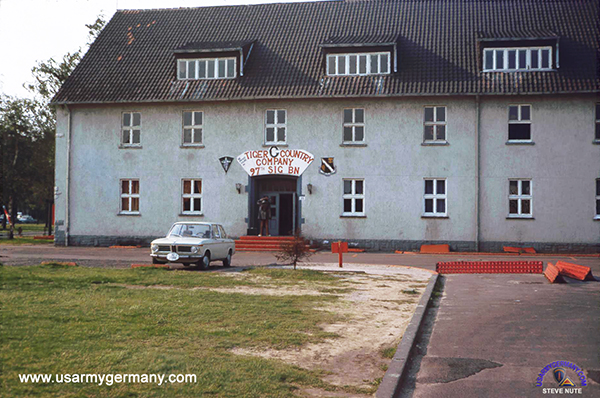 Company "C" 97th Sig Bn barracks, Coleman Bks, Sandhofen 1971 (Steve W. Nute) |
||||||||||||||||||||||||||||||||||||||||||||||||
| 1969 | ||||||||||||||||||||||||||||||||||||||||||||||||
| CENTAG Signal Support Group The CENTAG Signal Support Group was formed on 1 July 1969. However, its development actually began in April 1960, with the formation of CENTAG Signal Battalion (Provisional), consisting of two US Signal Companies, the 208th Signal Company and the 521st Signal Company. Later that year, in October, the 125th French Signal Company was assigned, establishing the unit as an international command in CENTAG (NATO). At this time, the name was changed to the CENTAG Signal Operations Battalion. The Battalion became tri-national on 2 May 1962, when the 75th German Signal Company was added, bringing the number of companies to four. In September 1966, a second German Signal Company, the 76th, was assigned as a replacement for the French Company which was reassigned. Almost three years later, on 1 July 1969, the CENTAG Signal Operations Battalion was reorganized and redesignated as the CENTAG Signal Support Group. At that time the Group received operational command of the 97th (US) Signal Battalion and the German Signal Battalion (CENTAG). In January 1971, the Group headquarters became tri-national with the arrival of a Canadian Staff Officer. The final change during the Group's seventeen (17) year history was the redesignation of the German Battalion as the 890th (GE) Signal Battalion (Fernmeldebataillon 890) in April 1971. Today (1982), the CENTAG Signal Support Group, consisting of over 1600 officers and men, stands well trained and equipped to accomplish its vital mission of providing communications for the Commander, Central Army Group and his Staff. |
||||||||||||||||||||||||||||||||||||||||||||||||
| (Source: Email from David J. Glynn, Co "A," 97th Sig Bn, Feudenheim Bunker and Coleman Bks, Sandhofen, 1969-1971) | ||||||||||||||||||||||||||||||||||||||||||||||||
| I was stationed at the Feudenheim Bunker in 1969 with the 97th Signal Battalion. We were part of NATO and under CENTAG. From the Bunker the 97th moved to Coleman Barracks in Sandhofen, Germany. We continued to work along with the German soldiers in the Bunker, I left in July of 1971. At that time the German soldiers were housed in the Bunker starting about 1970. They continued to be under our command until the time I left. That old switch board was still in use when I arrived and left. I was Trick Chief in the communication center. I arrived in Frankfurt, Germany in the Winter of 1968 just after Christmas on December 30th at 5.00 P.M., it snowed for 3 days as I recall, I hadn't seen that much snow in all my life. I spent the night in Army barracks somewhere in Frankfurt. I was placed on a train to Heidelberg the next day on New Years Eve, was then picked up and brought to Hammonds Barracks in Seckenheim. I remained there until Thursday, January 2 when I was picked up and brought to the Feudenheim Bunker. At this time "The Bunker" housed Co. A Signal Operations - CENTAG. This was the original Company to which I was assigned. The 97th Signal Battalion was housed a Coleman Barracks in Sandhofen, Germany north of Mannheim just next to the Autobaun. At that time we worked in conjunction with the German Signal Companies at the Bunker. We handled communications traffic for both CENTAG and the US Army. German soldiers were brought in each day to work with us in the communication center. During the Summer of 1969 Co A Signal Operations - CENTAG merged with the 97th Signal Battalion and became Company B, 97th Signal Battalion - CENTAG. Both the 97th and German signal companies were part of newly designated CENTAG Signal Support Group. We then moved out of the Feudenheim Bunker and into Coleman Barracks. The 97th Signal Battalion consisted of HQ/HQ Company along with Companies A, B and C. Oddly enough the Battalion Commander had his office next to and attached to our Company Building. We acquired several Volkswagen Mini-Vans and would drive our personnel back and forth to the Bunker. The German Signal Company at this time moved into the Bunker and remained housed there until I left in June of 1971. I do not know how long this arrangement lasted. During field exercises with the 97th we became a field unit and I recall two exercises near Pirmasens and two near Wuerzburg. I believe one was Schweinfurt. The years that I was there Americans commanded the ComCenter. There was always an American Officer or Warrant Officer in over all charge and always an American NCO Trick Chief who covered both ComCenter and Switchboard. I rarely saw a German Officer enter the comcenter. We did work side by side with the German soldiers in the comcenter. However, they were not allowed to enter the crypto room where messages were being encrypted and crypto repair took place. Besides using US KW-7's for encryption we also used British made Bit 16's for encryption along with onetime tape. These were US messages. It used to be very frustrating because many of the German soldiers who were drafted only served for 18 months. They would hardly work and it was difficult to make them very efficient. G-2, and G-3 were also located in the building. There was a war room which in times of exercises got real busy. There was also a bunker at Ruppertsweiler near Pirmasens that I was aware of and visited, actually a cave in the side of a mountain very extensive network of caves there. It was Co B Sig Op - CENTAG. It was formed from the 208 Signal Co. and Co. A Sig Op - CENTAG was formed from the 521 Signal Op Co. |
||||||||||||||||||||||||||||||||||||||||||||||||
| (Source: Email from Fred Beckman, Co "A," CENTAG Signal, Feudenheim Bunker, 1969-1970) | ||||||||||||||||||||||||||||||||||||||||||||||||
| As David Glynn had said about the 97th Sig Battalion Co B staffing the bunker he was my trick chief for a year. I also was assigned to CENTAG Signal Co A in October of 1969. Of course it had gone away by then. I was picked up at the train station by one of the clerks of Co B in a right hand drive Rover. Nothing says NATO like a British truck. I was assigned to the Bunker to work on the American Eyes-Only circuit. I worked the 8 to 8 night shift. It was fun to meet all the Germans. Only problem that they were all E-1, E-2 and a few E-3s. We were all E-4s or better but we got to sweep the floor, etc, etc. The old don't make waves, they are our allies, etc. I hung a NATO rank chart up on the door to our circuit cubicle and was told not to make waves again! I lasted through the reduction in staff to only three people on the shifts. 6 days on, three days off, rotating shifts. Very bleary eyed on the 6th day. We usually reported to the Bunker from all shifts when an alert or field problem was called. During one of these in October of 1970 I had been up 24 hours trying to get a circuit in from one of our field teams when it finally stayed up for a couple of minutes. When it when done again I swore at the machines. A German NCO was passing though I meant him I guess. I was asked not to return to the Bunker after the field problem was over. Since I could type (thank you US Army) I was made chief clerk. The reasoning was that everyone else knew what to do I just had to answer the phone and learn. This I did for my last year. Even picked up a 72H (morning report clerk MOS). Had a great time and met lots of great people while I was there. I was helped through the trains schedules and places to eat. The best was meeting our counter parts in NORTAG. Since most of the clerks in the communication station were female it was always a fun trip to Mochengladbach. |
||||||||||||||||||||||||||||||||||||||||||||||||
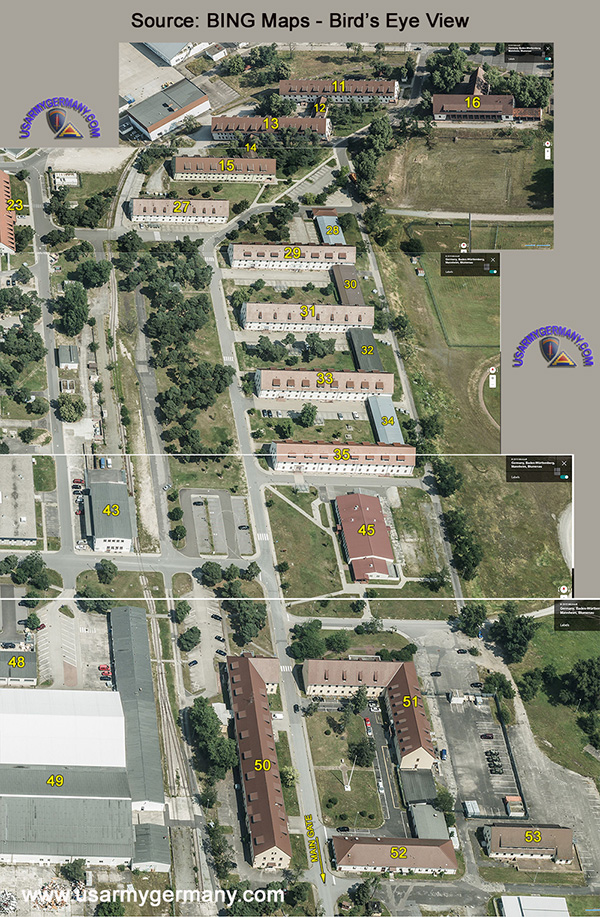 97th Sig Battalion area of Coleman Bks, Sandhofen (BING Maps) |
||||||||||||||||||||||||||||||||||||||||||||||||
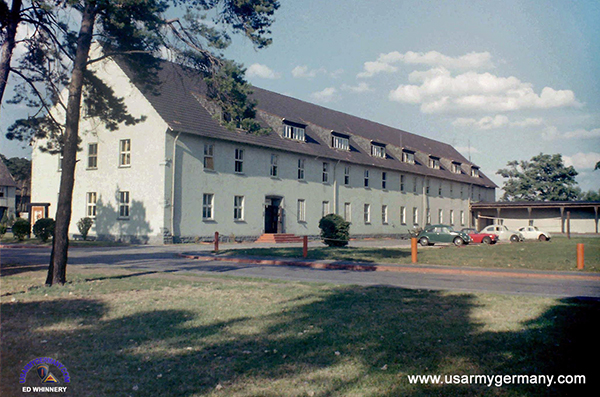 Company "B" 97th Sig Bn barracks, Coleman Bks, Spring 1971 (Ed Whinnery) |
||||||||||||||||||||||||||||||||||||||||||||||||
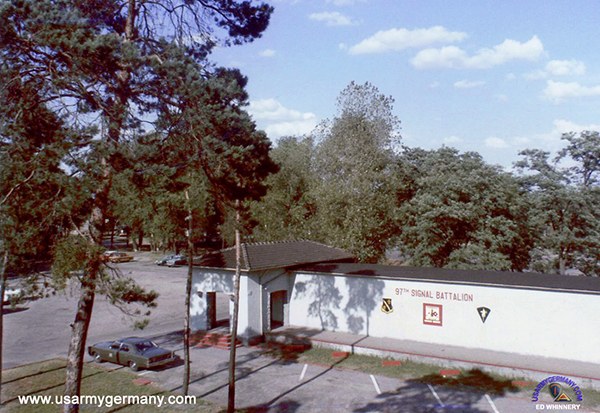 Bldg 28, HQ 97th Sig Bn offices, Coleman Bks 1971 (Ed Whinnery) |
||||||||||||||||||||||||||||||||||||||||||||||||
| 1969 | ||||||||||||||||||||||||||||||||||||||||||||||||
| (Source: Ed Whinnery Facebook, Company B, 97th Sig Bn, 1971-73) | ||||||||||||||||||||||||||||||||||||||||||||||||
| March 1971 - October 1973, B Company, 97th Signal Battalion. The role of B Company was strictly tactical. If I remember correctly, we had the following platoons; HF radio, ComCenter (TTY), Wire, and possibly one more. I remember that Co C had VHF Radio (Carrier) and we would go on field exercises with them. There was a comm center near BFV (can't remember which barracks). I think this was manned by Co A, but I'm not sure. I think the 7th Sig Brigade was involved with the comm cen bunker (Feudenheim?) When I arrived in March 1971, BN HQ offices/admin were in Bldg 28; Building 29 was Co B barracks; Bldg 31 was HQ Co barracks; Bldg 33 was Co A barracks; and Bldg 35 was Co C barracks. After the renovations in 1972 & 73, Bldg 29 became HQ Co; Bldg 31 became Co A; Bldg 33 became Co B; and Bldg 35 remained Co C. Bldg 45 was 97th messhall and Bldg 28 was BN HQ. I don't remember what the connecting buildings 30, 32 and 34 were used for, but I guess they were used by Co Hq, Co A and Co C. The Bn ELM shop was Bldg 16 on the north side of the sport field. The pictures I sent were taken during the spring of 1971, before the renovations. Click here to see two additional photos submitted by Ed Whinnery showing Hangar 1375. |
||||||||||||||||||||||||||||||||||||||||||||||||
 |
||||||||||||||||||||||||||||||||||||||||||||||||
|
|
||||||||||||||||||||||||||||||||||||||||||||||||
| Battalion Commanders | ||||||||||||||||||||||||||||||||||||||||||||||||
| (Source: 97th Signal Battalion, 40 Years, 1952-1982) | ||||||||||||||||||||||||||||||||||||||||||||||||
|
||||||||||||||||||||||||||||||||||||||||||||||||
|
||||||||||||||||||||||||||||||||||||||||||||||||
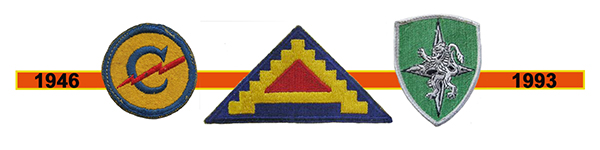
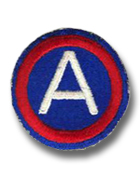
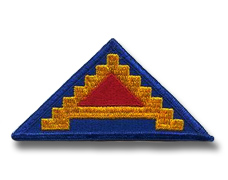
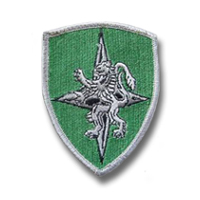
| PATCHES WORN BY THE 97TH SIG BN BETWEEN 1945-1989 | ||||||||||||||||||||||||||||||||||||||||||||||||
|
||||||||||||||||||||||||||||||||||||||||||||||||
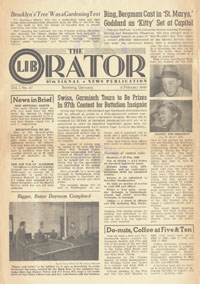
| The LIB-ORATOR - Some of the issues published while in Germany | ||||||||||||||||||||||||||||||||||||||||||||||||
|
||||||||||||||||||||||||||||||||||||||||||||||||
|
||||||||||||||||||||||||||||||||||||||||||||||||
| Wire Operation Company (WOC) - Company A | ||||||||||||||||||||||||||||||||||||||||||||||||
| 1954 | ||||||||||||||||||||||||||||||||||||||||||||||||
| (Source: Author's collection) | ||||||||||||||||||||||||||||||||||||||||||||||||
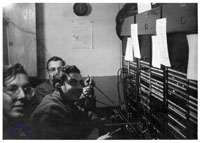
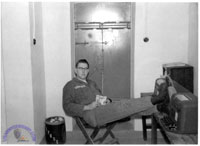
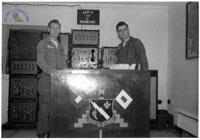
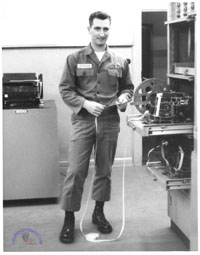
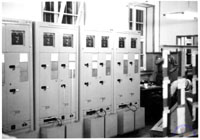
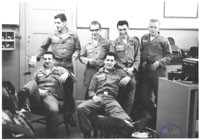
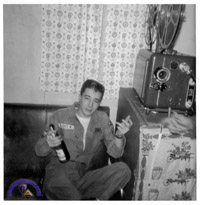
| The following photos are from a photo album I recently acquired. It belonged to a former member of Wire Operation Company, 97th Sig Bn, and served at Panzer Kaserne in Böblingen around 1954. I would be very appreciative if anyone with additional details about the Company and its operations shown in these pictures would contact me . |
||||||||||||||||||||||||||||||||||||||||||||||||
|
||||||||||||||||||||||||||||||||||||||||||||||||
| (Source: Email from Don Davis, Wire Co., 97th Signal Battalion) | ||||||||||||||||||||||||||||||||||||||||||||||||
MY TOUR OF DUTY WITH THE 97TH SIGNAL BN 1955-1956 I arrived in Germany in the winter of 1955. I was assigned to the 97th Signal Battalion, Wire Company, at Boeblingen. The first few months, I worked at the 7th Army Hqs. Communications Center at Patch Barracks. Don Davis former member of Wire Co. 97th Signal Battalion. |
||||||||||||||||||||||||||||||||||||||||||||||||
|
||||||||||||||||||||||||||||||||||||||||||||||||
|
||||||||||||||||||||||||||||||||||||||||||||||||
| 1958 | ||||||||||||||||||||||||||||||||||||||||||||||||
| (Source: Author's collection) | ||||||||||||||||||||||||||||||||||||||||||||||||
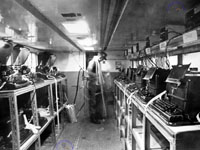
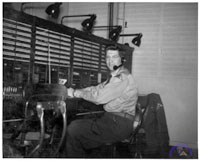
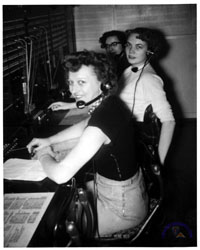
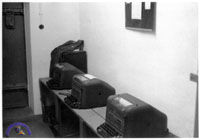
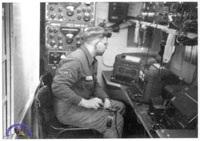
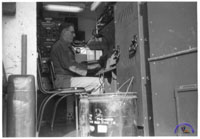
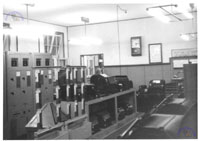
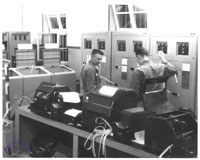
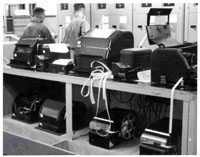
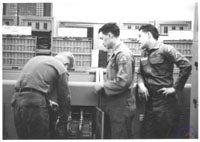
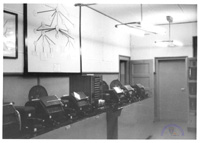
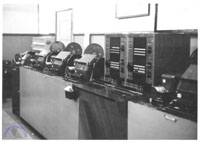
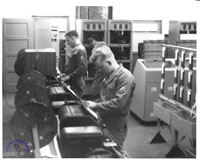
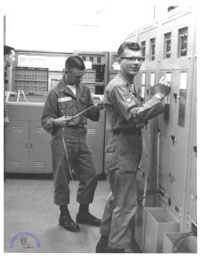
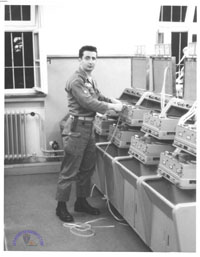
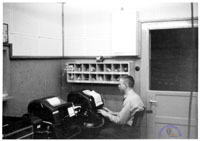
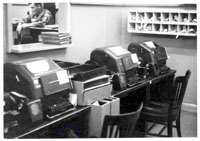
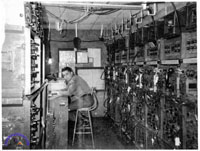
| The following photos are from a photo album I recently acquired. It belonged to a former member of Wire Operation Company, 97th Sig Bn, and served at Panzer Kaserne in Böblingen from 1958 to 1960. In late 1958, the teletypewriter operation platoon of Company A was moved to Company C. I believe the owner was a member of that platoon and worked in the Seventh Army Communications Center, Bldg. 3, Patch Barracks, Vaihingen. I would be very appreciative if anyone with additional details about the platoon, the Comm center at Patch or the teletypewriter equipment shown in these pictures would contact me . |
||||||||||||||||||||||||||||||||||||||||||||||||
| COMMENTS: (Source: Pat Callahan, Co. C 97th Sig Bn, worked at the 7th Army Communication Center, 1962) This could be the Unclassified Section of the 7th Army Communication Center at 7th Army HQ. |
||||||||||||||||||||||||||||||||||||||||||||||||
|
||||||||||||||||||||||||||||||||||||||||||||||||
|
||||||||||||||||||||||||||||||||||||||||||||||||
| Radio Operation Company (ROC) - Company B | ||||||||||||||||||||||||||||||||||||||||||||||||
| 1957 | ||||||||||||||||||||||||||||||||||||||||||||||||
| (Source: David A. Neighbors) | ||||||||||||||||||||||||||||||||||||||||||||||||
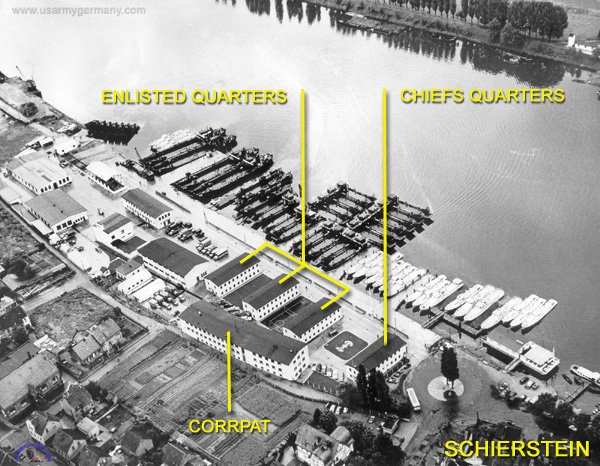
Probably the most memorable and best duty assignment of my army career was the seven months that I spent with the Rhine River Patrol. Although I don't remember the exact dates, I was at the Schierstein base during the seven months preceding the time that the decision was made to have the German Army assume the duties of the patrol. At the time, my primary assignment was as team chief of one of the radio-teletype teams operated by the 97th Signal Battalion, a Seventh Army unit, in Boeblingen, Germany.
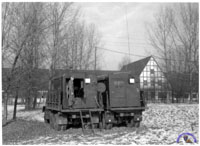
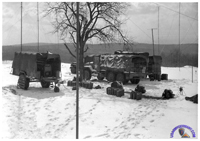
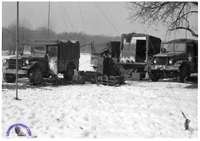
We used ANGRC-26 RATT vans. The detachment was part of Radio Company, 97th Signal Bn, which was part of the Seventh Army's 160th Signal Group at Boeblingen Germany. In those days, the battalion consisted of Headquarters and Headquarters Company, Radio Company, and Wire Company, and some numbered detachments at various places. In response to a request from the Rhine River Patrol, I was given command of three radio-teletype teams and sent to Rhine River Patrol Headquarters at Schierstein to establish a communications network between the bases at Schierstein, Mannheimn, and Karlsruhe. My mission was to provide a reliable means of communication between the three bases. During my brief stay at the Rhine River Patrol, we had one full-blown exercise, which started out as a USAREUR Alert designed to test the ability of USAREUR's units to move whenever required. The alert extended into days in which we were bivouacked at the base of the Rhine River bridge at Worms, Germany. This exercise gave me an opportunity to witness the missions of the Rhine River Patrol to support USAREUR forces in the exercise of their missions. In addition to it's normal patrol duties, the Rhine River Patrol took part in river crossing exercises which would not have been possible without their resources and support. One particularly memorable event that occurred during my assignment to the patrol was a party that took place on an island down-river from Schierstein. After everyone got a few beers under their belt, the event turned into a dunking party in which the men of lesser rank bodily through their superiors into the river. Thank God I could swim because I was one of those who was dunked. During my stay at Schierstein, I met the love of my life in the tiny village of Wiesbaden-Frauenstein. We were married on 1 March 1958 and celebrated our golden wedding anniversary last year. Among my most treasured possessions is a letter of commendation signed by the late Commodore (at that time) Axton T. Jones, Commander of the Rhine River Patrol ADDITIONAL INFORMATION |
||||||||||||||||||||||||||||||||||||||||||||||||
 |
||||||||||||||||||||||||||||||||||||||||||||||||
| The large building at the top of the compound was Headquarters, USN Rhine River Patrol (Webmaster note: CORRPAT). The four buildings adjacent to and perpendicular to the headquarters building were the enlisted men's barracks. The first one, by the gate was the Chief's quarters. All other noncoms and enlisted men occupied the other three buildings. My men and I were quartered in the second building from the gate. Situated along side the harbor, in front of the LSTs was another building whose front faced the main gate. Our AN/GRC-26s (two of them) were parked immediately in front of this building. This is from my memory and is, I believe correct. It was a long time ago (over 51 years). |
||||||||||||||||||||||||||||||||||||||||||||||||
| 1961 | ||||||||||||||||||||||||||||||||||||||||||||||||
| (Source: William R. Guettler, Radio Op Pltn, Co B, 97th Sig Bn, 1961-63) | ||||||||||||||||||||||||||||||||||||||||||||||||
| I was in the 97th from 1/1961-6/1963. I started out in B Company in the Radio Operations Platoon. The entire time I was there I was a "Team Chief" of a Angry-26D (AN/GRC-26D). We had both Angry-26Ds and Angry-26As, [don't ask me if there was ever any B's or C's -- if there were I never saw or heard of them].
As I understood it the A's were Korean War vintage. They basically were just older and not as pretty as the D's. Getting them on the air took a little more effort but once you were communicating you couldn't tell the difference -- just older and I was told a little more cantankerous. Both units had a receiver stack, which as I remember it consisted of two receivers, and a converter, [for converting radio-teletype signals to machine print commands]. It had two teletype machines and a ticker-tape machine. There was a box on the wall over the teletype machines to plug the morse code key into and a jack to plug the voice microphone into. There was also a huge transmitter with a antenna tuning unit setting on top of it. Add to that my waffle iron, coffee pot, my mini-frige for keeping beer cold when there were no officers about and a hot plate to heat C-rations with. We also carried six cases of C-rations at all times. Each case would feed a man for a week. Forget all the jokes, they were pretty damn good. Once during my tour they sent me to Dachau or near there to drop off a couple of A's and pick up a couple of brand new D's. As I recall I dropped off the truck and shack and returned w/ an entire new rig, right down to the tires. Damndest thing I ever saw. All we had to do when we got back to Panzer Kaserne was hook up the power cable to the van and start communicating -- and of course get all my unauthorized equipment back on board-coffee pot, hot plate, waffle iron, etc. I was told that the shack and all the radio gear cost $250,000. Can you imagine a 18 year old kid tooling around the back roads of Germany w/ that damn thing. I don't know what that amounts to in 2006 dollars but it'd be over a million at least. Hell, the first thing we did when we got to the autobahn was pull in the first rest stop where we saw a beer truck and exchange a one day C-ration box for a case of flippies, [twenty half-liter bottles]. The beer truck driver got canned beefsteak and potatoes, spaghetti and meat balls, canned peaches and pineapple, crackers and jam and a couple-a-packs of American cigarettes and we were in hog heaven. We were under strict orders not to use any of the "Running Spares" -- extra tubes and other parts to repair the equipment. We were allowed only to do 1st echelon maintenance which consisted of dusting the equipment. However when we were out in the boonies and the thing went on the fritz we'd replace tubes till we got the damn thing back on the air. Some of those tunning unit tubes cost hundreds of dollar each. We'd catch hell when we got back to post and turned in a req for all the tubes that we'd blown fooling around getting 'er back on the air but it didn't compare to the flak you'd get if you were off the air during a field problem and half of NATO didn't know what they were doing while you were sitting in the Black Forest waiting for the repairman to find you. |
||||||||||||||||||||||||||||||||||||||||||||||||
|
||||||||||||||||||||||||||||||||||||||||||||||||
| Site List (outstations) | ||||||||||||||||||||||||||||||||||||||||||||||||
| (If you have any additional information on the various remote sites with location, please contact me) | ||||||||||||||||||||||||||||||||||||||||||||||||
| 1950s On 5 July 1950, the 97th was reorganized and redesignated as the 97th Signal Operation Battalion. The Battalion consisted of  Headquarters
and Headquarters Company (formerly Headquarters Detachment), Radio
Operation Company (formerly Able Troop), Wire
Operation Company (formerly Baker Troop), and a new company, Message
Center Operation Company. Headquarters
and Headquarters Company (formerly Headquarters Detachment), Radio
Operation Company (formerly Able Troop), Wire
Operation Company (formerly Baker Troop), and a new company, Message
Center Operation Company. On 17 March 1955, the 97th Signal Battalion reorganized in accordance with TO&E 11-95R: Headquarters and
Headquarters Company became "Headquarters Company,"Wire
Operation Company became "Company A (Wire Operation)," Radio
Operation Company became "Company B (Radio Operation)," and Message
Center Operation Company became "Company C (Message Center Operation)."
On 15 August 1955 the Battalion set up its first "provisional" detachments. By 1958 the Battalion had four major detachments in Koblenz (III German Corps), Mannheim (Sullivan Bks), Baumholder (initially Hoppstätten, then moved to Baumholder) and Ulm (II German Corps), Germany. These detachments each operated a portion of the garrison communications network. |
||||||||||||||||||||||||||||||||||||||||||||||||
|
||||||||||||||||||||||||||||||||||||||||||||||||
|
|
||||||||||||||||||||||||||||||||||||||||||||||||
| 1960s On 5 March 1962, the battalion was reorganized in accordance with TOE 11-95D, under USAREUR General Order No. 33, dated 2 January 1962. The new Battalion consisted of five companies: Headquarters
Company (Coleman Bks, Mannheim)Field
Operations Companythree
Command Operations Companies. Based on notes, I believe that the 97th Sig Bn radio relay unit transitioned from the AN/TRC-24 to (AN/GRC-50) late 1962/erly 1963? Some of the radio relay sites at that time: Langenbrand still in operation; known as Watertown Radio?Böblingen radio relay site known as Montana RadioBad Dürkheim radio relay known as Yakima Radio |
||||||||||||||||||||||||||||||||||||||||||||||||
|
||||||||||||||||||||||||||||||||||||||||||||||||
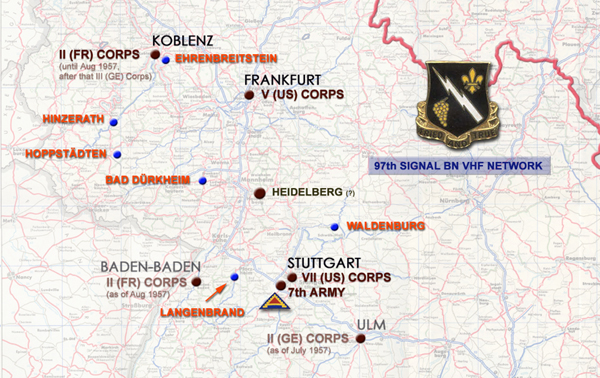 97th Signal Bn VHF radio relay sites, mid-1950s |
||||||||||||||||||||||||||||||||||||||||||||||||
| BAD DÜRKHEIM | ||||||||||||||||||||||||||||||||||||||||||||||||
| 1962 | ||||||||||||||||||||||||||||||||||||||||||||||||
| (Source: Email from William Plisko, Jr.) | ||||||||||||||||||||||||||||||||||||||||||||||||
| I was at the "Hill" in 1962 with the 97th Signal Battalion. I have photos from that time if you are interested. I got a response from Hochstetler one time and received some photos from 1976, which I will send along. It was not a Tiger Site to the best of my memories, only referred to as the "Hill" or "Bad D." | ||||||||||||||||||||||||||||||||||||||||||||||||
|
||||||||||||||||||||||||||||||||||||||||||||||||
|
||||||||||||||||||||||||||||||||||||||||||||||||
| HOPPSTAEDTEN DET | ||||||||||||||||||||||||||||||||||||||||||||||||
| 1956 | ||||||||||||||||||||||||||||||||||||||||||||||||
| (Source: Email from Allan Pevoto) | ||||||||||||||||||||||||||||||||||||||||||||||||
| I was with the 97th Signal Bn in Boebligen for several months in fall of 1956 when I played football. I was transferred to Wire Company from a Combat Engr outfit in August of 56 and when the football season was over I was sent to the Hoppstädten Detachment. Was there for about a year and then we moved the whole group (60 or so people) to Baumholder. I served as supply sergeant during this time. We had a major, whose name I cannot remember, in charge of the Hoppstätden Detachment until he was replaced by a Captain. We had a first sgt named Wolfe who was about as gung-ho a soldier as I ever saw. Gung-honess was not big in the 97th when I was there. In fact my first day at the 97th I fell out in full uniform (absolutely required in the combat engineers) and one of our sgts was holding formation in his underwear and a helmet liner. I kept hoping someone would pinch me and I would wake up. I could probably go on for hours. The Hoppstadten Detachment had moved to Hoppstadten from Weierhof before I joined them. Hoppstadten was also home to an artillary observation outfit who flew piper cubs and helicoptors from a small airfield. Our detachment was made up of people from the entire battalion: Wire, Radio (UHF& VHF), Crypto, Power, etc. Our mission, at least so far as I knew, was to support 7th Army in the event the larger battalion was unable to.
I was assigned to the supply room since I had no Signal Corps MOS and worked under a Sgt named Woodard or Woodward who evenually went to OCS and I never heard from him again. I took over the supply room and worked for a warrant officer named Mr. Crank (a very appropriate name I might add). At one point we were preparing for an IG inspection which we had never had, and we spent 54 straight hours getting the supply room and all our records in shape. Had to do a whole lot of midnight requisitioning in order to get things together. The German fellow who ran the local Gasthof, Norbert Hohn, would deliver food and drink to us as we were working. On the morning of the inspection my supply clerk and I were both asleep on the supply room floor. I guess we passed the inspection. I never heard anymore about it. We were not the most military of outfits. I was always convinced that most of us wound up at Hoppstadten because the battalion did not know what else to do with us. We had some real characters in the outfit, some of whom I have kept up with over the years. I had always said I was going to write a book, but then MASH came out. I am not sure anyone would believe my book. I would have to write it as fiction. In 1957 I think it was the entire detachment moved to Baumholder and we were in two different locations in Baumholder. I left Baumholder for the states in Sept, 1958 for discharge. I could probably go on for hours. |
||||||||||||||||||||||||||||||||||||||||||||||||
| KOBLENZ DET | ||||||||||||||||||||||||||||||||||||||||||||||||
| 1953 | ||||||||||||||||||||||||||||||||||||||||||||||||
| (Source: Email from Jim Martin, sent to me several years ago) Koblenz Det, 97th Sig Bn, 1953-54. I ran into Sgt. Ken Riley while walking our dog a year or so ago and he reminded me of all of the good times we had with the 97th. The Koblenz Detachment was established to provide communications from 7th Army HQ in Stuttgart to the 2nd French Corps. We provided a full range of communications - wire, radio, VHF. Two of the VHF stations were under the direct supervision of the Detachment with the rest falling under the 97th in Boeblingen. As I recall, the headcount ran about 30 including administrative and mess hall. We also operated a Medical office using a local doctor, a gas station for all military personnel, an enlisted man's club and a movie house. We were quartered with a French MP unit in a kaserne located within the town limits (I cannot remember the name). Rations were provided primarily from the Air Force at Wiesbaden. I also had a French interpret since I had a coordination role with the Hqs. Commandant at 2nd French Corps which was located in the Schloss on the Rhine River. He spoke perfect English when he came to see us, but we had to speak French when we visited him! In the 97th we were known as the "Leper Colony" since we were composed of people they didn't know what to do with. Most of the men had several Article 15's and a few had Summary Courts Martial, i.e., cast offs and misfits. Once they arrived in Koblenz they usually got into a bit of trouble, but soon settled down and did an outstanding job. Our communications record was excellent. I would have put them up against any group in the Army. I spent about a year there and, all in all, it was the most memorable time of my 6 1/2 years in the Army including two tours as ADC to the Chief Signal Officer. While we were there the US contingent included a few people from the State Department who served with the Military Security Board, two other officers who provided the liaison with the 2nd French Corps and one CIC type. We lived off of the economy in quarters provided by the French and had a ball. One thing I overlooked in my earlier notes on the Koblenz Detachment was that we operated a Message Center with cryptographic capability and provided daily courier service to 2nd French Corps Headquarters, i.e., we were a complete communications center. While at Koblenz we only participated in one field maneuver that I can recall. In the winter of '54 we relocated to a site near Montour (Montabaur?), Germany and established the command communications with the 7th Army field headquarters. I do not recall the name of the exercise, but I do recall how cold it was. On 7 May 1954 I did attend the 12th Anniversary of the Battalion at a party in the Officer's Club at Panzer Kaserne. Lt. Col. David W. Bowman was the CO at that time. I actually have the invitation giving part of the history to that date and a roster of the officers. As a side note, my wife and I were the first American couple to be married in the Chapel at Panzer Kaserne on 24 April 1954. I believe that there was one marriage service prior to ours, but it involved a non-American girl. In response to your additional questions: 1. Whenever the Detachment needed personnel they were supplied from the functional company. All personnel records were retained by the Battalion and all official administrative actions were made by the Boeblingen operations - I could only recommend. 2. To the best of my knowledge there were no other similar detachments operated by the 97th since the other units had equipment compatible with ours. 3. The two relay stations I had responsibility for were used for communications with 7th Army. One was located East of Koblenz on a hill several miles out of Erinbritstein (?) (Ehrenbreitstein) and the other one was about 30 miles South back on the West side of the river. 4. We had one AN/GRC-26 which maintained contact with HQs. Jim Martin |
||||||||||||||||||||||||||||||||||||||||||||||||
| LANGENBRAND DET | ||||||||||||||||||||||||||||||||||||||||||||||||
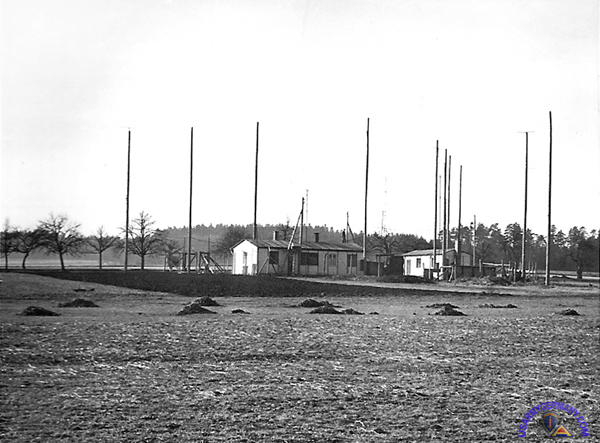 Langenbrand Radio Relay Station |
||||||||||||||||||||||||||||||||||||||||||||||||
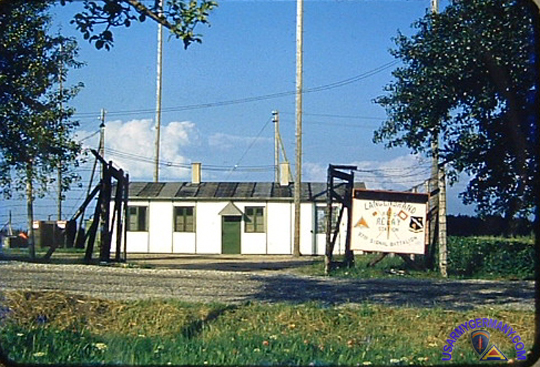 Langenbrand Radio Relay Station |
||||||||||||||||||||||||||||||||||||||||||||||||
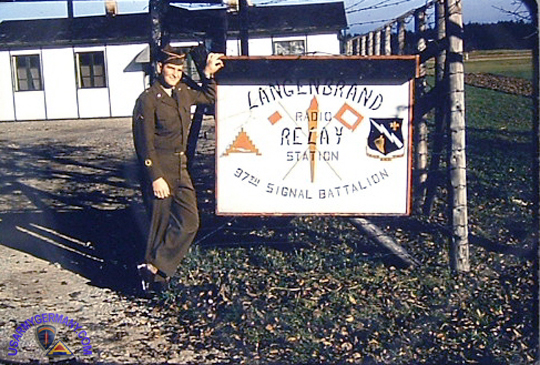 Til standing next to sign at the entrance |
||||||||||||||||||||||||||||||||||||||||||||||||
| 1954 | ||||||||||||||||||||||||||||||||||||||||||||||||
| (Source: Email from Clarence "Til" Tillery) | ||||||||||||||||||||||||||||||||||||||||||||||||
| I was trained as a Field Radio Repairman at Camp Gordon, GA and shipped out to the 97th Signal Batt arriving in mid December, 1954 and immediately went on manuvers. I was then assigned to the Langenbrand relay site. My duty at 97th was radio operations. I remained there until Dec 1955, when I shipped back to USA to enter NC State College, School of Engineering, graduating in 1960 with a degree in Mechanical Engineering. I will fill you in on what I remember and I send a few pixs I have. The site was located about 1/2 miles above the little Village of Langenbrand, which consisted of a bakery, butcher shop and restaurant/hotel (gasthaus). We spent many hours in that place owned and operated by Herr Stropple and his wife. We were very good customers and he treated us like family. Also, we related very well to the locals in that we supported their school and various projects.
When I arrive there in late December 1954, we were in a residence type building with local power. The radio equipment was located in what would be the living room. (See attached picture) There were two bedrooms with four cots each, a central bath and kitchen. There water quality was poor and not for consumption. We hauled in fresh drinking and cooking water from the Radio Company. Also, we alloted Class A rations for meals to be prepared by us. The most amazing thing was we were permitted to have beer on the site, since we could not drink the water. In my year there, I never saw that privilege abused.
There were two builings at the site. The main building housed everything including all radios. The second smaller building was basically storage. Our team eventually converted about a third of the smaller building to a radio room. Built a wall, painted it, pulled power, etc. and moved all operating equipment into it. Put in a phone system to the main house. This move made the billet area liveable. The new operaing area was not heated but all the radio equipment made it toasty warm. It worked very well for study etc. The setup (of the VHF net) was tactical. Even though we operated in the building, there was a radio van/2½-ton truck parked and waiting, It was attached to trailer which had 5 or 6 power generators plus gas and oil, cables, masts, antennas, etc. The site had a gas dump of probably 125 gallons in jerry cans. We could and did jump to a new site when on alert. Also, we had a
¾-ton truck for people movement.
The detachment at Langanbrand varied from 4 to 9 men, with a NCO assigned. It was not extermely regimented. We all worked together and covered for each other. We all were issued 100 mile permanent passes. Since I was the only married guy on the site, I spent a great deal of my time operating while the younger chaps were getting about. It gave me plenty of time to study some engineering correspondance courses, which helped when I started to college after discharge.
|
||||||||||||||||||||||||||||||||||||||||||||||||
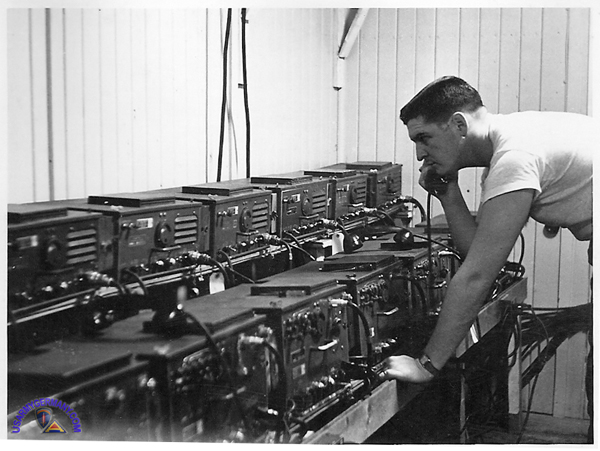 WWII-vintage TRC-1 radio relay sets at the Langenbrand station (receivers on the top shelf, transmitters on the bottom shelf) |
||||||||||||||||||||||||||||||||||||||||||||||||
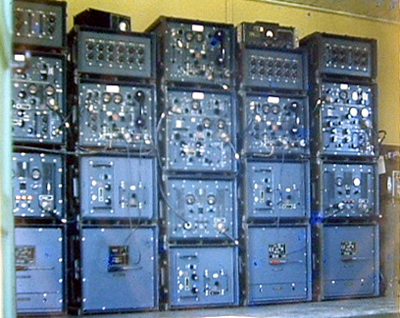 TRC-24 radio relay sets at the Langenbrand station |
||||||||||||||||||||||||||||||||||||||||||||||||
We operated as you mentioned, AN/TRC-1 as relays. Our station received and repeated four cicuits from 7th Army to the various Corps. We had 8 transmitters and 8 receivers to keep tuned and operating and a spare circuit to swap out. You can imagine what the antenna field looked like. Most of our antenna were on permanent telephone poles. (The circuit names were kept simple, as in A thru D, but we did have to know antenna direction plus send and receive frequencies for each circuit so we could line them up. All this radio work inspired my interest in amateur radio in my later years. I hold an Extra Class Ham ticket.)
In mid June 1955, I went to the Radio Company for training on the new system, I think AN/TRC-24 (1) but I am not sure. (See the setup in the Pics -- blue radios) We really got smart and located the equipment in an out building, got rid of the noise from our sleeping quarters. They had to be maintained 24/7/365 and it was noisy. The pixs I am attaching have my mug in them. Some will show the station from outside and inside, plus the antenna field. You will find some shots of boiling water in my steel helmet for shaving. We also heated our K-Rations using power unit exhausts. Make sure you punch a hole in the can or you will have baked beans everywhere. (1) Webmaster note: I have a note that the TRC-24's were replaced with GRC-50's (ANGRY-50) at the radio relay sites sometime between the end of 1962 and early 1963. Anybody have details? |
||||||||||||||||||||||||||||||||||||||||||||||||
|
||||||||||||||||||||||||||||||||||||||||||||||||
| WALDENBURG DET | ||||||||||||||||||||||||||||||||||||||||||||||||
| 1955 | ||||||||||||||||||||||||||||||||||||||||||||||||
| (Source: Email from Pete Balisciano) | ||||||||||||||||||||||||||||||||||||||||||||||||
| As for my tour of duty with the 97th, I was stationed in Boeblingen at the Panzer Kaserne. I was only in the Company area for about two months then went to a Radio Relay Site in a little mountain top town called Waldenburg. I was there from Feb. 1955 to March 1956. I was Team chief with three other men at the Site. Every time there was a Maneuver or an Alert, we had to tear down all the equipment, pack it in our trucks and set all up again on some hillsite out in the boonies.When it was all over do it all over again in reverse. As far as I know, the relay sites served most of the Seventh Army, from Stuttgart to the French Zone. |
||||||||||||||||||||||||||||||||||||||||||||||||
|
||||||||||||||||||||||||||||||||||||||||||||||||
|
|
||||||||||||||||||||||||||||||||||||||||||||||||
| Related Links: | ||||||||||||||||||||||||||||||||||||||||||||||||
|
||||||||||||||||||||||||||||||||||||||||||||||||