If you do
NOT see the Table of Contents frame to the left of this page, then
Click here to open 'USArmyGermany'
frameset |
160th
Signal Brigade
5th Signal Command
Looking for more information from military/civilian
personnel assigned to or associated with the U.S. Army
in Germany from 1945 to 1989. If you have any
stories or thoughts on the subject, please email me (webmaster).
|
|
|
|
|
| |
| Brigade
History |
|
160th Signal
Group DUI (used in Germany in the 1950s?)
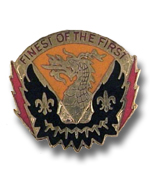
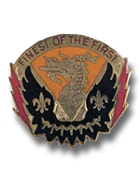
160th Signal Brigade DUI (approved Nov 5, 1968) |
|
LINEAGE:
Constituted 6 March 1945 in the Army of the United States as the 3160th Signal Service Battalion and activated in France
Inactivated 20 June 1947 in Germany
Redesignated 3 December 1954 as Headquarters and Headquarters Detachment, 160th Signal Group, and allotted to the Regular Army
Activated 28 January 1955 in Germany
Inactivated 1 October 1961 in Germany
Activated 25 March 1963 at Fort Hood, Texas
Inactivated 3 June 1972 at Oakland, California
Activated 1 July 1974 in Germany
Redesignated 1 October 1979 as Headquarters and Headquarters Company, 160th Signal Brigade
Inactivated 22 August 1991 in Germany |
|
| |
| (Source: Seventh Army TROOP LIST 30 June 1956) |
ORGANIZATION (Sept 1956): |
UNIT DESIGNATION |
DUTY STATION |
COMMENTS |
| HHD, 160th Sig Gp |
Panzer Ksn, Böblingen |
On 28 Jan 1955, the 301st Sig Gp is inactivated and replaced by the 160th Sig Gp; no change in mission or station |
| 25th Signal Bn (Construction) |
(Karlsruhe) |
In April 1956, the 40th Sig Bn (Cons) is replaced by the 25th Sig Bn (Cons) as part of Operation Gyroscope |
| 39th Sig Bn (Spt) |
Panzer Ksn, Böblingen |
|
| 97th Sig Bn (Operation) |
Panzer Ksn, Böblingen |
|
| 732nd Med Det |
Panzer Ksn, Böblingen |
|
|
| |
| (Source: Author's collection) |
160th Sig Gp
Panzer Ksn, Böblingen
|
|
|
|
|

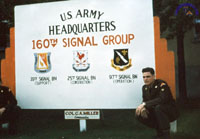
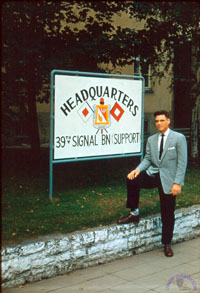
1. 160th Sig Gp sign, 1955 (KB)
|

2. 39th Sig Bn sign (KB)
|

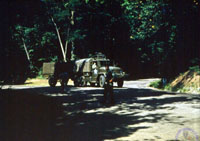
3. In the field (KB)
|
|
|
|
|
| (Source: STARS & STRIPES, May 10, 1954 - copy of article submitted by Don Davis, Wire Co., 97th Signal Battalion) |
Vital Link in 7th Army Communication Setup
160th Signal Gp -- 3,000 strong -- gets message through, maintains 24-hour-a-day vigil on intricate equipment
By Henry B. Kraft
You are sitting at a desk at any of the 100 or more installations of the 7th Army in Germany. You dial a number and before you have a chance to turn around you have your party. Or you may be sending a message or receiving one over the teletype. Or, for that matter, it may be a radio message.
Behind those operations, so simple at first glance, so much taken as accepted fact, are more than 3,000 personnel and equipment that is worth more than $85 million. Behind these operations is intelligence of a high degree, because it takes the keenest minds to plan and put into operation such a great network of communications.
This is the "Voice of Command" -- the Signal Corps -- and the personnel responsible for building, maintaining and operating the communications, which are the veins of the 7th Army, belong to the 160th Signal Gp, with headquarters at Boeblingen.
|
|
|
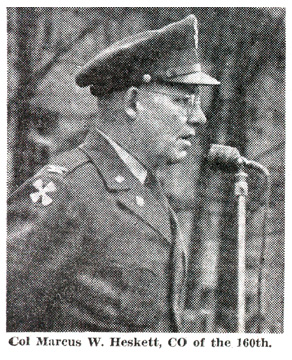
The office of Col Marcus W. Heskett, commanding officer of the 160th, is perhaps no different from the offices of other men of his rank, unless it be two odd telephones on his desk. There is the usual map on the wall which indicates the scope of his operations, the usual furniture. But there is the man himself.
Heskett is a quiet, soft-spoken man, immaculate and impressive. His briefings are famous for their brevity, but when that briefing is given he has covered everything. It is a vocal picture which outlines the functions of each unit of his big organization down to the solitary platoon.
From the network of communications for which Heskett and his aides are responsible, the "Voice of Command" goes over to every unit in the 7th Army. The group's slogan is simple, but pointed:
"The message must go through."
Heskett's organization works around the clock. There are men working and planning in the headquarters and also men in lonely areas throughout the 7th Army command, carrying out these plans. As the colonel describes the functions of the 160th Signal Gp, he leaves the listener wondering not only that the minds of men could plan such an intricate network of communications, but that the same minds could execute those plans. |
|
|
An army, whether in peacetime or at war, would be quickly paralyzed without an effective communications system. Such a responsibility is heavy indeed both for the commander of such a group and the men under him. There is no excuse for failure, no matter how difficult the obstacle.
Even NATO officers who visit installations of the 160th marvel at the equipment and the type of jobs accomplished. French, Dutch, British and other military groups have seen the system of communication in operation and expressed their admiration.
To obtain a single picture of a single job performed by the group, take the 40th Signal Bn, which has gyroscoped. In 1954, this battalion laid enough spiral four cable (rubber-covered cable) in support of 7th Army field exercises which, if stretched end to end, would reach from Honolulu to Stuttgart, Germany, and back.
|
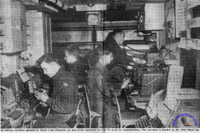
Teletype section
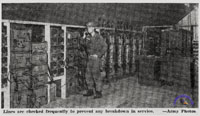
Checking lines
|
|
But this wasn't all. Those cables were serviced and maintained and when the exercises ended the cables were salvaged. Capt Kenneth S, Styles, attached to headquarters of the 160th was with the battalion when the task was done. And to illustrate that the life of a Signal Corps officer is no bed of roses, Styles, in that year, spent 293 days in the field.
The 160th Sig Gp is engaged in every form of communication known to man, except one. And that is that it has no carrier pigeons.
If any new system of communication is devised or considered, that system is studied by Heskett and his aides. Take the new IBM (International Business Machines) system for which men are now being trained under Heskett's direction. This is a MASS (Modern Army Supply System) project -- one which was actually developed during the Korean conflict. (See more in the 7th Army MASS section and MASS Platoon, 97th Sig Bn.)
Ten classes were planned for soldiers of the 7th Army to take this course. The third class is now being conducted, with from 10 to 15 students attending. Seems like a small number.
But one must consider that a high degree of intelligence and aptitude and background is required to be eligible for these courses. |
|
|
The classes cover two parts. In the first phase, students are trained in key punching. This includes care of instruments and handling the basic IBM cards. It takes a week to finish this course, but when the student is finished he should be able to handle about 120 IBM cards an hour.
The second phase is the transceiver course, which is a combination of transmitter and receiver. This machine is somewhat simular to the basic key-punching machine which the student operated during the first phase.
Erhard Hirth and Edward Walsh, IBM instructors, have the task of whipping the students into shape and teaching them how to operate the machines. And it isn't easy, for while the student uses what appears to be a typewriter and actually types out the message or requisition required, the cards reflect only punched holes which are codes.
As quickly as the message is punched, it is received at its destination and the amount of time thus saved is incalculable, according to the instructors.
The students come from all sections of the 7th Army. It takes real mental skill and speed for a student to complete the course. Hirth estimated that more than 50 per cent of those starting the courses fail.
The machine virtually thinks. When the operator punches a card for transmission and it contains an error or errors, the machine rejects that card automatically. The operator knows when he has made an error by glancing at the top right corner of the card. If it has a hole punched he has been accurate. If the machine has failed to punch that hole he has made an error.
The machine? Just another link in the intricate communications network which the 160th operates.
The group has three battalions -- the 39th, 25th and 97th. The work of these battalions is indelibly written in the proud record of the 7th Army, for they never cease in their labors.
Field SOPS cover 38 mimeographed pages -- just an indication of the vast system Heskett is responsible for.
Group staff organization and responsibilities are also simply enumerated. The group commander is responsible for the control and operation of the group and all subordinate units. The executive officer, who assumes command when Heskett is absent, is Lt Col George V. Gillette. He directs and coordinates the staff to achieve unity of action.
Speed is an essential in the group's work. To expedite its mission it has a small aviation section which is able to speed men and material to a specific point to set up or repair a communications system.
Although units of the 160th are scattered throughout the 7th Army area, Heskett and his aides know the whereabouts and activities of each unit, no matter how small. When the word for a certain job goes out the Men turn out as rapidly as firemen to a fire back home. There is no delay.
Working with Heskett at headquarters besides Gillette and Styles are Maj William F. Rogers, adjutant; Maj James M. Cotton, S4, and Capt Glen Clark, food service adviser.
Directing activities of the 39th Signal Bn are Lt Col John S. Bardwell, commanding officer; Maj Joseph N. Hite, executive officer; Maj Jeremiah F. Haves, depot CO; Capt Harry A. Nicoll, Jr., and 1st Lt Drew Dowling.
Lt Col Edwin J. Chatham is CO of the 25th Signal Bn, with Maj Earle H. Baughn, S3 officer; Maj Roland P. Lee, executive officer; Capt James G. Button, S4, and 1st: Lt Richard Sabater, adjutant.
Operating the 97th Signal Bn are Lt. Col James M. Johnson, CO; Maj Arthur J. Sebesta, executive officer; Capt Edward L. Lewis, S4, and Capt Eugene C. Paulson, group aviation officer.
These are the men who see to it that "The message goes through." |
|
| |
| (Source: STARS & STRIPES, March 28, 1956) |
7th Army VHF Relay Network
The 7th Army VHF system is scattered through southern Germany and connects command headquarters at the following locations:
Koblenz (German III Corps Hqs)
Mannheim ()
Schwäbisch Hall ()
Nellingen ()
Vaihingen (7th Army Hqs)
Darmstadt ()
Frankfurt (US V Corps)
Möhringen (US VII Corps)
Relay stations play an important role in the VHF system. These small sites are set up at various points between a sending and a receiving station, typically located on top of high hills within the line-of-sight of adjoining relay sites or the afore-mentioned stations (terminals). The sites are operated by the personnel from the VHF Platoon, Radio Company, 97th Signal Battalion, who are responsible for keeping the relay equipment at the sites in perfect operating condition.
One of the relay stations is located on a hill near Bad Dürkheim. Five men of the VHF Pltn are stationed at the site. They live in a five-room house that includes a bedroom, dining room/day room, washroom, control room for the radio equipment and a kitchen. Rations are procured from one of the Army kasernes at Mannheim (Sullivan Barracks?). Three times a week a run is made to the kaserne to pick up laundry, mail and supplies.
The relay stations are "mobile" - about six times a year the station participates in a field exercise. During these exercises the men dismantle the 50-foot antennas and load the radio equipment onto vans and deploy to a field site where a temporary relay site is set up for the duration of the exercise.
(Webmaster note: other 7th Army VHF relay stations that I am aware of during this period include Waldenburg (near Schwäbisch Hall) and Hoppstädten (near Baumholder. I would be interested in hearing from former members of the VHF Platoon who served at the VHF relay sites....) |
|
| |
| (Source: STARS & STRIPES, June 3, 1956) |
Aviation Section, 160th Signal Group
The Group Aviation Section at Stuttgart Army Airfield was created (early 1956) by consolidating the aviation assets from the 97th Sig Bn (Op) and 39th Sig Bn (Spt) and placing them under the direct control of Headquarters, 160th Gp. (HHD, 160th and the 25th Sig Bn (Cons) had no aviation support assigned.)
Today, the Avn Sec comprises 11 aviators and 11 aircraft (two L-20 utility planes; six L-19 reconnaissance planes; one H-13 recon helicopter; and two H-19 utility helicopters). (Prior to the recent arrival of the H-19's, two pilots from the unit were sent to the 328th Trans Co (Hel) at Nellingen for transition training.) The unit also has 17 mechanics; three of the 11 pilots serve also as aircraft maintenance officers.
The unit transports men and equipment between installations and remote sites; provides air messenger service; performs recon, aerial photography and limited aerial resupply for Group headquarters as well as all three subordinate battalions.
List of pilots:
Capt Eugene Paulson
1st Lt Bak Chin
1st Lt Donald (Jug) Haid
1st Lt R. F. Huff
1st Lt L. H.
Jacquey
1st Lt Jack McGee
1st Lt Jack Reinhardt
1st Lt J. I. Tabor
1st Lt Richard Tourtillopp
1st Lt Van Der Merel
1st Lt I. R. Webb
|
|
| |
| (Source: Email from Dave Zigler) |
I served in the 160th Signal Brigade from 1980-1984. I was originally assigned as Plans and Training NCO in the Brigade S-3. I also was assigned
to the 52nd Signal Battalion, Karlsruhe Detachment as NCOIC for about one
year. At the end of the year I returned to the Brigade S-3 as Manpower NCO.
During my assignment the Brigade was commanded by Col Anglin, Col Tony
Vydra, and Col Reynolds. The Deputy Commander was LTC Bill Kondik The S-3
was Maj Bill Kondik who later became the Brigade Deputy Commander as an LTC
and Maj Steve Harmon who later commanded the 43rd Signal Bn as an LTC.
The 589th operated the TCC, DCO and long-haul microwave in support of the
Karlsruhe Military Community. The microwave station was on the fouth floor
of the 160th Signal Brigade HHC Barracks on Smiley Barracks. During my
tenure in the 589th a new concrete microwave tower was constructed inside
the fence around the TCC. When I departed Germany the new microwave
equipment was in final acceptance from the installing contractor. I have
some (very few) pictures from the 160th. If you are interested I could scan
them and e-mail what I have to you. |
|
| |
| (Source: Email from Danny R. Meyers, HHC, 160th Sig Bde, 1987-1989) |
I was assigned to Headquarter s and Headquarters Co, 160th Signal Brigade at Smiley Barracks in Karlsruhe from June 1987 to June 1989. I was a 32 Delta, Station Technical Controller. When I arrived at the 21st Replacement in Frankfurt I was full of hopes of being assigned to a busy tech control facility such as DCS Vaihingen. Instead I was sent to the Headquarters Company to man a position in the CCC – Communications Command & Control Center, later renamed Operations Command & Control (OCC).
It was basically a help desk and reporting facility for outage and Hazcon conditions within the brigade’s assets. We collected the information (when did it go down, when did it come back up, what was the reason) and compiled it into a daily operations summary. The ranking person on the night shift got to pitch this information in briefing format to the Brigade CO each morning.
Due to personnel constraints I had volunteered for an extended tour of night shift duty so I gave a lot of these briefings along with my NCOIC, Chuck Brown. When I first got to the unit I was disappointed that I was not going to be doing hands-on tech control. But I soon realized that I had at my fingertips a complete snapshot of what the Army's strategic commo in Germany looked like at any given moment. The OCC’s physical proximity to Current Ops and the S-3 helped too.
I worked with great people in a great setting, and Karlsruhe was an absolutely beautiful city. I rotated back to CONUS a few months before the wheels came off in the Warsaw Pact so I can only imagine how things changed after that point. But 1987-89 was the best two years of my Army career and two of the most satisfying years of my life. |
|
| |
| (Source: Email from
Dave Frazee) |
When I became 1SG of the 587th Sig Co in the summer of 1990, I had no idea that the sleepy, small 150 soldier company with only two “outsites” any distance from Patch Barracks would turn into the monstrosity that it did. Getting resources, indeed even company clerks to run a stand-alone company the size of a small battalion, was a nightmare. Also, having 160th Sig Bde/302nd Sig Bn 55 miles away in Karlsrue was crazy too. Nothing like have the Bn Cdr or CSM call up and say “come over and talk to me” It happened regularly. Then the down-sizing exercise in closing sites and moving soldiers back to the States or discharging them was nuts. I had one soldier from Hohenstadt Relay site who with his family lived near the site which was about 60 miles form Stuttgart. When the site contracted out, 5th Sig flubbed up his orders so he sat at home, giving us a call once a day so we knew he was alive for about a month and a half till we could move them. Add to all of that the Stop-loss program for the Gulf War, the Gulf War itself ... those were trying times indeed.
SOME HISTORY
Feb 1991, a 5th Signal Command reorganization split the DOIM Community Battalions from those Companies providing Strategic Communication.
The 587th Signal Co moved directly under 160th Sig Bde which later reformed to become the 302d Signal Battalion which at its height had over 1500 soldiers stationed in Germany, Belgium, Italy, and the UK. It must have been the largest Sig Bn in the Army at the time.
In December 1990, the
587th had approx 150 soldiers stationed at Vaihingen Barracks, Boeblingen NCS (Cemetary Net control), Gross Engstingen (Cemetary Net Det), Nellingen Cemetary Net Site, and Pfullendorf (Cemetary Net Det). The unit had sections that supported the HQ USEUCOM Telephone Exchange, the HQ USEUCOM Microwave/Tech control (Defense Communications Station-Vaihingen), a GSC-49 Satellite Terminal (Secure Voice), an MSC-64 Single Channel Satellite Terminal, and URC-101 Single Channel Satellite radios supporting the HQ USEUCOM Command Center.
In mid-Feb 1991, the 587th expanded to 337 Soldiers located at the following locations: |
| |
Commander: Cpt Colleen E. Duffy |
| |
First Sergeant: David K. Frazee |
| |
Nuernberg DCS |
| |
Augsburg DCS (Reese Barracks) |
| |
Suttgart DCS (Robinson Barracks) |
| |
Bad Aibling DCS |
| |
Augsburg Sat DCS (Gablingen) -- We had this for about four months until it was moved to INSCOM. |
| |
Hohenstadt DCS -- Relay site between Stuttgart and Augsburg |
| |
Four additional Cemetary Net Detachments supporting USA Field Artillery Detachments throughout southern Germany (We took all of the 69th Sig’s Dets) |
| |
All Cemetary Net sites listed in the Dec 90 listing above. |
|
| |
Throughout 1991 the 587th picked up additional 5th Signal personnel from the CSCE (COMSEC) detachment that deactivated at Nellingen Barracks.
587th relinquished control of the USEUCOM Telephone Exchange to 578th Signal Co. of the 52d Sig Bn.
At the Conclusion of the Gulf War and the deactivation of VII Corps, the 5th Signal Command under USAREUR’s direction ramped up deactivation of all Cemetary Net Detachments, and various DCS sites were contracted out.
The unit rapidly reduced in size, so by June of 1992 it had approximately 238 soldiers with many scheduled to depart or be discharged in the Army’s down-sizing initiative. |
 |
|
| |
| 302nd Signal Battalion |
| |
| |
| |
| |
| |
 |
|
| |
| 379th Signal Battalion (Support) |
| |
379th Signal Bn (SPT) DI |
| |
| (Source: Seventh Army TROOP LIST 30 June 1958) |
ORGANIZATION (Sept 1958): |
UNIT DESIGNATION |
DUTY STATION |
COMMENTS |
| HHD, 379th Sig Bn (Spt) |
Panzer Ksn, Böblingen |
|
| 58th Sig Co (Spt) |
Pirmasens |
|
| 59th Sig Co (Spt) |
Pirmasens |
|
| 176th Sig Co (Repair) |
Panzer Ksn, Böblingen |
|
| 229th Sig Co (Spt) |
Panzer Ksn, Böblingen |
|
| 585th Sig Co (Spt) |
Panzer Ksn, Böblingen |
|
|
| |
| |
| (Source: USAREUR STATION LIST 30 June 1961) |
ORGANIZATION (June 1961) (speculative!): |
UNIT DESIGNATION |
DUTY STATION |
COMMENTS |
| HHD, 379th Sig Bn (Spt) |
Panzer Ksn, Böblingen |
|
| 59th Sig Co (Spt) |
Baumholder |
|
| 176th Sig Co (Repair) |
Panzer Ksn, Böblingen |
|
| 229th Sig Co (Spt) |
Panzer Ksn, Böblingen |
|
| 545th Sig Co (Depot) |
Mannheim |
|
| 585th Sig Co (Spt) |
Panzer Ksn, Böblingen |
|
|
 |
|
| 229th Signal Company (Support) |
| |
| (Source: Email from Haroland
M. Patterson) |
My first tour in Germany was with the 229th Signal Company (Spt), 379th Signal Bn, 160th Signal Group, Panzer Kaserne. My last tour was with the US Army Material Command Europe in Zweibrucken.
The 229th Signal Company was the most decorated company in the Army it had ten
battle rings on the guideon. The 379th Signal Battalion and the 229th was
activated at Camp Gordon, GA in 1956 and sent to Germany to replace the 39th Signal Battalion at Panzer Kaserne, Böblingen.
As far as the mission we was responsible for providing telephone and radio communications between Seventh Army and it's major units. It has been so long some of it I have forgotten, sorry. Hope this helps. I have been trying locate some of my fellow soldiers from the 229th but have not been able to locate any of them so far. |
 |
|
| 176th Signal Company (Repair) |
| |
| For more emails from former members of the 176th Sig Co (during the 39th Sig Bn period), click here. |
| |
| (Source: Email from Wayne M. Gryde) |
Really enjoyed your website. I'm starting to forget some of the fine details of my Army time. I did find a copy of my separation orders. I was
in the 176th Signal Co (Repair), 379th Signal Battalion (Support), APO 46.
Headquarters were in Boeblingen, Germany.
This Company had many small teams
that were attached to units stationed throughout Germany. I was sent to
Nurnberg first, then on to Straubing where I remained with Headquarters Co.
of the of the 11th ACR for the remainder of my tour. Returned to Boeblingen
only on return trip to Bremerhaven for return trip to America on the USNS
Rose.
My Army time in Germany is one of the high points in my life. Many
friends and many enjoyable times. Hope this helps you. I live in Polson,
Montana. This is a small town in Northwest Montana, near Flathead Lake and
Glacier National Park. |
|
| |
| (Source: Email from Bill Capers, 176th Sig Co, 1958-61) |
I just came across your website, and was pleased to see that you have included the 176th Signal Co (Repair) and the 379th Signal Battalion.
I was in the 176th Signal Company from April 1958 to May 1961, and was assigned to Team 5 and Team 6 as a Field Radio Repairman. Teams 5 and 6 were stationed in Nurenburg at the SS Kaserne (Merrell Barracks). Due to personnel shortage, I was temporarly assigned to the repair team in Straubing, supporting the 11th ACR for a few months in 1959.
Thanks for bringing back some memories of the old 176th Signal Company
|
|
| |
| (Source: STARS & STRIPES, March 30, 1961) |
176th Signal Company
The men of the 176th Sig Co (CO is Capt George C. Falk) are responsible for repairing 7th Army communications equipment. The 30 or more mobile repair teams are located throughout the 7th Army area of responsibility in Germany. The teams operated repair shops that are "customized" to provide the right kind of support to the specific signal units located within their area of responsibility. In most cases, they are located on the same kaserne as the units they support. Some of the teams (operating aviation electronic shops) that support Army aviation units are located at Army airfields where their customer units are stationed.
The 176th also operates repair shops for radar, teletypewriter, telephone, facsimile and various types of test and photographic equipment.
The teams of the 176th also participate in major 7th Army maneuvers such as the recent Winter Shield field exercise.
The mobile repair teams are also often used to support corps and division signal repair shops. |
 |
|
| 545th Signal Company (Depot) |
| |
| For more emails from former members of the 545th Sig Co (during the 39th Sig Bn period), click here. |
| |
| (Source: Email from
Larry
Poling) |
|
|
I was with the 545th Signal Co (Depot) in Sullivan Barracks, Mannheim Germany from 1960 - 1962.
I worked in Depot Supply and also in Maintenance on field radios.
I think it was in the early part of 1962 the 379th Sig Battalion was disbanded and we became Co. D and I can not remember the Bn. number.
The ones of us that had been there for a while never gave up the 545th and still wore our old 545th, 379th Signal crest. (when off duty). I am looking for a picture of or a company crest of the 379th Signal Battalion.
The 97th Signal Battalion was next door to us at that time and was still there in 1964 when I returned to Germany and with station in Heidelburg with the 2nd DPU. In 1965 I was in Bamberg, Germany with Service Btry, 2nd Battalion, 1st Artillery.
I am attaching an old photo taken of me at Sullivan Barracks. I was 17 at the time. I'm the one on the right. The other guy is a buddy of mine from the 97th.
|
|
 |
|
| |
| Newspaper Articles |
| |
 |
| (Source: STARS & STRIPES, Feb 12, 1958) |
160th Gp Pilots
Finish 1st Year
Of Courier Job
BOEBLINGEN, Germany (Special) - The 160th Sig Gp's aviation section completed 94 percent of its scheduled flights during the first year of its flying a Stuttgart-to-Heidelberg-to-Frankfurt courier route, officials announced here.
The first courier flight by the group's aviators on the three-city route was made Feb. 11, 1957, they said.
Since that time the organization's planes have hauled 18,445 pounds of courier traffic, including 269 passengers on official business.
The courier flight is made six days a week, covering 190 miles in 2½ hours of actual flying time each day.
During the year, pilots of the 160th Sig Gp piled up more than 700 hours of flying time covering more than 59,000 miles on the courier route. |
|
| |
 |
| 160th Signal
keeps lines open,
By
Rene Valdez, September 21, 1984 |
How
many times did you use the services of the 160th Signal Brigade
today? None? Well, if you used the military telephone anytime
today, you did in fact utilize one of its services.
Furthermore, if you shopped at the local AAFES facility, if
you live in government housing or got a prescription at the
medical facility, you were assisted by the 160th. The brigade
provides communication support for these activities and the
community as a whole.
Karlsruhe has been the home of the brigade's Headquarters and
Headquarters Company since July 1,1974. The missions of its
three battalions, the 43rd (Heidelberg), 52nd (Stuttgart/Vaihingen)
and the 69th (Augsburg), are directed from here. As the brigade
commander, Col. Harvey J. Reynolds wears a double-hat. He is
not only responsible for commanding the brigade, but as Area
Signal Representative, he is responsible for assuring that the
Karlsruhe Military Community is provided communication services.
The 160th's mission is to provide "the ability for all commanders
from the highest to the lowest echelons to communicate with
each other throughout southern Germany," states Brigade CSM
Charlie Robinson. According to Robinson, the 160th is the `Ma
Bell' for southern Germany, with the 589th Signal Detachment
and 52nd Signal Battalion, being the local operating office
for the Karlsruhe community. Besides telephonic communications,
the unit provides "message traffic for the whole community,
to include certain public services; an example of this is notification
of an emergency through the Red Cross," adds the CSM.
"One could almost say that the 160th is `Ma Bell' and Western
Union rolled into one," points out Capt. Ralph A. Marks, assistant
S-3 at the 160th. However, he is quick to stress "our mission
is greater in that we provide various types of communications
for different reasons." The brigade operates and maintains all
fixed station communications for the Defense Communication System
throughout southern Germany.
"The 160th Signal Brigade is responsible for over 35,000 square
miles of fixed strategic communications, in terms of microwave
links, satellite terminals, radio sites, dial central offices
and telecommunications centers,' comments 1st Lt. Patrick D.
Whitehead, Headquarters and Headquarters Company commander.
|
|
The
160th operates and maintains 51 dial central offices as part
of its telephone (DCO) system. It also provides dial service
assistance which includes booking AUTOVON calls, information
and personalized telephone services for general officers. These
general officers command units such as USAREUR, EUCOM, 1st Armored
Division, 1st PERSCOM, MEDCOM Europe, HQ USEUCOM, 2nd Armored
Calvary Regiment, 1st Infantry Division (Forward) and the 56th
Field Artillery Brigade.
The signal unit is also responsible for microwave and dial central
office facilities that allow for transmission of voice messages.
"Microwave communications is a means of transmitting secure
and unsecure voice and data traffic from one point to another,"
mentions SSgt. Milledge R. Adams, S-3 radio management non-commissioned
officer. The brigade operates 32 radio stations in support of
the telephone and record message system (TCC's). These radio
station locations are picked for technical reasons so the sites
are usually way out in the 'boonies.'
The telecommunications centers are the Western Union of the
system. The 160th maintains and operates 18 fulltime centers
aside from the one in Karlsruhe and two on-call centers. "The
Karlsruhe TCC provides record communications on a worldwide
basis," mentions SFC Charles R. Fanno, S-3 crypto facilities
inspector NCO.
"We can transmit messages electronically, by narrative, magnetic
or key-punch card means," adds SFC Thomas P. Standifer, Karlsruhe
TCC. Examples of these messages are Red Cross notifications,
weather forecasts, medical and aviation data, SIDPERS and personnel
and finance information. Even AAFES and the education system
receive materials from TCC.
Rotating in orbit above the equator are military communication
satellites that assure total earth communications coverage.
Twenty-two to 36 thousand miles below, the 160th maintains seven
satellite terminals that help accomplish this task.
All these isolated radio sites, satellite terminals, microwave
and DCO stations, plus telecommunication centers spread over
35,000 square miles, pose quite a challenge for the headquarters.
"The brigade commander could by no means have a scheduled brigade
run," comments Marks. "It would nearly be impossible to gather
all his personnel, and even if he could, people would have to
stay back to man some of the sites."
In conclusion Marks states, "The interesting thing about our
mission is that it's ongoing 24 hours a day, seven days a week,
52 weeks a year. It's not an exercise, it's real life." |
|
| |
| 160th Sig.
Bde. will bring information management under control in areas of training
& technology,
July
10, 1987 |
Sitting
behind his desk at the 160th Signal Brigade's Headquarters at
Smiley Barracks, Col. Clinton Booth pans his strategy for the
command.
"My primary focus is to bring information management into focus,"
Booth said. "The Department of the Army recognized for several
years that information management is big business and is out
of control. In 1984 the Information Mission Area was announced
and given to the Signal Corps to manage. Today, we must deal
not only with communications, but also automation, records management,
printing and publications and visual information.
"To better define the problem, let me just talk about office
automation. Almost every office you walk into today has a computer
on its desk and all of them are different. They come from different
vendors, operate with different operating systems and use different
software. One can quickly see that non-standard systems present
problems. Data cannot be passed between systems that are incompatable,
maintenance becomes a nightmare and is expensive and training
is difficult at best."
Most of these systems are user-owned.
"My brigade, however, has the mission to assist the user in
developing his automation needs and through tight control procedures
standardize the architecture, Booth said. In October, we will
pick up the responsibility for maintenance of these systems.
All in all it is a complex business, but the bottom line is
responsive information support at the most economical cost."
The 160th covers an area about the size Colorado. There are
over 3 000 soldiers and civilians working in a 125,000 square
mile radius that includes southern Germany, Geneva, Switzerland
and parts of the United Kingdom.
At Heidelberg, the 160th supports Headquarters USAREUR with
their communications and data processing needs through the 43rd
Signal Battalion. In Stuttgart there is the 52nd Signal Battalion
which supports European Command and Headquarters VII Corps.
The 69th Signal Battalion, headquartered in Augsburg supports
all the installations and communities in southeastern Germany.
|
|
"We operate the Army's portion of the Defense Communications
System in southern Germany," Booth said. "This includes
high capacity satellite, tropospheric scatter and microwave
radio systems as well as the European Telephone System and the
Defense Data Network. At every community, the brigade operates
and maintains telecommunications centers, telephone exchanges,
data processing facilities and a host of other services under
the IMA umbrella. In addition, we operate and maintain most
of the automation and communications associated with large command
and control centers."
He has been to all of the 160th's battalions, but there are
185 sites in southern Germany, so Booth has only had the opportunity
to see about one third of them. He said it will take about four
months to visit them all.
Booth's second goal as commander of the 160th Signal Brigade
is to build a winning team of soldiers and civilians.
"What I've been most impressed with is that I've got some super
soldiers, super officers and super civilians," he said. "We
have had a tendency to treat them all as separate entities,
but I'm going to try to bring them altogether to accomplish
my first goal. Every person is important and working together
as a team is essential for success."
A native of Massachusetts, Booth has served with the U.S. Army
for 23 1/2 years. He came to Germany in 1985 as the Deputy Chief
of Staff of Operations for 5th Sig Cmd. in Worms. On March 27
of this year he took command of the 160th.
Booth's wife, Carol and daughter Charlotte are both working
in Mannheim as Department of the Army Civilians. Newly graduated
from the University of Maryland, Charlotte plans to attend the
University of Virginia in the fall of 1988.
The Booths also have two sons. Chris works for Magnavox in Virginia
and Craig is attending Augusta College in Georgia.
When he can find some free time away from the job, Booth and
Carol enjoy volksmarching on the weekends.
"I don't have a lot of free time since I'm on the road a lot,
but we do volksmarch 40-50 kilometers a weekend," Booth said.
|
|
| |
| If you have more
information on the history or organization of the 160th Sig Bde, please
contact me. |
 |
|
| |
| 160TH SIGNAL
BRIGADE UNITS - 1970s-80s |
160th
Sig Bde
|
43rd
Sig Bn
|
52nd
Sig Bn
|
69th
Sig Bn
|
|
|
 |
|
| |
Related Links:
|
| |
| |
| |
| |
|