Tactical Air Control System
Page 1 - NATO Ground Environment Command & Control
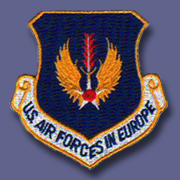
US Air Force, Europe
Looking for more information from military/civilian personnel assigned to or associated with any units of US Air Force, Europe that operated or supported the Theater Air Control System. If you have any stories or thoughts on the subject, please contact me . .
|
|
|
|
| |
| Overview & Some History |
|
| Radar Warning Net - 1940s |
|
| (Source: (1) Forty-Five Years of Vigilance for Freedom, HQ USAFE, (1988?); (2) Radio Facility Charts, European Area, 1 September 1946, 5th ACS Wing, Wiesbaden, 1946; (3) Various volumes of "The Third Year," OCCUPATION FORCES IN EUROPE SERIES) |
In the immediate period following the end of WWII, the Air Force had to determine the composition of the air element in the occupation forces that would remain in Germany. Early on in the Occupation, the air element was given a dual role: (1) it was to be employed in Germany to support the ground and service forces involved with the occupation mission; (2) it was to have a share in the maintenance of world-wide security in accordance with the highest national policy.
One of the important elements that had to be considered in determing the composition of the OTB for the air element was the radar coverage required to provide defense of the air bases from aircraft approaching from the East. Such a net established in Germany (and other countries of Europe) would be of great importance to the security of all air operations in Germany and the rest of Europe as well as serving as an early warning net for the United States itself.
The STATION LIST for 2 Sept 1947, lists the following radar units:
 501st Tactical Control Group, Bad Kissingen 501st Tactical Control Group, Bad Kissingen
601st Tactical Control Squadron, Simmershausen
602nd Tactical Control Squadron, Darmstadt
603rd Tactical Control Squadron, Neustadt
604th Tactical Control Squadron, Freising |
| |
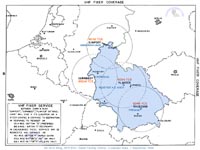 USAFE TACS, 1946
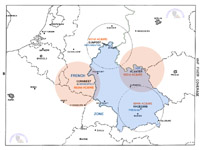
USAFE TACS, 1948
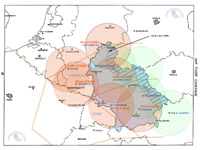
USAFE TACS, 1953
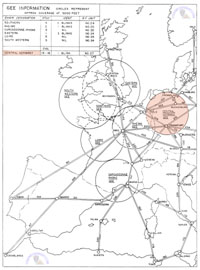
British GEE Chains, 1946
|
|
501st Tactical Control Group
The 501st and its four assigned squadrons, the 601st, 602nd, 603rd, and 604th TCS, were transferred from XII Tactical Air Command to the European Air Transport Service on 25 July 1947. Two months later, on 25 September, the group and one of its squadrons, the 603rd, were inactivated.
The three remaining squadrons remained with the EATS.
USAFE Reduction Plan
Until the beginning of the Berlin Air Lift Operation on 26 June, USAFE was chiefly concerned with the planned reduction program of the Air Forces within the Theater which was to reduce to a minimum the Air support necessary to the the US Constabulary. The permanent occupational troop basis for USAFE had been set at approximately 13,000 military personnel, effective 1 July 1948.
According to the plan, USAFE was to be composed of an Air Force headquarters, one fighter group of three squadrons, one photo reconnaissance squadron, two troop carrier groups, three tactical control squadrons, one air depot group, three air service groups, and supporting units.
This reduction was to be accomplished on or before 30 June 1948.
(Webmaster note: the deactivations of the 501st Tactical Control Group and the 603rd Tac Control Sq in May 1947 were probably part of this reduction plan.)
European Air Transport Service
The EATS (Prov) (51st Troop Carrier Wing) was discontinued on 20 Dec 1947. Command jurisdiction of former EATS stations were transferred to other commands, including the three radar sites (Rothwesten, Darmstadt and Freising) that were placed directly under Headquarters, USAFE in Wiesbaden. |
|
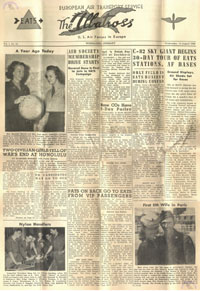 The Albatross, EATS The Albatross, EATS |
USAFE Communications, 1st Quarter 1948
Communications commitments of the Air Forces in the US Zone of Germany on 1 Jan 1948 consisted of four point-to-point radio nets operated from Wiesbaden. Included in these was a radio net from Wiesbaden to Rhein Main Air Base and the three tactical control sites.
Radar surveillance and Very High Frequency/Direction Finder (VHF/DF) facilities were operated from stations located at Darmstadt (602nd TCS), Freising (604th TCS) and Rothwesten (601st TCS). The VHF/DF sites were located at Bad Schwalbach, Eubstatt, Gedern, Grafing, Kleinsassen, Miesbach, Rodheim, Waldhausen, and Winbach in the US Zone; at Donnerfels in the French Zone; and at Karlshafen, Iburg, and Winterberg in the British Zone. Operating personnel at these locations were assigned to the 601st, 602nd and 604th Tactical Control Squadrons.
The 11th Signal Radio Maintenance Team maintained the radar and VHF/DF systems and other aids to aerial navigation.
|
|
Berlin Airlift
In early 1948, tensions between the Soviets in the East and the Allies in the Western Zones of Occupation began to increase significantly. In Fenruary 1948, the Republic of Czechoslovakia was forced into the communist bloc and a month later, a critical situation developed as the Western powers refused to accede to Soviet demands for control of transportation between Berlin and the western zones. This last refusal signaled the beginning of the Soviet blockade of Berlin.
With the real danger of communist aggression in Europe now fully apparent, USAFE decided to reactivate a fourth tactical control squadron, the 603rd TCS, in May 1948. The 603rd was located at Hof, Germany.
USAFE Tactical Control Units, June 1948
INSTALLATION |
OFF |
EM |
TOT |
|
Darmstadt Control Site (602nd) |
18 |
217 |
235 |
|
Freising Control Site (604th) |
19 |
239 |
258 |
|
Hof Control Site (603rd) |
11 |
92 |
103 |
|
Rothwesten Control Site (601st) |
17 |
234 |
251 |
|
7400th Communications Wing
On 1 December 1948, USAFE redesignated the 601st, 602nd, 603rd, and 604th Tactical Control Squadrons as aircraft control and warning squadrons. The squadrons had been assigned to the 7400th Communications Wing on 1 July 1948 and attached to USAFE from 1 July to 20 December 1948.
On 21 December they were attached to the 7402nd Aircraft Control and Warning Group. The 7402nd was organized as a tcatical control group at Wiesbaden on 1 July 1948 and assigned to the 7400th Comm Wing. Headquarters USAFE redesignated the 7402nd as an aircraft control and warning group on 16 December 1948.
In early December 1948, the 602nd AC&WS (the 602nd TCS was redesiganted as such on 23 Nov 1948) moved to Birkenfeld in the French Zone of Occupation for the purpose of setting up a radar site on the Erbeskopf mountain. (Webmaster note: it appears that a detachment remained at Goddelau/Darmstadt, the former radar site of the 602nd. It is possible that this unit continued operations at Goddelau until the new 602nd radar site was fully operational on the Erbeskopf.)
USAFE Tactical Control Units, December 1948
INSTALLATION |
OFF |
EM |
TOT |
|
Birkenfeld Control Site |
18 |
245 |
263 |
|
Darmstadt Control Site |
0 |
6 |
6 |
|
Freising Control Site |
29 |
294 |
323 |
|
Hof Control Site |
13 |
162 |
175 |
|
Rothwesten Control Site |
18 |
269 |
287 |
|
WILL ADD MORE LATER |
|
Related Links:
The SCR-584 - A tribute page for the microwave radar set, an anit-aircaft tracking radar |
|
|
AIR DEFENSE 1956/57
See information concerning the reorganization of the USAREUR AAA structure in the mid 1950s on the Army Air Defense Overview Page |
|
|
| USAFE Tactical Air Control System - 1955 |
|
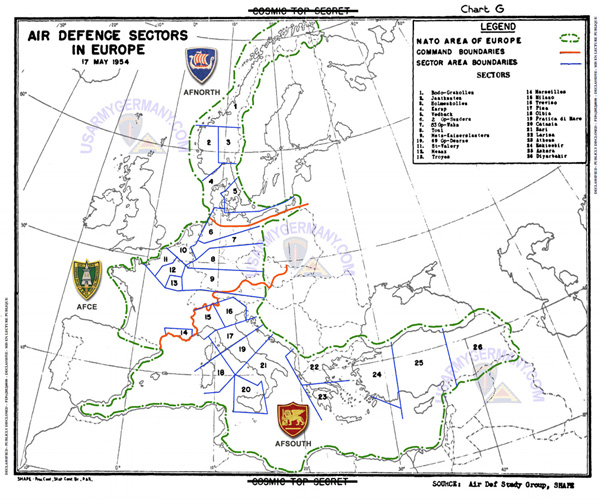
Air Defense Sectors in Europe, May 1954
(Source: SHAPE Study on Air Defence in the NATO Area of Europe, Oct 1954) |
|
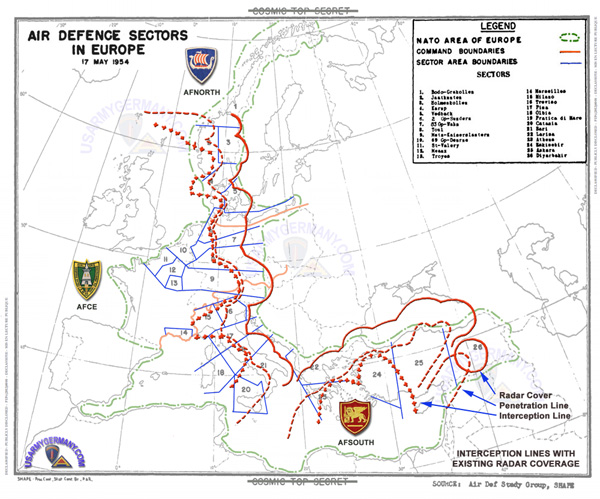
Air Defense Sectors w/ Radar Cover and Interception Lines, May 1954
(Source: SHAPE Study on Air Defence in the NATO Area of Europe, Oct 1954) |
|
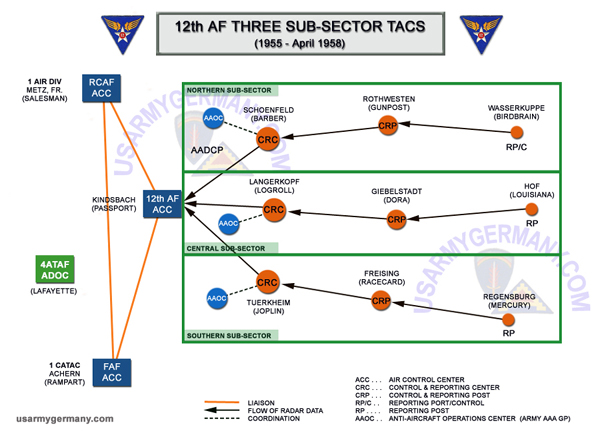
Schematic created by Walter Elkins based on information from the
Tactical Control System Realignment described below |
|
| (Source: Tactical Control System Realignment - 1957/58, Memorandum for the Commander, HQ Tactical Control Wing (Prov), no date, but definitiely from the 2nd half of 1957) (link) |
A three sub-sector system organization was inaugurated in the US defense sector (4th ATAF) in the spring of 1955. Under this organization of three sub-sectors, the Tactical Air Control System divided the area of responsibility into three similarly arranged sub-sectors oriented on an East-West axis.
The sub-sectors, Northern, Central and Southern, each consisted of a Control and Reporting Center (CRC), a Control and Reporting Post (CRP) and Reporting Post (RP).
The flow of radar data, moving East to West from RP to CRP to CRC, terminated in the Air Control Center (ACC) located in a bunker at Kindsbach, Germany (near Ramstein AB). The ACC exercised control and supervision in operational matters over the three sub-sectors through the CRC's which are designated as Sub-Sector Operation Headquarters.
The operational organization described above consisted of nine radar locations with three such locations assigned to each sub-sector. While this organization, since its inception and through its refinements, had proven far more effective than the former "one sector" system (Webmaster note: will describe this system in the near future), continued analysis of the system had shown that the basic complexity of three sub-sectors prevented maximum efficiency of operation.
This efficiency block was most apparent within the area of cross-telling. Due to the geographical size and the number of tracks appearing within the system, the frequency of cross told tracks had tended to slow down the normal flow of air surveillance information within the system. In attempting to overcome this problem the feasability of an Air Surveillance Officer Conference circuit was investigated.
While the value of the circuit was established, it was also evident that the circuit could only provided a partial solution to the effects of the problem without affecting the crux of the situation which was, and remained, an overly complex sub-sector structure.
(Webmaster would be VERY interested in hearing from anyone who has details on the TACS and AC&W squadrons from this period! Additions and corrections are WELCOME - email) |
|
|
| (Source: STARS & STRIPES, Dec 16, 1955) |
 Planned communications system, 1956
 |
|
In Dec 1955, NATO announced that it would construct a unified air raid warning screen from Norway across western Europe to Turkey, backed up by a new jam-proof communications net. The new early warning line would be the equivalent of the DEW Line across North America and was in response to the growing threat by speedy Russian jet bombers.
Gen Alfred M. Gruenther, SACEUR, also proposed that the national air defense forces be more tightly coordinated as a step towards their eventual integration. His plan would see the air defense forces grouped together into four regions (North, Central, South, and the UK).
Guenther's headquarters would be responsible for operating the early warning line in Europe. (One obstacle was the opposition of Britain to surrender complete control of her own aerial frontiers. The solution was to make the UK a separate region.) |
|
| The completely military communications network (to be known as ACE HIGH) was estimated to cost 15 million pounds (around $43 million) and would utilize "scatter" modes - bouncing sound waves off the troposphere for distances up to 250 miles and off the ionosphere for distances up to 1,300 miles. Three pilot links had already been approved - a short link in Norway (tropo) and longer links (ionosphere) between SHAPE and Naples, Italy, and Naples and Izmir, Turkey. The new communications system which could be operated around the clock by only 250 men would free SHAPE from dependence on civilian land lines and HF ciruits that could be jammed. |
|
|
| USAFE Tactical Air Control System Realignment - 1958 |
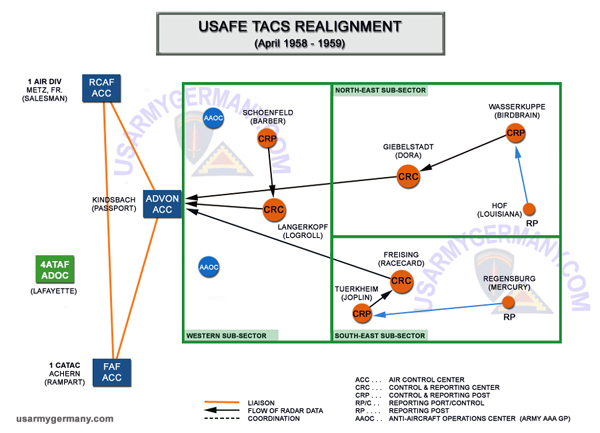
Schematic created by Walter Elkins based on information from the
501st TCW Historical Data Record, 1 Jan 1958 - 30 June 1958 |
|
| (Source: History, 501st Tactical Control Wing, 1 January - 30 June 1958) (link) |
Realigment of the Tactical Control System was implemented at 0800 hours, 21 April.
The following changes were effected: operations at the 601st Aircraft Control and Warning Squadron Control and Reporting Post (CRP) at Rothwesten were ceased; 601st Operating Location 1 at Wasserkuppe, Germany, was changed from a Reporting Post (RP) to a CRP; the 602nd AC&W Squadron CRP at Giebelstadt, Germany, was changed to a CRC; the 604th AC&W Squadron CRP at Freising, Germany, was changed to a CRC; the 615th AC&W Squadron CRC at Schoenfeld/Pruem, Germany, was changed to a CRP; the 616th AC&W Squadron CRC at Tuerkheim was changed to a CRP.
Realignment also brought about a physical change in the layout of track production areas from a north, central and southern structure to a northeast, southeast and western structure.
A regulation (501st Tactical Control Wing Regulation 55-22) to establish control and reporting procedures between French and 501st Tactical Control Wing units was published in May.
(Webmaster note: The direction of Radar Data Flow for the two remaining Reporting Posts (Hof and Regesnburg) were colored "blue" to indicate that I am not 100 percent certain, yet, that the data was first transmitted to the sub-sector CRP, as w2as the practice in the past. Once I have verified the correct flow path, then I will make them "black, indicating that they did in fact transmit the data to the CRPs.)
(Webmaster would be VERY interested in hearing from anyone who has details on the TACS and AC&W squadrons from this period! Additions and corrections are WELCOME - email)
|
|
|
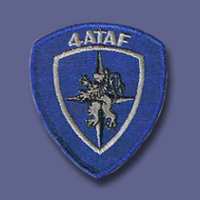
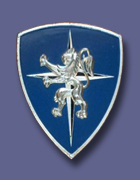 4 ATAF Emblem
 |
|
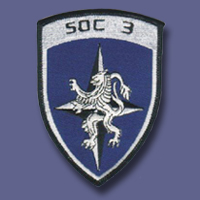
NATO divided the Central Air Defense Region into four Air Defense Sectors. Each of these sectors had its own operations center (SOC), which functioned as the central coordinating agency for the units under its control.
SOC-1 (Brockzetel, Germany) and SOC-2 (Uedem, Germany) were under the 2 ATAF.
SOC-3 (Börfink, Germany) and SOC-4 (Drachenbronn, France) were under the 4 ATAF.
The 86th Air Division Commander who reported to the Seventeenth Air Force at Ramstein AB, also served as Commander of SOC 3. The 86th Air Division was formed on 18 November 1960, when the 86th Fighter Interceptor Wing and the 501st Tactical Control Wing were placed under the same C2 organization. The 86th AD controlled four F-102 squadrons and five AC&W squadrons.
NOTE: With the pullout of France from NATO, SOC 4 was eliminated sometime in 1966/67. In 1967, Sector 3, previously comprised soley of American units, became 'international' with the incorporation of West German and Canadian elements previously assigned to SOC 4. |
|
|
| AIR DEFENSE COMMAND & CONTROL (1950s) |
|
ORG. |
COMMANDER |
LOCATION |
COMMENTS |
| |
AAFCE |
CINCUSAFE |
Fontainebleau, FR |
1951 - 1957 |
| |
4 ATAF |
CG, 12th Air Force
CINCUSAFE
|
Trier
Ramstein |
1952 - 1957
1957 - |
| |
ADOC |
|
Kindsbach |
|
| |
SOC-3 |
Cmdr, 86th Air Division |
Langerkopf |
1960 - |
| |
MCC |
Cmdr, 34th AAA Brigade? |
|
|
| |
SOC-4 |
Cmdr, 1er CATAC |
Drachenbronn, FR |
|
| |
|
|
|
|
| |
|
|
|
|
| |
|
|
|
|
|
|
| NOTE: In the 1980s, commander of the 17th Air Force, U.S. Air Forces Europe, served concurrently as commander, Allied Tactical Operations Center, Sembach Air Base, West Germany; and commander, Allied Air Defense Sector III, Boerfink, West Germany. |
|
|
| (Source: 601st Tactical Control Wing - A Historical Perspective, HQ 601st TCW, prob 1982 or soon thereafter) |
THE MISSION (in early 1980s)
The primary mission of the 601st TCW is to provide an effective European Tactical Air Control System (TACS). This process involves the command and control of USAFE and NATO aircraft during the conduct of air operations. In simpler terms, Wing elements are responsible for bringing friendly aircraft to the right target, at the right time, and making usre that they return home via the safest route possible.
For the purpose of this mission statement, Defensive Operations will denote missions involving air-to-air intercepts. Radar assistance rendered during defensive missions could be for the identification of unknown aircraft or the conduct of air operations in the highly fluid environment of a dogfight.
Conversely, Offensive Operations will refer to air strikes againts ground targets in support of American or NATO ground elements. |
|
| |
FIXED RADAR SITES (information from early 1980s)
This aspect of tactical air control and the interaction between NATO, USAFE and USAREUR elements in working towards providing air defense over West German airspace during the Cold War is the primary focus of this page (and the Command & Control Section, 94th ADA Bde). (The interaction between USAFE and USAREUR units in Offensive Operations will be dealt with on a different page.)
It should be noted that, for military purposes, West Germany was divided into two areas with respect to American and NATO aircraft operations -- 2 ATAF (Allied Tactical Air Force) which encompassed Northern Germany and 4 ATAF which took in all of Southern Germany. 2 ATAF supported Northern Army Group (NORTHAG) ground forces primarily composed of British, Dutch, Belgian and German forces. 4 ATAF supported Central Army Group (CENTAG) which was largely composed of American, German, French and Canadian troops.
The Defensive Air Control process begins with fixed radar sites whose domed facilities dot the West German countryside. In appearance, they are similar to the radar stations along the Northern Frontier back in the States which serve as part of the Distant Early Warning (DEW) system. The six fixed radar sites located in 4 ATAF are collectively known as the "412L System" because of the type of equipment they employ. Fixed radar sites in 2 ATAF use a different system called the "NATO Air Defense Ground Environment (NADGE) Network." However, it should be noted that the 601st TCW is only involved with fixed radar operations in 4 ATAF. Also, though six 412L fixed radar sites operate in Southern Germany, only the unit at Börfink comes under the 601st TCW. The other five sites (at Lauda, Freising, Meßstetten, Döbraberg and Wasserkuppe) are operated by the German Air Force (GAF) (1).
With regards to Börfink's Control and Reporting Center Mission -- as assigned to the Wing's 615th Aircraft Control and Warning Squadron (615th AC&WS) -- the site is tasked with providing 24 hour-a-day surveillance of its assigned airspace and rendering support for offensive and defensive air operations as directed by NATO planners. The 615th AC&WS' CRC also maintains the unique posture of being the Wing's only unit under NATO operational control for both peacetime and wartime conditions. To insure mission accomplishment, the 615th AC&WS maintains two detachments -- one at the Frankfurt Air Defense Notification Center (ADNC) and the other collocated with the Sector Operations Center (SOC) at Kindsbach, Germany. Kindsbach provides air situation and status displays in support of the Allied Sector III Commander and the Frankfurt operation produces the collection, processing, and dissemination of military and civilian flight information for use by the NATO Air Defense System. Lastly, elements of the 32nd Army Air Defense Command's Missile Control Center receives logistics and facility support from the Börfink CRC.
Unfortunately, the close proximity of 412L sites to the East German border, coupled with the immobile nature of their operations, result in the generally accepted belief that they will not survive very long in a hostile environment. Thus the need for a mobile and survivable radar system. (More details on the mobile radar elements will be provided later.)
(1) The 412L sites are undergoing a transition (early 1980s) to newer equipment and Börfink is the first Control and Reporting Center (CRC) to receive the conversion. When the modification is complete, the "412L" designation will be dropped and the fixed radar sites in 4 ATAF will become the "German Air Defense Ground Environment (GEADGE) Network." (One of the 601st TCW mobile radar units has picked up Börfink's responsibility of providing 24 hour surveillance coverage. This unit will continue to augment the fixed radar system until Börfink comes back on line as an operational unit. Also, this site was a master control and reporting center wherein it "ran" the entire 412L system. After the new GEADGE modification, this will no longer hold true.) |
|
| |
EARLY WARNING RADAR
The aircraft control and warning network implemented by NATO consisting initially of 18 radar stations. This early warning network became operational in 1962 and improved NATO's ability to react in a more timely manner by providing information on air activity in the areas adjacent to NATO's territories.
Radar Stations/Ground Control Intercept
The fire control radar used by SAM sites depend on early warning radar for initial target detection and location. The Early Warning (EW) radar is typically a low frequency (100-1000 Hz), large beam (6-16 degree), long range (200 or more nautical miles) system capable of searching a full 360-degrees for initial target detection and heading.
After the EW radar detects the target, the acquisition (Acq) radar further localizes the position for the small beam trackers. These radar are characterized by medium (3-6 degree) beams of medium (800 kHz to 8000 kHz) frequencies and no auto-track capability. They generally search an azimuth segment determined by the EW radar.
Height Finder (HF) systems are used to provide elevation data on the EW and Acq azimuth target data. These radar have characteristics very similar to Acq radar except that the smallest dimension of their beams will be vertical for best elevation resolution.
Ground Controlled Intercept (GCI) systems are usually composed of acquisition and height finder radars. They are used to vector interceptor aircraft to an intruding force.
The GCI stations typically consisted of one search radar, one or two height-finder radar, ground-to-air and air-to-ground communications. Before the introduction of the semi-automatic control systems in the early 1960s, the operators at each station were responsible for watching their respective round radar "scopes". When an aircraft was detected it would appear as a "blip" of light on the screen. Each radar station was connected via telephone to other nearby stations so that a target could be tracked by multiple stations. Information from the radar sites was tied into control centers (CRC) which were equipped with a large illuminated plexiglass board with geographic features of the local countryside imposed on its surface. Men standing on ladders behind these huge clear boards marked the trajectory of significant targets as reports came in from the various radar stations.
Between 1963-65, the air defense radar warning and control system in Central Europe was modernized. The radar sites converted from the manual plotting and tracking equipment to the 412L Air Weapons and Control System (built by General Electric) equipped with data link. Under this system, all missions were directed by data link rather than by voice transmission. The new system used general-purpose digital computers for real-time processing, analysis and distribution of target information from both its own sensors (radar) and other stations via data links. (In the early 1980s, the 412L system was replaced by the newer GEADGE system.)
Control and Reporting Center
The CRC is directly subordinate to the SOC and is the primary element concerned with decentralized execution of air defense and airspace control. The CRC directs region/sector air defense, provides aircraft guidance or monitoring for both offensive and defensive missions, relays mission changes to airborne aircraft as directed, and coordinates control of missions with subordinate air defense elements and other agencies.
Inherent in these functions are the following missions:
 to supervise radar elements, and to provide threat warning for friendly aircraft, to supervise radar elements, and to provide threat warning for friendly aircraft,
to develop procedures to insure that air defense assets of all services are employed in mutually supporting roles,
to establish coordination procedures based on friendly artillery fire plans and aviation operations,
to establish the means for air traffic regulation and identification, and
to support air rescue operations.
Liaison is established with other components to secure airspace usage data from related Radar Stations/Ground Control Intercept control systems. For example, when deployed, the Army Flight Operations Center (FOC) liaison element is normally located within the CRC. In discharging the responsibility for directing air defense, the CRC detects and identifies hostile airborne objects, recommends changes in air defense warning conditions, specifies weapons status, and scrambles or diverts air defense capable aircraft. During joint operations, the CRC assigns appropriate hostile airborne targets to the Army Air Defense System through the Army Air Defense Artillery Fire Coordination Officer located within the CRC.
Control and Reporting Post
The CRP was subordinate to the CRC and provided radar surveillance and control with an assigned subsector. The CRP had capabilities similar to the CRC and could assume CRC functions when directed. |
|
| |
TYPE |
LOCATION |
CALLSIGN |
UNIT |
COMMENTS |
| |
ADOC |
Kindsbach, Germany |
Passport |
615th AC&WS |
Located in an underground bunker called the "Cave". In the 1950s, the Air Force, in conjunction with NATO, used a manual plotting system to display the European air picture to the NATO staff; in the early 1960s the semi-automatic 412L system was installed. |
| |
SOC-3 |
Boerfink, Germany |
Waterhole |
615th AC&WS |
SOC-3 moved to Börfink in 1965? |
| |
CRC |
Boerfink, Germany |
|
615th AC&WS |
CRC moved from Langerkopf to Börfink in 1965? |
| |
SOC-3 |
Langerkopf, Germany |
Andrews |
615th AC&WS |
SOC-3 was previously known as "Smallarm" – Changed to "Andrews" effective 1 Nov 61. SOC-3 moved to Börfink in 1965? |
| |
CRC |
Langerkopf, Germany |
Logroll |
603rd AC&WS |
603rd inactivated 25 June 1965; 94th Arty Gp MCC collocated with CRC. A new CRC at Börfink assumed the Langerkopf's CRC mission? |
| |
CRC |
Freising, Germany |
Racecard |
604th AC&WS
II./FmRgt 31 |
Turned over to the Bundeswehr in Dec 1965. |
| |
CRC |
Giebelstadt, Germany |
Dora |
602nd AC&WS |
Moved from Birkenfeld in 1957; inact 1968; one FPS-20 and a couple of FPS-6 in mid-1960s. (CRC mission was probably taken over by the Lauda radar site at this time.) |
| |
CRC |
Lauda, Germany |
Batman |
II./FmRgt 32 |
Moved from Birkenfeld in 1957; inact 1968; one FPS-20 and a couple of FPS-6 in mid-1960s. (CRC mission was probably taken over by the Lauda radar site at this time.) |
|
CRP |
Döbraberg, Germany |
Patrick |
606th AC&WS
7./FmRgt32 |
On 16 December 1963, the 606th Aircraft Control and Warning Squadron was activated and assigned to the 86th Air Division (Defense) during January 1964. In January 1964 the 606th absorbed the men and equipment of Detachment 2, 602nd AC&WS. The squadron operated an AN/FPS-67C Search radar, a FPS-6C Height-finder, a FPS-90 Height-finder and 412L Data Processing equipment. From January 1964 to 1 Jul 1974, the squadron had primary responsibility as a reporting post to identify and track all aircraft approaching the East German—West German and Czechoslovakian—West German borders and forward information concerning these tracks to the control center (CRC). The secondary responsibility included functioning as a back—up unit for corridor control for the southern air corridor into West Berlin. At some point, the call sign was 'Rust Crowd'. In July 1974, the Air Force handed the site over to the Bundeswehr. |
| |
CRP |
Wasserkuppe, Germany |
Rooter |
616th AC&WS
5./FmRgt32 |
Gunpost in 1950s; Cedar Mine at some point; 616th AC&WS after a certain point; elements of HHB, 10th Arty Gp in 1964; handed over to the Bundeswehr in April 1976. |
|
LEGEND:
SOC . . . Sector Operations Center
CRC . . . Control and Reporting Center, a subordinate element of a SOC
CRP . . . Control and Reporting Post, a subordinate element of a CRC |
|
|
| (Source: Upcoming book on the history of RHEIN CONTROL by Frank Fischer, Germany) |
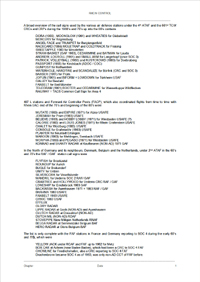 List of Callsigns used by Air Defense Radar Stations in Central Europe
|
|
Excerpt of upcoming book was submitted in MS Word Document format. |
|
|
| |
FIGHTER INTERCEPTORS
USAFE's air defense contribution to the Central Region (in the fighter interceptor category) during the early 1960s comprised the following squadrons:
32nd Fighter Interceptor Squadron, Soesterberg AB, the Netherlands (1960-1969) - controlled by SOC-1
496th Fighter Interceptor Squadron, Hahn AB, West Germany (1960-1970) - controlled by SOC-3
525th Fighter Interceptor Squadron, Bitburg AB, West Germany (1959-1969) - controlled by SOC-3
526th Fighter Interceptor Squadron, Ramstein AB, West Germany (1960-1970) - controlled by SOC-3
|
 12th Air Force
 17th Air Force
 |
|
All four of these squadrons were equipped with the Convair F-102 Delta Dagger. During normal flying hours, there was always at least one flight of F-102s in the air patrolling the ADIZ (Air Defence Identification Zone) along the Iron Curtain. These Combat Air Patrol (CAP) missions generally involved two or four aircraft. The normal sortie lasted approximately 1.4 hours but could be extended for longer periods of time through mid-air refueling with Boeing KC-135 tankers from the European Tanker Task Force.
Along with the CAP aircraft, each squadron had two or four Delta Daggers in a 'Zulu Alert' hangar. These aircraft were fully armed and fueled and ready to scramble - they could get airborne within three to five minutes of receiving the initial alarm. Additional aircraft were maintained on standby alert. The Delta Daggers could be at 40,000 feet within four to 4½ minutes after takeoff.
On 1 November 1968, the 496th, 525th and 526th FIS were relieved from assignment to the 86th and integrated into the parent wings at their respective home bases. The USAF element at Soesterberg AB had no parent wing and the unit was reassigned to HQ 17th AF. |
|
|
|
|
|
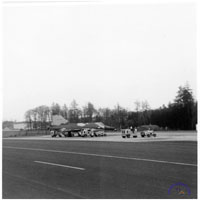
1. F-102A, 496th FIS, Hahn AB, April 1968
|
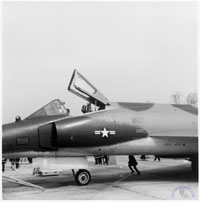
2. Close up of F-102A at Hahn
|
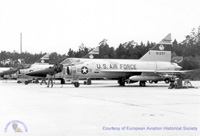
3. F-102A Delta Daggers of 526th FIS, Ramstein AB
|
|
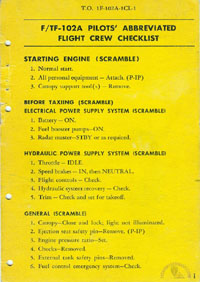
4. F-102A Abbreviated Crew Checklist (178 KB)
|
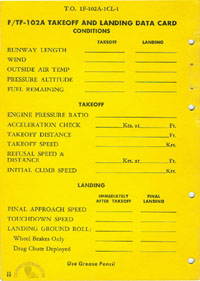
5. F-102A Takeoff/Landing Data Card (140 KB)
|
|
|
|
 Special Patch
|
|
CRC Freising ("Batman;" at this time already operated by the German AF FmRegt 31) and the 525th TFS (USAFE) represented SOC III at the AFCENT Air Defense Competition in 1971.
The team of CRC Freising/526th TFS won the "Guynemer Trophy" at the aerial gunnery competition that same year.
In 1971, USAFE air defense units were already equipped with the F-4 Phantom. |
|
|
|
| |
| AIR-TO-AIR INTERCEPTS (information from early 1980s) |
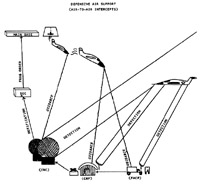 Air-To-Air Intercept
 |
|
SOC (Sector Operations Center) is responsible for all air defense efforts within its assigned sector of the Central Region. This important NATO element coordinates and directs all air-to-air intercept activity.
During a general defensive operation, the forward based FACP (Forward Air Control Post) will pick up incoming enemy aircraft on its radar. The FACP will then use radio communications to pass on pertinent information to the rearward based CRP (Control and Reporting Post) which subsequently up-channels the reported sighting.
As depicted in the graphic on the left, the SOC will then "frag" (or schedule) an alert aircraft to intercept the intruder and subsequently notify radar units of the mission number and radio frequency to be used in its control.
Following ground radar directions, the interceptor will usually be passed from the CRC to the CRP and, if needed, to the FACP. After mission accomplishment, the friendly aircraft returns to its home base by contacting the TACS units in reverse order. |
|
|
| |
| (Source: Email from Rodrigo Gebhard, FmRgt 32, GAF and other sources) |
I was sent TDY to Hahn Air Base in early 1968 to participate in some cross-training with the 496th FIS ("Electric Chicken"). This fighter interceptor squadron was still equipped with the F-102A „Delta Dagger“ and was one of three USAFE squadrons tasked with the air defense role in the 4th ATAF area.
At Hahn Air Base there was a special building called the „Zulu Alert" barn near the runway. Two fully-armed F-102As were kept ready to take off within a few minutes of a Zulu scramble. Flight and ground-based crews lived in the two-storied Zulu hangar while on Zulu Alert assignment. During a scramble, the crew would slide down a fireman's pole from their second floor living quarters to the aircraft in the hangar.
The scramble order would be initiated by the SOC/CRC via the so-called "Weapons-Loop." Air surveillance data would be transmitted point-to-point from the 412L weapons computer at a ground-based radar site via a data link to the pilots' fire control system in the scrambling aircraft.
ADDITIONAL INFORMATION
You mentioned mid-air refueling by KC-135 tankers (see section on Fighter Interceptors) – at the time I was at CRC Boerfink in the late 1960s, we would still encounter sometimes KC-97L “Stratotankers.” These aerial refueling tankers were equipped with piston engines and two jet engines (these were added to increase speed and altitude, making the tankers more compatible with high performance jet aircraft). The KC-97s were flown primarily out of England by Air National Guard units. They flew their refueling mission in the area around Baumholder, flying a pattern in a designated air refueling area nicknamed “Gretchen Anchor.” This area was still utilized in the 1990s under the same name, but by then the tankers flown were KC-135’s and KC-10’s. CRC Boerfink had control of the fighters until they reached the tankers, then the pilots would switch to the radio frequency of the tanker and be controlled by the tanker until refueling was completed.
Now about the concept of the “loop.”
In the air defense system there were several dedicated communications circuits that connected air defense units together – these were called “loops.” Each unit had a loudspeaker and microphone (with PTT) connected to a loop. Radar sites could have several loudspeakers. You could even dial up a particular loop using the Electronic Switching Center (ESC) and connect to a headset.
There was the Tactical Loop (TAC-Loop) that connected all of the defense weapons assets - the weapons sections at the radar sites, fighter interceptor squadrons, the Army’s ADA assets and the Sector Operations Center (SOC). Using this loop, it was possible for Boerfink to call the 496th FIS directly and send a Scramble Order. The response would follow: “Scandalize authenticate XXXXXXX.” A series of codes would be provided that authenticated the order and the Zulu flight would be launched.
Other examples of use for the loop: I could call the 50th TFW at Hahn on this loop and request QNH (air pressure). Or, Zulu aircraft returning to Hahn from a CAP mission under the control of the CRC: “Copper Ring … Scandalize” “Copper Ring is on ….” “AF 1234 over to Eifel Control” “Roger”
Then there was the Surveillance Loop : a lot of traffic on this loop – radar data, plots, height information, equipment outages, etc .
Each unit within 4 th ATAF was connected to these loops. Even the French at CRC “Rampart” (Drachenbronn).
The technical component of the 412L system used for transmitting data to the F-102’s was designated as “Data Link F-102.” However, this was discontinued after the transition from F-102 to the F-4E Phantom. Bandit data (“Bandit” was the term used by controllers to designate unfriendly aircraft) such as height, direction, speed, number of aircraft, etc. was transmitted via voice communications. Even the vector data from the 412L radar sites such as attack angle, speed settings and intercept approaches (cut-off, stern attack, etc.) were communicated via voice to the intercept pilot.
Because CRC Boerfink was close to the US air bases at Hahn, Bitburg and Spangdahlem, they worked more closely with the fighter interceptor units at those bases. During the recovery after a intercept mission, the CRC worked closely with “Eifel Control” and RAPCON (Ramstein Approach Control). “ Eifel” was the approach control for Hahn, Bitburg and Spangdahlem. RAPCON served Ramstein and Zweibruecken. |
|
| |
MISCELLANEOUS C&C INFORMATION:
SOC-4 ("Rampart") was under French command and was located at Drachenbronn, France. SOC-4 had a CRC located at Friederichshafen ("Chowline") and probably also controlled the CRC at Freising, Germany (operated by the US). The other subordinate CRC's were located on French soil, including the Canadian operated CRC Metz which was closed in 1962).
CRC Börfink ("Hard Tire") began operation in ... and was operated by the 615th AC&W Squadron.
CRC Lauda ("Batman") began operation in 1968 (?) and was turned over to the Bundeswehr in April 1969 (Batman); 69th Arty Gp MCC collocated with CRC.
606 AC&WS (86 ADD) was stationed at Doebraberg (garrisoned at Hof). Just for further info, somewhere in chasing the history of Hof Air Station (aka Camp Hof and Kingsley Kaserne), the information developed that right at the end of WW II the 606 was actually based for a short time on a mountain top in the Cheb, Czechoslovakia area, until the various demarcation lines were firmly established and the unit fell back into American administrated territory. (Jerry Mangas, SSGT, TGN-4 & EXP-1, 1965-68, 6915 Radio Group Mobile, Hof/Saale, Germany)
86th Air Division (Defense)
Activated on 18 Nov 1960.
Inactivated on 14 Nov 1968.
At least In the mid-1960s, Commander of the 86th Air Division also served as Commander, Sector Operations Center 3
86th Air Div Commanders:
Col Robert J. Rogers, 4 Jul 1959 (86th FIW) -14 Mar 1961
Col George W. Rogers, 15 Mar 1961-29 Jun 1961
Brig Gen Frank W. Gillespie, 30 Jun 1961-9 Jul 1964
Brig Gen Thomas L. Hayes, Jr., 10 Jul 1964-11 Jan 1966
Brig Gen James M. Vande Hey, 12 Jan 1966-27 Jun 1967
Brig Gen Richard N. Ellis, 28 Jun 1967–14 Nov 1968
Fire Control System
(In USAFE fighter interceptor aircraft,) the Hughes Eletronic Control System was tied to the CRC's by a Data Link communications system known as SAGE in the USA and NADGE in Europe. The data link operated in the UHF band and allowed the ground based radar to be tied into the fighter's fire control system/auto-pilot, allowing the fighter to be automatically steered onto an interception course to the target.
Link 1 is a duplex digital data link primarily used by NATO's Air Defence Ground Environment (NADGE). It was designed in the late 1950s and mainly provides for exchange of air surveillance data between Control and Reporting Centres (CRCs) and Combined Air Operation Centres (CAOCs)/Sector Operation Centres (SOCs). It has a data rate of 1200/2400 bit per second (bps). It is not crypto secure and has a message set (S-series) limited to air surveillance and link management data.
Weapons Engagement Zone
The Weapons Engagement Zone, in air defense, is airspace of defined dimensions within which the responsibility for engagement of air threats normally rests with a particular weapon system.
a. fighter engagement zone (FEZ) -- that airspace of defined dimensions within which the responsibility for engagement of air threats normally rests with fighter aircraft.
b. high-altitude missile engagement zone (HIMEZ) -- that airspace of defined dimensions within which the responsibility for engagement of air threats normally rests with high-altitude surface-to-air missiles.
c. low-altitude missile engagement zone (LOMEZ) -- that airspace of defined dimensions within which the responsibility for engagement of air threats normally rests with low- to medium-altitude surface-to-air missiles.
d. short-range air defense engagement zone (SHORADEZ) -- that airspace of defined dimensions within which the responsibility for engagement of air threats normally rests with short-range air defense weapons. It may be established within a low- or high-altitude missile engagement zone.
e. joint engagement zone (JEZ) -- that airspace of defined dimensions within which the multiple air defense systems (surface-to-air missiles and aircraft) are simultaneously employed to engage air threats. |
 |
|
| |
| AIRCENT / AAFCE |
| |
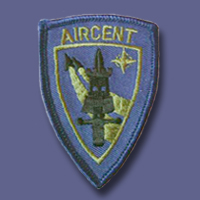
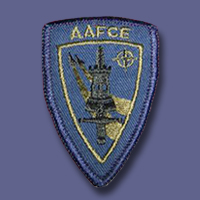
 AIRCENT Headquarters crest, 19.. - 1965 AIRCENT Headquarters crest, 19.. - 1965 |
 AIRCENT Headquarters crest, 1965 - 19.. AIRCENT Headquarters crest, 1965 - 19.. |
| |
| (Source: USAREUR Annual Historical Report, 1953-54) |
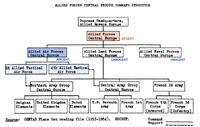 AFCENT - AIRCENT, 1953
 |
|
|
|
|
|
| CENTRAL REGION AIR DEFENSE COMMANDS |
| (Source: Walter Elkins, from many sources that will be listed as project progresses) |
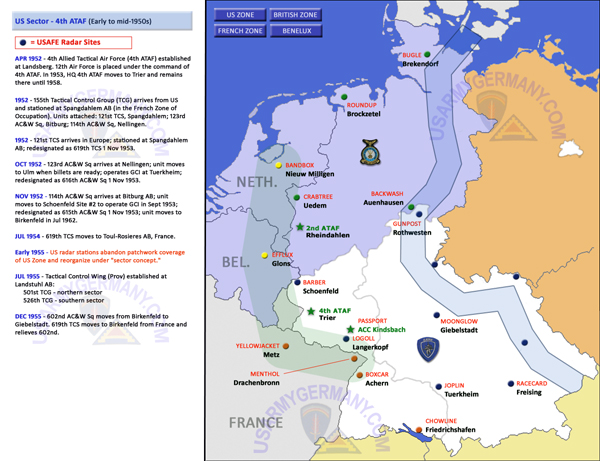 Evolution of Integrated Air Defense Ground Environment within AIRCENT (DRAFT)
INPUT REQUESTED!
Evolution of Integrated Air Defense Ground Environment within AIRCENT (DRAFT)
INPUT REQUESTED!
|
|
| |
| (Source: STARS & STRIPES. April 2, 1963) |
AIRCENT To Observe 12th Birthday
The seven nation NATO command of Allied Air Forces Central Europe (AIRCENT) will mark its 12th anniversary at its headquarters in Fontainebleau on April 2, 1963 by inaugurating a permanent display of AIRCENT squadron crests in the entrance of the headquarters building. The display will be unveiled during an international ceremony hosted by the AIRCENT commander, Air Chief Marshal the Earl of Bandon.
The crests represent operational flying units which, located on NATO air bases in the Central Region, are committed to AIRCENT by Belgium, Canada, Germany, France, The Netherlands, the United Kingdom and the United States. Many ranking air officers from these countries, including the chiefs of the Belgian, German and Netherlands air forces are expected to attend the anniversary ceremony.
AIRCENT's mission is to help prevent any aggressive action against NATO territory. In addition to its aircraft strength which now totals more than 2,000 jet planes, the command boasts a growing force of surface-to-surface and surface-to-air missiles. |
|
| |
| |
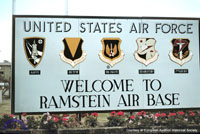 Welcome Sign, Ramstein AB, approx. 1974
 |
|
|
|
|
|
| |
| NATO CENTRAL REGION AIR DEFENSE COMMANDS |
|
|
| |
4ATAF 'FALLEX'
Pirmasens |
|
|
|
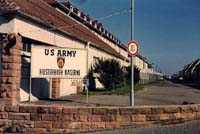
1. Main Gate, at Husterhoeh, FALLEX '68 |
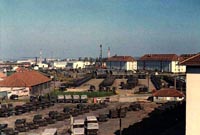
2. Tac HQ on soccer field |
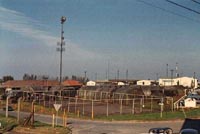
3. 4ATAF Tac HQ |
|
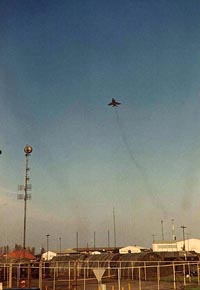
4. RF-4 Phantom checks out 4ATAF hqs |
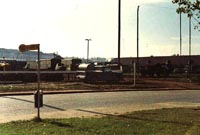
5. 4ATAF vehicles |
|
|
|
|
|
| |
| Miscellaneous TACS Information |
| |
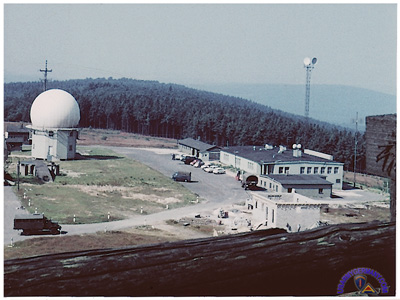 "RHEIN CONTROL" on Erbeskopf, 1960
 |
|
The air traffic control center “RHEIN CONTROL” was known by many members of the air navigation community of Western Europe during the post-war era as a unique and really jointly operated facility for all civil and military flights in the upper airspace.
The author, Frank Fischer, has had first hand experience having been assigned to RHEIN CONTROL for almost 17 years as area (radar) controller and civil servant of the BFS from 1959 to 1975.
For much more on the background for the book see the write up online.
Click here to see write up on the "Story of RHEIN CONTROL" book
(Mircosoft Word format).
|
|
|
| |
| (Source: SIGNAL, April 1965) |
A radar surveillance and control fence became operational along the East-West German border on October 29, 1964, Electronic News reported recently. The electronic warning system is intended to prevent accidental overflights into Communist territory by Allied aircraft. The code name of the system is Project Wind Drift.
The new facilities, with three Ground Control Intercept radar stations (Webmaster: Wasserkuppe, Döbraberg and Regensburg?) will provide continuous radar surveillance, positive aircraft control and an immediate retrieval capability. The operational plan was developed by USAFE, in cooperation with the Ground Electronics Equipment Installation Agency.
Who can provide more details? |
|
|
|
Related Links:
|
 |
|
Radar Museum Web Site - Tom Page and Gene McManus host this very fine web site that is primarily dedicated to AC&W squadrons and Radar sites located in the Continental U.S., Alaska, Greenland and Iceland. However, there is a growing section that covers the Air Force's overseas radar sites and units. |
|
 |
|
Kindsbach - Kindsbach Underground Facility - a Yahoo Group site for vets from all services who were stationed or worked at Kindsbach Underground Facility in the 1960's, 1970's, and 1980's before it was closed. |
|
 |
|
Langerkopf Yahoo Group - a YAHOO Groups site for former members of USAFE radar and communications units stationed at Langerkopf. |
|
 |
|
Vets USAFE Radar Sites - a YAHOO Groups site for former members of USAFE radar and radio sites. |
|
 |
|
TAC Missileers  - a website for US Air Force, Cold War veterans who served as part of the MACE or MATADOR cruise missile programs. - a website for US Air Force, Cold War veterans who served as part of the MACE or MATADOR cruise missile programs. |
|
|
Aircraft Control & Warning web sites
601st TCW Reunion - George P. Sivertson
601st AC&WS - Willie Hanson
603 TCS/Sembach Alumni - Mike Malloy
603rd AC&WS - Langerkopf - Mark Stephen
606th AC&WS - Jerry Harrell
Hof Reunion - Jerry Mangas (6915th RMS) - site includes information on 602nd and 606th AC&WS
615th AC&WS - Wes Macdonald
Pruem Air Station - Scott Sevin's great web site dedicated to all units (Army and Air Force) stationed at Pruem from the 1950s until its closure in the early 1990s. Lots of great photos!
Birkenfelder Reunion Association - The web site is hosted by former members of the U. S. Air Force who were assigned to Birkenfeld Air Base, Germany, between 1948 and 1969.
The Fontainebleau Veterans Association - a UK website, the association includes former military and civilians (all nationalities) who served in Fontainebleau with NATO establishments. |
| |
|